


Your team checks Google rankings every Monday. Traffic’s holding, keywords look healthy, the dashboard’s green. Then a buyer opens ChatGPT, types “best software for [your category],” and gets five recommendations. Your brand isn’t one of them.
Nothing in your current reporting explains why, because rank tracking was never built to measure what an AI decides to say about you. With 94% of B2B buyers now researching through AI answer engines, that gap quietly settles deals before you ever see them. Closing it is what an AI response monitoring system is for.
What an AI Response Monitoring System Actually Tracks
An AI response monitoring system is a diagnostic platform that watches how AI models interpret, describe, and recommend your brand across their generated answers. It doesn’t track a position on a results page. It tracks whether you show up in the answer at all, how you’re framed, and which sources the model trusted to back that framing.
That’s a different question than SEO has ever asked.
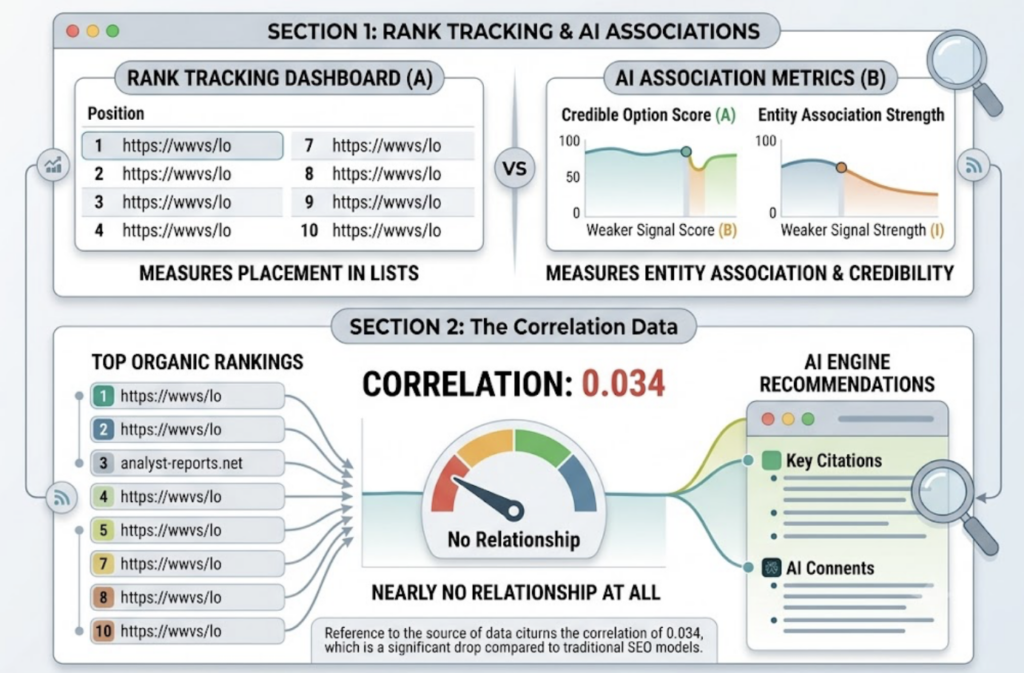
Rank tracking measures placement in a list of links. AI response monitoring measures entity association: whether the model connects your brand to a buying intent and presents you as a credible option. The data on that gap is blunt. The correlation between Google organic rankings and AI citation probability runs as low as 0.034, close to no relationship at all.
How AI Response Monitoring Software Works Under the Hood
Most AI response monitoring software runs on a four-stage pipeline. Knowing it tells you what to expect from any tool you evaluate.
First, prompt universe mapping. You define a “golden set” of high-intent prompts: “best B2B software for [use case],” “[your brand] vs [competitor],” and so on. These mirror how real buyers actually ask.
Second, cross-platform sampling. The system runs those prompts across ChatGPT, Perplexity, Gemini, and others, because each engine cites by its own logic and a single-engine view is misleading.
Third, semantic parsing. NLP and LLM-based judges pull structured data out of unstructured answers: was the brand mentioned, where did it land in the response, and how was it characterized.
Fourth, continuous tracking. This is the part teams underestimate. AI citation patterns can shift 15 to 20% week over week, so a one-time snapshot ages out fast.
Run the audit once and you get a screenshot. Run it continuously and you get a system.
Why AI Response Monitoring Matters More Than Rankings
Here’s the uncomfortable part. Up to 80% of AI citations come from sources outside the Google top 10, which means your hard-won rankings may have almost nothing to do with whether an AI recommends you.
This is the ranking-mention separation: you can rank first and still go unmentioned, or rank nowhere and get named as the top pick. Buyers increasingly act on the AI’s answer, not the blue links beneath it. If the model leaves you out, you’re not losing a position. You’re losing the consideration set entirely.
That’s the gap most brands still can’t see.
How to Measure AI Response Monitoring: The Metrics That Count
A dashboard full of mention counts isn’t analytics. It’s a vanity number. To measure AI response monitoring in a way that drives decisions, your analytics have to answer “compared to whom, and how well.”
Five metrics do most of the work:
| Metric | What It Tells You |
|---|---|
| Mention Rate | Share of high-intent prompts that surface your brand at all |
| Share of Voice | Your frequency versus competitors in the same category |
| Weighted Position | First mention scores higher than fourth, so placement is graded |
| Sentiment Score | Whether the AI calls you “enterprise-grade” or a “budget option” |
| Citation Source Authority | Which domains (G2, Reddit, PR) the AI trusts as proof |
The point of a good AI response monitoring dashboard isn’t to show more numbers. It’s to connect a drop in mentions to a specific cause, so you know exactly what to fix.
Common Mistakes in AI Response Monitoring
Most teams stumble because they treat AI monitoring like a standard SEO sprint. A few mistakes show up again and again.
Single-platform blindness. Tracking ChatGPT while ignoring Perplexity and Google AI Overviews, even though each one cites by different logic.
Assuming ranking equals citation. We covered the data: a number-one organic spot guarantees nothing in an AI answer.
Ignoring entity signals. AI engines favor brands with consistent descriptions across trusted third-party sites. Inconsistent framing across the web confuses the model.
Static content. Pages without clear headings, schema, or declarative stats are hard for AI to extract and cite.
Treating it as a one-off. A single snapshot feels reassuring and tells you almost nothing about the trend.
Keep those five as a quick checklist before you trust any report.
What to Look for in an AI Response Monitoring Tool
Not every AI response monitoring tool does the same job. Some hand you raw mention counts and stop there. The stronger solutions explain the why and point you toward action.
When you compare options, weigh four things.
| Capability | Basic Monitoring Tool | Strategic Analytics Platform |
|---|---|---|
| Platform coverage | Single engine, often ChatGPT only | Cross-platform, engine-agnostic |
| Actionability | Mention counts, no next step | Predictive insight plus GEO tasks |
| Citation analysis | No view into why you’re cited | Source attribution and competitor displacement |
| Integration | Standalone dashboard | Built into your workflow |
Topify sits at the strategic end of that table. Its Comprehensive GEO Analytics suite tracks seven visibility dimensions: visibility, sentiment, position, volume, mentions, intent, and CVR. In practice, that means you can watch your ChatGPT mention rate fall, trace it back to a specific review site that stopped citing you, and act on a recommended fix, all in one view.
The difference isn’t more data. It’s knowing what the data is telling you to do next.
Building an AI Response Monitoring Strategy That Holds Up
A tool is not a strategy. The teams that win treat AI response monitoring as a loop, not a launch.
Start by defining your prompt universe from real buyer intent. Set a baseline share of voice across the three major engines before you change anything, so you can prove movement later. Review on a fixed cadence, not when someone happens to remember.
When gaps appear, fix the underlying signals: third-party reviews, PR, and the structure of your own pages. Then feed what you learn back into your content pipeline, so the next cycle starts from a stronger position. That feedback loop is how you improve, not a single push.
The fastest way to begin is small. Run a one-week pilot audit with a structured prompt set, benchmark your share of voice, and you’ll have a clear read on where you stand. You can get started with a single project and expand once the gaps are visible.
Conclusion
AI response monitoring isn’t a reporting habit. It’s the diagnostic loop that tells your content strategy where it’s actually working. Rankings still matter, but they no longer decide who AI recommends, and that’s the decision happening in front of your buyers right now. Start by measuring what the model says about you across platforms. Once you can see the gap, closing it becomes a plan instead of a guess.
FAQ
Q: What is an AI response monitoring system?
It’s software that tracks how AI models like ChatGPT, Perplexity, and Gemini mention, describe, and recommend your brand inside their generated answers, rather than tracking your position on a search results page.
Q: How does AI response monitoring software work?
It builds a “prompt universe” that mirrors real buyer questions, runs those prompts across multiple AI engines at scale, and uses NLP to extract metrics like mention rate, sentiment, and competitor positioning from the responses.
Q: How much does AI response monitoring software cost?
Pricing ranges widely. Basic scrapers start at low monthly fees, while full GEO analytics platforms like Topify start around $99 a month, scaling with the number of prompts and how often you monitor.
Q: What are examples of AI response monitoring software?
Examples include dedicated GEO platforms such as Topify, alongside broader LLM observability tools, though the latter tend to be built for developers rather than marketing teams.

