

Your domain authority is solid. Your content calendar is full. Your SEO rankings haven’t moved in months, which usually means everything’s working.
Then a prospect tells you they asked ChatGPT for a recommendation in your category and went with a competitor they’d never heard of before. You check. Your brand wasn’t mentioned once. And there’s nothing in GA4, Search Console, or your rank tracker that explains why.
That’s the gap an AI recommendation tracking dashboard is built to close.
What Your Analytics Stack Can’t See
Google Analytics 4 tracks sessions. Search Console tracks clicks. Neither has visibility into what ChatGPT, Perplexity, or Gemini says when someone asks a buying question in your category.
The core problem is structural. Traditional BI and SEO tools operate on a batch model, analyzing past structured data to explain what happened. AI recommendation tracking requires real-time, conversational analysis of unstructured, non-deterministic output.
Three gaps stand out:
Zero-click invisibility. AI search satisfies user intent directly in the chat interface. The traffic never hits your website, so your analytics never see it.
Non-deterministic results. LLMs don’t return static SERPs. The same query can yield different brand mentions depending on model version, context, or recent training data. Weekly manual checks miss most of that variance.
Source blindness. You can’t tell which of your content assets are building LLM trust or citation authority, so you can’t prioritize what to optimize.
Tracking AI recommendations requires a purpose-built layer. That’s what an AI recommendation tracking dashboard delivers.
What an AI Recommendation Tracking Dashboard Actually Tracks
The term “dashboard” gets used loosely. A real AI recommendation tracking dashboard doesn’t just count brand mentions. It maps your brand’s position in the AI answer ecosystem across six dimensions:
| Metric | What It Measures |
|---|---|
| Visibility Score | How frequently your brand appears across a core set of buyer-intent prompts |
| AI Share of Voice (SOV) | Your mentions relative to competitor mentions across the same prompt set |
| Sentiment Score | Whether AI describes your brand positively, neutrally, or negatively |
| Citation Sources | Which URLs and domains LLMs use to validate their recommendations about your brand |
| Mention Position | Where your brand ranks within AI-generated lists (top 3 vs. buried in paragraph text) |
| CVR (Conversion Visibility Rate) | Estimated likelihood that AI-cited pages lead to downstream business outcomes |
Visibility Score tells you whether you exist in AI search. Share of Voice tells you whether you’re winning. Sentiment tells you whether being visible is actually helping your brand. Citation Sources tell you what to optimize.
Without all six, you’re managing partial information.
5 Signals Your Team Needs This Now
You don’t always need a dashboard until something makes the absence obvious. These are the situations that tend to force the decision:
A competitor appears in ChatGPT recommendations with no clear reason. They’re newer, smaller, and rank below you on Google. But AI keeps recommending them. Without citation source data, you can’t reverse-engineer why.
Your brand shows up in AI answers, but the description is wrong. ChatGPT calls you a “budget option” when your positioning is mid-market. Perplexity describes a product feature you discontinued two years ago. Tracking only mentions without context doesn’t catch this. Sentiment analysis does.
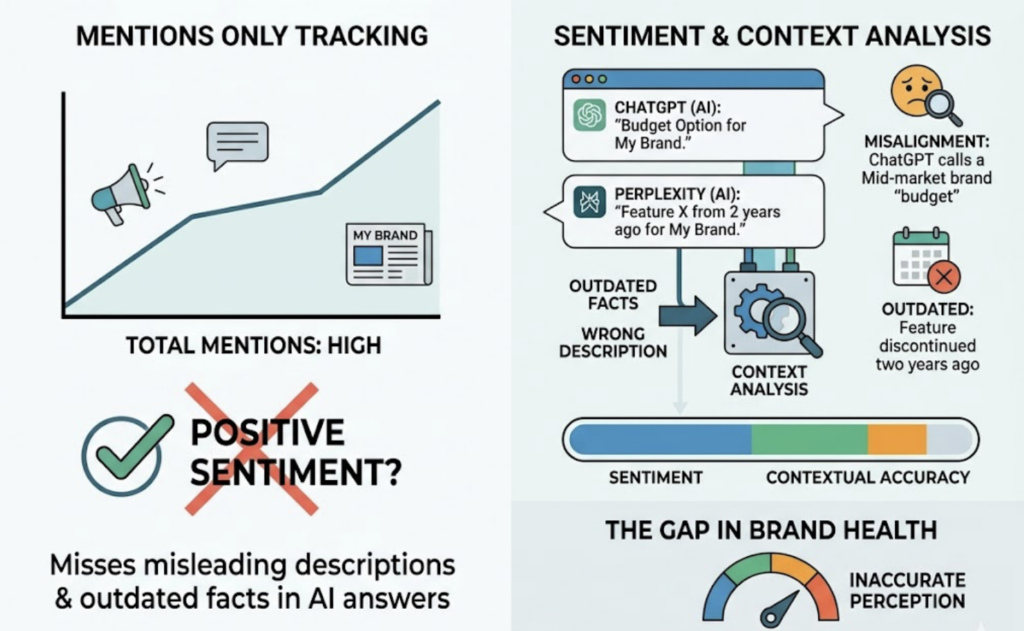
Traffic from AI platforms is unattributed in GA4. You’re seeing a new referral source you can’t identify, or direct traffic is climbing without an obvious cause. AI-referred traffic often lands as dark traffic.
Your content team doesn’t know which assets build LLM authority. They’re producing articles without knowing whether any of them are cited by ChatGPT or Perplexity. Source analysis closes that gap.
You’re reporting on AI search to leadership with no data. “We checked ChatGPT and our brand showed up” is not a reportable metric. A structured dashboard is.
That last one is accelerating adoption. According to Semrush’s 2026 AI search visibility guide, marketing teams are under increasing pressure to report AI search performance alongside traditional SEO metrics.
How to Measure What Actually Matters in AI Recommendations
Not every metric in an AI recommendation tracking dashboard deserves equal weight. Some are useful for optimization. Others are useful for reporting. A few are mostly vanity.
High-signal metrics (change your strategy):
- Citation Sources: directly tells you what content to build or update
- Sentiment Score: tells you whether your messaging is landing in AI training data
- Mention Position: affects click intent; being mentioned fifth in a list is meaningfully different from being mentioned first
Reporting metrics (useful for stakeholders):
- Visibility Score and Share of Voice: trackable over time, comparable to competitors
Context-dependent metrics:
- CVR is valuable for BOFU teams but less relevant if your goal is top-of-funnel awareness
One common mistake is tracking mentions without geo-context. A brand that appears in U.S. ChatGPT responses may be invisible in the UK or Australia. Localized citation patterns vary significantly, and global averages mask that variance.
The practical benchmark: if a metric doesn’t tell you what to do next week, it’s probably not worth your weekly review time.
Best Tools for AI Recommendation Tracking in 2025
The market has split into two generations of tools. The first generation layered AI tracking onto existing SEO platforms. The second generation was built specifically for AI recommendation monitoring from the ground up.
Here’s how the main options compare:
| Tool | AI Platform Coverage | Core Strength | Best For |
|---|---|---|---|
| Topify | ChatGPT, Gemini, Perplexity, DeepSeek, Doubao, Qwen + others | Full-spectrum GEO: visibility, sentiment, position, citation, CVR, competitor monitoring, one-click execution | Marketing teams and agencies needing end-to-end AI visibility management |
| Omnia | ChatGPT, Perplexity, AI Overviews | Strong action layer: converts citation data into content briefs | Content teams focused on AI Overviews |
| SE Ranking | Primarily Google AI Overviews | Integrates AI tracking into existing SEO workflows | SEO teams that want to add AI coverage without switching tools |
| Semrush / Ahrefs | Limited AI-specific tracking | Strong on traditional SEO, backlinks, on-page | Teams where traditional SEO is still the primary channel |
The difference between first- and second-generation tools becomes clear at the execution layer. Semrush and Ahrefs are excellent for on-page SEO and traditional backlinks but generally lack the generative AI-specific tracking required to measure LLM citations or prompt-level share.
Topify sits closest to what the research calls an “action-layer” platform. It monitors brand performance across seven metrics simultaneously (visibility, sentiment, position, volume, mentions, intent, and CVR), covers more AI platforms than most alternatives, and connects monitoring to execution through its One-Click GEO Agent. For teams that need to do something with the data, not just look at it, that last part matters.
Pricing starts at $99/month (Basic: 100 prompts, 9,000 AI answer analyses, 4 projects) and scales to $199/month (Pro: 250 prompts, 22,500 analyses) and enterprise plans from $499/month. There’s also a free GEO Score Checker available without signup.
Build Your AI Tracking Workflow in 5 Steps
A dashboard with no workflow attached is just a reporting tool. Here’s how to turn one into an active optimization system:
Step 1: Build your prompt library. Aggregate high-intent buyer questions from sales call logs, support tickets, and your existing keyword research. Convert them into natural language prompts that mirror how your customers actually talk to AI. This is your monitoring foundation.
Step 2: Set up competitor benchmarking. Catalog your brand alongside 3-5 direct competitors, including product variations and common aliases. You need this baseline before you can measure share of voice or position changes.
Step 3: Deploy cross-platform monitoring. Run your prompt library across multiple LLMs simultaneously. Tracking only ChatGPT and ignoring Perplexity or Gemini misses the broader market reality. AI rankings fluctuate daily, so automated, consistent monitoring matters more than manual spot-checks.
Step 4: Analyze citation sources first. Before you look at visibility scores, check which domains and URLs are driving LLM trust in your category. This is your content optimization roadmap. Reverse-engineer what top-cited competitors are publishing, then build your own authority briefs.
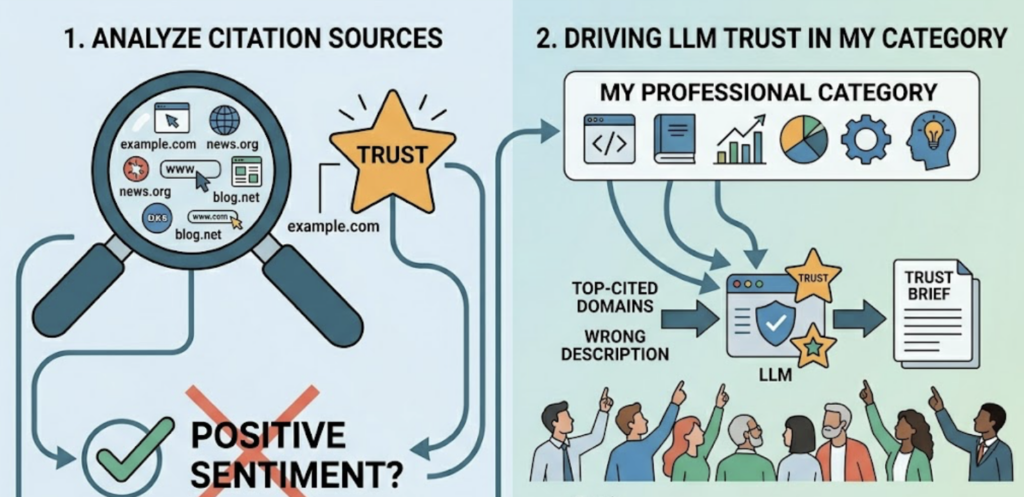
Step 5: Run a monthly prompt refresh. Buyer language evolves. Model training data updates. Your prompt library should reflect both. A static set of prompts gives you data, but not necessarily current data.
That last step is what separates teams that get value from their dashboard from teams that have a dashboard they stopped checking.
What Does an AI Visibility Dashboard Cost?
Pricing in this market varies more than you’d expect, largely because the tools serve different scope requirements.
Free tier: Several platforms offer limited free access. Topify’s GEO Score Checker requires no signup and gives you a starting benchmark. Useful for a first read, not for ongoing monitoring.
Entry-level paid ($49-$99/month): Covers basic AI platform monitoring, limited prompt volume, and single-project tracking. Suitable for solo founders or small teams running one brand. Topify’s Basic plan at $99/month includes 100 prompts and 9,000 AI answer analyses across ChatGPT, Perplexity, and AI Overviews.
Professional ($199-$499/month): Expanded prompt volume, multi-project support, competitor monitoring, and sentiment tracking. Topify’s Pro plan at $199/month handles 250 prompts and 22,500 analyses across 8 projects. See full pricing here.
Enterprise ($499+/month): Custom prompt volumes, dedicated account management, and full-suite analytics. For larger agencies managing multiple client brands, Topify’s enterprise tier starts at $499/month.
The pricing logic is straightforward. Cost scales with prompt volume and platform coverage, not with feature gates. You pay for how much monitoring you need, not for access to the metrics that matter.
Conclusion
The shift from “Google rankings” to “LLM authority” isn’t a future trend. It’s already shaping where high-intent buyers go after a ChatGPT conversation. Brands without an AI recommendation tracking dashboard are making decisions based on data that doesn’t include their most important discovery channel.
The good news: the tooling has matured. You can build a functional tracking workflow in a week, with a structured prompt library, cross-platform monitoring, and citation source analysis. Start with a free GEO score check, map your current prompt coverage against competitors, and add systematic tracking from there. The brands building this infrastructure now will be the ones Get started with Topify showing up first when the next buyer asks.
FAQ
Q: What is an AI recommendation tracking dashboard?
A: It’s a monitoring tool that tracks how often, how positively, and in what position your brand appears in AI-generated responses across platforms like ChatGPT, Perplexity, and Gemini. Unlike traditional analytics tools, it captures brand presence in AI answers rather than website traffic.
Q: How does an AI recommendation tracking dashboard work?
A: The system runs a library of buyer-intent prompts across multiple LLMs on a recurring basis, then analyzes the responses for brand mentions, sentiment, position, and citation sources. Over time, it builds a dataset that shows how your AI visibility changes relative to competitors.
Q: What are examples of metrics tracked in an AI visibility dashboard?
A: Common metrics include Visibility Score (how often your brand appears), Share of Voice (your mentions vs. competitors’), Sentiment Score (positive/neutral/negative), Citation Sources (which domains AI trusts to validate your brand), Mention Position (rank within AI-generated lists), and CVR (Conversion Visibility Rate).
Q: How much does an AI recommendation tracking dashboard cost?
A: Entry-level plans typically start around $49-$99/month for basic monitoring. Professional-tier tools with competitor tracking and multi-platform coverage run $199-$499/month. Enterprise pricing is custom. Some platforms, including Topify, offer a free GEO score check without requiring a subscription.

