

Your brand ranks on Google. You’ve got dashboards, keyword reports, a healthy backlog of optimized content.
But when someone asks ChatGPT “what’s the best [your category] tool,” you have no idea what it says. You’re not tracking it. You’re not even sure where to start.
That’s the gap an AI recommendation tracking system is designed to close.
What an AI Recommendation Tracking System Actually Does
An AI recommendation tracking system (ARTS) is a framework for measuring how often, how positively, and in what context your brand appears inside LLM-generated answers across platforms like ChatGPT, Perplexity, Gemini, and others.
It’s not keyword rank tracking. It’s entity-based attribution at the prompt level.
The distinction matters. Traditional SEO tools track where your page appears in a list. An ARTS tracks whether your brand is named, recommended, or cited inside a generated answer, and what role it plays in that answer.
The 5 Data Points Worth Tracking
Most teams start by counting mentions. That’s not enough. A complete tracking system captures five signals:
Direct Citation: How often your brand name appears in a generative response across your target prompt set.
Sentiment Polarity: Whether AI positions you as a recommended solution, a neutral comparison, or a negative example. Being mentioned isn’t the same as being recommended.
Source Attribution: Which of your URLs the model is citing as “evidence” when it mentions you. This tells you which content is actually driving your AI presence.
Recommendation Category: Is the AI calling you “best for X,” an “alternative to Y,” or just including you in a generic list? The classification determines real commercial value.
Prompt Coverage Consistency: Whether your brand appears across a range of semantically related queries, or only shows up on one narrow phrasing. Consistency is what converts visibility into a reliable channel.
Why Your Current Analytics Can’t See Any of This
Traditional tools like Google Analytics or Search Console are built on one assumption: users click through to your site.
AI search breaks that assumption entirely. A user asks Perplexity a question, gets a fully formed answer, and never visits anyone’s website. There’s no click to track. No session to attribute. No conversion path to follow.
The problem runs deeper than zero-click behavior, though.
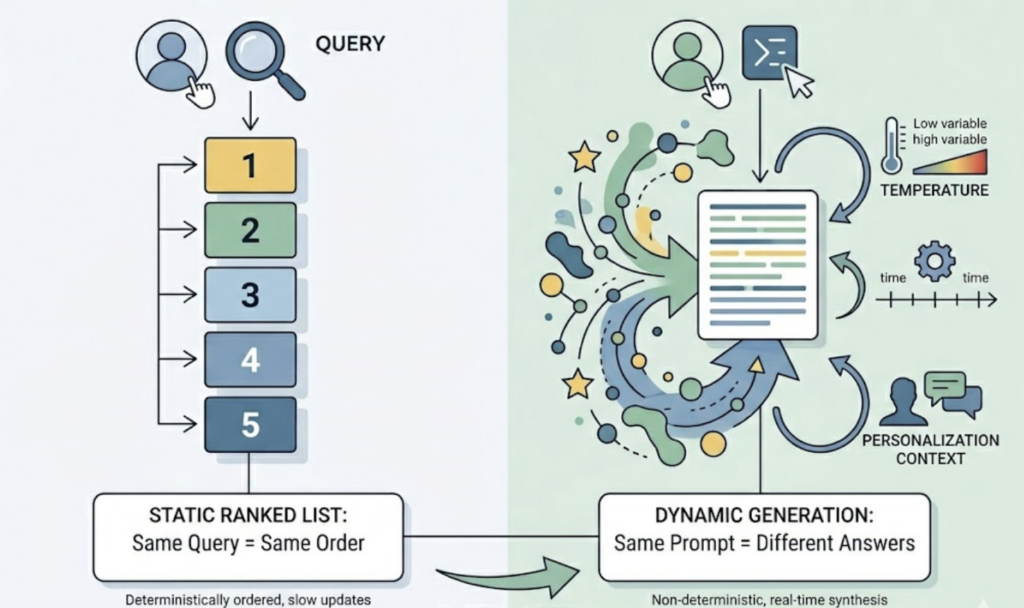
Traditional SEO assumes static results. Type a query, get a ranked list. LLMs don’t work that way. The same prompt run twice can return different answers depending on model temperature, recent fine-tuning, or personalization context. Standard rank-tracking logic doesn’t apply to non-deterministic outputs.
There’s also what researchers call the “black box” problem. Traditional tools can’t identify whether an LLM recommendation is driven by a direct citation in a RAG pipeline or by patterns baked into the model’s weights during training. Without that distinction, you can’t act on what you’re seeing.
How the Tracking System Works, Step by Step
A well-structured ARTS follows a three-stage cycle that runs continuously, not just once a quarter.
Stage 1: Prompt Coverage
The system executes a pre-defined set of high-intent queries against multiple LLMs simultaneously. Not just one model. A brand that only monitors ChatGPT is missing Perplexity users, Gemini users, and every AI assistant embedded in a browser or productivity tool.
The query set should include head terms (“best CRM for small business”), long-tail variants (“what CRM do most startups use in 2026”), and comparison prompts (“alternatives to [competitor]”). Semantic coverage determines how accurate your visibility picture is.
Stage 2: Answer Capture
Raw responses are logged systematically: full answer text, any URLs cited, follow-up questions the model suggests, and the framing used around brand mentions. The goal is structured data, not screenshots.
Stage 3: Brand Signal Extraction
NLP or LLM-based classifiers parse each captured response to extract brand presence, sentiment score, citation source, and recommendation type. This is where raw tracking data becomes actionable insight.
The full cycle runs continuously. AI rankings can shift daily based on model updates and changes in which content sources the model prioritizes.
The Metrics That Actually Move Decisions
Not all metrics are equally useful. Here’s how to prioritize:
| Metric | What It Measures | Priority |
|---|---|---|
| AI Share of Voice | Your brand mentions vs. total competitor mentions in the tracked prompt set | Primary |
| Citation Depth | Number of unique owned URLs the AI is citing | Primary |
| Sentiment Bias | Positivity/negativity of the context around your brand | Secondary |
| Query Reach | How many prompt variations result in a brand mention | Secondary |
One metric to deprioritize: click-through rate. It’s a reflex from traditional SEO thinking. In AI search, recommendation share is the signal that matters. Whether your brand is named and positioned favorably, not whether a click happened.
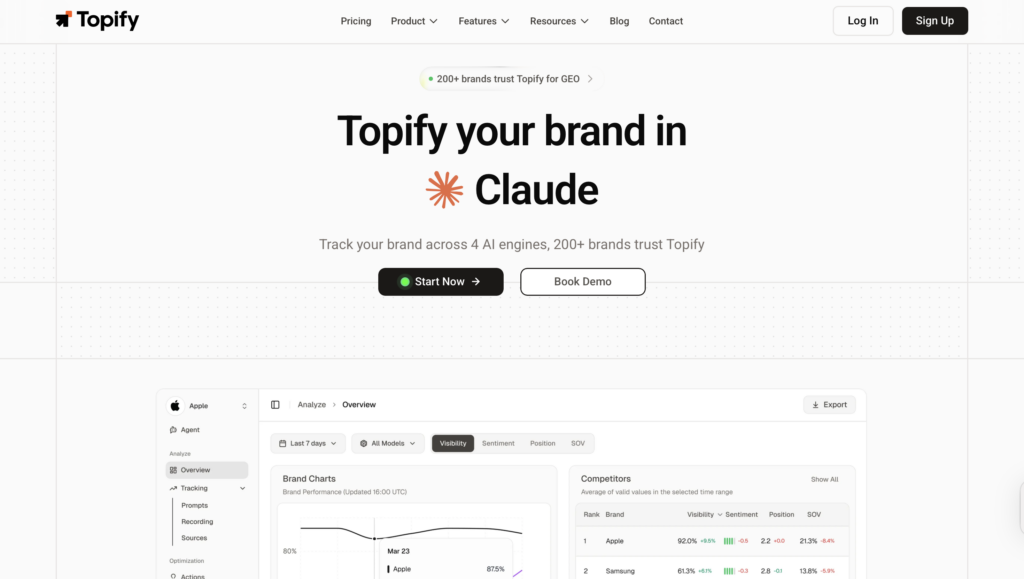
Topify consolidates these metrics into a single visibility dashboard, tracking brand performance across ChatGPT, Gemini, Perplexity, and several other major AI platforms via seven core signals: visibility, sentiment, position, volume, mentions, intent, and CVR (Conversion Visibility Rate).
5 Mistakes That Distort Your AI Tracking Data
Most teams starting with AI recommendation tracking hit the same problems.
Tracking only one model. ChatGPT is large, but it’s not the whole market. Different user segments use different AI tools. A brand that only monitors one platform is measuring a fragment of its actual AI footprint.
Counting mentions without context. A brand mentioned as a “cautionary example” still counts as a mention. Without sentiment filtering, high mention volume can mask a fundamentally negative AI positioning.
Ignoring source injection. If the AI is citing a competitor’s blog post as the “authoritative source” on your product category, that’s a content gap you need to fill. Tracking which URLs the model cites is as important as tracking brand names.
Running static tests. A monthly manual check isn’t tracking. It’s a snapshot. AI models are fine-tuned continuously, and a content update from a competitor can shift your recommendation share within days.
Prioritizing volume over quality. A mention buried in a low-intent, off-topic response is worth far less than a direct recommendation in a high-intent research prompt. Reach means nothing if the context doesn’t drive decisions.
How to Choose the Right AI Recommendation Tracking Platform
If you’re evaluating tools, these are the capabilities that separate functional platforms from ones that look good in a demo:
Multi-model coverage. The platform should audit your brand across at least three to four major LLMs. Single-model tools give you partial data at full price.
Automated prompt generation. Manually writing query sets at scale isn’t sustainable. Look for platforms that generate semantic permutations of your core terms automatically.
Citation mapping. You need to see which specific URLs the AI is pulling from when it recommends or cites your brand. This is how you connect your content strategy to your AI visibility.
Temporal tracking. Visibility trends over time, especially in response to content updates, are what let you prove ROI and iterate intelligently.
Sentiment and position data. Knowing you’re mentioned isn’t enough. You need to know whether you’re being positioned as the first recommendation or the afterthought.
Topify’s Source Analysis feature maps exactly which domains and URLs AI platforms cite when your brand or competitors come up. Its Competitor Monitoring module tracks position in real time across the full competitive set, so you know not just where you stand, but why.
Pricing starts at $99/month for the Basic plan, covering 100 prompts and 9,000 AI answer analyses across ChatGPT, Perplexity, and AI Overviews. Enterprise plans start at $499/month with dedicated account management and custom configurations.
For teams not ready to commit, Topify’s free GEO Score Checker provides an immediate read on your current AI visibility baseline without requiring signup.
FAQ
What is an AI recommendation tracking system?
It’s a framework for measuring how often and how favorably a brand appears in AI-generated answers across platforms like ChatGPT, Perplexity, and Gemini. It captures mentions, sentiment, source citations, and recommendation category across a defined set of prompts.
How does an AI recommendation tracking system work?
It runs a defined set of queries against multiple LLMs continuously, captures full responses, and uses NLP classifiers to extract brand signals: presence, sentiment, position, and citation source.
How do you measure an AI recommendation tracking system’s effectiveness?
The primary metrics are AI Share of Voice (your mentions vs. competitors) and Citation Depth (how many of your own URLs the AI is citing). Recommendation Share is a more actionable signal than click-through rate in this context.
What’s the difference between an AI recommendation tracking tool and traditional SEO software?
Traditional SEO tools track page rankings in static search results. AI tracking tools monitor dynamic, generated answers where your brand may be recommended, compared, or excluded, with no traditional ranking signal to follow.
How often should you run an AI recommendation tracking system?
Continuously. AI model fine-tuning happens frequently, and recommendation patterns can shift week to week. Monthly snapshots miss the movement between updates.
What are the best tools for AI recommendation tracking? Platforms with multi-model coverage, automated prompt generation, citation mapping, and temporal tracking are the most reliable. Topify covers all four, with dedicated analytics for each major AI platform.
How much does an AI recommendation tracking system cost?
It varies widely. Topify’s Basic plan starts at $99/month. Enterprise configurations with custom prompt sets and dedicated account managers start at $499/month.
What are common mistakes in AI recommendation tracking?
Monitoring only one AI model, counting mentions without sentiment context, running static monthly tests, and focusing on mention volume over recommendation quality in high-intent prompts.

