

You searched for your brand on ChatGPT. It appeared somewhere in the third paragraph, after two competitors. Your rank checker logged that as a “position 3” result. You moved on.
But two weeks later, a prospect told you they’d asked Perplexity which tool to use in your category, and your brand wasn’t mentioned at all. Same product. Different AI platform. Different day. Completely different outcome.
That’s not a ranking problem. It’s a visibility gap, and most AI rank checkers aren’t built to find it.
What AI Rank Checkers Actually Measure
Most tools marketed as AI rank checkers do one thing: they run a query, check whether your brand appears in the response, and log the position. Position 1 means you were mentioned first. Position 3 means two other brands came before you. Clean, simple, familiar.
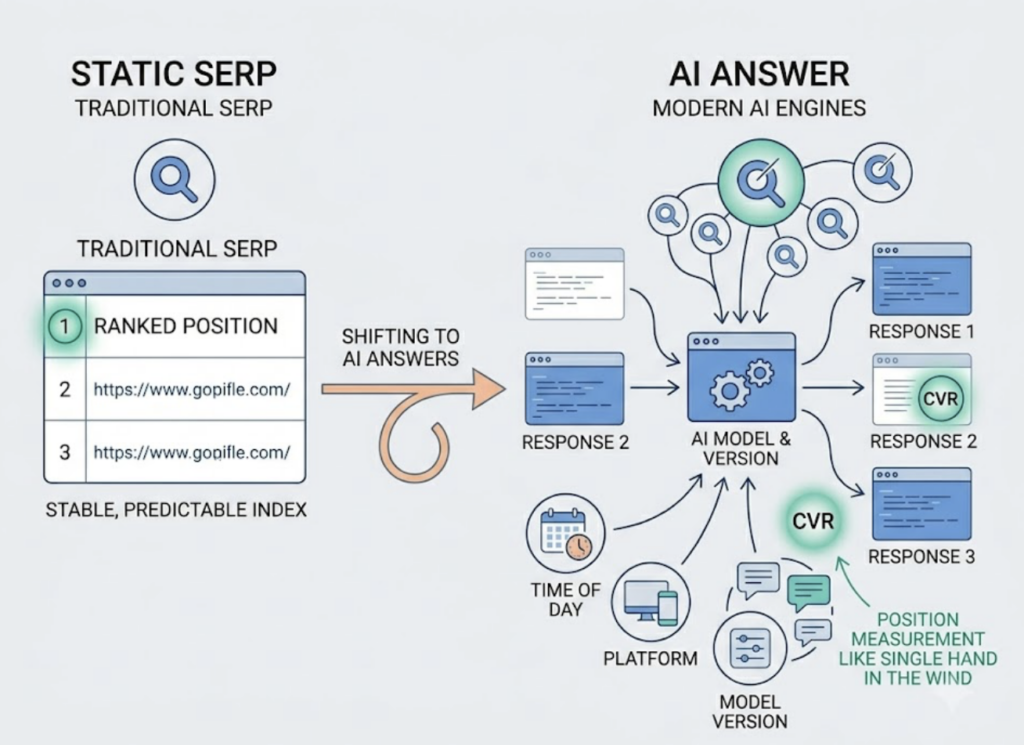
The problem is that AI engines don’t work like traditional SERPs. There’s no fixed index, no stable crawl, no consistent ordering. Every query generates a new response, and that response shifts based on phrasing, model version, time of day, and the platform being used. Logging a “position” on a single query is like measuring wind speed by holding your hand out the window once.
Rank data tells you where you showed up. It doesn’t tell you when you didn’t. It doesn’t tell you why. And in AI search, the “why” is everything.
The Visibility Gap Most Brands Never See
Here’s the structural issue with position-only tracking: it only captures moments when your brand appears. The queries where you’re completely absent never show up in the report. Your dashboard looks cleaner than your actual AI search presence.
According to research on AI Overviews citation behavior, only about 12% of AI Overviews link to the top-ranked organic result, breaking the assumption that strong SEO translates to AI visibility. A brand can hold the #1 position in Google while being entirely absent from AI-generated answers for the same keyword.
That absence is the visibility gap. And rank checkers, by definition, can’t measure what’s not there.
Why “Not Mentioned” Is Harder to Fix Than Low-Ranked
Low position is a ranking problem. You can fix it with content optimization, more authoritative citations, better structured data. The playbook exists.
Not mentioned at all is a different category of problem entirely.
When AI platforms skip your brand, it’s typically because you haven’t established what researchers call a “trust cascade”: consistent mentions across multiple authoritative third-party domains like industry review sites, G2, Reddit threads, and niche publications. AI models prioritize brands with cross-web consensus. If that consensus doesn’t exist for your brand, the model simply defaults to competitors who have it.
That’s not a positioning fix. That’s a structural authority gap.
To close it, you need to know which sources AI platforms are citing, which prompts are triggering competitor recommendations, and what sentiment the model attaches to your brand when it does appear. None of that information comes from a rank checker.
What Brand Visibility Tools Track That AI Rank Checkers Don’t
The table below shows where the capability gap actually sits:
| Capability | AI Rank Checker | Brand Visibility Tool |
|---|---|---|
| Detects brand mentions | Yes | Yes |
| Records position in response | Yes | Yes |
| Tracks non-mention (absence) | No | Yes |
| Measures AI sentiment toward brand | No | Yes |
| Identifies which sources AI is citing | No | Yes |
| Monitors competitor visibility | Limited | Yes |
| Surfaces high-value prompts you’re missing | No | Yes |
| Tracks cross-platform variance (ChatGPT vs. Perplexity vs. Gemini) | Rarely | Yes |
| Estimates conversion likelihood from AI mentions | No | Yes |
The right column isn’t a wishlist. It’s the minimum data set needed to understand your brand’s position in AI search, and to take action on it.
One critical dimension that often gets overlooked: AI sentiment is a conversion factor. Being described as “a cautious choice” or “better suited for smaller teams” in an AI response can actively push prospects toward competitors, even when your brand appears frequently. Rank data doesn’t capture this at all.
How Topify Closes the Gap
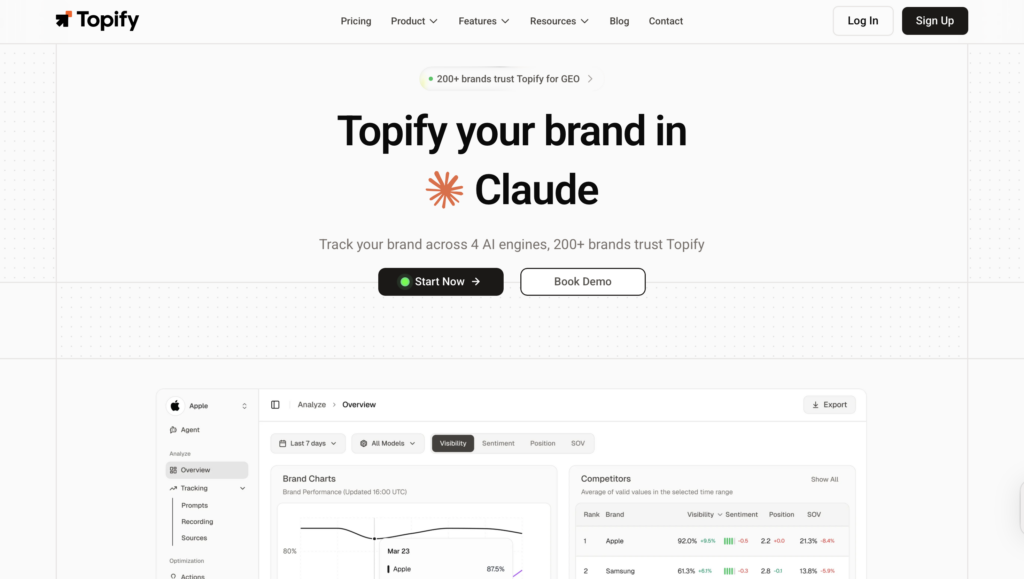
Topify is built around the insight that AI search visibility requires more than a position number. Its Comprehensive GEO Analytics tracks seven metrics across each brand: visibility, sentiment, position, volume, mentions, intent, and CVR (Conversion Visibility Rate). Together, these create a complete picture of how AI platforms treat your brand, not just whether you show up.
A few specific capabilities stand out:
Source Analysis reverses-engineers the domains and URLs that AI platforms actually cite when describing your category. You can see whether your brand’s content is in that citation pool, and which competitors have dominated it. This is how you find the structural gaps that a rank check will never surface.
High-Value Prompt Discovery continuously surfaces the queries that are driving AI recommendations in your space. If a new prompt type is sending users toward a competitor, you’ll see it in Topify’s data before it shows up in your traffic drop.
Cross-Model Variance Detection tracks how your brand appears differently across ChatGPT, Perplexity, Gemini, DeepSeek, and other platforms. A brand might be well-positioned on Perplexity but entirely absent on ChatGPT, requiring distinct content strategies for each platform.
Competitor Monitoring shows you exactly how rivals are positioned across all of these dimensions, not just where they ranked on a given query.
Topify’s plans start at $99/month for 100 prompts and 9,000 AI answer analyses across ChatGPT, Perplexity, and Google AI Overviews, scaling to Pro at $199/month for teams tracking 250 prompts across 8 projects.
Four Steps to Diagnose Your Brand’s AI Visibility
If you’re not sure whether you have a ranking problem or a visibility gap, here’s a practical starting point:
Step 1: Run a presence audit. Pick 10-15 prompts your target audience would realistically ask across ChatGPT, Perplexity, and Gemini. Note not just where your brand appears, but how often it’s missing entirely. If absence is common, you’re dealing with a visibility gap, not a ranking issue.
Step 2: Check the sentiment when you do appear. Does AI describe your brand as a leader, an alternative, or a fallback option? Neutral or cautious language is a signal worth investigating, even if your position looks fine.
Step 3: Identify who AI is citing in your category. Look at which third-party domains consistently appear alongside competitor mentions. These are the sources AI treats as authoritative. If your brand isn’t present in those domains, that’s where to focus.
Step 4: Set up continuous monitoring. AI citation patterns shift faster than traditional SERP rankings. A one-time audit is useful. Ongoing tracking is what makes it actionable. Get started with Topify to monitor your brand’s AI visibility across platforms at the prompt level.
Conclusion
Rank checkers made sense when search was a list. AI search isn’t a list. It’s a synthesized recommendation that can include your brand, exclude it, or misrepresent it, and the only way to know which is happening is to measure all three.
The brands that are winning in AI search right now aren’t just checking their position. They’re tracking their presence, understanding their sentiment, auditing their citation sources, and monitoring competitor trajectories across multiple platforms. That’s what brand visibility tools are built to do. And it’s why a rank check, on its own, will keep showing you a number that doesn’t explain what’s actually happening.
FAQ
Q: What’s the difference between an AI rank checker and a brand visibility tool?
A: An AI rank checker records where your brand appears in AI-generated responses, typically as a position number. A brand visibility tool tracks a broader set of signals: whether your brand appears at all across multiple platforms and prompts, what sentiment the AI attaches to your brand, which sources AI is citing in your category, and how your visibility compares to competitors over time.
Q: Can I use a traditional rank checker to track AI search performance?
A: Traditional rank checkers are built for SERP position data. They can be adapted to record whether a brand appears in AI responses, but they’re not designed to capture absence (queries where you’re not mentioned), sentiment, source citations, or cross-platform variance. For AI search specifically, you need tools built around the way generative engines actually work.
Q: How do I know if my brand is being mentioned in ChatGPT or Perplexity?
A: The most reliable method is systematic prompt testing across multiple platforms. Define the prompts your audience would realistically use, run them consistently, and record both mentions and absences. Manually, this is time-intensive. Platforms like Topify automate this at scale, running hundreds of prompts across multiple AI engines and tracking results over time.
Q: Is Topify an AI rank checker?
A: Not exactly. Topify tracks position as one of seven metrics, but it’s built as a full AI search visibility platform. The difference is that Topify also tracks sentiment, source citations, competitor benchmarking, prompt-level data, and estimated conversion visibility, giving you the context needed to understand why your AI search performance looks the way it does, not just where you currently rank.

