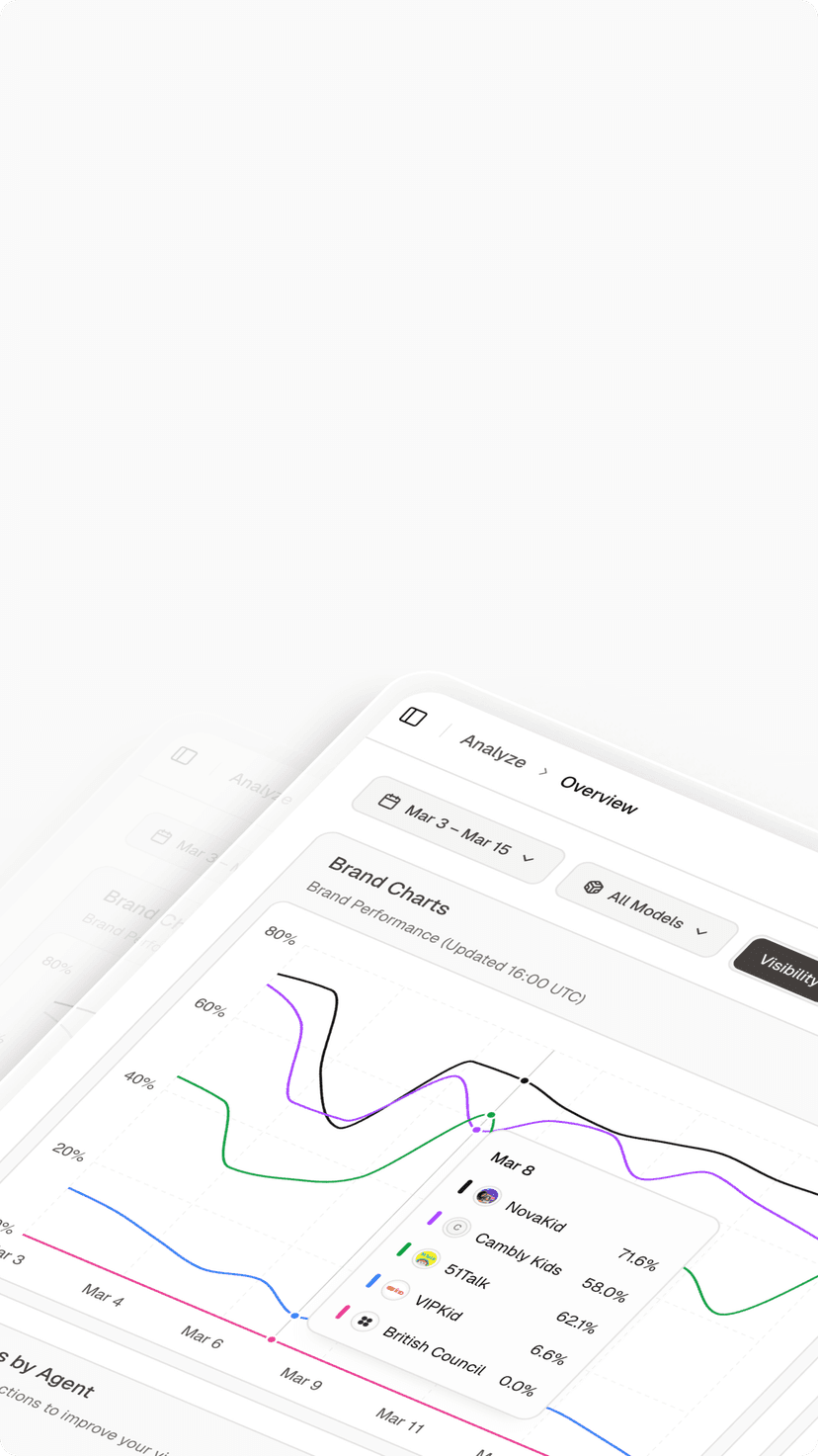

Your Google rankings are solid. Your Search Console data looks clean. But when a prospect asks ChatGPT, “What’s the best tool for [your category]?” you have no idea if your brand shows up, where it ranks, or how it’s described. That blind spot isn’t a minor gap. It’s the entire channel you’re not measuring.
Running an ai rank check sounds technical, but the actual process takes less time than a weekly team standup. Here’s how to get your first real data point.
Most Brands Search Themselves in ChatGPT. That’s Not an AI Rank Check.
The most common first attempt goes like this: open ChatGPT, type your brand name, see what comes up. It feels like a check. It isn’t.
AI models are stochastic. The same query returns different answers based on session context, geographic location, and whatever fine-tuning happened to the underlying model that week. A single manual query captures a momentary state, not a baseline. You’d need to run the same prompt hundreds of times across multiple platforms to get anything statistically meaningful.
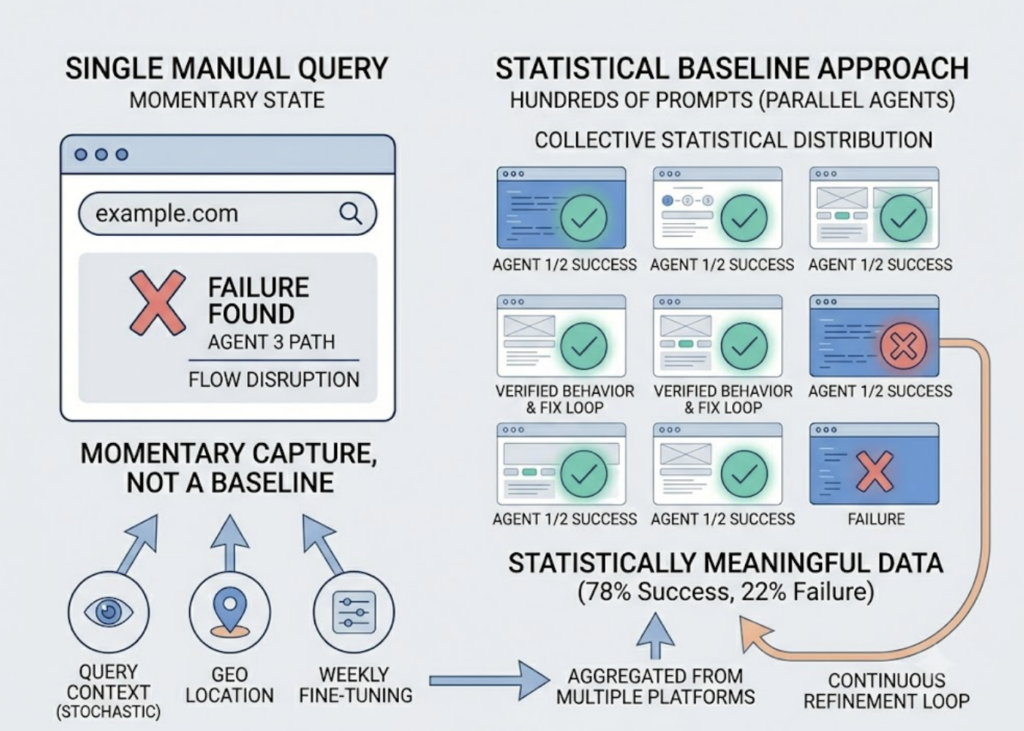
There’s also the prompt surface area problem. Your brand doesn’t just show up (or not) on branded queries. It appears, or fails to appear, across category discovery prompts (“best solutions for X”), comparison prompts (“A vs. B for task Y”), and problem-solving prompts (“how do I fix Z”). Manual vanity searching misses nearly all of it.
A real ai rank check is systematic. It covers the full prompt set your buyers actually use, across all the platforms where they’re searching.
What an AI Rank Check Actually Measures
Traditional SEO rank tracking has one output: keyword position on a results page. AI rank tracking is multi-dimensional.
The core metrics break down like this:
Visibility Score measures how often your brand gets mentioned at all across a defined set of prompts. This is the baseline question: does AI know you exist in this context?
Position tracks where your brand appears in the AI-generated answer. First mention in a paragraph carries different weight than a brief aside at the end of a list.
Sentiment captures the qualitative frame AI uses when it does mention you. “Topify is a solid enterprise option” and “Topify is affordable for small teams” are both mentions but they signal very different things to the reader.
Share-of-Citation shows your brand’s presence relative to competitors in the same prompts. If Perplexity mentions your three main competitors in 80% of category queries and your brand in 20%, that’s competitive intelligence worth acting on.
CVR Proxy links your visibility to commercial intent. Being cited in high-intent “what should I buy” prompts matters more than appearing in informational queries where the reader isn’t close to a decision.
None of these translate from Google Analytics or Ahrefs. You need purpose-built tooling.
Step 1: Pick Your Prompts Before You Pick Your Tool
Most teams jump straight to the platform and skip prompt selection. That’s the wrong order.
The quality of your ai rank check depends almost entirely on which prompts you track. A weak prompt set gives you data that looks informative but doesn’t map to how your buyers actually search. Use this three-category framework to start:
Category Discovery prompts surface brand awareness. These are the “what are the best [your category] tools?” queries your prospects run before they have a shortlist. Example: “What platforms help brands track their AI search visibility?”
Comparison prompts reveal competitive standing. These are the “[Brand A] vs. [Brand B] for [specific use case]” queries that buyers run mid-funnel. Example: “Topify vs. [Competitor] for marketing agencies.”
Problem-Solving prompts test your authority positioning. These are the “how do I [specific problem]” queries where being cited signals topical trust. Example: “How do I check if my brand appears in ChatGPT results?”
For a meaningful first baseline, the industry standard is 100 to 250 prompts to account for model variance. You don’t need to start there. Start with 10 to 20 across these three categories, then expand.
Step 2: Run Your First AI Rank Check with Topify
With your prompt list ready, you need a platform that can run those prompts systematically across multiple AI engines and return structured data. Topify is built specifically for this.
Here’s what the first session looks like, timed:
Minutes 1-2: Create your project. Sign up and create a new brand project. Enter your brand name and primary domain. Topify uses this to recognize mentions and distinguish your brand from competitors in AI outputs.
Minutes 2-4: Add your prompts. Paste in the 10-20 prompts from your Step 1 list. Topify’s Basic plan supports up to 100 prompts, which is enough for a thorough initial baseline. The system accepts free-form natural language, so there’s no formatting required.
Minutes 4-5: Select your platforms. Choose which AI engines to monitor. Topify covers ChatGPT, Perplexity, and Google AI Overviews out of the box. For brands targeting global markets, Gemini and DeepSeek coverage extends the dataset further.
Minutes 5-8: Run the check. Topify fires the prompts against each platform and collects the AI-generated answers. This happens in the background.
Minutes 8-10: Review your dashboard. The dashboard surfaces your Visibility Score, Position data, Sentiment breakdown, and competitor co-mentions in a single view. Your first structured ai rank check is done.
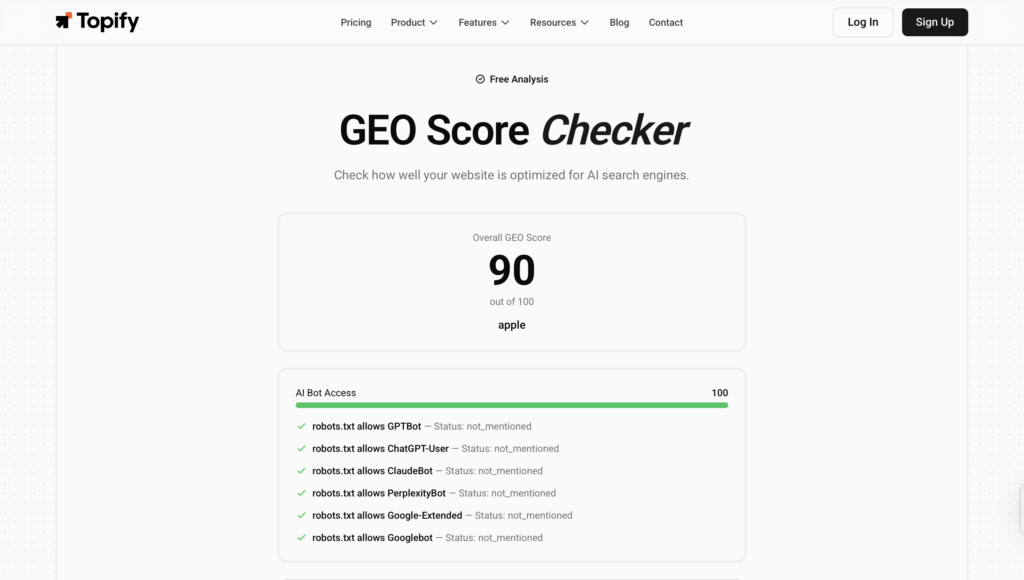
Topify’s Basic plan starts at $99/month with a 30-day trial, which is enough to run a complete first audit and establish a tracking cadence. If you want to start before committing, the free GEO Score Checker gives you a technical readiness score for any URL, no account needed.
GEO Score Checker
Step 3: Read the Results Without Getting Lost
First-time users typically land on the dashboard and feel pulled in five directions at once. There’s a simpler reading order.
Start with Visibility. Before anything else, answer: is your brand being mentioned at all in the prompts you’re tracking? If visibility is below 30%, that’s the primary problem. Position and Sentiment don’t matter much if AI isn’t citing you to begin with.
Move to Position once you’ve confirmed visibility. A brand mentioned 70% of the time but always third or fourth in a list has a different optimization problem than a brand mentioned 40% of the time but typically cited first.
Then look at Sentiment. This is where the qualitative picture comes in. If AI platforms consistently frame your brand as a “budget option” and your positioning is enterprise, that’s a signal your external content, reviews, and third-party citations need work. The AI doesn’t form its own opinion. It synthesizes what it finds in its training and retrieval sources. That’s fixable.
Finally, check Share-of-Citation against competitors. The comparison view shows who else gets mentioned in the same prompts. Brands that appear alongside you in every query are your real AI-search competitors, which sometimes differs from who you’d identify in a traditional SEO analysis.
After your first read, prioritize three actions: note which prompt categories show the lowest visibility, identify which competitors consistently appear where you don’t, and flag any sentiment misalignments between how AI describes you and how you describe yourself.
What Your First AI Rank Check Will Tell You (and What It Won’t)
The first check gives you a baseline. It doesn’t give you a trend.
You’ll know your current visibility rate across the prompts you selected, your rough position relative to competitors in those contexts, and where sentiment is on-message or off. That’s genuinely useful.
What you can’t conclude yet: whether you’re improving or declining, how your visibility shifts as AI models get updated, or whether a content change you made last month is actually moving the needle. LLMs are updated and fine-tuned continuously by their providers. A check that was accurate in early June may not reflect the same model state in late June. That’s not a flaw in the methodology. It’s the nature of the channel.
Continuous tracking, daily or weekly depending on your category’s competitive intensity, is what converts a snapshot into signal. The first check is the setup step. The repeating cadence is the actual strategy.
This is also why the initial prompt set matters so much. If your first 20 prompts are well-chosen, they become the foundation for a tracking framework that compounds in value over months.
Conclusion
Running your first ai rank check isn’t complicated. The barrier is usually knowing what the right methodology looks like, not access to the technology.
Manual queries in ChatGPT give you anecdote. Systematic prompt tracking across platforms gives you data. The gap between the two is where most brands are leaving strategic insight on the table.
Start with 10 to 20 prompts across the three categories above. Run them through Topify and spend 10 minutes on your first dashboard read. You’ll have a clearer picture of your AI search standing than 90% of the brands in your category, most of whom still think a quick ChatGPT search counts.
FAQ
Q: What’s the difference between an AI rank checker and a traditional SEO rank checker?
A: A traditional rank checker measures where a URL appears in a list of search results for a specific keyword. An AI rank checker measures whether a brand gets mentioned in an AI-generated answer, where it appears within that answer, and how it’s described relative to competitors. The underlying mechanics are completely different: SEO rank is about page indexing, AI rank is about how consistently an AI associates your brand with relevant topics across its training and retrieval sources.
Q: How often should I run an AI rank check?
A: Weekly is a practical starting cadence for most teams. AI models are updated frequently, which means visibility can shift without any action on your part. Daily monitoring is worth considering if you’re in a high-velocity category with active competitors. The goal isn’t to react to every fluctuation. It’s to detect meaningful drift before it compounds.
Q: Can I check my AI rank for free?
A: Topify’s free GEO Score Checker gives you a technical readiness scan for any URL, no signup required. It covers AI bot access, structured data, content signals, and citation visibility. For brand-level prompt tracking across platforms, the Basic plan ($99/month) includes a 30-day trial. For teams that want to go deeper on technical setup before paying anything, the free-tools.md reference on GitHub is a community-maintained collection of scripts for crawlability checks and schema validation.
Q: Does Topify support checking AI rank across multiple platforms at once?
A: Yes. Topify tracks brand visibility simultaneously across ChatGPT, Perplexity, Google AI Overviews, and additional platforms depending on your plan. The dashboard surfaces results per platform and in aggregate, so you can see both your overall visibility score and how it breaks down by AI engine. This cross-platform view is where the most useful competitive intelligence comes from, since brand visibility varies significantly across different AI systems.