

Search “best AI rank checker” and you’ll find a dozen platforms, each claiming to track your brand in AI search. Half of them only cover one or two engines. The other half show you position numbers without telling you whether your brand was actually recommended, or just mentioned in passing. Meanwhile, the gap between what these tools measure and what actually drives AI-driven discovery keeps growing.
The real question isn’t which tool has the cleanest dashboard. It’s which one measures what AI search actually does to your brand.
Most AI Rank Checkers Are Solving the Wrong Problem
Traditional rank trackers give you a number. Position 1, position 3, position 7. That model works for Google, where results are a list.
AI search doesn’t work that way. When someone asks ChatGPT or Perplexity for a software recommendation, the engine generates a response. Your brand either appears in that response, or it doesn’t. And if it does appear, there’s a meaningful difference between “mentioned as an option” and “recommended as the top choice.” Most AI rank checkers track the former and call it visibility.
That’s the gap most brands still can’t see.
AI Overviews now appear in roughly 48% of Google searches, up from 34.5% in late 2025. Studies show a 38% drop in organic click-through rates when an AI summary is present. Your traditional rank tracker sees none of that.
The 7 AI Rank Checkers, Side by Side
Before diving into each tool, here’s how they compare across the metrics that actually matter:
| Tool | AI Platforms Covered | Position Tracking | Recommendation Tracking | Starting Price |
|---|---|---|---|---|
| Topify | ChatGPT, Perplexity, Gemini, DeepSeek, Doubao, Qwen + more | Yes | Yes (7-metric GEO framework) | $99/mo |
| Semrush One | ChatGPT, AI Overviews, AI Mode, Gemini (expanding) | Yes | Partial (sentiment + citations) | $199/mo |
| Ahrefs Brand Radar | ChatGPT, Perplexity, Gemini, Copilot, AI Overviews, AI Mode | Yes | Partial (mention-based) | $828/mo (base + bundle) |
| AIclicks | ChatGPT, Perplexity, Gemini, Claude, Grok, AI Overviews | Yes | Partial (citation tracking) | $49–$83/mo |
| LLMrefs | ChatGPT, Perplexity + others | Yes | No | $49–$79/mo |
| Scrunch AI | ChatGPT, Perplexity, Gemini, Copilot, Meta AI, Claude | Yes | No | ~$300/mo |
| HubSpot AEO Grader | ChatGPT, Perplexity, Gemini | No (snapshot only) | No | Free |
#1 Topify: Built for Recommendation Tracking, Not Just Ranking
Most tools in this category started as traditional SEO platforms that added an AI monitoring layer. Topify was built in the opposite direction: from AI search outward.
The core difference is the measurement framework. Where other tools track whether your brand appears in an AI answer, Topify tracks seven distinct metrics: visibility, sentiment, position, volume, mentions, intent, and CVR (Conversion Visibility Rate). That last metric, CVR, estimates the likelihood that an AI answer actually drives a user toward your brand, not just that your name showed up somewhere in the text.
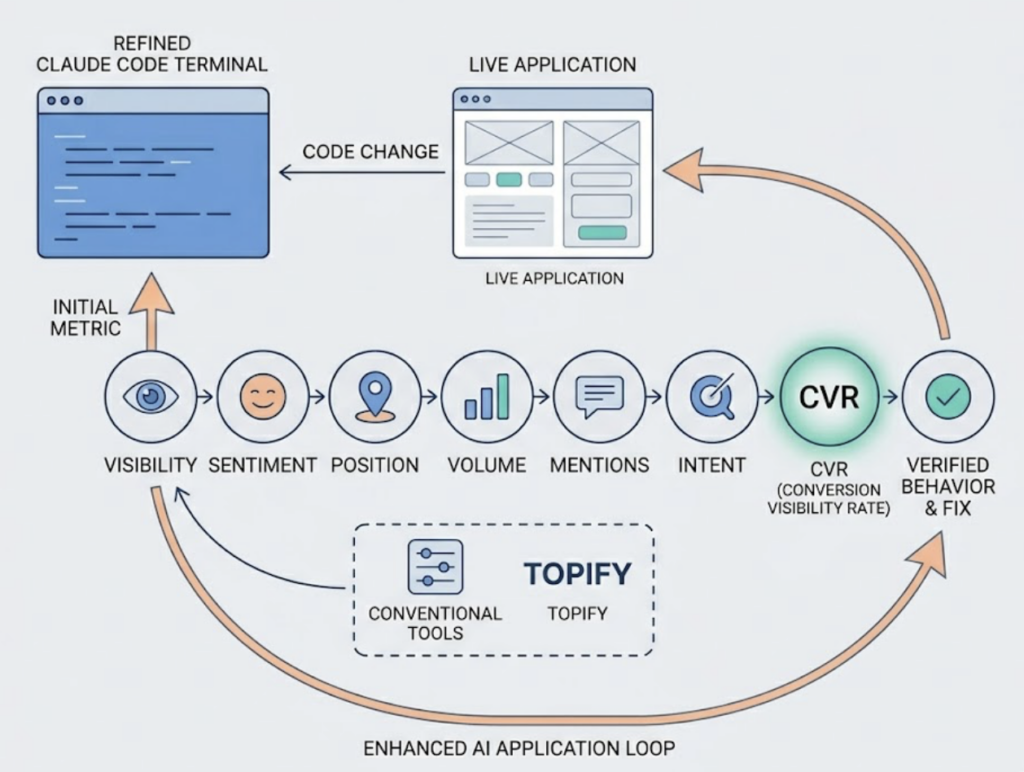
In practice, this means a Topify report tells you not just “you appeared in 60% of ChatGPT answers for this prompt,” but also how positively your brand was framed, where you ranked relative to competitors, which sources the AI cited, and whether that mention was the kind that actually influences decisions.
Platform coverage is broader than most tools: ChatGPT, Perplexity, Gemini, DeepSeek, Doubao, Qwen, and other major AI engines across global markets. For brands with international presence, that cross-market coverage matters. Many tools claim multi-platform tracking but cap out at three or four engines.
Topify also includes one-click GEO execution. Once the platform surfaces a visibility gap, you can deploy an optimization strategy without building a separate workflow. That’s where it moves beyond a “rank checker” into a full AI search optimization platform.
Pricing: Basic at $99/mo (100 prompts, 4 projects, 9,000 AI answer analyses), Pro at $199/mo (250 prompts, 10 seats), Enterprise from $499/mo. Get started here.
Best for: Marketing teams and agencies that need to track both whether a brand appears in AI answers and whether it’s being recommended, with the ability to act on that data.
#2 Semrush One: Strongest for Teams Already in the Semrush Ecosystem
Semrush One bundles traditional SEO tools with an AI Visibility Toolkit. For teams that already rely on Semrush for keyword research, backlink analysis, and site audits, adding AI tracking in the same workflow makes practical sense.
The AI features cover share of voice, sentiment analysis, and citation tracking across ChatGPT, AI Overviews, and AI Mode. You can track the same keyword on Google vs. ChatGPT side-by-side, which is genuinely useful for spotting the disconnect between traditional rankings and AI visibility. A brand that ranks #1 on Google for a query can be invisible in ChatGPT responses for the same topic.
The limitation is the response view. When you drill into a specific prompt, the UI renders the raw AI text rather than a structured summary, which means manually reading through paragraphs to locate your mention.
Pricing: AI Visibility Toolkit starts at $99/mo per domain; Semrush One starts at $199/mo. Best for generalist SEO teams, not pure AI visibility specialists.
#3 Ahrefs Brand Radar: Largest Dataset, Highest Price Tag
Ahrefs launched custom AI prompt tracking in Brand Radar in January 2026, adding monitoring across ChatGPT, Gemini, Perplexity, Copilot, AI Overviews, and AI Mode. The scale is impressive: over 100 million prompts across 6 AI indexes.
The standout feature is cross-channel coverage. Brand Radar scans YouTube transcripts, Reddit threads, and TikTok captions alongside AI responses, making it useful for PR and comms teams that need to connect AI mentions with broader brand signal.
The cost, however, is significant. Brand Radar AI Indexes add $199/mo per platform or $699/mo for all six, on top of a base Ahrefs subscription starting at $129/mo. Total minimum cost: $828/mo. For teams that need prompt-level recommendation tracking rather than broad dataset exploration, that price-to-utility ratio is hard to justify.
Best for enterprise brands already invested in Ahrefs that need large-scale directional AI data alongside traditional SEO metrics.
#4 AIclicks: Best Entry Point for Prompt-Level Citation Tracking
AIclicks tracks brand visibility across seven AI engines including ChatGPT, Perplexity, Gemini, Claude, Grok, and Google AI Overviews. The prompt-level citation view shows which sources AI engines are pulling from when your brand is mentioned, which is useful for diagnosing why a competitor is being recommended over you.
Pricing starts at $49–$83/mo, making it accessible for SMBs and solo founders. The trade-off is that AIclicks blends software with managed-service execution, so if you only want the tracking layer, you’re paying for more than you need.
Best for smaller teams that want prompt-level AI visibility data without an enterprise budget.
#5 LLMrefs: Built for SEO Teams Expanding into AI Tracking
LLMrefs is designed to look and feel like a traditional rank tracker, except for AI search. You import existing keyword lists and the platform maps them to LLM visibility across ChatGPT and other engines.
It supports geo-targeting across 20+ countries and 10+ languages, which makes it practical for agencies managing international clients. Pricing starts around $49–$79/mo.
The limitation: LLMrefs focuses on position tracking without a recommendation layer. You’ll know if your brand appeared, but not whether the AI was actively suggesting it over competitors.
Best for SEO-led teams that want to extend existing keyword workflows into AI visibility, without switching platforms entirely.
#6 Scrunch AI: Enterprise Monitoring with an AI Crawler Layer
Scrunch AI tracks brand presence across ChatGPT, Perplexity, Gemini, Copilot, Meta AI, and Claude. What sets it apart is the Agent Experience Platform (AXP), a machine-readable version of your site designed to help AI crawlers index and cite your content more accurately.
Pricing starts around $300/mo for monitoring-only capabilities. Scrunch is built for enterprise teams with existing BI pipelines that need API access and multi-brand management. For a marketing team that wants a fast feedback loop between what AI says and what content to fix, the platform can feel heavier than necessary.
Best for large enterprise brands that need AI crawler visibility and security-grade monitoring infrastructure.
#7 HubSpot AEO Grader: Free Snapshot, No Ongoing Tracking
HubSpot’s AEO Grader sends your brand information to ChatGPT, Perplexity, and Gemini and returns a one-time perception score across five dimensions. It’s free, takes about two minutes to run, and gives a reasonable first read on how AI models currently characterize your brand.
The limitation is in the name: it’s a grader, not a tracker. You get a snapshot, not a trend line. There’s no competitive benchmarking, no prompt-level breakdown, and no way to monitor how your AI visibility changes over time. It’s a useful starting point for teams that have never checked their AI presence, but it’s not an ongoing monitoring solution.
Best for teams that want a free first-look at their AI brand perception before committing to a paid platform.
What “AI Rank” Actually Means in 2026
Here’s the distinction that most tool comparisons skip: there are two separate questions in AI search visibility.
The first is position: if your brand appears in an AI answer, where does it show up? First recommendation, third option, brief mention at the end?
The second is mention: does your brand appear at all?
Traditional rank trackers, even when adapted for AI search, tend to optimize around position. But 93% of AI Mode sessions end without a click, meaning the AI answer is often the only impression a user sees. Whether you’re being actively recommended in that answer, or just named as an afterthought, is not the same thing.
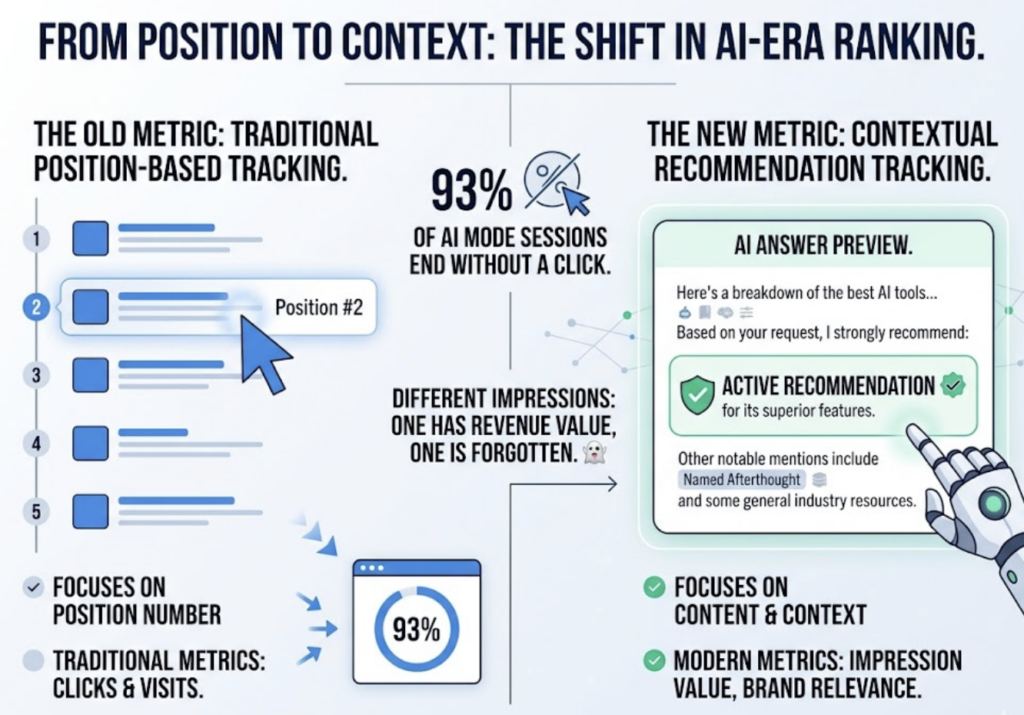
The GEO framework, which tools like Topify are built around, treats AI visibility as a multi-dimensional signal: visibility, sentiment, position, source citations, and conversion potential. Tracking “rank” in AI search without those dimensions is like tracking keyword position without click-through rate or conversion data.
How to Pick the Right AI Rank Checker for Your Team
Three common scenarios:
You need position data only, with an existing SEO stack. Semrush One or Ahrefs Brand Radar add AI tracking without forcing a tool switch. Expect to pay a premium.
You’re a smaller team that needs prompt-level citation data. AIclicks or LLMrefs give you AI visibility for under $100/mo. LLMrefs is stronger for international SEO teams; AIclicks is stronger for citation-level diagnostics.
You need to track both position and recommendation, across multiple AI platforms, and act on the data. That’s where the platform category diverges from the rank-checker category. Topify’s seven-metric GEO framework covers the full picture: not just where your brand shows up, but how it’s being presented, whether it’s being actively recommended, and which sources are driving or limiting that recommendation.
Most teams start with a position tracker and upgrade once they realize position data alone doesn’t explain why a competitor keeps getting the recommendation.
Conclusion
The AI rank checker market is splitting into two categories: tools that tell you where your brand appeared, and tools that tell you whether your brand was recommended. Most of the platforms in this list are in the first category. That’s useful, but it’s not the whole picture.
As AI search becomes the primary discovery layer for buyers across categories, the difference between appearing and being recommended will determine which brands actually capture that traffic. Start with a tool that measures both. If you’re evaluating options, Topify covers the full GEO analytics stack, from visibility and sentiment to position, CVR, and competitor benchmarking, across the broadest platform coverage in this category.
FAQ
Q: What is an AI rank checker?
A: An AI rank checker is a tool that monitors how your brand appears in responses generated by AI search engines like ChatGPT, Perplexity, and Gemini. Unlike traditional rank trackers that measure keyword position in Google’s blue-link results, AI rank checkers analyze whether your brand is mentioned, how positively it’s framed, and where it appears relative to competitors in AI-generated answers.
Q: Can I check my brand’s ranking in ChatGPT?
A: Yes. Tools like Topify, AIclicks, and Semrush One track your brand’s presence and position in ChatGPT responses across specific prompts. What these tools measure varies: some track whether you appeared, others also track sentiment, citation sources, and whether you were actively recommended vs. passively mentioned.
Q: How is AI rank different from Google rank?
A: Google rank tells you your position in a list of links for a specific keyword. AI rank tells you how often your brand appears in synthesized AI answers, how it’s described, and whether it’s being recommended. A brand can rank #1 on Google for a query while being completely absent from AI responses to the same question, because AI engines pull from different signals than Google’s PageRank algorithm.
Q: Is there a free AI rank checker?
A: HubSpot’s AEO Grader is free and gives a one-time snapshot of how ChatGPT, Perplexity, and Gemini characterize your brand. For ongoing tracking, competitive benchmarking, and prompt-level monitoring, paid tools are required. Most platforms offer free trials.

