

Search “best AI tracking platform” and you’ll find a dozen tools, each claiming to tell you how your brand performs in AI search. Most dashboards show you a mention count and call it visibility. The difference between a number and an insight is whether the platform can tell you which prompts triggered that mention, where in the AI’s answer your brand appeared, and what sources the model relied on to decide you were worth naming.
That gap is exactly where most evaluations go wrong.
What AI Query Tracking Actually Measures
AI query tracking monitoring is not keyword rank tracking with a new name. It’s a fundamentally different discipline.
Traditional SEO tools measure positions in a static index. AI query tracking measures how language models respond to specific user prompts, across multiple platforms, on a recurring basis. The same query can produce different answers on ChatGPT, Perplexity, and Gemini, and those answers can shift week over week as models update.
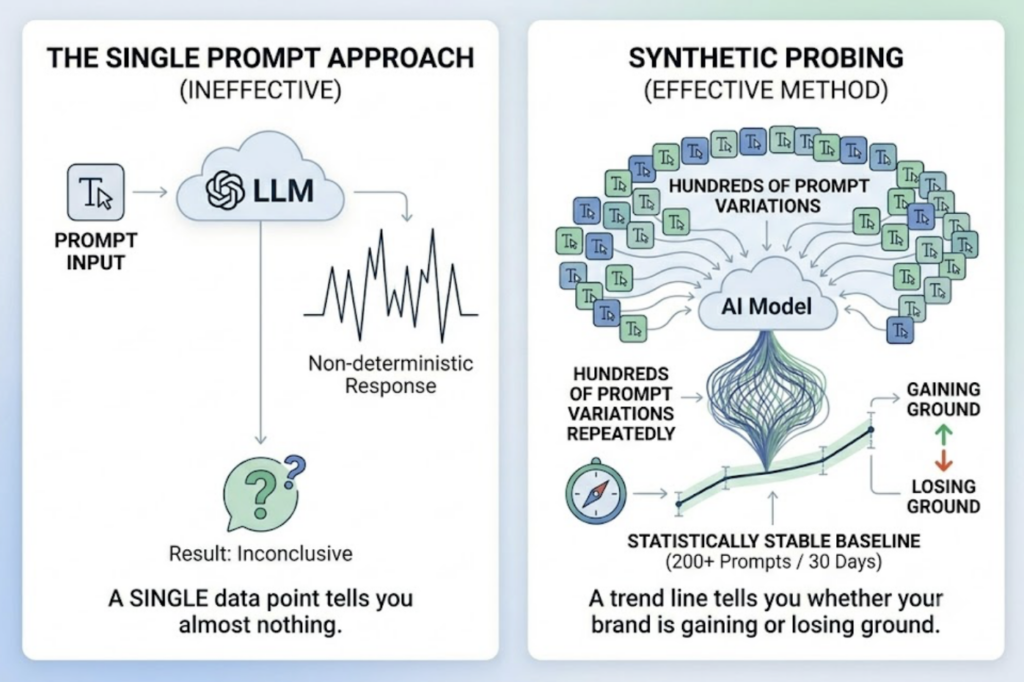
Because LLM responses are non-deterministic, effective tracking requires what researchers call synthetic probing: submitting hundreds of prompt variations repeatedly to build a statistically stable baseline. A single data point tells you almost nothing. A trend line built from 200+ prompts over 30 days tells you whether your brand is gaining or losing ground in AI-mediated discovery.
Why Standard SEO Tools Miss This Entirely
Ahrefs and Semrush are built on a crawl-based model. They index pages, track backlinks, and measure URL positions in search engine result pages. That architecture cannot capture what happens when a user asks ChatGPT a conversational question and never clicks a link.
The problem isn’t that traditional tools are bad. It’s that they were designed for a fundamentally different environment. AI search is a zero-click environment where the AI synthesizes an answer and the user’s intent is satisfied without visiting a single page. Traffic-to-ranking correlation models break completely here.
There’s also a contextual sensitivity issue. LLM responses are affected by conversation history, model versioning, and even the phrasing of a question. An AI query tracking system has to simulate real user inquiry patterns, not just check whether a URL is indexed.
That’s a different architecture entirely.
The 5 Metrics That Matter in AI Query Monitoring
Before evaluating any AI query tracking tool, you need to know what you’re measuring.
Visibility Score is the frequency at which your brand appears across a core cluster of category-relevant prompts. It’s your baseline: are you being mentioned at all?
Position Tracking goes one layer deeper. It measures where your brand appears in an AI-generated list or synthesis, whether you’re the first recommendation, a buried afterthought, or absent entirely. Position matters because AI users rarely scroll past the first two or three names in a generated answer.
Sentiment Score evaluates the narrative framing. Is your brand presented as the category leader, a niche option, or a budget fallback? If an AI consistently describes your enterprise software as “great for small teams,” that’s a positioning problem your marketing team needs to know about.
Source and Citation Analysis is the most strategically valuable metric. It identifies which domains the AI relies on as evidence when it mentions your brand. Knowing which content sources feed the model’s recommendations lets you reverse-engineer your inclusion in the RAG (Retrieval-Augmented Generation) pipeline and target the gaps.
Conversion Visibility Rate (CVR) tracks the downstream impact: correlating AI visibility spikes with branded search volume and direct site traffic. It connects AI search performance to revenue outcomes.
These five metrics are not interchangeable. A platform that only tracks mentions is giving you visibility without position, sentiment, or source context. That’s like knowing your ad ran without knowing whether anyone saw it.
How to Evaluate an AI Query Tracking Platform
The evaluation criteria most teams use are too shallow. “Does it track ChatGPT?” is a starting question, not a final answer.
Platform coverage matters because each AI engine uses different training data and citation logic. A platform tracking only ChatGPT will miss what Perplexity (which surfaces cited research links) and Gemini (integrated with Google’s knowledge graph) are saying about your brand. At minimum, your AI query tracking software should cover all three.
Prompt volume capacity separates serious platforms from lightweight tools. Single-prompt testing produces unreliable data due to LLM non-determinism. Look for platforms that support hundreds of prompt variations per tracking cycle. The research standard is running prompts on a recurring basis to build statistically stable trend data.
Competitor benchmarking is table stakes for any brand-level decision. You need Share of Voice data: how often your brand appears relative to competitors across the same prompt set, not just your own mention count in isolation.
Execution capability is the dividing line between a reporting tool and a visibility platform. Does the platform stop at data, or does it tell you what to do? The most useful AI query tracking solutions map citation gaps directly to content actions and can generate structured data or FAQ content to fill them.
One more thing worth checking: how fresh is the data? AI citation patterns shift as models update. A platform that refreshes weekly is meaningfully less useful than one running continuous monitoring.
Topify: Built for Prompt-Level AI Visibility
Topify was built specifically for AI search intelligence. It covers ChatGPT, Gemini, Perplexity, DeepSeek, Doubao, Qwen, and other major platforms from a single dashboard, which matters because brand performance varies significantly across engines.
The Visibility Tracking feature runs synthetic probing across your defined prompt set and surfaces trends over time, not just snapshots. You can see whether your brand’s mention rate is rising or falling and trace the inflection point to a specific event, such as a competitor publishing a new comparison article that the AI started citing.
Competitor Monitoring auto-detects which brands appear alongside yours in AI answers and gives you a side-by-side view of Visibility Score, Sentiment, and Position. In practice, this means you can spot a competitor pulling ahead in Perplexity recommendations before it shows up in your traffic data.
Source Analysis is where Topify’s architecture separates it from most alternatives. It traces the exact domains and URLs that AI platforms cite when mentioning your brand or your competitors. That’s the fastest path to understanding why the AI recommends what it recommends, and what content you need to publish or earn coverage on to shift that equation.
One-Click Execution closes the loop. You can state your optimization goal in plain language, review the proposed strategy, and deploy it with a single click. No manual content workflow required.
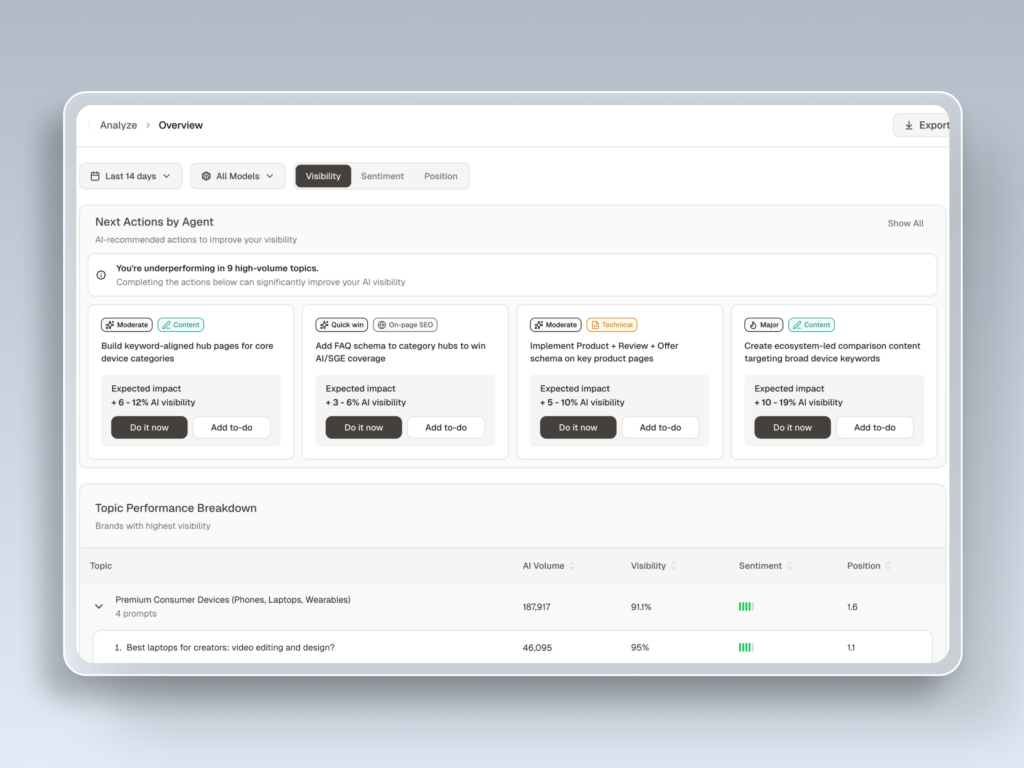
Topify’s Basic plan starts at $99/month for 100 prompts across 9,000 AI answer analyses. The Pro plan at $199/month expands to 250 prompts. For teams running a high-volume AI query tracking system, the Enterprise plan starts at $499/month with dedicated account management.
Search Atlas and Other Tools: What They Track (and What They Don’t)
The AI visibility market currently splits into two categories: legacy SEO platforms that have added LLM tracking modules, and native GEO platforms built specifically for AI search intelligence.
Search Atlas falls in the first category. It’s a capable multi-channel marketing platform with strong traditional SEO infrastructure. Its LLM visibility module is a meaningful addition for teams already managing SEO, PPC, and local search from one place. The trade-off is depth: these modules tend to extend existing keyword-ranking logic rather than run the synthetic probing infrastructure that native GEO platforms use for granular diagnostics.
Semrush has taken a similar approach with its AI Toolkit. Ahrefs has added AI Overview tracking. Both are useful for teams that need a single platform across all marketing channels and are willing to accept shallower AI-specific data.
| Native GEO Platform | Legacy Platform + AI Module | |
|---|---|---|
| Prompt volume capacity | High (hundreds of prompts/cycle) | Typically lower |
| Synthetic probing | Core architecture | Extension of crawl model |
| Source/citation analysis | Deep | Limited |
| Execution capability | One-click content actions | Manual |
| Traditional SEO features | Focused on AI search | Comprehensive |
| Best for | AI-first brands, GEO specialists | Teams consolidating channels |
The right choice depends on your primary use case. If AI search visibility is your top priority and you’re running a serious GEO program, a native platform is the better fit. If you need one tool managing your entire marketing stack and AI tracking is secondary, a legacy platform with an AI module may be enough.
Conclusion
AI query tracking monitoring is no longer a niche capability. It’s becoming a standard part of how brands measure and manage their presence in AI-mediated search. The gap between teams that track this and teams that don’t is widening every quarter.
The metrics matter, the platform coverage matters, and execution capability matters. Start with the five metrics covered here, check whether your current toolset covers them, and get started with Topify if it doesn’t. Your competitors are already running prompt-level tracking. The question is whether you know what they’re seeing.
FAQ
Q: What is an AI query tracking tool?
A: It’s a software system that submits user queries to AI platforms like ChatGPT, Perplexity, and Gemini on a recurring basis, then monitors whether and how your brand appears in the generated answers. It tracks mention frequency, position, sentiment, and the sources the AI cites as evidence.
Q: How is AI query tracking different from traditional rank tracking?
A: Traditional rank tracking measures URL positions in search engine result pages, a static index model. AI query tracking measures the semantic presence and recommendation behavior of language models, which generate answers on the fly, don’t always link to sources, and can describe your brand differently on different platforms or even different days.
Q: Which AI platforms should I track my brand on?
A: At minimum, ChatGPT (broadest user base, strong general recommendations), Perplexity (citation-heavy, surfaces source links), and Gemini (integrated with Google’s search infrastructure). Depending on your market, platforms like DeepSeek or Qwen may also be relevant, particularly for global brands.
Q: What’s the difference between an AI query tracking software and an AI visibility platform?
A: Tracking software focuses on data collection and reporting, showing you what’s happening. A visibility platform combines tracking with actionable optimization, telling you what to do about it. The latter typically includes source analysis, competitor benchmarking, content recommendations, and execution tools. That’s the difference between a dashboard and a strategy system.
Read More
- AI Search Monitoring Dashboard: How to Track Brand Visibility in One Place
- AI Citation Tracking Platforms in 2026: Which Tools Actually Show What ChatGPT, Perplexity, and Claude Are Citing
- How to Track AI Search Visibility and Rankings in ChatGPT

