

Search “best AI query tracking tool” and you’ll find dozens of platforms promising full visibility across every AI engine. Dig deeper and most of them only cover one platform, usually ChatGPT, and only count how many times your brand was mentioned. Only 22% of marketers are currently tracking AI visibility and traffic, which means the market is early. But early also means most of the tools haven’t caught up to what “tracking” actually requires in 2026. Exposure Ninja
The same brand can see citation volumes differ by 615x between Grok and Claude, proving that single-platform tracking isn’t just incomplete — it’s actively misleading. The gap between what most tools measure and what brands actually need is wider than their dashboards suggest. Superlines
Why Most AI Query Tracking Tools Only Solve Half the Problem
The core problem isn’t a lack of tools. It’s that most tools were built around the wrong question.
They ask: “How often is our brand mentioned?” The right question is: “When a high-intent user asks an AI about our category, do we show up, where, with what sentiment, and why?”
Mention counts are a vanity metric. They don’t tell you your position relative to competitors, the sentiment accuracy of how the AI describes your brand, which third-party sources the AI is pulling from, or whether your visibility is holding steady or quietly eroding. That’s not tracking. That’s scorekeeping without context.
There’s also the platform silo problem. AI engines have fundamentally different retrieval preferences. Perplexity prioritizes real-time, community-validated sources like Reddit and niche directories. Gemini leans on the Google ecosystem, including Maps and Business Profiles. ChatGPT favors high-trust consensus sources like Wikipedia and third-party review platforms. A tool that only monitors one of these gives you a partial picture at best.
Real AI query tracking has to happen at the prompt level. Because LLM responses are non-deterministic, you need synthetic probing — running queries across multiple engines at scale to build a statistically meaningful baseline. Without that, you’re not measuring visibility. You’re measuring a random sample.
The 6 Best AI Search Tracking Tools in 2026
| Tool | Platform Coverage | Primary Strength | Best For |
|---|---|---|---|
| Topify | ChatGPT, Gemini, Perplexity, DeepSeek, Qwen + more | Full-spectrum GEO + actionable execution | Enterprises and agencies at scale |
| Profound AI | Multi-model | Synthetic journey simulation | Enterprise competitive benchmarking |
| Peec AI | Multi-model | High-level visibility stats | Rapid status monitoring |
| Brandlight | Multi-model | Sentiment and reputation monitoring | Brand management teams |
| Semrush AI Toolkit | Google AI Overviews | Traditional + AI SEO integration | Existing Semrush users |
| Ahrefs Brand Radar | Web mentions + AI | General brand mention tracking | Content teams |
#1 Topify: Full-Spectrum AI Query Tracking Across Every Major Platform
Most AI tracking tools tell you that something changed. Topify tells you why, and then shows you what to do about it.
The difference starts with platform coverage. Topify tracks brand performance across ChatGPT, Gemini, Perplexity, DeepSeek, Doubao, Qwen, and other major AI engines — not just the obvious one. That matters because citation rates, sentiment, and brand mention patterns vary up to 615x across AI platforms, and you can’t optimize what you can’t measure. Superlines
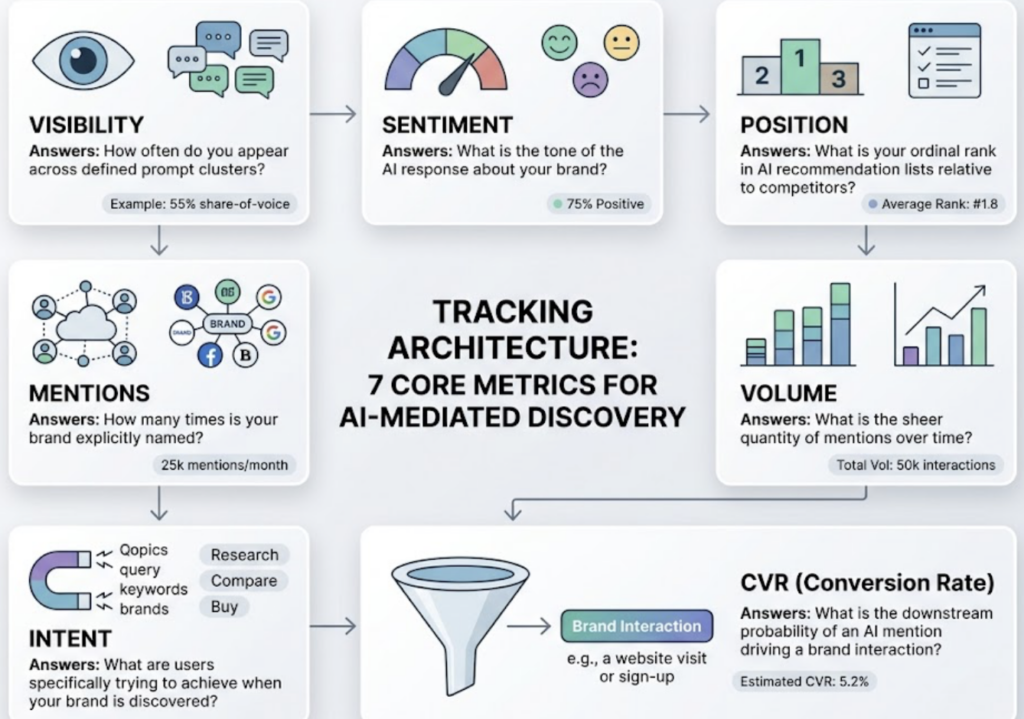
The tracking architecture runs on seven core metrics: Visibility, Sentiment, Position, Volume, Mentions, Intent, and CVR. Each one answers a different question your brand should be asking. Visibility shows how often you appear across defined prompt clusters. Position tracks your ordinal rank within AI recommendation lists relative to competitors. CVR estimates the downstream probability of an AI mention driving a brand interaction.
Source Analysis is where Topify separates from the pack. It reverse-engineers the specific domains and URLs that AI platforms are citing in your category. In practice, this means you can identify exactly which third-party publications, review platforms, or directories are shaping your AI presence — and which ones your competitors are dominating that you haven’t touched.
The Competitor Monitoring layer automates detection of rival citation strategies. You don’t have to guess why a competitor is getting cited instead of you. The data surfaces it directly.
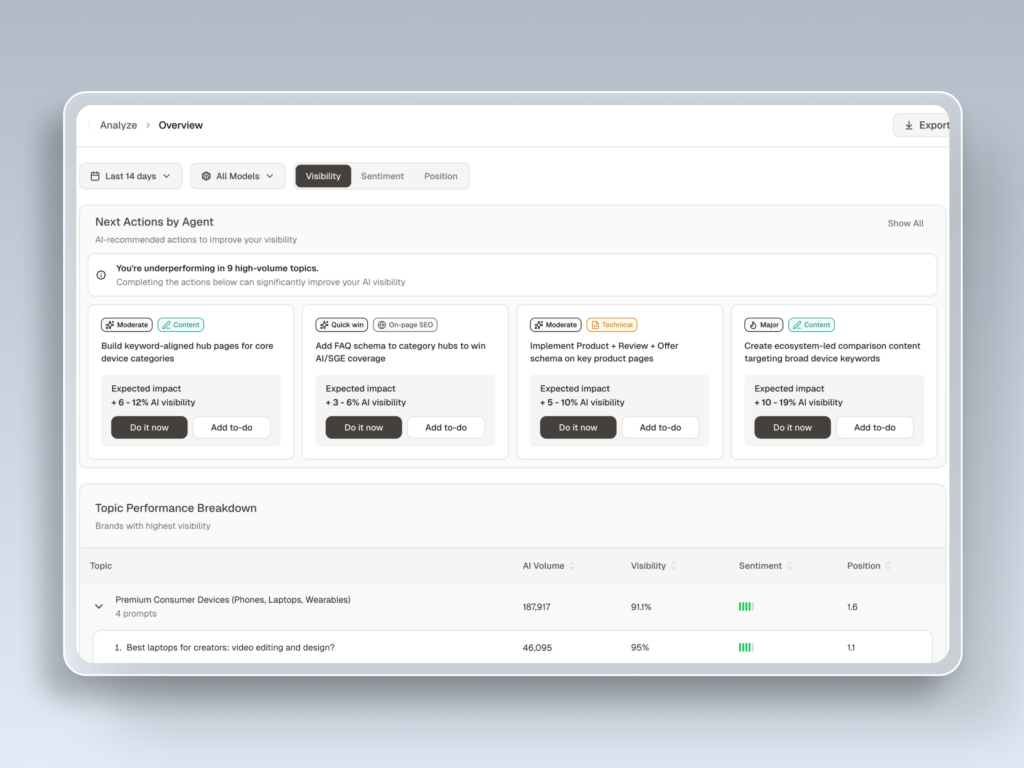
What makes the platform genuinely different is the One-Click Execution layer. Most tracking tools stop at the dashboard. Topify takes the visibility gap data and translates it into deployable GEO actions — structured content, FAQ sections, Schema updates — that teams can launch without manual workflow setup.
Topify’s pricing starts at $99/month (Basic) with 100 prompts and 9,000 AI answer analyses per month, scaling to $199/month (Pro) for 250 prompts and 22,500 analyses. Enterprise plans start at $499/month with dedicated account management.
#2–#6: Other AI Search Tracking Tools Worth Knowing
Profound AI focuses on synthetic journey simulation — modeling how a decision-maker researches a buying decision across multiple AI touchpoints. It’s strong for enterprise competitive benchmarking but tends to be heavyweight for teams that need faster operational insight.
Peec AI offers clean high-level visibility stats across multiple models. It works well for rapid status checks and suits teams that want a quick read on brand presence without deep analytics. Coverage and granularity are more limited than enterprise-grade platforms.
Brandlight centers on sentiment and reputational monitoring. Its strength is tracking how AI engines describe your brand emotionally and factually. A good fit for brand management teams focused on narrative accuracy, less so for teams that need prompt-level query tracking or competitive positioning data.
Semrush AI Toolkit integrates AI Overview monitoring into the broader Semrush platform. Its main advantage is that existing Semrush users don’t need a new workflow. Coverage is heavily weighted toward Google’s ecosystem, which is a real limitation given how fragmented AI search has become.
Ahrefs Brand Radar tracks brand mentions across web and AI surfaces. It’s designed for content teams monitoring general brand buzz rather than teams building a structured AI visibility strategy. Prompt-level granularity and competitive citation analysis are not its core focus.
What to Look for in an AI Query Tracking Tool
The selection criteria matter more than the feature list. Here’s what actually separates tools worth using from tools that generate reports nobody acts on.
Prompt-level granularity. Can you define the exact queries your target audience is asking? 88.1% of AI Overview queries are informational, which means the prompts driving AI answers are highly specific. Generic brand monitoring misses most of them. Search Influence
Platform diversity. ChatGPT Search processes 250–500 million weekly queries and Perplexity around 50 million. These aren’t fringe platforms — they’re where your audience is forming opinions about your category. Your tracking tool needs to cover both, plus Gemini and the platforms growing in your vertical. Digital Applied Team
Actionability. Only 14% of marketers currently use AI citation tracking, despite 43% naming AI search optimization as a core 2026 strategy. That gap exists because most tools deliver data without direction. The better tools close the loop: visibility gap identified, content action recommended, change deployed. GoodFirms
Synthetic probing. Real tracking runs queries continuously, not in spot checks. Non-deterministic LLM responses mean any single query result is statistically unreliable. Look for platforms that run queries at scale, across un-cached browser sessions, to build a valid baseline.
Competitor citation tracking. Knowing your own visibility score is table stakes. Knowing why a competitor ranks above you in AI answers — and which sources are driving that — is where the competitive edge lives.
Conclusion
Referral traffic from ChatGPT achieves a 14.2% conversion rate, dramatically surpassing the 2.8% rate from conventional organic search. That’s not a reason to abandon traditional SEO — it’s a reason to build a parallel system that tracks what traditional tools can’t see. Sedestral
AI query tracking in 2026 isn’t optional for brands competing on information-driven queries. The tools that get you there aren’t the ones with the most impressive dashboards. They’re the ones that cover more platforms than you think you need, go deeper than mention counts, and connect visibility data to executable strategy.
For most teams, Topify offers the most complete path from measurement to action. Get started here to see where your brand stands across AI platforms today.
FAQ
Q: What is AI query tracking? A: AI query tracking is the process of using synthetic probing to measure how AI engines — ChatGPT, Perplexity, Gemini, and others — respond to high-intent user prompts relevant to your brand, products, or category. It goes beyond basic mention counting to track citation quality, position, sentiment, and source attribution at the prompt level.
Q: How is AI query tracking different from traditional SEO monitoring? A: Traditional SEO tracks your position on a static ranked list of links. AI query tracking monitors the probability of being cited by an LLM inside a synthesized answer — a fundamentally different visibility surface that standard tools like Google Search Console don’t measure.
Q: Which AI platforms should I track my brand on in 2026? A: At minimum, ChatGPT (general consensus authority), Perplexity (source-heavy real-time discovery), and Gemini (Google-integrated search). Given that citation volumes can vary dramatically between platforms, multi-platform tracking is the baseline standard, not an advanced feature.
Q: What’s the best AI search tracking tool for small teams? A: Look for platforms that offer prompt-level synthetic probing on entry-level plans. Topify’s Basic plan ($99/month) covers 100 prompts and 9,000 AI answer analyses per month — enough to build a statistically reliable visibility baseline without an enterprise budget.

