

Your brand ranks well on Google. Your content is solid. Then a buyer opens ChatGPT, types “best [your category],” and gets five names back. Yours isn’t one of them, and nothing in your current stack told you that was happening. The instinct is to go shopping for software. That’s where it gets messy: every tool on the page promises to track AI mentions, half of them watch only one chatbot, and the rest bury you in charts that never explain what changed. The hard part isn’t finding a tool. It’s telling them apart.
Most AI Mention Tracking Tools Show Rankings, Not Mentions
Here’s the thing most buyers miss. Being mentioned and being ranked are two different events, and a lot of software measures only the second one.
Traditional rank trackers report where a page sits in a list. But an AI answer doesn’t work like a list. A brand can rank #1 on Google and still go unnamed when someone asks Perplexity or ChatGPT for a recommendation.
That gap is where most AI mention tracking tools quietly fail. They report a position the moment your brand appears, but they don’t tell you how often it never appears at all.
The numbers make this concrete. A brand might show up in half of its relevant prompts, yet if a competitor is the top recommendation in 40% of those answers, the brand is losing share inside the exact conversations that drive purchase decisions. Manual spot-checking won’t catch it, because the pattern only surfaces over weeks.
A mention isn’t just your name showing up. It’s whether you’re included, how you’re framed, where you land in the order, and which sources backed the claim.
What Separates an AI Mention Tracking Platform From a Dashboard
Once you accept that mentions matter more than rank, the next question is what actually separates one tool from another. The cleanest test is whether you’re buying a dashboard or a platform.
A dashboard counts. It shows raw mention totals and charts, then leaves your team to figure out what they mean. A platform interprets. It tells you why visibility dropped and points at the fix.
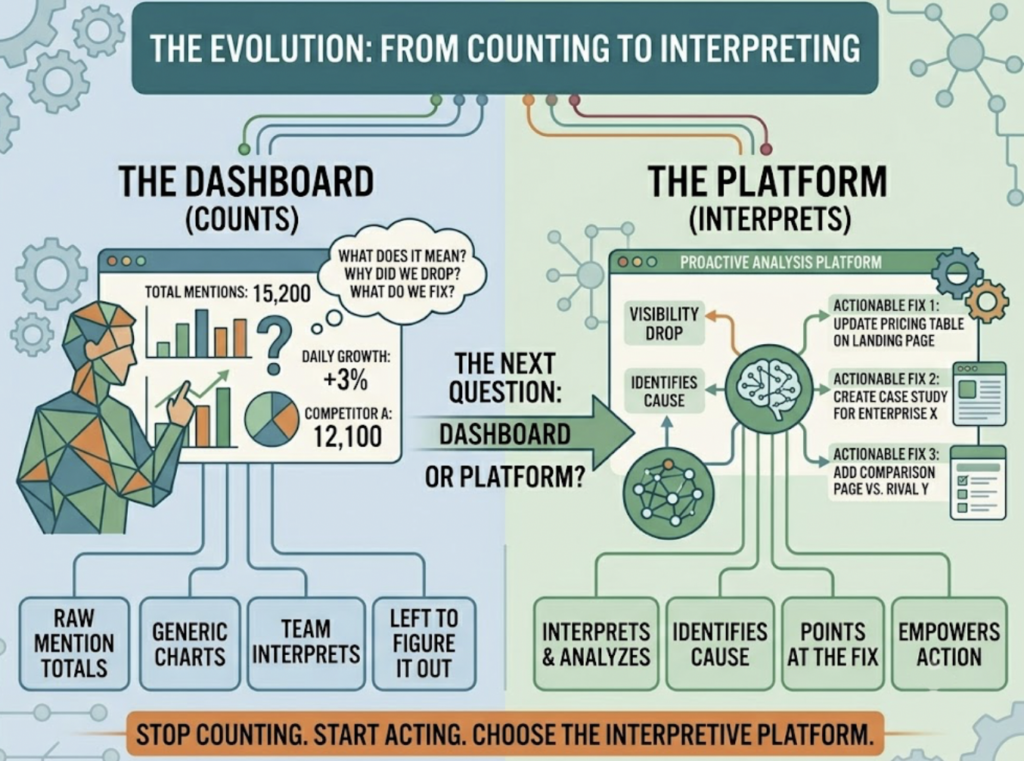
That difference compounds at scale. Static reporting is fine for a single project. A team managing several brands needs causal attribution, source mapping, and API access, not another tab full of numbers.
So when you compare an AI mention tracking platform against a basic dashboard, five capabilities tend to separate the serious tools:
- Multi-platform coverage: polling ChatGPT, Gemini, Perplexity, Claude, DeepSeek, and Google AI Overviews, since your buyers don’t all use the same engine.
- Prompt-level granularity: testing a fixed set of buyer-intent prompts like “best alternatives to X” so results stay comparable week over week.
- Reverse-engineered attribution: mapping why an AI picked a given source, which exposes the citation gap competitors are exploiting.
- Sentiment auditing: catching hallucinations or negative framing that generic sentiment tools miss.
- Competitor benchmarking: tracking who AI names ahead of you, not just whether you appear.
Plus one practical filter. If the tool stops at reporting and never connects to your content workflow, you’ll spend more time exporting data than acting on it.
AI Mention Tracking Software Compared at a Glance
Most roundups compare these tools by features, pricing, and use case. The faster way to read the market is by category: dedicated GEO suites, SEO-integrated platforms, and specialized monitors. Here’s how a few representative options line up.
| Tool | AI Engine Coverage | Mention + Sentiment | Citation Mapping | Competitor Tracking | Best For | Starting Price |
|---|---|---|---|---|---|---|
| Topify | ChatGPT, Gemini, Perplexity, DeepSeek, Doubao, Qwen, and more | Yes, 7-metric matrix | Yes, reverse-engineered | Yes, real-time | Tracking plus execution in one place | $99/mo |
| Profound | Major AI engines | Yes | Yes | Yes | Large enterprises with big budgets | Enterprise / custom |
| Semrush | Adds AEO/GEO to traditional SEO | Partial | Limited | Yes | Consolidating SEO and GEO | Subscription tiers |
| Peec AI | Niche AI engines | Sentiment-focused | Partial | Limited | Regulated industries watching hallucinations | Custom |
The table flattens a lot of nuance, so treat it as a starting filter, not a verdict. The differences that matter show up once you run your own prompts through each.
Topify: The Most Complete AI Mention Tracking Solution
For teams that want mention tracking and the means to act on it in one place, Topify tends to be the most complete AI mention tracking solution in the category. It’s built around AI search visibility rather than retrofitted onto a legacy SEO tool, which shows in how it handles the mention problem.
The core is a seven-metric matrix: visibility, sentiment, position, volume, mentions, intent, and CVR (conversion visibility rate). Most tools track one or two of these. Tracking all seven together is what turns a raw mention count into something you can act on.
Here’s how that plays out in practice. Say your ChatGPT mentions drop one week. A dashboard would show the dip and stop there. Topify lets you trace it to a specific source that stopped citing your brand, check whether a competitor took your spot, and see how sentiment shifted, all in the same view. The drop becomes a diagnosis instead of a mystery.
Three features do most of the heavy lifting.
Dynamic competitor benchmarking shows which brands AI engines recommend ahead of you and surfaces new rivals in real time, so you’re not just watching your own line on a chart.
Citation reverse-engineering analyzes the exact domains and URLs AI platforms cite. If competitors dominate G2, Reddit, or industry forums while your brand is absent, that’s the citation gap to close first.
One-click execution is the part most tools skip. You state a goal in plain English, review the proposed strategy, and deploy. The insight turns into a content or schema fix without a manual handoff.
Coverage is broad. Topify polls ChatGPT, Gemini, Perplexity, DeepSeek, Doubao, Qwen, and other engines, which matters if your audience spans more than one market.
On price, the Basic plan starts at $99/mo and includes a 30-day trial, tracking across ChatGPT, Perplexity, and AI Overviews, 100 prompts, and four projects. Pro runs $199/mo for larger prompt sets and more seats, and Enterprise starts at $499/mo with a dedicated account manager. You can get started without locking into an annual contract.
The trade-off: if all you want is a passive mention counter, this is more platform than you need. The value shows up when you actually use the execution layer.
Other AI Mention Tracking Systems Worth Knowing
Topify isn’t the only option, and the right AI mention tracking system depends on what your team already runs.
Profound sits at the enterprise end, with deep citation mapping and agent analytics aimed at large organizations managing complex brand portfolios. It’s capable, though the price reflects the audience.
Semrush and Conductor take the integration route. They add AEO and GEO metrics to established SEO suites, which appeals to teams that want one unified view instead of a separate tool. The trade-off is depth: AI mention tracking is a feature there, not the focus.
Peec AI and Lumentir are the specialists. They lean into hallucination detection and sentiment drift, which makes them a fit for regulated industries where a wrong AI claim about your brand carries real risk.
None of these is wrong. They’re built for different starting points. The question is whether you want AI mention tracking as your primary discipline or as an add-on to something you already use.
Choosing AI Mention Tracking Analytics for Your Team
The right AI mention tracking analytics for a solo founder aren’t the same as the ones an agency needs. Match the tool to your situation, not the longest feature list.
If you’re a solo founder or small team, start with coverage and simplicity. You want to know whether you show up across the major engines and where the obvious gaps are, without paying for enterprise modules you won’t touch. A free check is usually the right first move.
If you run an in-house marketing team, prioritize the platform layer: causal attribution, competitor benchmarking, and a workflow that turns insight into action. This is where mention tracking earns its keep, because you’re reporting to leadership and need to explain movement, not just show it.
If you’re an agency managing multiple clients, multi-project support, role-based access, and API integration stop being nice-to-haves. You need to run the same prompt sets across portfolios and report consistently. A single-project dashboard breaks down fast here.
One rule cuts across all three. Test before you commit. Run your own industry-critical prompts through a trial and see whether the output changes what your team would actually do next week.
Conclusion
The move from tracking rankings to tracking mentions is the real shift of 2026, and it’s why a Google-first stack leaves you blind to half the picture. The brands that pull ahead treat AI visibility as an operational discipline, not a vanity metric: baseline your prompts, find the citation gaps, fix the content, and watch for sentiment drift on a regular cadence.
Start small. Run one set of buyer-intent prompts through a tool that covers more than one engine, and see where your brand actually stands. The first honest baseline is usually the thing that changes how a team works.
FAQ
Q: What tools can help optimize brand visibility in AI search engines?
A: Look for AI mention tracking software that polls multiple engines (ChatGPT, Gemini, Perplexity, Claude, DeepSeek), tracks not just whether you appear but how often and in what context, and maps the sources AI cites so you can close citation gaps. Platforms like Topify combine these into one view, while SEO-integrated suites add lighter GEO metrics to tools you already run.
Q: What’s the difference between AI mention tracking and AI rank tracking?
A: Rank tracking tells you where a page sits in a search results list. Mention tracking tells you whether your brand is named at all inside an AI-generated answer, how it’s framed, and which sources support it. A brand can rank #1 on Google and never get mentioned by ChatGPT, which is exactly the gap mention tracking exists to close.
Q: Can I track brand mentions across ChatGPT, Perplexity, and Gemini at once?
A: Yes. Most dedicated platforms poll several engines on a schedule and consolidate the results. Coverage varies, so confirm the specific engines a tool supports before buying, especially if your audience uses regional models like DeepSeek, Doubao, or Qwen.
Q: Are there free AI mention tracking tools?
A: Some platforms offer free checks or trials that let you baseline your visibility before paying. A free GEO or visibility check is a low-risk way to see whether your brand shows up across AI engines and where the gaps are, then decide if you need the full analytics layer.

