

Your monthly report has SEO rankings, traffic, and conversions. Then your CMO asks how the brand is doing in ChatGPT, and the honest answer is you don’t know how to put a number on it. Most teams start by typing their own brand name into an AI engine and reading what comes back. That feels like research, but it isn’t measurement. One query, on one platform, on one day tells you almost nothing, because AI answers shift with context, model version, and phrasing. To know where you actually stand, you need a repeatable way to measure brand visibility in an AI search tracker, not a one-off gut check.
Why Google Metrics Can’t Tell You How Visible Your Brand Is in AI Search
Domain Authority and keyword position were built for a world where the same query returned the same list of blue links. AI search doesn’t work that way.
The shift from link-based ranking toward entity authority and citation trust means a brand can hold the #1 organic spot and still be missing from the synthesized answer an AI engine hands the user. That’s the ranking-mention separation, and it’s the single biggest blind spot in most reporting today.
Three things break the old metrics:
First, results are probabilistic, not deterministic. The same prompt produces different phrasing and different brand mentions depending on model version and surrounding context, so a static rank number can’t describe it.
Second, the click is disappearing. AI engines answer inside the interface, which makes click-through rate secondary to whether the model recommends you as a source in the first place.
Third, the trust signals changed. AI systems favor content that’s structured and machine-readable, like clear entity definitions and FAQ schema, over keyword-dense pages written for crawlers.
The takeaway is simple. You can’t manage AI visibility with metrics that were never designed to see it.
What an AI Search Tracker Actually Measures
Measuring presence in AI search means quantifying influence, not just whether your name showed up. A useful tracker converts vague “are we visible?” questions into specific, comparable numbers.
The clearest way to think about it is the four-pillar framework that’s become the working standard for AI search measurement.
| Metric | What it measures | Why it matters |
|---|---|---|
| Mention Rate | % of buyer-relevant prompts where your brand is named | The floor of AI presence. No mention means no consideration. |
| Citation Rate | % of answers linking directly to your domain | The modern backlink. Citations drive trust and referral traffic. |
| Share of Voice | Your prominence versus competitors in AI answers | Benchmarks your spot on the AI-generated shortlist. |
| Sentiment | The tone of how the AI describes you | A negative mention can hurt more than no mention at all. |
Mention, Position, and Sentiment Are Three Different Questions
Teams often collapse these into one number, and that’s where measurement goes wrong. “Did the AI mention us” is a yes/no floor. “Where did we land relative to rivals” is position and share of voice. “What did it say about us” is sentiment.
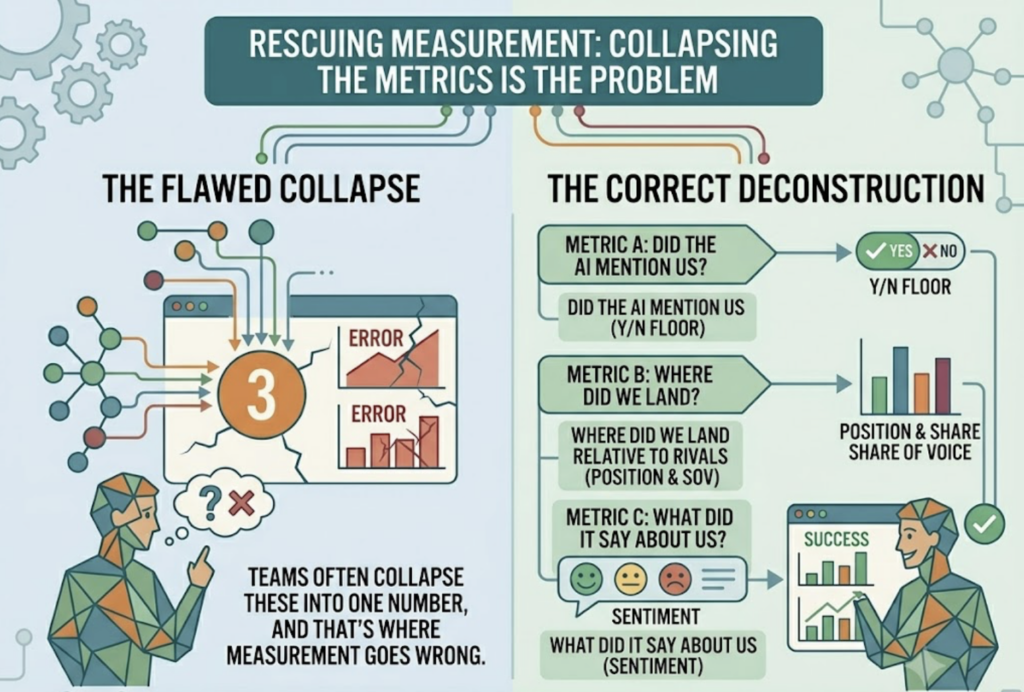
A platform like Topify breaks this out across seven tracked signals, including visibility, mentions, position, sentiment, volume, intent, and a conversion-oriented metric, so you’re not stuck inferring brand health from a single count. The point isn’t more dials. It’s separating the questions that actually drive different decisions.
How to Measure Brand Visibility in an AI Search Tracker, Step by Step
A repeatable measurement workflow has four moves. Skip any one and your numbers get noisy fast.
Step 1: Build a golden prompt set. Stop tracking generic keywords. Assemble a library of 100-plus high-intent buyer queries that mirror how people actually ask, like “best enterprise CRM for small teams” or “compare Product A vs Product B.” This prompt set is your measurement instrument, so it has to reflect real demand, not vanity terms.
Step 2: Sample each platform separately. ChatGPT, Perplexity, and Gemini retrieve and synthesize differently, so mention rates diverge across them. Track each engine on its own to find the gaps, because an aggregate score hides which platform is ignoring you.
Step 3: Set a baseline, then watch the trend. AI visibility is volatile, and a single snapshot is statistically meaningless. Treat visibility as a probability distribution over time, with weekly or monthly monitoring to absorb model updates instead of overreacting to one bad day.
Step 4: Map the sources. When the AI names a competitor, dig into why. Often it’s pulling from a third-party review site or a community thread rather than an official page, which tells you whether to fix your own content or earn presence on outside authoritative platforms.
This is where source-level tracking earns its keep. Topify’s visibility tracking ties each mention back to the specific domains AI engines cite, so a drop in ChatGPT mentions can be traced to a source that stopped referencing you, inside the same view you used to spot the drop.
Common Mistakes That Make Your Visibility Numbers Lie
Most teams don’t measure too little. They measure the wrong things, then trust the output.
The most common error is the scaling trap: brute-forcing thousands of generic prompts because volume feels rigorous. Generic prompts don’t match buyer behavior, so you end up with a precise number that describes nothing. Fewer, high-intent, context-aware queries beat a giant pile of junk every time.
Three more pitfalls show up constantly:
Ignoring entity signals. If you don’t give AI systems machine-readable metadata like Organization, Product, and FAQ schema, they read your structure as thin, no matter how good the copy is.
Treating GEO as a separate silo. Generative Engine Optimization isn’t divorced from SEO. It’s built on the same foundation of E-E-A-T, crawlability, and technical health, so siloed teams duplicate work and miss shared wins.
Managing the dashboard instead of the business. Counting raw citations without asking whether they drive assisted conversions or qualified leads turns measurement into a vanity exercise.
Good measurement always loops back to one question: does this number change what we do next?
How to Choose the Best AI Search Tracker for Your Brand
Once you know what to measure, picking a tool gets easier. The best AI search tracker for your brand is the one that turns observation into action, not the one with the busiest dashboard.
Four criteria separate a real tracker from a glorified counter:
| Criteria | What to look for | Why it matters |
|---|---|---|
| Actionable insights | Specific content fixes, not just charts | A number you can’t act on is trivia |
| Attribution mapping | The exact source the AI used for a mention | Tells you what to optimize or where to earn presence |
| Competitive benchmarking | Side-by-side share of voice versus rivals | Visibility is relative, not absolute |
| Platform coverage | Multi-engine tracking as standard | Single-engine monitoring is a partial map |
On coverage, single-engine tools are the most common shortcut, and the most misleading. Topify tracks across ChatGPT, Gemini, Perplexity, and other major engines including DeepSeek, Doubao, and Qwen, which matters if your audience isn’t all on one platform.
On action, this is the gap most dashboards never close. Beyond reporting the seven metrics, Topify’s competitor benchmarking shows which brands the AI recommends and where you sit in that order, while its citation analysis surfaces the exact domains and URLs feeding those answers. That combination points you at a fix instead of leaving you with a score.
Pricing is usually the last question, and it’s a fair one. Topify’s entry plan starts at $99 a month and covers ChatGPT, Perplexity, and AI Overviews tracking with 100 prompts, which is enough to run a real golden prompt set rather than a token sample. You can get started without committing to an enterprise contract first.
Other tools in this category each have their place, and the right pick depends on whether you need depth on one engine or breadth across many. The non-negotiables stay the same: multi-platform coverage, source attribution, and insights you can actually use.
Conclusion
The report gap your CMO pointed at won’t close with a one-off search. It closes when you treat AI visibility like any other measurable channel: a defined prompt set, per-platform sampling, a baseline you track over time, and source mapping that tells you what to fix. Pick a tracker that scores you across engines and then tells you why, and your next quarterly review has a real answer instead of a shrug. Start with a focused prompt set this month, baseline it, and measure the trend from there.
FAQ
What is measuring brand visibility in an AI search tracker?
It’s the practice of quantifying how often, how prominently, and how favorably AI engines like ChatGPT and Perplexity name your brand across a set of buyer-intent prompts. Instead of keyword rankings, you track mention rate, citation rate, share of voice, and sentiment over time.
How can I improve my brand’s visibility in AI search?
Strengthen entity signals with machine-readable schema, earn citations on the third-party sources AI engines actually pull from, and keep your content structured and authoritative. Then re-measure, because improvement only counts if your mention and citation rates move on a tracked trend.
What are common mistakes when measuring AI search visibility?
The big ones are tracking thousands of generic prompts instead of high-intent queries, measuring a single platform, relying on one snapshot instead of a trend, and counting citations without tying them to business outcomes.
How much does an AI search tracker cost?
It varies by platform coverage and prompt volume. Topify’s entry plan starts at $99 a month with multi-engine tracking and 100 prompts, while enterprise tiers scale up prompt counts, seats, and projects for larger teams.

