

Your team spent six months building SEO authority. Domain authority is up, keyword rankings are solid, and organic traffic looks healthy. Then someone on the leadership team asks ChatGPT for a product recommendation in your category, and your brand doesn’t appear anywhere in the response. Five competitors do. Your Google Analytics dashboard has no metric that explains why, because it was never designed to measure what AI chooses to say.
That gap between what traditional SEO tracks and what actually drives AI recommendations is widening every quarter. And for brands that don’t close it, the cost isn’t hypothetical. It’s measurable in lost pipeline, missed conversions, and a shrinking share of the fastest-growing discovery channel in digital marketing.
What AI Mention Tracking Analytics Actually Measures
AI mention tracking analytics is the practice of systematically monitoring how often, where, and in what context a brand appears in AI-generated answers. It’s not the same as traditional brand monitoring, which tracks mentions on social media, news sites, and forums. Instead, it focuses on a fundamentally different layer: the synthesized responses produced by large language models like ChatGPT, Perplexity, Gemini, and DeepSeek.
The distinction matters. Traditional monitoring tells you what people say about your brand. AI mention tracking tells you what machines say about your brand, and machines are increasingly the ones shaping purchase decisions.
Here’s the scale: ChatGPT alone reached 800 million weekly active users by October 2025 and now processes over one billion queries per day. It accounts for roughly 77% of all AI-driven referral traffic to websites. Perplexity, with its citation-heavy answer format, drives another 15%. When a user asks one of these platforms “what’s the best project management tool for remote teams,” the answer isn’t a list of ten blue links. It’s a curated recommendation of two or three products, often with a brief explanation of why each one fits.
If your brand isn’t in that answer, you’re not in the consideration set. AI mention tracking analytics exists to make sure you know where you stand.
Why Your SEO Dashboard Can’t Track AI Mentions
Google’s search market share dipped to 89.74% by March 2025. That’s the first time it dropped below 90% in nearly a decade. Meanwhile, AI-powered search tools captured between 12% and 15% of the global search market by year-end 2025, up from roughly 5% at the start of that year. Gartner’s 2024 prediction that traditional search volume would fall 25% by 2026 is tracking on schedule.
But the more disruptive number is zero-click behavior. In the US, 58.5% of searches now end without a single click to an external website. When Google’s own AI Overviews appear, that rate jumps to 83%. The user gets the answer inside the search interface itself.
This breaks the fundamental assumption of traditional SEO: that ranking high on a results page translates to traffic, which translates to conversions. In a zero-click environment, the AI’s synthesized answer is the final destination. If your brand isn’t named in that synthesis, your PageRank is irrelevant.
That’s the gap most brands still can’t see.
Traditional SEO tools measure keyword rankings, backlink profiles, and domain authority. None of these metrics tell you whether Perplexity is recommending your competitor instead of you, or whether ChatGPT describes your product as “budget-friendly” when your positioning is premium. AI mention tracking analytics fills that blind spot by directly querying AI platforms and analyzing the responses for brand presence, sentiment, and citation sources.
The 5 Metrics That Define AI Mention Tracking Analytics
Measuring AI mentions isn’t just about counting how many times your brand name appears. The context, position, sentiment, and source attribution of each mention determine its actual business impact. Here are the five metrics that matter most.
1. Visibility Score
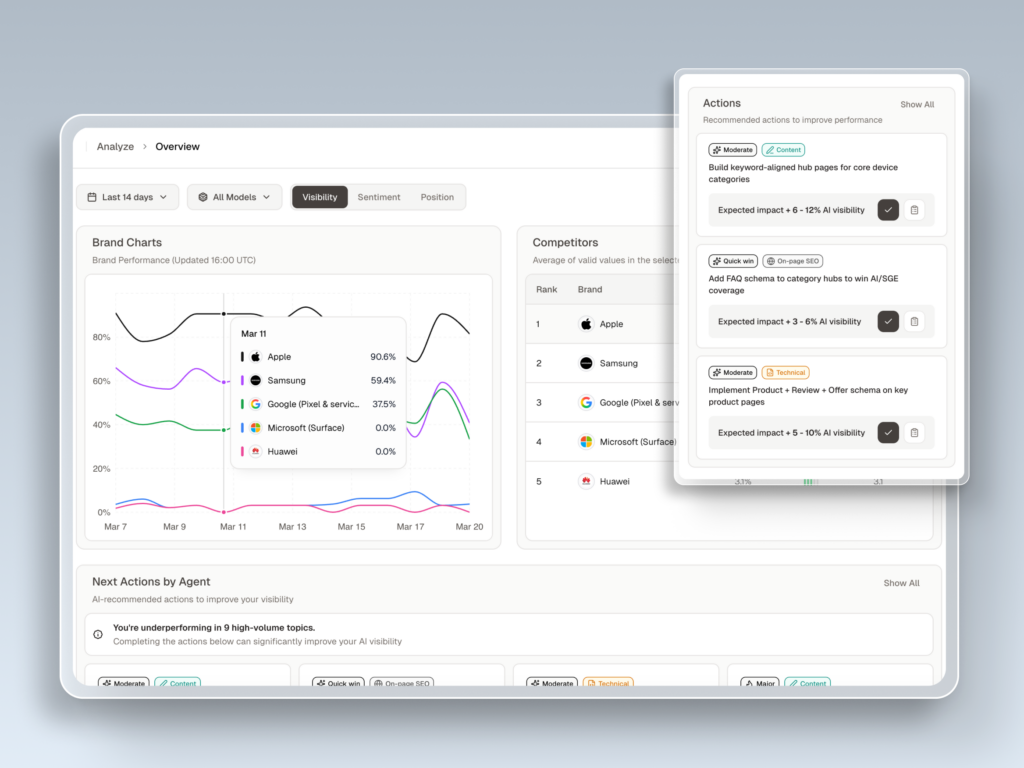
This is the percentage of target prompts where your brand appears in the AI-generated response. If you’re tracking 100 high-value prompts across ChatGPT, Gemini, and Perplexity, and your brand shows up in 34 of those responses, your visibility score is 34%. It’s the top-of-funnel metric for AI discovery.
2. Sentiment Score
Not all mentions are equal. An AI response that describes your product as “the industry standard for enterprise teams” is fundamentally different from one that calls it “a decent option for small budgets.” Sentiment scoring evaluates whether AI platforms frame your brand positively, neutrally, or negatively, using a 0-to-100 scale rather than simple positive/negative buckets.
3. Position Rank
Research shows that the first brand mentioned in an AI recommendation list earns significantly more trust and click-through than the third or fourth. If ChatGPT lists five CRM tools and your competitor is consistently #1 while you’re #4, that ordering gap translates directly into lost conversions. Position tracking monitors where your brand falls in the recommendation hierarchy.
4. Citation Source Analysis
AI models don’t form opinions in a vacuum. They pull from specific web sources to construct their answers. Citation source analysis identifies which domains and URLs the AI is referencing when it mentions (or doesn’t mention) your brand. This is where strategy meets execution: if you discover that Perplexity cites a competitor’s blog post in 40% of relevant answers, you know exactly what content gap to close.
5. Conversion Visibility Rate
This advanced metric ties AI visibility directly to revenue impact. Platforms like Topify calculate CVR by estimating the conversion probability of a specific mention context. The underlying economics are compelling: AI search traffic converts at an average rate of 14.2%, compared to 2.8% for traditional organic search. That’s a 5.1x advantage. The average value of an AI-referred visit is $47, versus $9 from Google. For SaaS companies specifically, the conversion multiplier reaches 8.5x.
Those numbers explain why AI mention tracking analytics isn’t a nice-to-have. It’s where the highest-converting traffic in digital marketing is being allocated.
How the Best GEO Agencies Build an AI Mention Tracking Strategy
A top GEO agency doesn’t start with tools. It starts with a framework. Here’s the four-step process that separates effective AI mention tracking from random spot-checking.
Step 1: Define your prompt universe. Identify 50 to 200 prompts that your target audience is likely to type into ChatGPT, Perplexity, or Gemini. These aren’t traditional keywords. They’re full-sentence queries like “what’s the best invoicing software for freelancers in Europe” or “compare Notion vs Coda for product teams.” The best GEO agencies use tools like Topify’s High-Value Prompt Discovery to surface prompts with real AI search volume, not guesses.
Step 2: Establish your baseline. Run those prompts across multiple AI platforms and record your brand’s visibility score, sentiment, position, and citation sources. This baseline is your “before” snapshot. Without it, you can’t measure improvement.
Step 3: Monitor continuously, not once. AI recommendations shift. A brand that was #1 in ChatGPT’s answer last month might drop to #3 this month because a competitor published a well-cited research report. Continuous monitoring flags these changes in near-real-time so you can respond before the damage compounds.
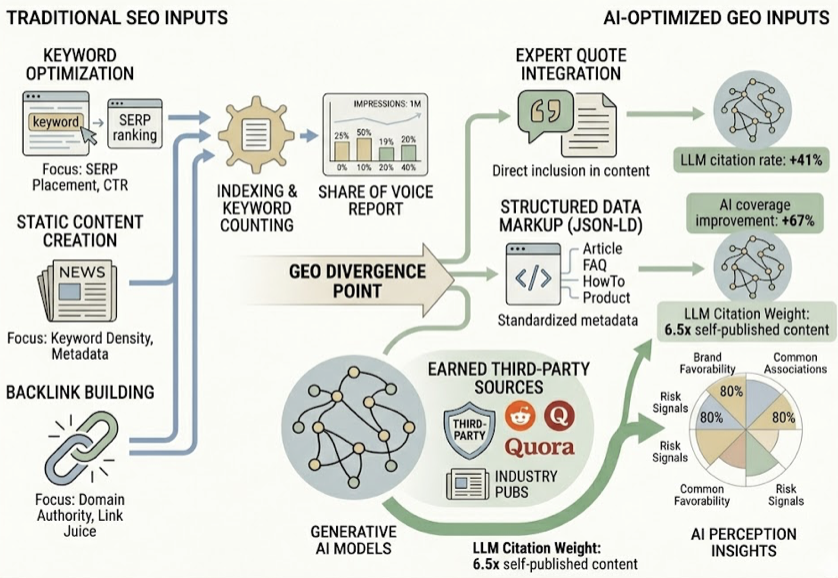
Step 4: Optimize the inputs. This is where GEO strategy diverges from traditional SEO. The most effective technique for improving AI visibility is including expert quotes in your content, which can increase AI citation rates by up to 41%. Structured data markup (JSON-LD for Article, FAQ, HowTo, Product schemas) drives a 67% improvement in AI coverage. And here’s a critical insight: citations from independent third-party sources carry roughly 6.5x more weight with LLMs than self-published brand content. That means your GEO strategy needs to extend beyond your own website into earned media, Reddit, Quora, and industry publications.
A top geo agency understands that AI mention tracking analytics isn’t a one-time audit. It’s an ongoing operational discipline, like financial reporting or competitive intelligence.
5 Mistakes That Tank Your AI Mention Tracking Results
Most brands that attempt AI mention tracking make at least one of these errors. Each one silently degrades the accuracy and usefulness of the data.
Tracking only one AI platform. ChatGPT, Perplexity, and Gemini use different retrieval architectures, different training data, and different citation patterns. A brand that’s visible on ChatGPT might be completely absent from Perplexity. Monitoring a single platform gives you a false sense of security.
Counting mentions without reading sentiment. Being mentioned in an AI response where the model describes your product as “outdated” or “limited in functionality” is worse than not being mentioned at all. Volume without sentiment context is a vanity metric.
Ignoring citation sources. If you don’t know which web pages the AI is pulling from when it recommends your competitor, you can’t reverse-engineer the strategy to overtake them. Citation source analysis is the actionable layer that transforms tracking into optimization.
Relying on manual spot-checks. Typing your brand name into ChatGPT once a week and reading the response is not a tracking strategy. AI answers change based on model updates, retrieval augmentation shifts, and new content indexing. Manual checks miss 90%+ of the variation.
Flooding the web with AI-generated filler content. Some brands try to game AI citation by mass-producing low-quality articles. Both search engines and AI models are increasingly penalizing this approach. The over-automation penalty is real, and it can push your brand further down the recommendation hierarchy instead of up.
AI Mention Tracking Analytics Tools: What to Use in 2026
The market for AI visibility platforms has expanded rapidly. Here’s how the major players compare across pricing, coverage, and core strengths.
| Platform | Starting Price | AI Models Covered | Best For |
|---|---|---|---|
| Topify | $99/mo | ChatGPT, Gemini, Perplexity, DeepSeek, Qwen | Cross-border SaaS, agencies managing multiple clients |
| Profound | $99/mo | 10+ engines incl. Claude, Grok | Enterprise legal/finance with compliance needs |
| ZipTie.dev | $69/mo | ChatGPT, Perplexity, Google AIO | Accuracy-focused SEO teams (UI scraping approach) |
| SE Ranking | $119/mo | AIO, Gemini, ChatGPT | SMBs needing integrated SEO/GEO workflow |
| Cockpyt AI | €59/mo | ChatGPT, Perplexity, AIO | French freelancers and VSEs |
| Qwairy | €59/mo | 10 AI engines | French marketing teams needing broad coverage |
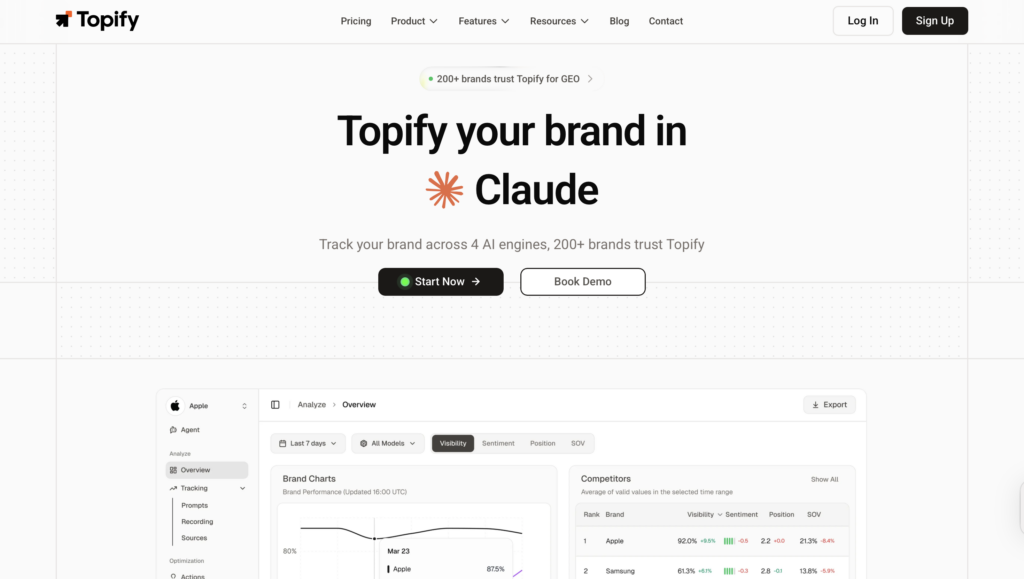
For teams tracking brand visibility across multiple AI platforms and geographies, Topify stands out for three reasons. First, its seven-dimension metric system (visibility, sentiment, position, volume, mentions, intent, and CVR) covers the full spectrum of AI mention tracking analytics in a single dashboard. Second, it’s one of the few platforms with Mandarin LLM coverage (Qwen, DeepSeek, Doubao), which matters for any brand with Asia-Pacific exposure. Third, its one-click agent execution turns insight into action: define your optimization goal, review the proposed strategy, and deploy it without manual workflows.
Pricing starts at $99/month for the Basic plan (100 prompts, 9,000 AI answer analyses, 4 projects). The Pro plan at $199/month scales to 250 prompts and 22,500 analyses. Enterprise plans start at $499/month with a dedicated account manager. Full details are on the Topify pricing page.
A Note on the French GEO Agency Landscape
The French market has developed its own specialized ecosystem for AI visibility. Domestic tools like Cockpyt AI, Qwairy, and Botrank.ai address regional needs, with Botrank.ai introducing “Bob,” an autonomous AI agent that structures action plans from visibility data.
One insight specific to France: LinkedIn is the most cited domain across AI platforms for professional and tech queries, appearing in 11% of all analyzed AI answers. For any French geo agency or brand targeting the French market, LinkedIn content optimization is a disproportionately high-value GEO lever.
Another regional finding: French websites that implement comprehensive JSON-LD schema see a 67% improvement in AI coverage. And because AI systems are heavily influenced by English-language training data, translating French content into English can boost citation rates even within French-language queries.
Your AI Mention Tracking Checklist
Before you invest in any platform, make sure you’ve covered these fundamentals:
- Define 50+ target prompts that match how your audience queries AI platforms (full sentences, not two-word keywords)
- Select at least 3 AI platforms to monitor (ChatGPT + Perplexity + one more relevant to your market)
- Identify 3 to 5 direct competitors for benchmarking against your visibility and position data
- Establish a baseline across all five core metrics: visibility, sentiment, position, citation sources, and CVR
- Set a monitoring cadence: weekly for fast-moving categories, bi-weekly minimum for stable markets
- Assign ownership: someone on your team needs to own the AI visibility number the way someone owns organic traffic
- Connect tracking to action: every drop in visibility or sentiment shift should trigger a specific content or PR response
Conclusion
The brands that treated SEO as a growth channel ten years ago are the ones dominating organic traffic today. AI mention tracking analytics is the same inflection point, just earlier in the curve.
AI search traffic already converts at 5.1x the rate of traditional organic. The average AI-referred visit is worth $47. And with zero-click behavior hitting 83% when AI Overviews are present, the window for brands to establish their position in AI recommendations is narrowing fast. Start with 10 high-value prompts, measure your baseline across ChatGPT and Perplexity, and build from there. The compounding advantage goes to whoever moves first. You can get started with Topify to set up your tracking in minutes.
FAQ
Q: What is AI mention tracking analytics?
A: AI mention tracking analytics is the process of monitoring and measuring how a brand appears in AI-generated responses across platforms like ChatGPT, Perplexity, and Gemini. It tracks metrics including visibility score, sentiment, position rank, citation sources, and conversion visibility rate to quantify a brand’s presence in the AI discovery layer.
Q: How does AI mention tracking analytics work?
A: AI mention tracking tools query AI platforms with a defined set of prompts relevant to your brand and industry. They then analyze the responses to determine whether your brand is mentioned, how it’s described, where it ranks relative to competitors, and which web sources the AI cited. This data is collected continuously and displayed in dashboards for ongoing monitoring.
Q: How can I improve my AI mention tracking analytics results?
A: Focus on three high-impact areas. First, include expert quotes in your content, which can increase AI visibility by up to 41%. Second, implement structured data markup (JSON-LD) across your site for a potential 67% improvement in AI coverage. Third, build citations from authoritative third-party sources like industry publications and community platforms, which carry 6.5x more weight with LLMs than self-published content.
Q: How much does AI mention tracking analytics cost?
A: Pricing varies by platform and scale. Entry-level tools start around $59 to $69 per month. Mid-tier platforms like Topify start at $99/month for 100 prompts and 9,000 AI answer analyses. Enterprise plans with dedicated account management typically start at $499/month and up. The right investment depends on how many prompts, platforms, and competitors you need to track.

