

Your team checked once. Someone on the marketing side typed your category into ChatGPT, asked for the best options, and scanned the answer for your brand. Maybe it showed up. Maybe it didn’t. Either way, you closed the tab thinking you had your answer.
You didn’t. One query on one day tells you almost nothing, because AI answers shift by the week, vary with how a question is phrased, and rank brands in an order you never saw. Counting whether your name appeared is the easy part. The harder questions are how often, in what light, and next to whom.
That gap is exactly what a real AI mention tracking tool exists to close.
What an AI Mention Tracking Tool Should Capture Beyond a Raw Count
An AI mention tracking tool is an analytics system that monitors how large language models and answer engines like ChatGPT, Perplexity, Gemini, and Claude reference, describe, and rank your brand when people ask buyer-intent questions.
The word “mention” is misleading, though. It suggests a yes-or-no event: were you named, or not? In practice, a single appearance carries four layers of meaning, and a tool that only reports the first one is barely tracking anything at all.
The four dimensions worth separating:
- Presence. Does your brand appear in the narrative the AI generates, or is it absent from the recommendation entirely?
- Context and sentiment. When you do appear, is the model describing you positively, neutrally, or in a way that undercuts your positioning?
- Relative position. Are you the first option named, or buried at the bottom of a list of seven?
- Citation source. Which specific URLs or third-party entities does the AI lean on to justify mentioning you?
A raw count flattens all four into a single number. That’s how brands end up celebrating a “rising mention rate” while the model quietly describes them as a budget alternative and lists two competitors first.
Presence is the floor. Everything that actually moves a buying decision sits in the other three layers.
How AI Mention Tracking Software Works Under the Hood
People often assume this kind of AI mention tracking software scrapes search results the way an SEO crawler does. It doesn’t, because there’s no stable page to scrape. AI answers are generated fresh, and they fluctuate.
So a credible AI mention tracking system works by sampling, not scraping. The process generally runs in four stages.
First, it builds a prompt library. This is a “golden set” of buyer-intent questions tied to your category, the kind of things a real prospect would actually ask an assistant before choosing a vendor.
Second, it runs cross-platform simulation. The software feeds those prompts to multiple AI engines on a schedule, rather than relying on a single manual check.
Third, it parses and normalizes entities. Using NLP, the system pulls brand mentions out of unstructured AI text and standardizes them so trends are comparable over time.
Fourth, it detects drift. Because models update frequently and outputs wobble, the tool repeats samples and calculates a confidence score for your visibility, filtering out one-off flukes.
That last step is the one manual checks can never replicate. A human asking ChatGPT once captures a snapshot. A tracking system asking the same set of prompts repeatedly captures a pattern, and the pattern is the only thing you can act on.
The Metrics a Useful AI Mention Tracking Dashboard Puts First
A dashboard full of numbers isn’t the same as insight. The question is whether the AI mention tracking dashboard surfaces metrics that map to decisions, or just decorates the screen with charts.
Five metrics carry most of the weight. Here’s what each one actually answers.
| Metric | What it answers |
|---|---|
| Mention Rate | What share of buyer-intent queries include your brand at all? |
| Share of Voice | How do you stack up against competitors named in the same AI answer? |
| Sentiment Score | How does the model frame your brand based on its sources and training data? |
| Positioning | Where do you land in the AI’s consideration set, first pick or afterthought? |
| Citation Attribution | Which pages, yours or third-party, are being treated as the source of truth? |
Read down that list and a useful split emerges. Mention rate and share of voice tell you whether you’re winning. Sentiment, positioning, and citation attribution tell you why.
Most teams obsess over the first two and ignore the last three. That’s backward. Strong AI mention tracking analytics treat citation attribution as a roadmap, because the sources fueling your competitor’s mentions are usually the same sources you can earn.
If your dashboard can’t tell you which third-party pages the model trusts, it’s measuring the symptom and skipping the cause.
Five Mistakes That Turn Mention Data Into Noise
Brands tend to stumble here because they run AI monitoring like a traditional search project. The mechanics are different, and the same instincts that worked for keyword ranking quietly sabotage mention tracking.
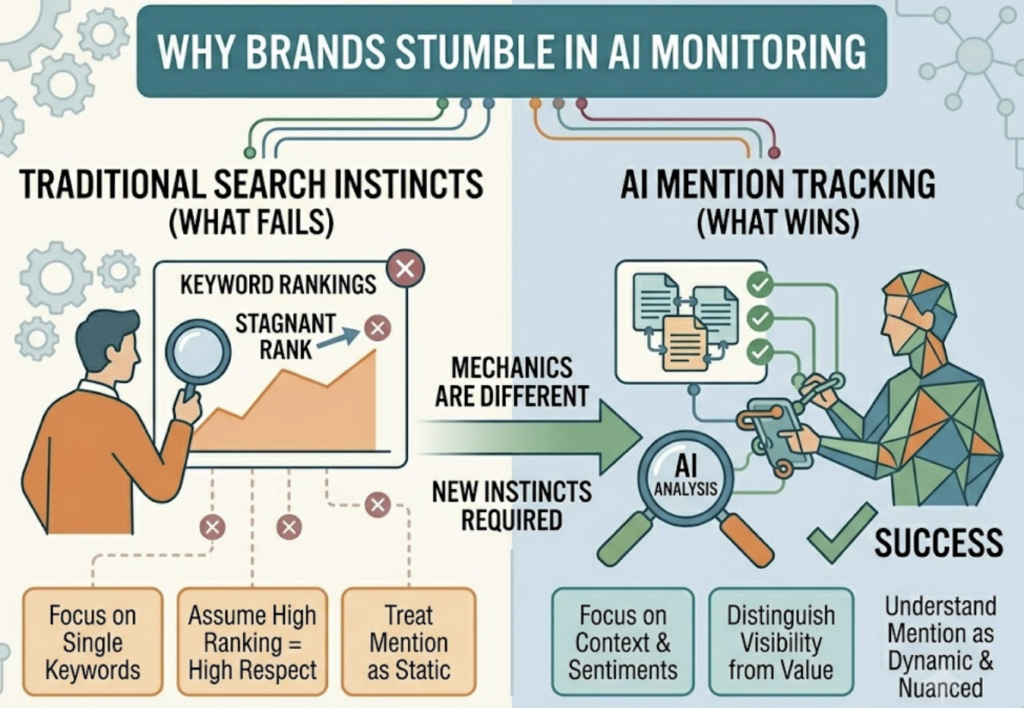
Single-engine blindness. Watching only Google AI Overviews while ignoring the volume flowing through ChatGPT and Perplexity. You optimize for one room and miss the building.
Chasing mentions over context. Getting your name dropped is hollow if the model ties it to the wrong use case or cites low-authority sources. A mention in a bad frame can hurt more than no mention.
Ignoring competitor baselines. Visibility is relative. If your mention rate holds steady while a rival’s climbs across the same prompt set, your real influence is shrinking even though your own chart looks flat.
Static monitoring. Treating a single check as the whole story. Models change daily, and yesterday’s snapshot is already stale.
Sampling too thin. Running five prompts and calling it data. Without enough volume, you can’t separate a genuine shift from random noise in the model’s output.
None of these are exotic. They’re the default behaviors of a smart team applying old habits to a new surface.
How to Choose an AI Mention Tracking Platform Worth Paying For
Once you’re past the basics, picking an AI mention tracking platform comes down to one filter: does it hand you actionable intelligence, or just a prettier pile of noise?
Run any contender through this checklist before you commit budget.
- Platform coverage. Does it track beyond the obvious engines, across ChatGPT, Gemini, Perplexity, and others where your buyers actually ask?
- Prompt-level granularity. Can you upload your own buyer-journey prompts, or are you stuck with the vendor’s generic set?
- Citation reverse-engineering. Does it reveal which third-party sources, think G2, Reddit, niche forums, are driving the AI’s trust in a brand?
- Competitor benchmarking. Can you see your share of voice against named rivals inside the same answer, not just your own trend line?
- An action layer. Does it connect the dashboard to a fix, like content briefs or schema guidance, so insight turns into work that ships?
That last criterion is where most tools quietly fail. Plenty of platforms will tell you that you’re invisible. Far fewer tell you what to change, and fewer still help you change it.
Pricing tends to track that capability gap. Entry-level AI mention tracking solutions start around $29 a month for thin, single-engine monitoring, while platforms built for real prompt volume and operational integration generally start near $500 a month. The spread reflects depth, not branding. The cheaper tier usually stops at presence; the higher tier reaches into context, attribution, and execution.
The right question isn’t “what’s cheapest.” It’s “what’s the cost of acting on numbers that only tell half the story.”
Where Topify Fits as an AI Mention Tracking Solution
If you want monitoring that doesn’t dead-end at a dashboard, Topify is built around that exact problem. It treats mentions not as a vanity count but as one of seven native GEO metrics, sitting alongside visibility, sentiment, position, volume, intent, and CVR.
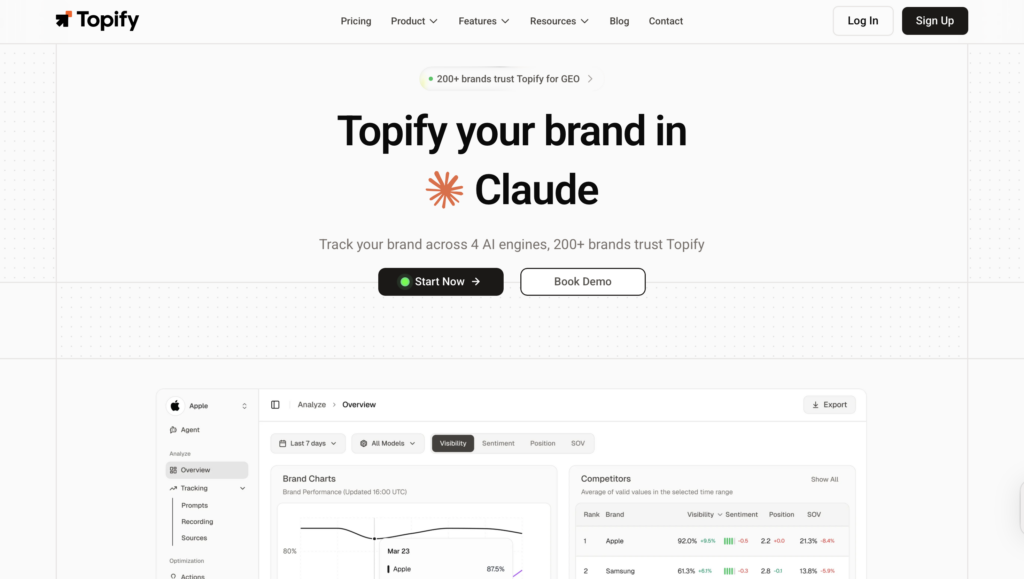
That structure matters for mention tracking specifically. You see whether you appear, in what tone, and where you rank in the consideration set, all in one view rather than stitched together from separate tools.
Coverage spans ChatGPT, Gemini, Perplexity, DeepSeek, and Google AI Overviews, which gives you a unified read on your AI market share instead of a single-engine guess.
Where it pulls ahead is the layer past measurement. Topify’s “reverse-engineer AI citations” feature shows exactly which external sources are powering your competitors’ visibility, so you can target the same pages instead of guessing at content. And its One-Click Execution links those insights to actual updates, closing the gap between knowing you’re invisible and doing something about it.
In practice the workflow is simple: load a cluster of high-value prompts, run a baseline across platforms, then watch mention rate, sentiment, and citation quality move as you act. You can get started with Topify on a single project, and the pricing scales with prompt volume rather than locking you into an enterprise bundle on day one. For a quick orientation to free GEO checks before you commit, Topify also keeps a reference of free tools you can start with.
Conclusion
A mention is a starting line, not a finish. The brands that win in AI search aren’t the ones with the highest raw count. They’re the ones who know the context around every mention, the position they hold against rivals, and the sources the model trusts.
Pick a tool that measures all of that, run it consistently, and treat the data as a to-do list rather than a scoreboard. Track it, understand why, then fix it. That’s the whole loop.
FAQ
What is an AI mention tracking tool?
It’s a platform that uses simulated, buyer-intent prompts to test how AI models respond to your brand, then reports on visibility, sentiment, competitive position, and the sources behind each mention. Rather than checking once by hand, it samples repeatedly to separate real patterns from one-off noise.
Can you give examples of what these tools track?
Beyond a simple mention count, they track how often you surface in high-intent answers, where you land in a recommended list, how the model describes you, and which third-party pages it cites to validate your presence. Those four signals together describe your actual standing.
How much does an AI mention tracking tool cost?
Pricing ranges widely. Lightweight monitoring can start around $29 a month, while platforms built for high prompt volume and operational integration generally begin near $500 a month. The difference usually comes down to platform coverage, prompt granularity, and whether the tool helps you act, not just observe.
What’s a good starting strategy?
Identify a cluster of roughly 50 high-value buyer prompts, run them through a baseline monitor across multiple engines, and spend your first 90 days improving mention rate and citation quality for those specific questions. Narrow and consistent beats broad and occasional.
How do I improve my results once I’m tracking?
Focus on the citation layer. Find which third-party sources the AI trusts for your category, then earn presence on those pages so the model has a reason to mention and recommend you. Pair that with steady re-sampling so you can tell whether your changes are actually moving the numbers.

