

Your team spent six months building content, earning backlinks, and climbing Google rankings. Then a potential customer asked ChatGPT for a tool recommendation in your category and got a list of five brands. Yours wasn’t on it. Your analytics dashboard didn’t flag it. Your SEO report didn’t mention it. The sale went somewhere else, and you had no idea.
That’s the real cost of ignoring AI brand visibility. Not a theoretical future risk. A transaction that already happened.
AI Search Isn’t Coming. It’s Already Here.
ChatGPT now has 900 million weekly active users, up 125% from the start of the year. Perplexity AI processes over 435 million searches per month. More importantly, 52% of adults actively use ChatGPT, Gemini, or Perplexity for online search and purchasing decisions.
The shift is most concentrated where it hurts most. Among households earning over $100,000 per year, AI search adoption sits at 72–74%. That’s your highest-value customer segment, and they’re increasingly getting brand recommendations from AI, not from Google.
These aren’t people browsing AI out of curiosity. They’re using it to make decisions.
What “AI Brand Visibility” Actually Measures
AI brand visibility isn’t about page rankings. It measures how often, how prominently, and with what tone your brand appears inside AI-generated answers.
When someone asks ChatGPT “What’s the best CRM for a 50-person team?”, AI doesn’t display a list of links. It synthesizes an answer, names two or three brands, and frames them with specific context. Your visibility score reflects whether you’re one of those named brands, where you appear in the answer, and how AI describes you.
There are seven core metrics worth tracking: visibility (mention frequency), position (where in the answer you appear), sentiment (how AI frames your brand), volume (how many distinct prompt types trigger your brand), citations (how often AI links to your domains), intent alignment (whether AI recommends you in the right context), and CVR (conversion rate from AI-referred traffic).
CVR is where this gets concrete. AI-referred traffic converts at 3 to 5 times the rate of traditional organic traffic, because users have already completed deep research before they ever reach your website.
Why Sentiment Scores Matter More Than You’d Expect
In traditional SEO, if the #1 result doesn’t answer your question, you click #2. In AI search, that option often doesn’t exist. AI delivers a conclusion, and that conclusion carries a specific tone about your brand.
Research shows that a 10% improvement in brand perception score leads to a 25% increase in user intent to choose that brand at the verification stage. Sentiment isn’t just a soft metric. It determines whether your brand makes it into the consideration set at all.
If your training data footprint frames your brand as “a budget alternative” while your positioning is enterprise-grade, AI will keep saying the wrong thing to every user who asks, across every platform, indefinitely.
The Brands Already Losing Customers Right Now
The most dangerous part of AI brand invisibility is that it doesn’t show up anywhere in your existing reports.
In B2B SaaS, the compression is severe. 94% of B2B decision-makers now use LLMs to conduct vendor due diligence. They’re not Googling anymore. They’re asking ChatGPT to compare your product against two competitors, generate a shortlist based on company size, and explain the pricing differences. If your brand isn’t extracted as a relevant entity in that answer, you’re cut from the process before the conversation even begins.
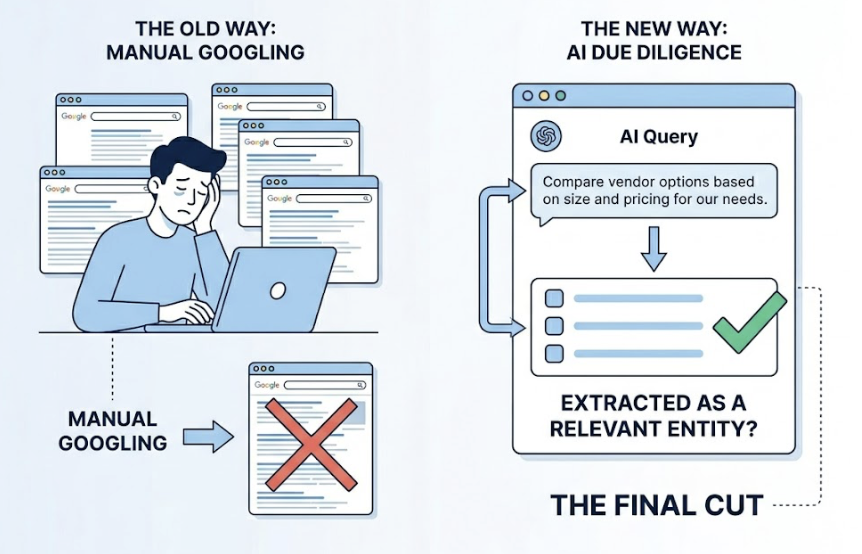
AI typically mentions 2 to 7 brands per answer. That’s a significantly tighter shortlist than Google’s first page of 10 results. The brands that don’t make the cut don’t get a second chance in that session.
In e-commerce, AI recommendation engines already account for 7% of traffic but 26% of revenue. For products with incomplete data, outdated inventory signals, or weak third-party validation, AI agents skip them automatically at decision time. No warning. No fallback.
That’s the gap most brands still can’t see.
B2B buyers now complete 70% of the decision path before they ever contact sales. And AI is shortening that overall journey by 33%. The early stage, where a buyer asks AI to narrow the field, is where invisible brands are quietly eliminated.
Why Your SEO Rankings Don’t Protect You Here
This is the assumption that costs brands the most time: “If we rank well on Google, AI will find us.”
The data says otherwise. The overlap between ChatGPT’s answers and Google’s top 10 search results is only 6.5%. The two systems operate on fundamentally different logic.
Google ranks pages based on backlinks, keyword signals, and user behavior. AI models, especially those using retrieval-augmented generation (RAG), work with semantic vector matching. They look for content that provides informational density and direct answers, not keyword coverage.
A page ranked #50 on Google that contains structured data, precise statistics, and clear factual statements will often be cited by AI more than a page ranked #1 built for keyword density. AI measures “conversational authority”: how tightly your brand is associated with specific concepts across its training corpus and real-time index.
The citation logic is also different. AI pulls from Wikipedia, peer-reviewed sources, industry review platforms like G2 and Capterra, and forum discussions. It prioritizes third-party consensus over brand-owned content. A backlink profile optimized for Google won’t solve the problem of weak representation on the nodes AI actually trusts.
Content structure matters too. Pages with tables, lists, and clear conclusions see 40% higher citation rates in AI answers. Traditional long-form content built for time-on-page and keyword saturation typically has high extraction resistance for AI systems parsing content into chunks.
5 Things That Determine Whether AI Recommends Your Brand
Citability: structure your content so AI can extract it. Implement JSON-LD schema markup at the site level (Organization, Product, FAQ). Use a conclusion-first writing structure: the first 50 to 60 words of any article should directly answer the core question. Princeton research found that adding statistics, expert quotes, and citation references improves AI visibility by 30–40%.
Prompt coverage: appear across the full intent spectrum. Don’t just track branded queries. Map out 500 to 1,000 natural-language prompts your target audience might ask at different stages: problem discovery, solution comparison, risk assessment. If your brand only shows up when someone types your name, you’re missing the top of the funnel entirely.
Competitive positioning in AI answers. AI typically includes 2 to 7 brands per answer. Your goal isn’t just to appear. It’s to hold a specific label: “best for enterprise teams,” “highest reliability,” “fastest implementation.” If a competitor already owns a valuable label in AI answers across your category, unseating them requires deliberate content strategy, not more backlinks.
Sentiment consistency across platforms. If Reddit threads describe your product differently from how LinkedIn posts frame it, AI registers the inconsistency and tends to hedge. Brands with consistent third-party sentiment across forums, review platforms, and industry media get recommended with more confidence.
Source domain authority on AI-trusted nodes. Wikipedia coverage, G2 and Capterra reviews, Trustpilot ratings, and forum discussions carry disproportionate weight in AI citation logic. A brand with 200 mediocre blog backlinks will often lose to a brand with three strong G2 reviews and a Wikipedia mention.
How to Start Tracking AI Brand Visibility Today
The core problem isn’t that AI brand visibility is hard to improve. It’s that most brands have no baseline to work from.
Start by defining a core prompt set: 50 to 100 natural-language queries that reflect how your target buyers actually search, split across discovery, comparison, and validation intent. Run those prompts across ChatGPT, Perplexity, and Gemini. Record where your brand appears, in what position, and what language AI uses to describe you.
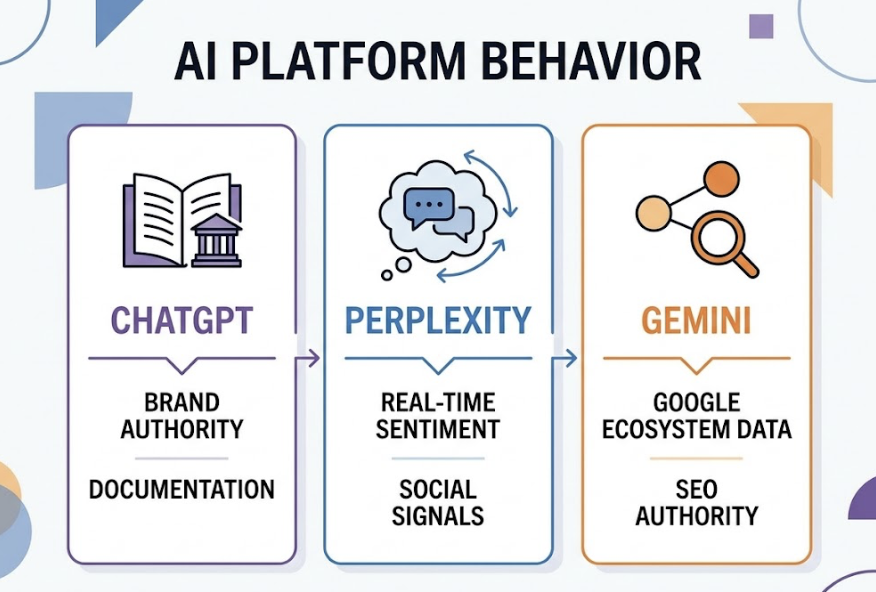
Each platform behaves differently. ChatGPT leans on long-term brand authority and official documentation. Perplexity prioritizes real-time forum sentiment and social signals. Gemini integrates Google ecosystem data and traditional SEO authority. A brand can look strong on one and be invisible on another.
This is where manual auditing hits its limits fast. Tracking 100 prompts across three platforms, weekly, isn’t a sustainable workflow for most marketing teams. Topify was built specifically for this gap. Its Visibility Tracking runs your entire prompt set automatically across major AI platforms, returning mention frequency, position data, and sentiment scores in a single view.
The Competitor Monitoring feature goes further. It surfaces not just where your competitors appear, but what content strategies are driving their AI citations, which sources are being pulled, and what sentiment labels they currently hold. That context is what turns a visibility gap into an actionable optimization plan.
When Topify’s monitoring shows your brand trailing in “security-focused” queries, for example, the response is targeted: update FAQ pages, strengthen third-party review language on G2, and run a content gap analysis against the sources AI is currently citing. The feedback loop closes quickly.
Get started with Topify and run your first brand visibility audit across ChatGPT, Perplexity, and Gemini.
Conclusion
AI brand visibility isn’t a future optimization problem. The customer journeys reshaping your pipeline are happening right now, inside AI conversations your analytics tools aren’t logging.
The brands building AI visibility now are accumulating a compounding advantage: more citations mean stronger semantic association, which means higher mention frequency, which means more conversions at 3 to 5x the rate of organic traffic. The brands waiting are losing ground that gets harder to recover with each passing month.
The question isn’t whether to invest in AI brand visibility. It’s whether you start with data or keep guessing.
FAQ
Q: What is AI brand visibility?
A: AI brand visibility measures how often, how prominently, and with what sentiment your brand appears inside AI-generated answers across platforms like ChatGPT, Gemini, and Perplexity. Unlike traditional SEO rankings, it tracks your brand as a knowledge entity within AI reasoning, not just as a page in search results.
Q: How is AI brand visibility different from SEO?
A: SEO optimizes web pages for click-through from search result lists. AI brand visibility, which falls under generative engine optimization (GEO), optimizes how your brand is extracted, synthesized, and framed by AI models. SEO is driven by keywords and backlinks; AI visibility is driven by entity association, structured content, and third-party consensus.
Q: How do I know if my brand is showing up in AI answers?
A: Run a prompt audit. Use 50 to 100 natural-language queries that reflect your buyers’ search behavior and test them across ChatGPT, Perplexity, and Gemini. Note whether your brand appears, in what position, and how it’s described. Automated platforms like Topify can run this process at scale and track changes over time.
Q: Can smaller brands compete with established players in AI search?
A: Yes, often more effectively than in traditional SEO. AI systems weight domain-specific authority and factual density over general brand size. A brand with highly structured, data-rich content and strong niche community presence on platforms like Reddit or G2 can outrank much larger competitors for specific prompt categories.

