

A practical guide to improving AI brand visibility in ChatGPT and beyond
Open ChatGPT and type: “What’s the best [your category] software?” If your brand doesn’t appear, you’re not dealing with a product problem. You’re dealing with a structural exclusion from the AI’s knowledge circle.
That gap is more expensive than most teams realize. AI referral traffic converts at 15.9% compared to 1.76% for traditional organic Google traffic. Visitors who arrive from an AI recommendation skip the research phase entirely. They arrive at pricing and demos.
So the question isn’t whether AI brand visibility matters. It’s what’s actually driving it, and what you can do this week to change where you stand.
You’re Not in ChatGPT’s Answers. Neither Are Most Brands.
Most marketing teams assume strong Google rankings translate to AI visibility. They don’t.
Publishers globally observed a 33% decline in traditional search traffic between 2024 and 2025, with news organizations hit hardest at 38%. Desktop searches per user dropped 20% year-over-year in the U.S. Meanwhile, 44% of consumers now cite AI tools as their primary source of insight, ahead of traditional search at 31%.
The mechanism is completely different. Google ranks links. ChatGPT synthesizes recommendations. A brand that’s spent a decade building backlink authority can still be entirely absent from an AI answer if it hasn’t built presence in the right places.
That’s the structural problem most marketing teams haven’t caught up to yet.
How ChatGPT Decides Which Brands to Recommend
ChatGPT doesn’t run a keyword search when you ask it a question. It performs a virtual consensus check across everything it’s learned and everything it can retrieve in real time.
Two channels drive this process. The first is parametric memory: the statistical patterns baked into the model during training. If your brand isn’t prominent in high-quality training sources including major news archives, industry publications, and community forums, it doesn’t come up from memory.
The second is Retrieval-Augmented Generation (RAG), where the model pulls from live web sources during your query. Here’s the detail that changes everything: 85% of brand citations in AI responses originate from third-party domains, not brand-owned websites. ChatGPT treats your homepage as a self-reported claim. It looks to independent sources to confirm or deny that claim.
If you have strong owned content but a thin third-party footprint, you’re invisible to the very consensus check that drives recommendations.
5 Signals That Shape Your AI Brand Visibility Score
Generative Engine Optimization (GEO) research has identified five specific signals that determine whether you get cited or get skipped.
Signal 1: Referring Domain Diversity
Sites with more than 32,000 referring domains receive 3.5x more citations in ChatGPT than sites with fewer than 200. Active Reddit and Quora discussions about a brand correlate to a fourfold increase in citation rates. LLMs are fine-tuned on human feedback, so they weight “human chatter” heavily over corporate messaging.
Signal 2: Entity Clarity
It takes roughly 250 consistent documents across the web for a stable brand narrative to form inside an LLM. If your category label and value proposition vary between your website, LinkedIn profile, and press releases, the model’s confidence score in recommending you drops.
Signal 3: Sentiment
Sentiment isn’t just a PR metric in generative AI. It’s a technical ranking factor. ChatGPT is trained to avoid recommending brands associated with consistent negative reviews or unresolved controversies. A brand appearing in an AI response with cautionary framing is in a worse position than a brand that isn’t mentioned at all.
Signal 4: Prompt-Specific Presence
AI brand visibility varies by query intent. For problem-discovery queries, AI lists category leaders. For solution-comparison queries, it highlights differentiators. You need to know which prompt scenarios trigger your inclusion, and which ones surface competitors instead.
Signal 5: Content Structure
Pages using structured formatting including bulleted lists, tables, and direct Q&A sections observe 30-40% higher visibility in AI responses. Content organized into sections of 120-180 words with the core claim in the first 40-60 words earns significantly more citations. This atomic structure lets RAG systems extract and credit your content with minimal friction.
Track Where You Actually Stand Before Optimizing Anything
You can’t fix what you can’t measure.
Most teams default to manual testing: type a few prompts into ChatGPT, see if the brand appears, draw conclusions. That approach has three hard limits. It’s confined to a single platform. It can’t detect how visibility shifts over time. And it can’t tell you which competitors are being recommended instead of you.
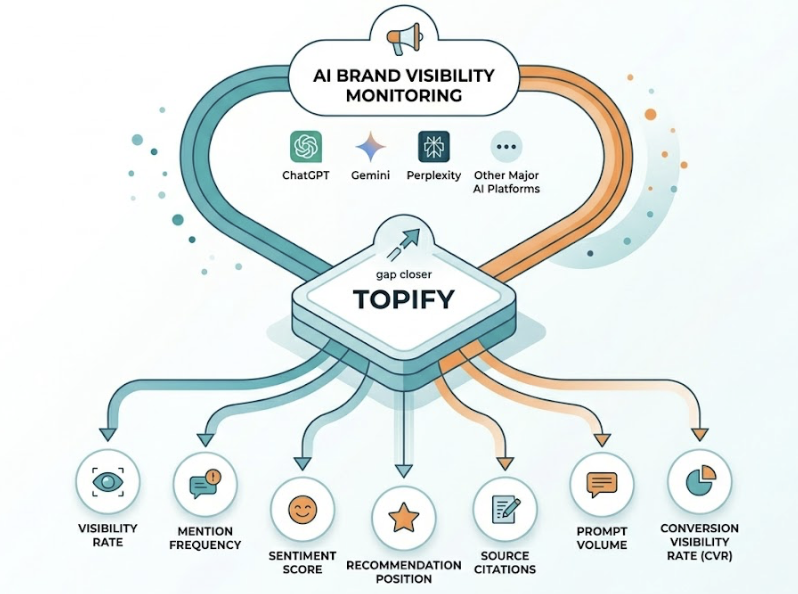
Topify was built specifically to close this gap. The platform tracks AI brand visibility across ChatGPT, Gemini, Perplexity, and other major AI platforms, measuring seven core metrics: visibility rate, mention frequency, sentiment score, recommendation position, source citations, prompt volume, and conversion visibility rate (CVR).
The Basic plan starts at $99/month and covers 100 prompts and 9,000 AI answer analyses. Research indicates that 20-30 prompts is the minimum needed to establish a meaningful baseline. Below that, you’re reading noise.
One concrete example: Topify’s analysis of Harness, a software delivery platform, found that while Harness dominated “Continuous Delivery” prompts, it had a visibility gap in “startup” and “simplicity” queries where GitHub Actions was the default recommendation. That kind of gap doesn’t show up in manual testing. It requires systematic prompt coverage across intent scenarios.
3 Steps to Rank Higher in ChatGPT Search Results
Once you have a baseline, the path forward follows a clear sequence.
Step 1: Expand Your Citation Ecosystem
Since 85% of AI citations come from third-party sources, this is where most of the leverage sits. Use source analysis to identify exactly which domains are driving your competitors’ recommendations. Then run targeted digital PR to earn coverage on those same outlets: industry media, technical blogs, and authoritative review platforms.
Community presence matters specifically here. Authentic discussions about your brand on Reddit and industry forums carry outsized weight because LLMs prioritize community consensus as a proxy for real-world relevance.
Step 2: Harmonize Your Brand Narrative
Entity clarity is an AI trust signal. Use identical language for your category label, value proposition, and product description across every owned and earned property. Implement JSON-LD schema to explicitly define your organization, products, and industry associations. This gives AI retrieval systems a structured reference that removes ambiguity during synthesis.
Inconsistency is an AI trust killer. Fragmented messaging across platforms splits the model’s confidence.
Step 3: Monitor, Refresh, and Iterate
AI-cited pages are 25.7% fresher than traditional Google results on average. Content updated within the last 30 days receives up to 6x more citations than content over a year old.
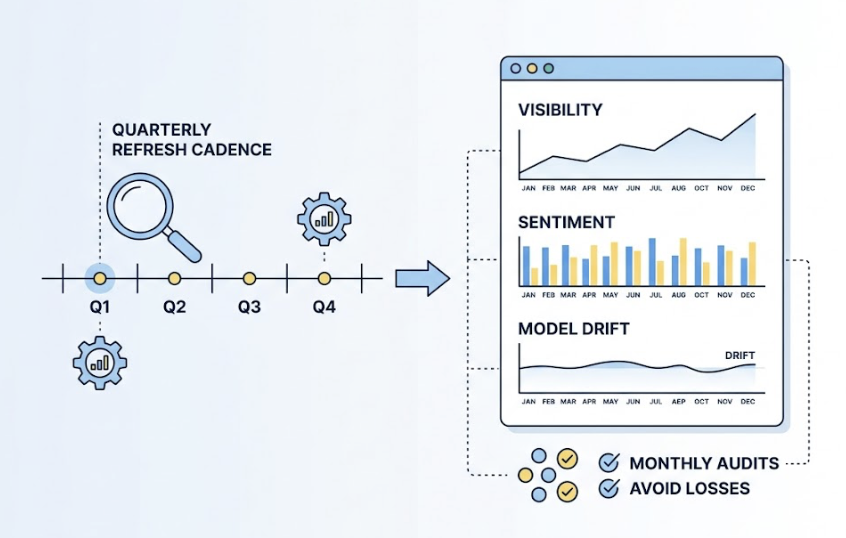
Set a quarterly refresh cadence for high-value pages. More important: monitor model drift. LLMs are retrained regularly, and your brand’s representation can shift without notice. Monthly audits of visibility and sentiment scores let you catch changes before they compound into competitive losses.
The timeline is faster than most teams expect. Technical improvements show impact within 2 weeks. Initial citations in Google AI Overviews typically appear in 3-4 weeks. Consistent ChatGPT mentions generally take 5-6 weeks, with mature category-level visibility requiring 2-3 months of sustained effort.
The Conversion Data Behind AI Brand Visibility
The ROI data from early GEO adopters is concrete.
In one documented case, the agency Discovered helped a B2B SaaS client pivot from traditional SEO to a GEO-centric content model. By publishing 66 LLM-optimized articles in a single month, the brand achieved a 600% uplift in citations and grew AI-referred trials from 575 to over 3,500 per month within seven weeks.
Across sectors, B2B SaaS companies report 800% year-over-year growth in AI-referred traffic, while retail brands tracked by Adobe Research observed a 12x jump in AI-sourced visits. AI-referred sessions also show 30% higher time-on-site, which indicates that users who find a brand through a synthesized recommendation arrive already in consideration mode, not discovery mode.
That distinction matters for how you interpret visibility metrics. You’re not just trading impressions. You’re reaching buyers who’ve already been pre-qualified by the AI’s recommendation.
Conclusion
AI brand visibility is a quantifiable metric with a direct line to revenue. ChatGPT doesn’t reward your backlink investments or keyword density. It recommends brands that independent, authoritative sources consistently validate, and whose content is structured well enough to cite.
Track your current position first. Then build the third-party presence, narrative consistency, and content structure that AI systems actually weight. The compounding advantage of getting this right today will be significantly harder to close in two years.
Start with a visibility baseline. The gap is usually larger than expected, and more specific than a single manual test can reveal.
FAQ
Does ranking in ChatGPT work like Google SEO?
No. Google SEO is built on backlinks, keyword density, and technical site performance. ChatGPT ranking (GEO) is driven by entity density in training data, independent third-party consensus, and how structurally citable your content is for RAG extraction.
How long does it take to improve AI brand visibility?
Technical and structural improvements typically show results within 2 weeks. Initial citations in Google AI Overviews appear in 3-4 weeks. Consistent mentions in ChatGPT or Gemini generally take 5-6 weeks, with mature category-level visibility requiring 2-3 months of sustained optimization.
Which AI platforms should I track first?
Start with ChatGPT, which serves 900 million weekly users, and Perplexity, which offers the most transparent citation data due to its retrieval-first architecture. Monitor Google AI Overviews concurrently since they directly affect traditional organic click-through rates.
What’s the difference between AI mentions and AI brand visibility?
An AI mention is a single occurrence of a brand name in a response. AI brand visibility is a composite score that weights mention frequency by the authority of citing sources, the sentiment of the description, and the recommendation position relative to competitors.
Can small brands rank in ChatGPT results?
Yes. Unlike Google, which often defaults to high-authority legacy domains, AI models prioritize the most relevant and citable answer for a specific prompt. A small brand that builds structured, expert content corroborated by community discussion can outrank larger competitors in niche generative queries.

