

Your social listening dashboard lights up every time someone mentions your brand on X or Reddit. It stays quiet when ChatGPT tells a buyer your competitor is the smarter pick. That conversation never hits a public feed, so your monitoring stack never logs it. And it’s happening at scale: 64.82% of Google searches now end without a click, with more of that intent flowing into AI assistants that answer the question outright. The problem isn’t that your brand looks bad inside AI answers. It’s that nobody’s watching what AI says about you at all.
Why Most Brand Monitoring Tools Can’t See What AI Says
Traditional brand monitoring was built for a web of links. Crawlers index public pages, social APIs pull public posts, and the tool counts mentions. That model assumes the conversation is observable. AI answers break that assumption.
When someone asks Perplexity or Gemini for a recommendation, the model doesn’t hand back ten blue links. It synthesizes one answer. If your brand isn’t in that synthesis, you’re not ranked lower. You’re absent. And absence leaves no footprint a crawler can find.
In an AI answer, there’s no position four. There’s in, or there’s out.
There’s also a quieter failure mode. A brand can rank first on Google and still never get cited by ChatGPT, because AI platforms run their own retrieval and pull from a narrower set of sources. Your strong SEO performance is a leading indicator, not a guarantee of AI citation. On top of that, models can misstate your pricing, mislabel your positioning, or invent features you don’t ship. Keyword-based listening tools scan for brand names, so these silent hallucinations slip past them entirely.
That gap is what an AI brand monitoring tracker exists to close. It’s a diagnostic layer that watches the one surface your current stack can’t reach: the generated answer itself.
What an AI Brand Monitoring Tracker Actually Measures
An AI brand monitoring tracker simulates how real users query AI assistants, then quantifies how your brand shows up in the responses. The mechanics are consistent across serious tools. The system runs a curated set of industry prompts (informational and comparison queries like “what’s the best CRM for small business”) across multiple LLMs, parses each unstructured answer for mentions and citations, and normalizes the results into metrics you can track over time.
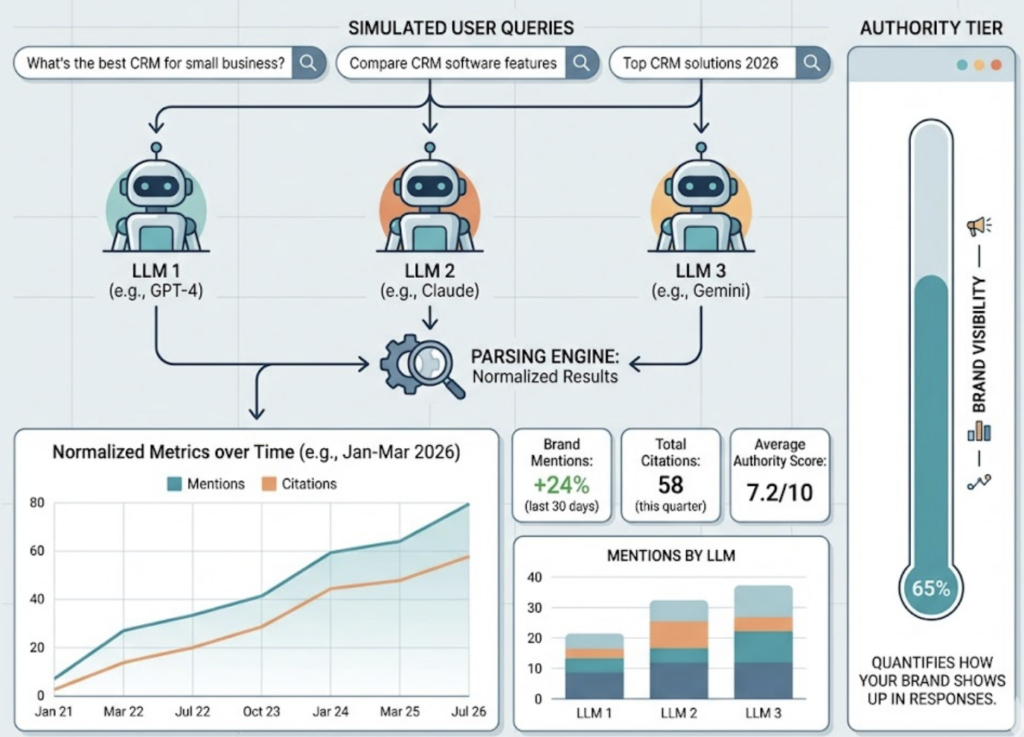
The reason this works is that it measures AI on its own terms. As Nightwatch’s framework for measuring LLM visibilityputs it, your brand either appears in the answer or it doesn’t, in a specific position, described a specific way, cited or uncited. Visibility is the sum of those outcomes across every prompt that matters to your category.
Most teams ask how to measure it. These are the metrics that count:
- AI Share of Voice: the percentage of category-relevant answers that mention or cite your brand.
- Citation source: which exact URLs and domains the model used to back up the mention.
- Position: how prominent the mention is, first paragraph versus a closing footnote.
- Sentiment: whether you’re framed as the solution, the cautionary tale, or a neutral option.
- Hallucination rate: how often the model states something factually wrong about you.
Here’s the line that separates the best LLM visibility tools from the weak ones: tracking happens at the prompt level, not the keyword level. Keyword tracking tells you where a page ranks. Prompt tracking tells you what the AI actually said when a buyer asked.
Best LLM Visibility Tracking Tools, Ranked
Coverage is the first filter. A tool that only watches one model gives you a partial picture, because the Big Four (ChatGPT, Perplexity, Gemini, and Claude) each cite a different mix of sources. The second filter is explanation: does the tool just show you a number drop, or does it tell you which source stopped citing you.
These tools are ranked on coverage breadth, source-level explainability, and whether the output points to a next action.
| Tool | Model coverage | Source / citation analysis | Competitor benchmarking | Sentiment | Starting price |
|---|---|---|---|---|---|
| Topify | ChatGPT, Gemini, Perplexity, DeepSeek, and more | Yes, URL-level | Yes, automatic | Yes, 0-100 | $99/mo |
| Profound | Multi-model | Yes | Yes | Yes | Enterprise / on request |
| Nightwatch | ChatGPT, Perplexity, Gemini, Claude | Yes | Yes | Yes | Mid-tier add-on |
| LLMrefs | ChatGPT, AI Mode, AI Overviews, Perplexity | Partial | Yes | Limited | Budget |
| Otterly.AI | ChatGPT, Perplexity, AI Overviews | Partial | Yes | Limited | Budget |
| Promptwatch | Prompt-level, multi-model | Partial | Yes | Yes | Mid-tier |
Specialized AI visibility tools often start at $300 to $500 a month and climb from there, which is why where a tool lands in this table depends as much on what it explains as on what it costs.
#1 Topify: All-in-One LLM Visibility Software
Most tools stop at the data. They show you a visibility score dropped and leave you to guess why. Topify closes that loop, which is why it leads this list as a piece of LLM visibility software rather than a dashboard.
It pulls seven metrics into a single view: visibility, sentiment, position, volume, mentions, intent, and CVR. In practice, that means you can spot a drop in ChatGPT mentions, trace it to a specific source domain that stopped citing your brand, and see whether sentiment shifted at the same time, all without switching screens. The diagnosis and the cause live next to each other.
The source analysis is where this earns its keep. Topify reverse-engineers the exact domains and URLs that AI platforms cite for your category, so you can see whether your own content or a competitor’s is feeding the answer. That turns “we lost visibility” into “we lost the citation that was driving it,” which is a problem you can actually fix.
Competitor benchmarking runs in parallel. You see who the engines recommend alongside you, when a new rival starts surfacing, and how your position moves against theirs over time. Coverage spans ChatGPT, Gemini, Perplexity, DeepSeek, and other major engines, so the picture isn’t skewed by a single model’s habits.
There’s also an execution layer most trackers skip. State a goal in plain English, review the proposed strategy, and deploy it with one click through Topify’s agent. The CVR metric ties the whole thing back to revenue by estimating how likely an AI answer is to push a user toward a brand interaction, not just a mention count.
Pricing starts at $99 a month and includes tracking across ChatGPT, Perplexity, and AI Overviews, 100 prompts, and competitor monitoring, with a 30-day trial. You can check the full plans or get started and run a visibility baseline before committing.
The Other LLM Visibility Tools Worth Knowing
No single tool fits every team. These cover the rest of the field.
Profound is an enterprise-grade platform built around RAG-focused insights, with deeper integration into partnership and revenue automation systems. It suits large organizations that need that level of pipeline tooling and have the budget to match.
Nightwatch pairs traditional SEO rank tracking with LLM visibility monitoring in one interface, which is useful if your team wants AI data sitting next to classic rankings. It tends to fit SEO-led teams expanding into GEO rather than brand-led ones.
LLMrefs is a budget option focused on share of voice and citations across ChatGPT, AI Mode, AI Overviews, and Perplexity. It’s a reasonable entry point for solo operators who want directional data without enterprise pricing.
Otterly.AI is another lightweight tracker covering the major engines. It’s serviceable for quick checks, though its source and sentiment depth is thinner than the heavier platforms.
Promptwatch leans into prompt-level tracking with daily refreshes and real-time alerts, which makes it a fit for teams that care most about being notified the moment a competitor overtakes them.
How to Choose Your AI Brand Monitoring Tracker: A Checklist
Before you commit, run any candidate through this checklist:
- Model coverage: Does it track the Big Four, or just one engine? Single-model coverage is a partial answer.
- Source attribution: Can it tell you why the AI cited a source, and which URL it pulled from? A number without a cause isn’t actionable.
- Competitor context: Does it benchmark rivals alongside you, so a share-of-voice shift has meaning?
- Sentiment and accuracy alerts: Will it flag negative framing or a hallucination spike fast enough to respond?
- Action, not just data: Does the output prescribe a next step, or hand you a chart and walk away?
A few common mistakes sink these rollouts. Teams track only ChatGPT and miss that Perplexity is recommending a competitor. They watch the visibility number and ignore the source layer, so they never learn what’s driving the change. And they treat AI visibility as an extension of SEO, when commercial keywords rarely trigger AI answers and informational content is where citations are won.
On pricing: the question isn’t the monthly fee, it’s the cost of staying blind. With 85% of consumers placing at least some trust in AI shopping recommendations and nearly 40% having bought an AI-recommended product in the past six months, an undetected misrepresentation in AI answers is a revenue leak. A $99 tracker that catches it pays for itself the first time it does.
Conclusion
The brands that stay visible in AI search aren’t the ones with the loudest social presence. They’re the ones who know, prompt by prompt, what the models are saying and why. The first move is small: run a baseline. Track a handful of category prompts across the major engines, see where you appear and where you vanish, and find out which sources are feeding the answers. Once you can see the gap, you can close it. Until then, you’re optimizing for a search experience your buyers have already left behind.
FAQ
What is an AI brand monitoring tracker? It’s a tool that simulates real user queries inside AI assistants like ChatGPT, Perplexity, and Gemini, then measures how your brand appears in the generated answers. Unlike social listening, which scans public posts, it watches the synthesized AI response, the surface where most modern buyers now get recommendations.
How does an AI brand monitoring tracker work, and how do you measure it? It runs a curated set of prompts across multiple LLMs, parses each answer for brand mentions and citations, and normalizes the output into metrics. You measure it through AI share of voice, citation sources, position within the answer, sentiment, and hallucination rate, tracked at the prompt level rather than the keyword level.
What are common mistakes when choosing one? The big three: tracking only one AI platform, watching the visibility score without the underlying source data, and assuming Google rankings guarantee AI citations. Each leaves you reacting to symptoms instead of causes.
How much does an AI brand monitoring tracker cost? Pricing ranges widely. Many specialized platforms start at $300 to $500 a month, while entry-level options like Topify begin at $99 a month with multi-platform tracking and a 30-day trial. The right spend depends on how many prompts and competitors you need to monitor.

