

You ask ChatGPT to recommend a tool in your category. It names five competitors and skips you entirely. You pull up Google’s AI Overview for your own brand and find a description that’s half wrong: outdated pricing, a feature you deprecated last year. None of this shows up in your social listening dashboard or your rank tracker, because neither was built to watch what AI says. The conversations that shape buying decisions are moving inside AI answers, and most brands have no idea what’s being said about them there.
What an AI Brand Monitoring System Is
An AI brand monitoring system is a structured way to track how AI engines mention, rank, cite, and describe your brand across ChatGPT, Gemini, Perplexity, and Google AI Overviews. It’s brand monitoring rebuilt for a web where the answer, not the link, is the destination.
The distinction matters. Social listening watches public posts and reviews. Rank tracking watches where your pages land in blue-link results. Neither can see inside an AI-generated answer, which is exactly where a growing share of buying research now happens.
That’s the gap most brands still can’t see.
AI assistants now field over 1.5 billion daily queries, according to Scope’s 2026 analysis of consumer search behavior. Yet roughly 60% of small and mid-sized businesses have no awareness of whether their brand appears in those answers at all. They’re optimizing for a results page their customers increasingly skip.
A monitoring system closes that blind spot. It tells you, on a recurring basis, whether AI engines know your brand exists, how they describe it, and whether they recommend you or a rival when someone asks.
How an AI Brand Monitoring System Works
The core shift is from keyword-level tracking to prompt-level tracking. Instead of watching a search term, you watch the actual questions a customer asks an AI during research, like “what’s the best CRM for a small team.”
Here’s the basic loop. You define a set of prompts that map to your customer journey. The system queries multiple LLMs with those prompts on a schedule. It parses each answer for brand mentions, sentiment, position in the response, and which sources the AI cited. Then it scores those results over time so you can see movement.
Citation mapping is the part traditional tools never touched. When an AI engine answers a question, it tends to pull from a small pool of sources it treats as authoritative. A 2026 study by Digital Applied that analyzed 1,000 AI Overviews found the top 1% of cited domains captured 47% of all citations. If your brand isn’t in that authority tier, you’re effectively invisible for those queries, no matter how strong your traditional rankings look.
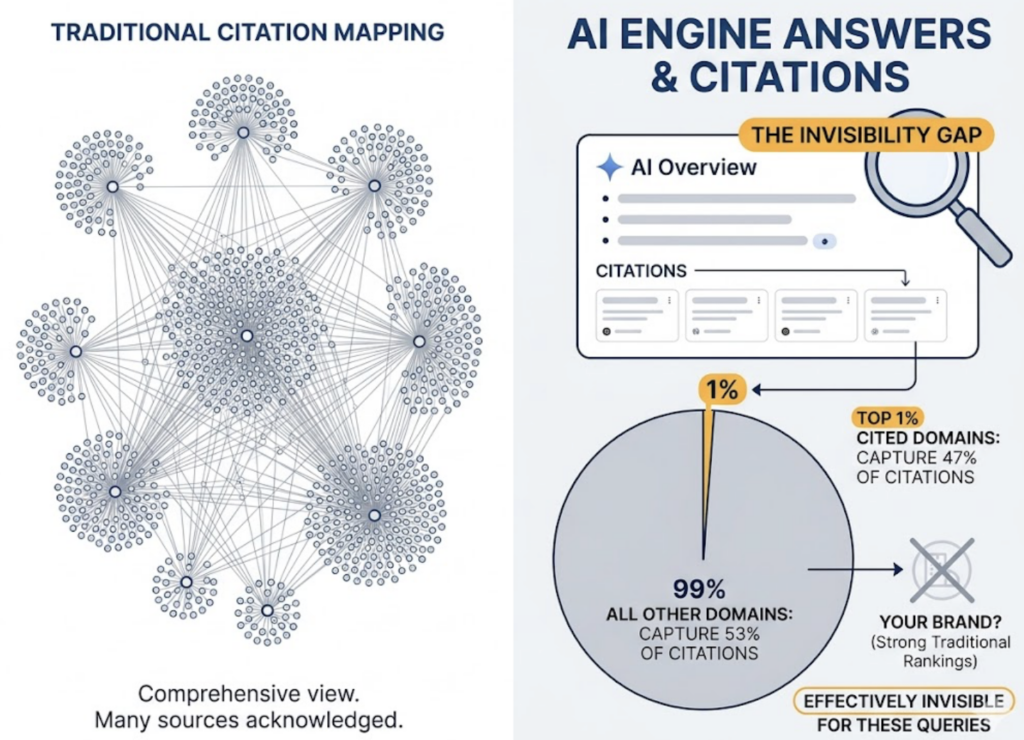
Cross-engine tracking is the other non-negotiable. Google AI Overviews and Perplexity cite the same URLs only 13.7% of the time, per the same body of research. Watching one engine tells you almost nothing about the others.
How to Measure an AI Brand Monitoring System
You can’t manage what you can’t quantify, and AI visibility needs its own KPI stack. Five metrics do most of the work.
| Metric | What it measures | Why it matters |
|---|---|---|
| Visibility Rate | Share of tracked prompts where your brand is mentioned or cited | Tells you if AI knows you exist |
| Citation Share | Your portion of total citations in a competitive set | Proxy for topical authority |
| Sentiment Score | The tone AI uses to describe your brand | Early warning for false or negative claims |
| Position Index | Where you land in the answer, first mention or fifth | Measures prominence in short summaries |
| CVR | Conversion rate from AI-referred traffic | Connects visibility to revenue |
Sentiment deserves extra attention. Hallucination rates across top models still run between 15% and 27%, based on 2026 figures from SQ Magazine and LLM Pulse. That means roughly one in five AI answers about your brand could carry a confident, incorrect claim about your pricing, features, or history. Most ai overviews tracking software flags mentions but skips this layer, which is where quiet brand damage builds up.
The point of measurement isn’t a prettier dashboard. It’s catching a sentiment drop or a citation loss while you can still act on it.
Where AI Overviews Tracking Fits In
Google AI Overviews is its own surface, and it behaves differently from chat assistants. It sits at the top of the results page, summarizes an answer, and often resolves the query before anyone clicks. In 2026, informational queries on Google hit a 64.82% zero-click rate. If you’re not cited inside that summary, you don’t exist for most of those searchers.
This is why aio tracking has become a category of its own. An ai overviews tracking tool watches which domains Google’s summary pulls from for your target questions, so you can see whether you’re feeding the answer or watching a competitor do it.
A few things separate the best ai overviews tracking tools from noisy ones:
- Source-level detail, not just “you appeared” but which URL got cited
- Coverage of the same prompts across other engines, so AIO data sits in context
- Competitor citation tracking, since the 47% concentration at the top means you’re fighting for a finite pool of citation slots
The strongest setups treat AI Overviews tracking software as one input into the broader monitoring system, not a standalone report. The whole value is seeing AIO, ChatGPT, and Perplexity side by side.
What to Look For in the Tools
Most ai overviews tracking tools and brand monitoring platforms claim the same thing. The differences show up in what they actually capture. Five dimensions sort the field.
| Capability | Why it matters |
|---|---|
| Multi-engine coverage | One engine is a blind spot, given 13.7% cross-citation overlap |
| Source and citation analysis | Tells you where AI authority comes from |
| Competitor benchmarking | Citation share only means something against rivals |
| Sentiment tracking | Catches hallucinated claims before customers do |
| Execution, not just data | Insight you can’t act on is a report, not a system |
This is where Topify fits for teams that want the full picture in one place. Its Visibility Tracking follows brand mentions across ChatGPT, Gemini, Perplexity, Google AI Overviews, and others, while Source Analysis reverse-engineers the exact domains and URLs those engines cite. In practice, that means you can spot a drop in ChatGPT mentions and trace it back to a source that stopped citing you, inside the same view.
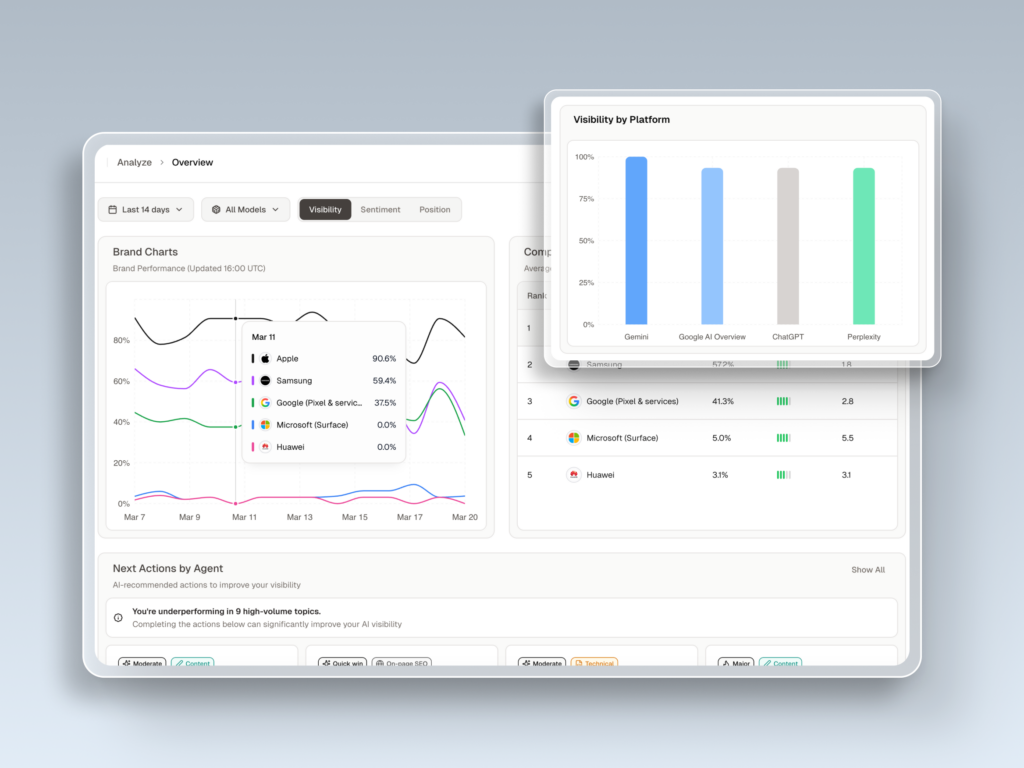
Competitor Monitoring rounds it out by showing which brands AI recommends ahead of you and how that ordering shifts week to week. For brands chasing the citation tier, that benchmarking is the difference between guessing and knowing.
One structural signal is worth acting on regardless of tool: schema. A 2026 study found schema-marked pages get cited 2.3× more often than unstructured equivalents. Good monitoring tells you where you’re losing citations. Structured content is often how you win them back.
Common Mistakes That Quietly Break the System
A monitoring system can technically run and still tell you nothing useful. The failure modes tend to repeat. Use this as a quick checklist.
- Tracking one engine. With only 13.7% citation overlap between AIO and Perplexity, single-platform data is a partial view sold as a full one.
- Keyword-level instead of prompt-level. Customers ask AI full questions, not keywords. Track the questions.
- Ignoring sentiment. A mention isn’t a win if the description is wrong. With hallucination rates near 15% to 27%, tone needs its own metric.
- No competitor baseline. A 30% visibility rate means nothing until you know whether the leader sits at 35% or 80%.
- Skipping the citation layer. If you track mentions but not sources, you’ll never learn how to improve your standing.
Fixing these is most of how to improve an ai brand monitoring system. The upgrade is rarely a fancier dashboard. It’s covering more engines, dropping to the prompt level, and adding the source and sentiment layers you skipped.
Building Your Strategy and What It Costs
A working strategy for an AI brand monitoring system follows a simple sequence. Define the prompts your buyers actually ask. Set a baseline across engines. Track on a schedule. Benchmark against competitors. Then act on the gaps, usually by strengthening the sources AI cites in your category.
An example makes it concrete. A B2B SaaS brand might track 100 buying-intent prompts across four engines, discover it’s cited in 22% of them versus a rival’s 41%, find that most rival citations trace back to three review sites, and prioritize getting placed and accurately described on those sources. That’s a full loop: measure, diagnose, act.
On ai brand monitoring system pricing, dedicated tools generally run from under $100 a month for small teams up to several hundred for higher prompt volumes and seats. Topify pricing starts at $99 a month on the Basic plan, which covers ChatGPT, Perplexity, and AI Overviews tracking with 100 prompts. Pro runs $199 a month for 250 prompts and more seats, and Enterprise starts at $499. You can get started with Topify on a trial before committing.
The honest framing: the cost of a tool is small next to the cost of a competitor owning your category in AI answers while you’re not looking.
Conclusion
The brands that get described accurately and recommended often in AI answers aren’t lucky. They’re watching. An AI brand monitoring system turns a black box into something you can measure, benchmark, and improve, the same way you already manage traditional SEO.
Start small. Pick 20 to 50 prompts your customers actually ask, run them across the major engines, and see where you stand today. The first baseline is usually a wake-up call. From there, the work is steady: track, diagnose, act, repeat.
FAQ
Q: What is an AI brand monitoring system?
A: It’s a structured process for tracking how AI engines like ChatGPT, Perplexity, and Google AI Overviews mention, cite, rank, and describe your brand, then measuring those results over time so you can improve them.
Q: What’s an example of an AI brand monitoring system in action?
A: A SaaS brand tracks 100 buying-intent prompts across four AI engines, finds it’s cited in 22% of answers versus a competitor’s 41%, traces the gap to a few review sites, and works to get accurately represented there. Visibility climbs as those sources start citing it.
Q: What’s a quick checklist for an AI brand monitoring system?
A: Cover multiple engines, track at the prompt level, measure visibility plus citation share plus sentiment plus position, set a competitor baseline, and analyze which sources AI cites. Missing any one of these leaves a blind spot.
Q: How much does AI brand monitoring cost?
A: Tools generally range from under $100 a month for small teams to several hundred for larger prompt volumes. Topify starts at $99 a month, with Pro at $199 and Enterprise from $499.

