

Your AI search dashboard looks healthy. Brand mentions are up, ChatGPT cites you on a few queries, and the monthly report finally has an “AI visibility” line. Then a prospect asks an AI assistant to compare your category, and the answer ranks a competitor first, calls them “better value,” and never explains why.
You didn’t see it coming, because your tracking only watches your own name. That’s the blind spot in most AI search optimization programs: they measure the brand you own and stay blind to the competitors AI keeps recommending instead.
Most AI Search Optimization Stops at Your Own Brand
Marketing teams tend to treat AI search optimization as an extension of traditional SEO. They watch their own mentions, their own citations, their own sentiment, and call it a program. The problem is that large language models don’t work that way. They synthesize and compare, then hand the user a single recommendation.
So when an AI consistently frames a rival as the safe pick and you as the also-ran, that isn’t a ranking gap you can see in a self-only dashboard. It’s a narrative gap that forms before the user clicks anything.
Self-tracking tells you how you’re doing. It says nothing about whether you’re losing.
This matters more every quarter, because the click is disappearing. Roughly 64.82% of Google searches now end without a click, and on AI-native engines the rate is far higher: around 93% on Perplexity and 82% on ChatGPT Search. Buyers are getting their shortlist inside the answer. If you can’t see how that answer treats your competitors, you’re optimizing half the picture.
AI Search Visibility Is Measurable. So Is Your Competitor’s
AI search visibility measures whether AI engines mention you, where they place you, and how they describe you. The useful insight is that every one of those measurements applies just as cleanly to the brands you’re up against.
Tracking AI brand visibility for yourself and your top three rivals on the same prompts turns a vanity number into a competitive read. Here’s the stack worth monitoring:
| Metric | What it measures |
|---|---|
| Share of Voice | The percentage of category answers that name you versus competitors |
| Citation Share | The slice of total citations in a topic cluster your brand captures |
| Recommendation Rate | How often AI explicitly suggests you on “best,” “top,” or “alternatives” prompts |
| Position Index | Whether you appear first or fourth in the AI’s list |
| Sentiment Gap | The difference between how AI describes you and how it describes a rival |
Position and sentiment are where most surprises live. You can hold a respectable share of voice and still lose, because the model names you last and frames the competitor as the default. This is also the layer that separates AI search visibility from Google rankings, where a strong domain authority tells you nothing about what AI chooses to say.
The Competitor GEO Performance Layer AI SEO Tools Miss
Generative engine optimization is dynamic and comparative in a way classic AI SEO tools rarely capture. The engine doesn’t just read your copy. It interrogates your data, pulls quantifiable attributes like specs and pricing, and pits them against rivals in real time.
Two signals decide a lot of this. The first is co-citation: being named alongside category leaders marks your brand as a coherent entity for that use case. If you’re never cited next to competitors on your core queries, the model tends to treat your entity as irrelevant there.
The second is source trust. Models lean heavily on third-party validation, so a competitor can capture your visibility simply by showing up more often in the review sites AI engines trust. Search Engine Land’s reporting on how brand depth shapes what AI systems recommend points the same direction: presence and consistency across trusted sources drive the recommendation.
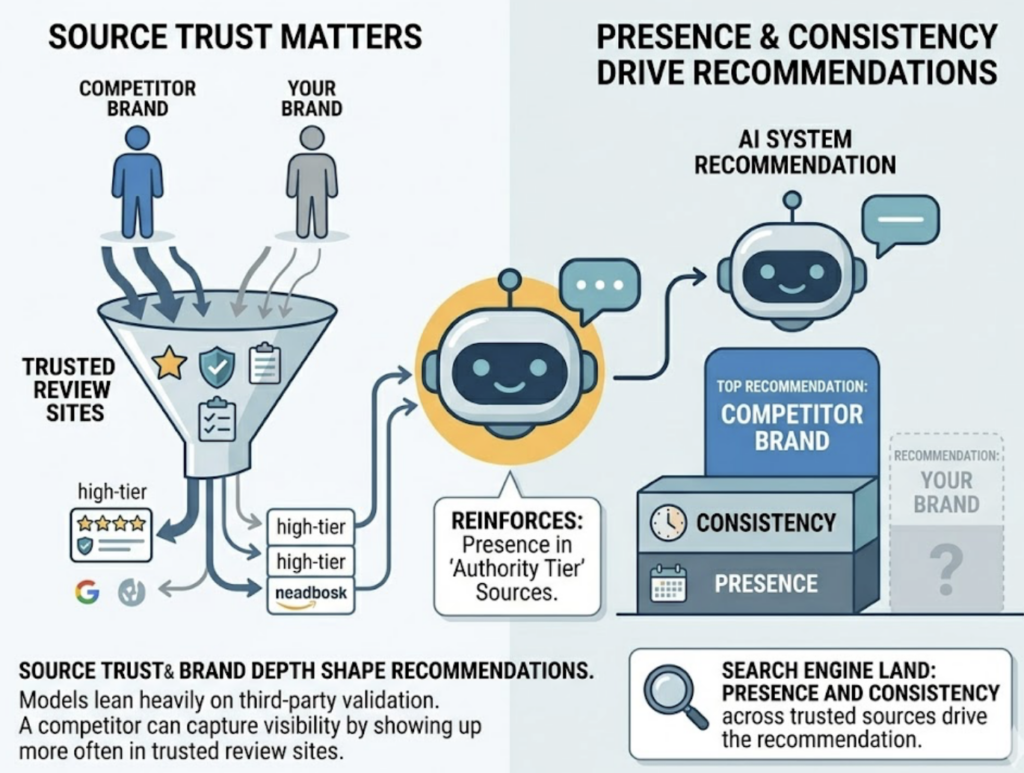
The gap is that most AI SEO tools only render your own scorecard. To track competitor GEO performance, you need the comparative view: the same prompts, run across the same engines, scored side by side.
What AI Tells Buyers About Competitor Pricing
Pricing isn’t just a number on your site anymore. It’s a label an AI assigns you in front of a buyer.
AI engines routinely surface pricing and value framing pulled from third-party sources. If an assistant keeps calling a competitor “better value” while tagging you “enterprise-only,” that framing reaches the buyer whether or not it reflects your actual value. Competitor pricing tracking in AI search optimization exists to catch this drift early.
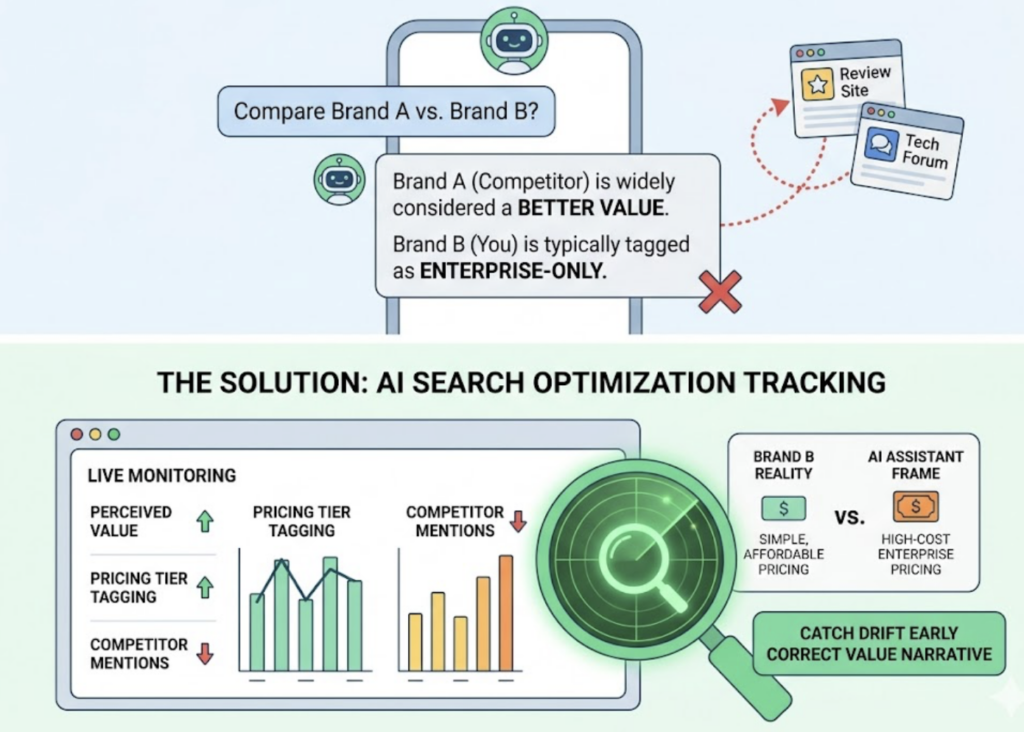
The response is a content one. When the model’s value label is wrong, the fix is usually structured “vs.” pages that clarify the comparison with clean, machine-readable data, so the engine has an accurate source to cite. You can’t correct a narrative you can’t see, which is why pricing signal monitoring belongs in the workflow rather than in a quarterly audit.
Turning AI Search Analytics Into a Competitive Workflow
The point of AI search analytics is to move from passive observation to strategic response. A mature AI search intelligence workflow runs on three loops: prompt-level benchmarking across the major engines, pricing and sentiment signal tracking on competitors, and source attribution that tells you which domains are feeding a rival’s recommendation.
For teams that want this comparison built in rather than bolted on, Topify treats AI search optimization as a comparative discipline from the start. Its Competitor Monitoring auto-detects the rivals AI engines name in your category, then benchmarks them next to you across seven metrics: visibility, sentiment, position, volume, mentions, intent, and CVR. Position Tracking shows whether you’re cited first or fourth on high-intent prompts, while Source Analysis reverse-engineers the exact domains driving a competitor’s mentions. In practice, you can spot a rival winning a “best of” citation, trace it to the third-party page behind it, and hand your content team a specific target, all in one view.
That last step is the difference between knowing you’re behind and knowing what to do about it.
Choosing an AI Visibility Platform That Tracks Rivals
Not every tool labeled for AI visibility actually handles competitors. When you evaluate an AI visibility platform for competitive tracking, the capabilities below separate a real intelligence engine from a self-only dashboard.
| Capability | Why it matters for competitive tracking |
|---|---|
| Multi-engine coverage | Rivals win on different platforms, so ChatGPT, Gemini, Perplexity, Claude, and Copilot all need monitoring |
| Prompt-level simulation | Running the same competitor prompts at scale is what surfaces trends instead of snapshots |
| Granular attribution | Tracing answers back to specific domains and pages shows where a competitor’s authority comes from |
| Automated competitive alerts | You want a notification the moment a rival takes a “best of” citation or sentiment shifts, not a month later |
A platform that checks these boxes turns competitor tracking into a standing process. One that doesn’t leaves you watching your own reflection while the market moves around you.
Conclusion
AI search optimization isn’t only about getting mentioned. It’s about being the logical conclusion of the buyer’s research, which means knowing exactly how AI frames, prices, and ranks everyone else in your category. Start with 20 to 30 high-intent prompts, score yourself and your top rivals on the same metrics, and watch the position and sentiment gaps first. The brands that treat competitor visibility as core to their AI strategy will see where their narrative is eroding while there’s still time to fix it.
FAQ
Q: How do you track competitor GEO performance in AI search?
A: Run the same high-intent prompts your buyers use across ChatGPT, Gemini, Perplexity, and Claude, then score each competitor on the same metrics you track for yourself: share of voice, citation share, recommendation rate, and position. Platforms with built-in competitor detection automate this so you see relative movement, not just your own numbers.
Q: Can you see competitor pricing in AI answers?
A: Often, yes. AI engines surface pricing and value framing pulled from third-party sources, so a competitor can appear labeled “better value” even when your specs are stronger. Competitor pricing tracking flags these labels so you can correct the narrative with structured comparison content.
Q: What’s the difference between AI search analytics and traditional SEO analytics?
A: Traditional SEO analytics measures clicks, rankings, and traffic to your own pages. AI search analytics measures whether AI engines mention, cite, and recommend you, and how that compares to competitors, often on queries that never produce a click at all.
Q: How do I start competitive AI search intelligence without a big team?
A: Pick a focused set of high-intent prompts, run them across the major AI engines, and log which brands get named and how. From there, an AI visibility platform can scale the monitoring and alert you when a rival’s position shifts. You can get started with Topify to automate the tracking.

