


Your domain authority is solid. Your content is ranking. But when someone asks ChatGPT, “What’s the best [tool/service] in your category?” your brand either isn’t mentioned, or it’s described in a way that doesn’t match your positioning at all.
Traditional analytics can’t catch this. They weren’t designed to. That gap is exactly what an AI brand intelligence system is built to close.
Your Brand Has a Reputation Inside AI. You Just Can’t See It Yet.
AI search engines like ChatGPT, Gemini, and Perplexity don’t just retrieve links. They synthesize answers based on what they’ve indexed, weighted by RAG (Retrieval-Augmented Generation) outcomes, entity authority, and source consensus.
The result: your brand has a reputation inside these models, shaped by thousands of data points you’ve never audited. That reputation determines whether you’re recommended, ignored, or mislabeled.
Most brands have no visibility into this layer at all. And because AI search is now a primary discovery channel for buyers across SaaS, finance, healthcare, and retail, that blind spot has direct revenue consequences.
What an AI Brand Intelligence System Actually Covers
An AI brand intelligence system is a software architecture designed to interface directly with LLMs, simulating real buyer queries to measure how AI engines perceive, validate, and position your brand.
It’s not a social listening tool. It’s not a media monitoring dashboard. The data source is fundamentally different: instead of crawling static web content, it runs prompt-based simulations against live AI models and analyzes the outputs.
A complete AI brand intelligence system covers five core components:
| Component | What It Measures | Business Problem Solved |
|---|---|---|
| Visibility Rate | % of category-intent queries where your brand appears | Diagnoses if buyers even know to consider you |
| Sentiment Score | Tone and framing of AI responses about your brand | Prevents “budget alternative” labeling when you’re aiming for premium |
| Position Ranking | Sequential order of brand placement in recommendations | Addresses the Top-3 bias: most buyers don’t convert on entries past the first few |
| Source Attribution | Which third-party domains AI uses to validate your brand | Reveals the trust ecosystem you actually need to build |
| CVR (Conversion Visibility Rate) | Correlation between AI mentions and downstream acquisition | Bridges brand awareness to hard ROI |
Each component answers a different business question. Visibility without sentiment tells you you’re mentioned, not how. Sentiment without source attribution tells you there’s a problem, not where it originates.
How It Differs from Traditional Brand Monitoring
The distinction matters more than most teams realize. Traditional monitoring and AI brand intelligence aren’t competing versions of the same thing. They serve different strategic purposes.
| Feature | Traditional Monitoring | AI Brand Intelligence System |
|---|---|---|
| Data Source | Static public web (social, news, blogs) | Dynamic RAG outputs (ChatGPT, Gemini, Perplexity) |
| Methodology | Keyword-based crawling | Prompt-based simulation |
| Core Value | Tracking existing public opinion | Managing future buyer discovery |
| Primary Metric | Share of Voice (mentions) | Share of AI Voice (recommendation rate) |
| Key Question | “What are people saying?” | “How are we being recommended?” |
Traditional tools are backward-looking. They tell you what’s already been published. An AI brand intelligence tool or platform is forward-looking. It tells you what buyers will encounter the next time they ask an AI for a recommendation in your category.
That’s not a small distinction. It’s the difference between monitoring reputation and actively managing buyer discovery.
4 Signals That Tell You If Your System Is Working
Deploying an AI brand intelligence solution is only useful if you know what to measure over time. Four signals indicate whether your system is generating actionable value:
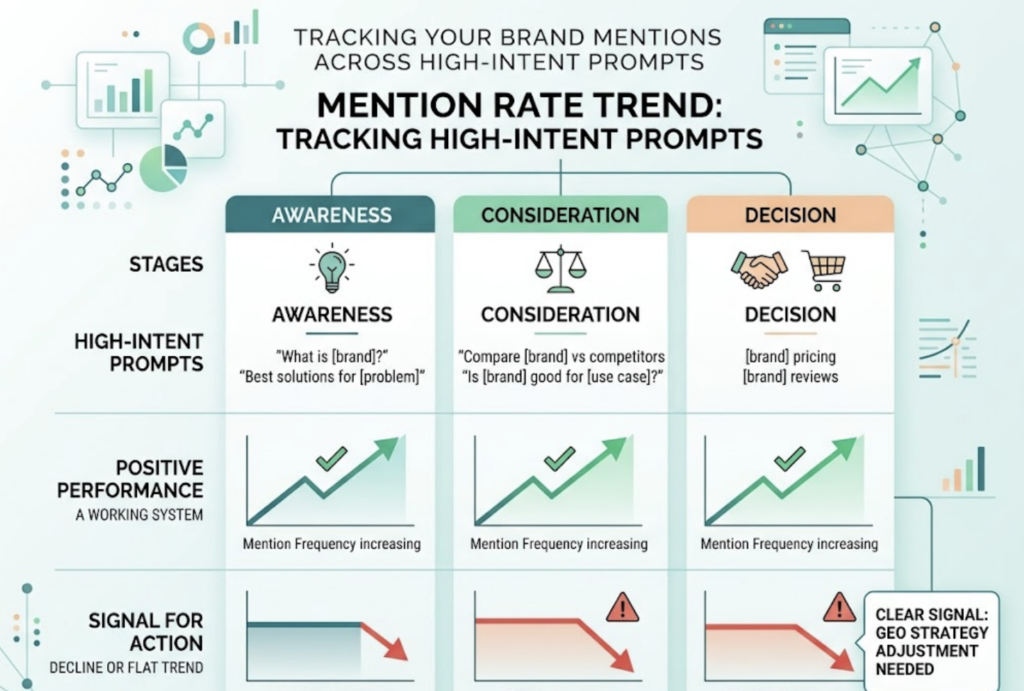
1. Mention Rate Trend Track how often your brand appears across high-intent prompts at each stage of the buyer journey: awareness, consideration, decision. A working system shows upward movement in mention frequency. A flat or declining trend in high-intent prompts is a clear signal that your GEO strategy needs adjustment.
2. Sentiment Velocity AI models drift. A brand that’s positively framed this month can shift to neutral or negative framing over weeks as models update their retrieval sources. Tracking sentiment direction, not just a static score, tells you whether your narrative is holding or eroding.
3. Citation Domain Coverage This one’s often overlooked. The authority of the domains AI cites when validating your brand matters as much as the volume of citations. A working AI brand intelligence analytics layer should show increasing citations from high-authority industry domains, not just your own site.
4. Relative Position Delta Where are you in the recommendation list compared to your top three competitors? A shift from position #4 to #1 across key buyer-intent prompts is the clearest indicator that your GEO optimization strategy is working. Position without context is noise. Position relative to competitors is signal.
Common Mistakes That Break the Whole System
Most brands that attempt AI brand intelligence monitoring underinvest in a few critical areas. These are the patterns that consistently show up:
Monitoring only one AI platform. ChatGPT, Perplexity, Gemini, and DeepSeek use different retrieval sources and weighting logic. A brand that leads on one platform can be invisible on another. Limiting your AI brand intelligence dashboard to a single engine gives you a sample, not a picture.
Tracking visibility but ignoring sentiment. Being mentioned is not the same as being recommended correctly. A brand frequently cited as a “cost-effective option” when its positioning is premium has a visibility quality problem, not a volume win. This is the “Sentiment Blindness” trap, and it’s more common than most teams expect.
Neglecting the source attribution layer. Many brands optimize their primary website and stop there. But AI engines validate brand authority through the ecosystem of third-party domains they trust. If those domains don’t reference your brand accurately and consistently, your entity authority stays low, regardless of how strong your own site is.
Treating traditional SEO rank as a proxy for AI visibility. This is the most widespread mistake. AI models prioritize entity authority and source consensus over traditional link-building signals. Strong SERP rankings don’t guarantee AI recommendations. The two systems respond to fundamentally different inputs.
How to Build One Without Starting from Scratch
Building internal infrastructure for AI brand intelligence is resource-intensive. It requires continuous prompt-library maintenance, cross-model API integration, and sentiment scoring models. For most teams, the build route is impractical.
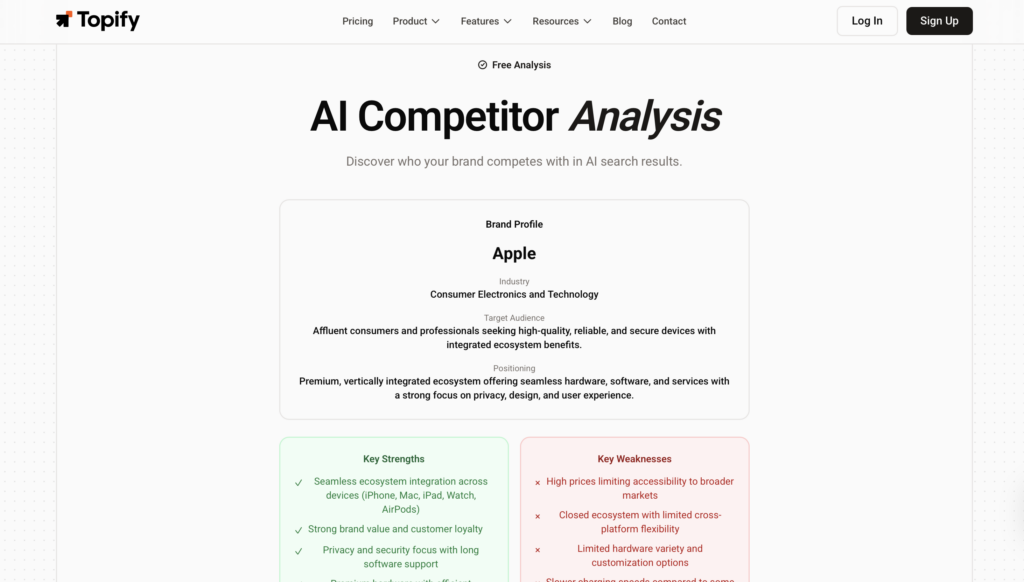
Commercial platforms are the faster path. Topify offers an integrated AI brand intelligence platform that covers all five measurement components and connects visibility data to actionable execution, without requiring you to build the underlying data infrastructure.
In practice, Topify runs prompt simulations across ChatGPT, Gemini, Perplexity, DeepSeek, and regional engines like Qwen and Doubao, then surfaces Visibility, Sentiment, Position, and Source Attribution data in a unified dashboard. You can see where your brand stands across platforms in a single view, not six separate reports.
What separates a full AI brand intelligence platform from a basic monitoring tool is the execution layer. Topify’s AI agent translates visibility data into specific content and citation workflows automatically. You define the goal, the system handles the strategy execution.
For teams starting out, the recommended sequence is:
- Audit: Run baseline prompts across the top AI engines for your category.
- Benchmark: Map your position against your top three competitors.
- Optimize: Focus on the citation sources your competitors are winning on that you’re not.
- Automate: Use an AI brand intelligence analytics platform to track drift and execute adjustments continuously.
Topify’s Basic plan starts at $99/month, which covers 100 prompts and 9,000 AI answer analyses across ChatGPT, Perplexity, and Google AI Overviews. For teams managing multiple brands or needing broader platform coverage, the Pro plan at $199/month expands to 250 prompts and 8 projects.
Conclusion
An AI brand intelligence system isn’t a replacement for existing analytics. It’s the layer that existing analytics were never built to cover: how AI engines perceive, validate, and recommend your brand to buyers who never visit a search results page.
The brands building this infrastructure now are the ones that will hold AI recommendation positions when the market catches up. The ones waiting are handing that ground to competitors who aren’t.
If you don’t know your current mention rate, sentiment direction, or citation coverage across the major AI platforms, that’s the starting point. Run a baseline audit. The data tends to be more surprising than most teams expect.
FAQ
Q: What is an AI brand intelligence system?
A: An AI brand intelligence system is a software platform that interfaces directly with large language models to measure how AI engines like ChatGPT, Gemini, and Perplexity perceive, position, and recommend a brand. Unlike traditional social monitoring, it uses prompt-based simulation to analyze RAG outputs, tracking metrics like visibility rate, sentiment score, position ranking, source attribution, and conversion visibility rate.
Q: How does an AI brand intelligence system work?
A: The system runs a library of buyer-intent prompts across multiple AI platforms and captures the outputs. It analyzes which brands are mentioned, in what order, with what sentiment framing, and citing which third-party sources. Over time, it tracks how these signals change, giving marketing teams a continuous view of their brand’s standing inside AI-generated recommendations.
Q: How do I measure whether my AI brand intelligence system is effective?
A: Track four signals over time: mention rate trend across buyer-intent prompts, sentiment velocity, citation domain coverage (the quality and authority of sources AI uses to validate your brand), and relative position delta against competitors. Improvement across all four indicates a working GEO strategy. A flat or declining trend in any one of them typically points to a specific gap in your content or citation ecosystem.
Q: What does AI brand intelligence system pricing typically look like?
A: Commercial platforms vary widely. Topify’s Basic plan starts at $99/month, covering 100 prompts and 9,000 AI answer analyses. The Pro plan runs $199/month for larger teams. Enterprise pricing starts at $499/month for custom configurations. Building internal infrastructure from scratch is significantly more expensive when factoring in prompt library maintenance, API integration, and ongoing model monitoring costs.

