

Your domain authority is solid. Your keyword rankings are holding. But none of that tells you whether ChatGPT is recommending your competitor instead of you. The shift to AI-generated answers has created a visibility gap that traditional analytics tools weren’t built to close. An AI brand intelligence dashboard is built for exactly that gap.
Your SEO Rankings Don’t Tell the Whole Story Anymore
Traditional search analytics measure clicks, sessions, and SERP position. Those metrics still matter, but they measure navigation. AI search doesn’t work that way.
When someone asks ChatGPT “what’s the best [your category] tool,” the engine synthesizes an answer. Your brand either gets mentioned or it doesn’t. No click happens either way. Standard attribution models fail to capture this, which is why most monthly reports have a blind spot where AI visibility data should be.
The core conflict is this: SEO prioritizes getting a user to your page. GEO prioritizes being the source the AI trusts enough to cite. A brand can rank #1 on Google and be completely absent from AI answers, and most teams won’t notice until a competitor is already solidly positioned.
That’s the gap an AI brand intelligence dashboard is designed to expose.
What an AI Brand Intelligence Dashboard Actually Tracks
The metrics that matter in AI search are fundamentally different from traditional KPIs. Here’s what a well-built AI brand intelligence dashboard covers:
Visibility Rate measures the percentage of commercial-intent queries where your brand gets mentioned. It’s the baseline number that tells you whether AI systems have enough context to include you at all.
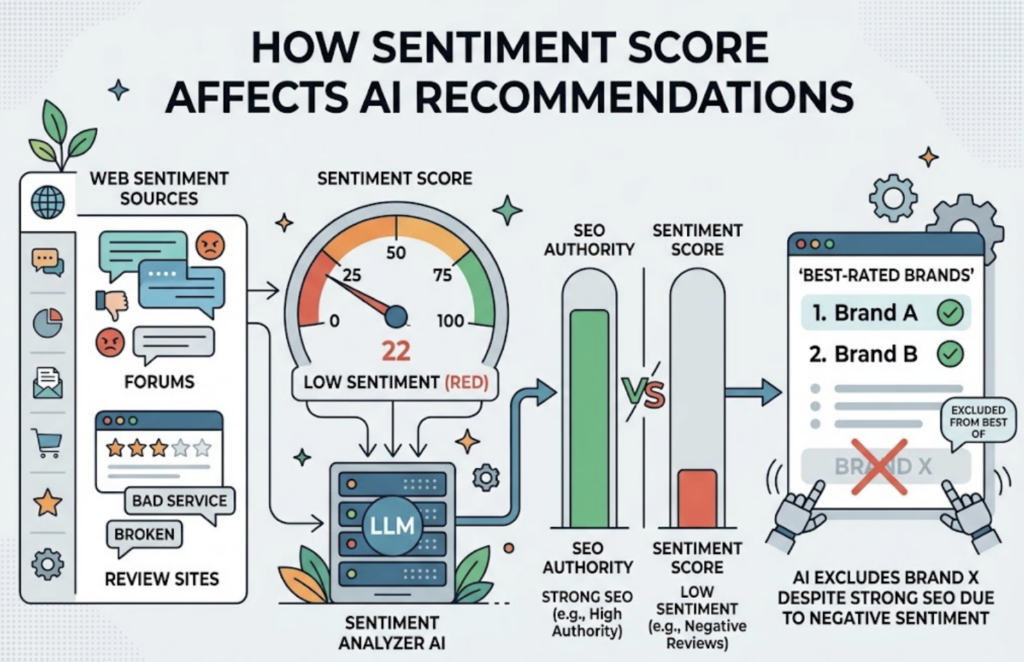
Sentiment Score tracks the emotional tone of how AI describes your brand, typically on a 0-100 scale. This matters because LLMs aggregate sentiment from the web. If forums and review sites skew negative, the model may quietly exclude your brand from “best of” recommendations, even if your SEO authority is strong.
Position Tracking shows where your brand appears relative to competitors in AI answers. Being mentioned fifth in a recommendation list is very different from being the first suggestion.
Source Attribution identifies the specific domains and URLs the AI cites when referencing your brand. This tells you which content the AI currently trusts, and where your gaps are.
Competitor Monitoring surfaces which brands the AI recommends alongside or instead of yours, including newly emerging competitors you may not be tracking.
AI Volume Analytics quantifies how frequently your target prompts are being asked across AI platforms, giving you a sense of which topics have real traffic potential.
CVR (Conversion Visibility Rate) estimates how likely an AI recommendation is to drive actual user engagement toward your brand.
Together, these seven metrics replace a single vanity number with a full-spectrum view of your brand’s health inside AI systems.
How to Read Your Dashboard Without Getting Lost
More data isn’t automatically useful. The goal of an AI brand intelligence dashboard is clarity, not comprehensiveness.
Start with Visibility Rate. If your brand isn’t appearing in a meaningful percentage of relevant queries, everything else is secondary. A low visibility rate means the AI doesn’t have enough reliable signal to include you, and that’s a content and authority problem to solve before optimizing Sentiment or Position.
Once visibility is established, shift attention to Sentiment Score. According to research on AI brand visibility tracking, models can suppress brands from positive recommendations when training data contains widespread negative signals from forums or review platforms. A visibility rate of 60% paired with a declining sentiment score is a warning sign worth catching early.
Source Attribution deserves a weekly review. AI platforms don’t announce when they change which sources they rely on. Monitoring citation domains is often the first signal that something has shifted in how the model perceives your brand authority.
A practical weekly review process: check Visibility Rate for significant drops, scan Sentiment for directional changes, and review Source Attribution for any domains that stopped citing you. That three-step check catches most meaningful changes before they compound.
5 Blind Spots That Standard Analytics Tools Won’t Show You
Most marketing teams are currently operating with significant gaps in their AI brand intelligence. These are the most common ones.
Single-platform monitoring. Tracking only ChatGPT leaves out Perplexity, Gemini, and other AI engines that are growing as primary search surfaces. Each platform has different citation patterns and recommendation logic. A brand that appears consistently in ChatGPT may be largely absent from Perplexity.
No sentiment tracking. Mention volume and sentiment move independently. A brand can be mentioned frequently while being framed negatively (“frequently criticized for poor customer support”) or neutrally excluded from “best of” lists. Sentiment Score separates those outcomes.
Static reporting. AI model outputs shift based on web crawls, training updates, and citation changes. A quarterly report is already stale by the time it’s delivered. Continuous monitoring is the only way to catch changes before they affect recommendations in your favor or against you.
Mentions without position data. Being mentioned in an AI answer is not the same as being recommended first. If your brand consistently appears as the third or fourth option after two competitors, you have an AI brand intelligence gap that mention-count metrics won’t surface.
No source-level analysis. Knowing that Perplexity is recommending a competitor is useful. Knowing which specific domains Perplexity cites when recommending that competitor is actionable. Source attribution is where insight becomes strategy.
How Topify’s AI Brand Intelligence Dashboard Works in Practice
Topify is built around the exact metrics above, pulling them into a single AI brand intelligence dashboard that covers ChatGPT, Perplexity, Gemini, and other major platforms simultaneously.
The dashboard organizes visibility, sentiment, position, volume, mentions, intent, and CVR into a structured view per prompt and per platform. In practice, this means a marketing team can open Monday morning, see that visibility dropped 8 points on Perplexity over the past week, trace the drop to a specific source that stopped citing them, and have a content response queued by end of day.
Competitor Monitoring surfaces newly emerging rivals automatically. You don’t have to manually add every brand to a watchlist; the platform detects who AI engines are recommending alongside your category and tracks their position changes relative to yours.
Source Analysis shows the exact URLs AI platforms are currently citing in answers that mention your brand. This is the mechanism that reverse-engineers AI citations at scale, so you can prioritize earning coverage on the domains that actually influence model recommendations.
For teams that want to move from data to action, Topify’s One-Click Execution lets you define goals in plain language and deploy a GEO strategy without manually building workflows. The AI agent monitors, reasons, and acts on your behalf on an ongoing basis.
Topify’s Basic plan starts at $99/month, which includes tracking across ChatGPT, Perplexity, and AI Overviews, 100 prompts, and 9,000 AI answer analyses per month. The Pro plan at $199/month expands to 250 prompts and 22,500 analyses. Enterprise plans start at $499/month for custom configurations. All plans include a 30-day trial.
AI Brand Intelligence Dashboard Pricing: What to Expect
The tooling market has split into two segments with different value propositions.
Lightweight tools in the $50-$150/month range typically offer basic mention tracking and rudimentary sentiment analysis, often restricted to a single platform. They’re useful for getting initial signal but struggle to support the kind of cross-platform, source-level analysis that actually drives strategic decisions.
Enterprise platforms in the $400-$1,000+/month range provide comprehensive dashboards, historical trend analysis, competitive benchmarking, and multi-LLM source attribution. The additional cost is usually justified for brands where AI search visibility has a direct commercial impact on pipeline or revenue.
One underrated evaluation criterion: the ability to export response history. Understanding why an AI chose a competitor over your brand on a specific prompt is more strategically valuable than the metric itself. Platforms that only show current snapshots leave you guessing about causation.
Topify sits in the enterprise range while starting at a price point that makes it accessible for mid-market teams. The $99/month entry tier covers the core AI brand intelligence dashboard functionality that most teams need before they’re ready to scale prompt coverage.
Common Mistakes Teams Make With Brand Intelligence Dashboards
Getting a dashboard is step one. Actually using it effectively is different.
Setting it up once and not monitoring continuously. AI citation patterns shift with model updates and web crawls. A brand that was well-positioned in February may be cited less frequently by April without anyone noticing. Continuous monitoring isn’t optional once AI search becomes a meaningful traffic and acquisition channel.
Tracking visibility but ignoring sentiment. Visibility Rate tells you if you’re in the conversation. Sentiment Score tells you whether the AI is recommending you or just mentioning you. The difference between “Brand X is popular in this category” and “Brand X is frequently recommended by experts” is a sentiment gap that affects conversion.
Focusing only on your own brand. Competitor Monitoring often surfaces the most actionable intelligence. Understanding which sources a competitor has earned coverage on, and which prompts they appear in that you don’t, is faster to act on than guessing at your own gaps.
Treating AI brand intelligence as a reporting tool rather than an optimization input. The output of a dashboard should drive content decisions, source acquisition strategy, and sentiment management. Teams that generate weekly reports without changing their GEO strategy are leaving the value on the table.
Conclusion
An AI brand intelligence dashboard doesn’t replace your existing analytics stack. It fills the specific gap between what traditional tools can see and where your potential customers are actually making decisions.
The brands building visibility in AI search now are establishing citation patterns that will compound over time. Waiting until AI search is a clearly dominant channel means competing against brands that have already earned the trust signals that matter. Starting with a structured dashboard, even a basic one, puts you in a position to act on the data rather than explain the gap.
Get started with Topify to see where your brand stands in AI answers today.
FAQ
Q: What is an AI brand intelligence dashboard?
A: An AI brand intelligence dashboard is a monitoring and analytics platform that tracks how your brand appears across AI search engines like ChatGPT, Perplexity, and Gemini. Unlike traditional SEO tools, it measures metrics specific to AI-generated answers: visibility rate, sentiment score, position relative to competitors, and the sources that AI systems cite when referencing your brand.
Q: How does an AI brand intelligence dashboard work?
A: The platform runs structured queries across AI engines and analyzes the responses. It extracts where and how your brand appears, what sentiment the AI associates with it, which competitors appear alongside or instead of you, and which domains the AI is citing as sources. Over time, it builds a trend view that reveals how your AI brand intelligence metrics are shifting.
Q: How do I measure AI brand intelligence dashboard performance?
A: The core KPIs to track are Visibility Rate (what percentage of relevant prompts include your brand), Sentiment Score (whether the AI frames your brand positively or neutrally), Position (where you appear relative to competitors), and Source Attribution (which domains the AI trusts for your category). A meaningful benchmark is comparing these metrics across platforms and tracking week-over-week trends rather than point-in-time snapshots.
Q: What should I look for in an AI brand intelligence tool?
A: Prioritize multi-platform coverage (not just ChatGPT), source-level attribution (not just mention tracking), sentiment analysis beyond simple positive/negative labels, and the ability to monitor competitor positioning. Also look for continuous monitoring rather than on-demand snapshots, since AI citation patterns shift frequently. Pricing typically ranges from $50-$150/month for lightweight tools to $400-$1,000+/month for full AI brand intelligence platforms.

