

Your brand might rank #1 on Google and still not exist inside a ChatGPT answer.
That’s the gap AI brand intelligence analytics is designed to close. It’s not a repackaged version of social listening or SEO reporting. It’s a distinct discipline: measuring how AI systems perceive, describe, and recommend your brand across the platforms where your buyers now go for answers.
If you don’t measure it, you can’t manage it.
What “Mentioned by AI” Actually Means
When someone asks ChatGPT “What’s the best project management tool for remote teams?” and your brand doesn’t appear, you haven’t lost a keyword ranking. You’ve lost a recommendation.
Traditional brand monitoring tools like Brandwatch or Sprout Social track social media streams and news mentions. AI brand intelligence analytics tracks something different: how an LLM synthesizes information about your brand when it forms an answer. The AI isn’t returning a list of links. It’s making a judgment call.
This creates two structural shifts in how you measure brand presence. First, citation rate and sentiment consistency replace click-through rate as the meaningful KPIs. Second, the “zero-click” experience is now the default: the user gets their answer and moves on, with no visible traffic signal for you to track.
Why Your Current Brand Monitoring Misses This
Most marketing teams are still applying 2012 SEO logic to a 2026 environment.
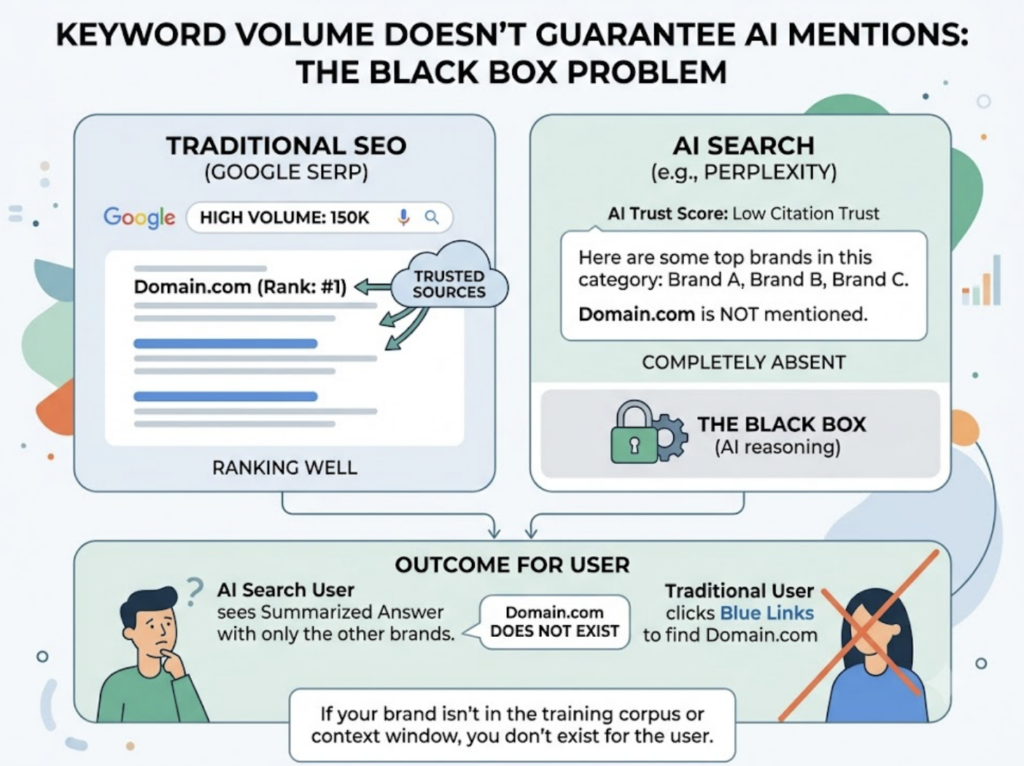
Keyword volume doesn’t correlate with AI mention rate. A domain that ranks well in Google’s SERP can be completely absent from Perplexity’s answers if the AI doesn’t trust the sources that cite it. That’s the “black box” problem: unlike a blue-link index, AI search is a curated, summarized answer. If your brand isn’t in the training corpus or the retrieved context window, you effectively don’t exist for that user.
The strategic shift this requires is real. You’re not chasing positions anymore. You’re earning citations.
The 5 Metrics That Define AI Brand Intelligence Analytics
An AI brand intelligence system needs to track five distinct data points. Anything less is incomplete.
| Metric | What It Measures | Why It Matters |
|---|---|---|
| Visibility Rate | % of commercial-intent queries where your brand is mentioned | Baseline for entity awareness in AI |
| Sentiment Score | Emotional tone AI ascribes to your brand (positive/neutral/negative) | Detects hallucinations and legacy negative associations |
| Position Rank | Where your brand appears in AI-generated lists vs. competitors | Drives impact on decision-stage queries |
| Source Attribution | Specific URLs/domains AI cites when referencing your brand | Identifies which content the model treats as authoritative |
| Prompt Coverage | Breadth of queries that trigger a brand mention | Measures depth of entity authority across the category |
Each metric answers a different question. Visibility tells you if you’re in the room. Position tells you where you’re seated. Sentiment tells you how you’re being introduced. Source attribution tells you why. Prompt coverage tells you how consistently all of the above hold across different user queries.
A real AI brand intelligence analytics system tracks all five. A dashboard that only shows mention count is giving you one variable out of five.
3 Mistakes That Undermine Your AI Brand Intelligence Data
Most teams that start measuring AI brand intelligence make one of three errors early on. They’re worth naming directly.
Mistake 1: Counting mentions without auditing sentiment. A brand can have 100 AI mentions and still be losing. If 90 of those mentions are framed negatively, or if the AI is surfacing outdated, low-trust information, higher visibility is actively damaging. An AI brand intelligence tool should flag sentiment anomalies, not just mention totals.
Mistake 2: Measuring one model and calling it done. ChatGPT is not the full picture. Different LLMs weight training data differently. A brand that leads in Gemini might not appear at all in Perplexity. Your AI brand intelligence analytics strategy needs multi-platform coverage from day one.
Mistake 3: Optimizing for keywords instead of entity authority. AI engines don’t rank keywords. They prioritize factual accuracy and authoritative source clusters. Trying to “force-rank” for a phrase the way you would in traditional SEO won’t move your AI brand intelligence metrics. Building structured, citable, authoritative content will.
How to Build an AI Brand Intelligence Analytics Strategy
The operational framework here is straightforward. Four steps, run continuously.
Step 1: Define Your Prompt Universe
Build a database of high-intent prompts that match how your buyers actually search. Think “What are the best [industry] tools for [use case]?” and “Compare [your brand] vs. [competitor].” These become your tracking anchors. Without a defined prompt set, you’re measuring a random sample, not your market.
Step 2: Set Baseline Metrics
Before you optimize anything, audit your current state across all major AI platforms. Establish a share-of-voice baseline for each key category. This is your starting line. Everything you do from here should move these numbers.
Step 3: Track Weekly Across Platforms
LLMs update their retrieval sources continuously. A brand’s position can shift overnight if a key citation source loses its authority or a competitor secures better coverage. Weekly tracking is the minimum cadence that lets you catch changes before they compound.
Topify‘s Visibility Tracking monitors brand performance across ChatGPT, Gemini, Perplexity, and other major AI platforms automatically, running prompt batches and surfacing week-over-week changes without manual prompt testing.
Step 4: Act on Source Attribution Data
This is where most teams stop reading the data and start actually using it. When the AI cites a competitor instead of you, the source attribution data tells you why: better structured data, recent authoritative press, links from sources the AI favors. Topify’s Source Analysis identifies the exact domains AI platforms cite, so you can close the authority gap rather than guess at it.
AI Brand Intelligence Tools: What the Market Looks Like
The tooling market for AI brand intelligence analytics currently breaks into three tiers:
Tier 1: Manual / In-house ($0/mo + labor). Scripts, manual prompt testing, spreadsheets. Cheap to start, but high labor cost, no historical depth, and inconsistent tracking across platforms. Works for initial exploration, doesn’t scale.
Tier 2: Dedicated AI brand intelligence platforms ($99 to $499/month). This is where purpose-built tools like Topifyoperate. Topify automates prompt runs across multiple LLMs, tracks all five core metrics in a single AI brand intelligence dashboard, and surfaces competitor gaps in real time. The Competitor Monitoring feature benchmarks your visibility, sentiment, and position against rivals automatically. The Sentiment Analysis module runs a 0-100 scoring model that flags tone shifts before they become reputation problems.
The key differentiator at this tier isn’t just reporting. It’s execution. Topify’s One-Click Execution lets you define a strategy goal in plain English and deploy it without building manual workflows.
Tier 3: Enterprise agency suites ($500 to $2,000+/month). Full-service management including monitoring, content production, and PR strategy. Appropriate for brands with complex multi-market needs. For most mid-sized businesses, a dedicated AI brand intelligence software platform offers better ROI by staying focused on the metrics that matter.
According to BlastX Consulting’s 2026 research, the biggest gap in this category isn’t data collection. It’s the gap between AI insight and organizational action. The tool matters less than whether your team can actually use what it surfaces.
AI Brand Intelligence Analytics Pricing: What to Budget
Pricing in this category follows the three-tier structure above.
If you’re building in-house, the real cost is labor: typically 10 to 20 hours per month of analyst time to run prompts manually, compile reports, and attempt cross-platform normalization. At standard agency rates, that’s $1,500 to $3,000/month in hidden cost with no structured output.
Purpose-built AI brand intelligence platforms start at around $99/month (Topify’s Basic plan includes 100 prompts, 9,000 AI answer analyses, and tracking across ChatGPT, Perplexity, and AI Overviews). The Pro tier at $199/month expands to 250 prompts and 22,500 analyses. Enterprise plans start at $499/month with dedicated account management and custom configuration.
For teams evaluating AI brand intelligence solutions, the calculation isn’t platform cost vs. zero. It’s platform cost vs. labor cost vs. the revenue impact of being absent from AI recommendations while competitors aren’t.
Conclusion
AI brand intelligence analytics isn’t a future concern. Brands that don’t measure their AI search presence in 2026 are making decisions without roughly half their data.
The framework is clear: track visibility, sentiment, position, source attribution, and prompt coverage. Avoid the three measurement mistakes most teams make early. Build a prompt universe, set baselines, track weekly, and act on source data.
The tools to do this exist. The question is whether your team is using them.
FAQ
What is AI brand intelligence analytics?
AI brand intelligence analytics is the practice of measuring and managing how AI systems perceive and recommend a brand. It tracks metrics like visibility rate, sentiment score, position rank, and source attribution across AI platforms like ChatGPT, Perplexity, and Gemini.
How does AI brand intelligence analytics work?
A defined set of commercial-intent prompts is run across multiple AI platforms on a recurring basis. The system records whether the brand is mentioned, how it’s described, where it ranks among competitors, and which external sources the AI cited. These data points are aggregated into a dashboard for tracking and action.
How do I measure AI brand intelligence analytics?
Start by defining your prompt universe, then establish baseline metrics across your key AI platforms. Track the five core metrics weekly: visibility rate, sentiment score, position rank, source attribution, and prompt coverage. Tools like Topify automate this process across platforms.
How to improve AI brand intelligence analytics scores?
Improvement comes from closing authority gaps. When source attribution data shows the AI citing competitors, analyze which domains it trusts and why. Produce structured, citable content on those platforms, secure authoritative coverage, and ensure your brand’s information is consistently accurate across AI-retrievable sources.

