

Your rankings are holding steady. Impressions in Search Console keep climbing. Then you pull the click numbers and they’ve barely moved, or they’re sliding backward, and nothing in your usual dashboard explains why. The instinct is to blame the content calendar, a core update, or a technical issue nobody’s found yet. None of that is what’s happening. Zero click searches now account for the majority of Google activity, and the reporting stack most SEO teams still rely on was built for a search engine that no longer works that way.
Zero-Click Searches Are Quietly Rewriting What “Ranking #1” Means
The scale of the shift is hard to overstate. 68.01% of US Google searches ended without a single click in the first four months of 2026, up from 60.45% in 2024. SparkToro calls it the fastest two-year acceleration it’s measured since it started tracking the metric in 2016, when the rate sat closer to 45%.
Mobile is driving most of the change. Zero-click rates hit 77% on mobile devices, compared to roughly 50 to 56% on desktop. Informational queries, the kind that used to send readers to blog posts and guides, now resolve without a click 74% of the time.
That’s not a niche pattern buried in one query type. It’s the default outcome for most searches your content is built to answer.
Why Zero-Click Searches Broke the Old SEO Scoreboard
Traditional SEO reporting runs on one assumption: if you rank, someone clicks. AI Overviews broke that assumption at the source. When an AI Overview appears on a search results page, click-through rate for the top-ranked result falls by roughly 37.5%, and the overall zero-click rate for that query jumps toward 83%.
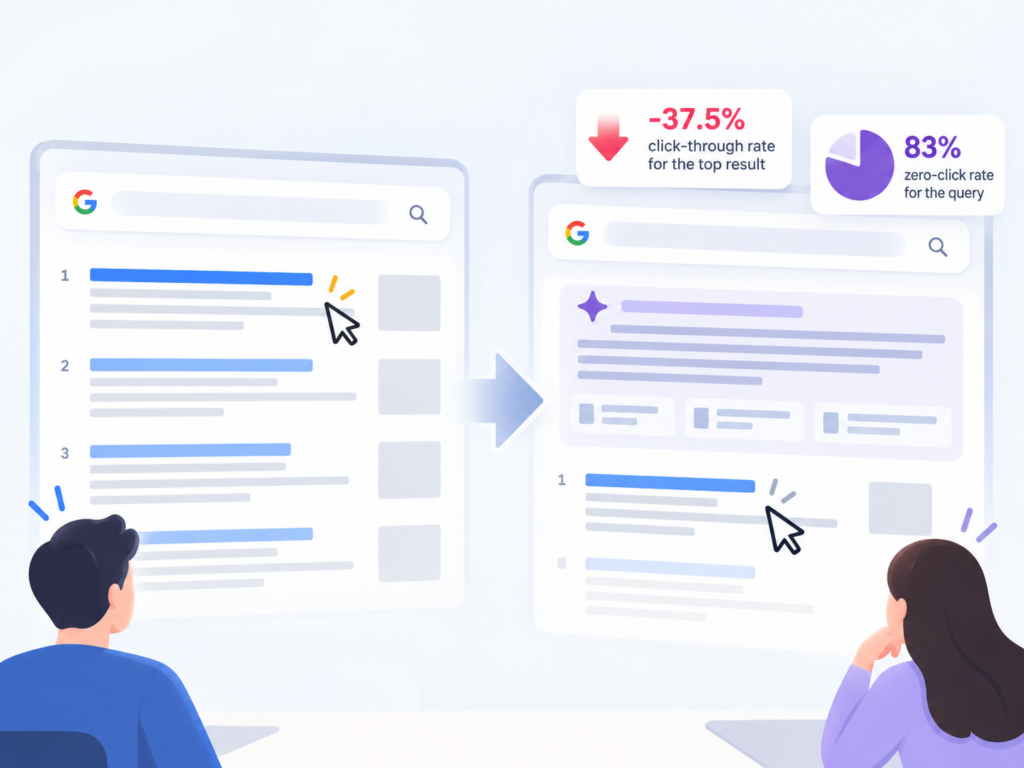
Pew Research found the same pattern from a different angle, watching real search sessions instead of aggregated data. Click rate on a query dropped from 15% to 8% once an AI Overview showed up, roughly cutting it in half.
You didn’t lose your ranking. The page that used to convert a ranking into a visit stopped being the only page that matters.
The Real Problem Isn’t Traffic. It’s a Measurement Blind Spot
Here’s the part most teams miss. A drop in organic sessions doesn’t necessarily mean a drop in visibility. It might mean your brand is showing up inside the answer itself, in an AI Overview, a ChatGPT response, or a Perplexity summary, without anyone clicking through to confirm it. Google Analytics has no field for that. Search Console can’t see it either.
You’re not necessarily losing visibility. You’re losing the ability to see it.
This isn’t a hypothetical gap. Semrush’s 2026 AI Visibility Index, built from 126 million AI search prompts, found that 45% of marketing leaders can’t accurately measure their brand’s visibility inside AI-generated answers. Only 9% have tools that track every relevant metric across platforms. The same research uncovered a subtler trap: on Gemini, the overlap between brands mentioned in an answer and the domains actually cited as sources drops to as low as 30%. Your name can appear in the answer while a competitor’s site gets the citation credit, and a click-based report would show neither event.
The problem compounds outside consumer search too. A survey of 104 senior B2B marketing leaders found 81% consider AI visibility a blind spot in their marketing intelligence, with 21% calling it a major one. These are teams with mature SEO programs. They’re just measuring the wrong layer now.
What You Actually Need to Measure in a Zero-Click World
Clicks used to be a reasonable proxy for four different things: whether you were found, how you were perceived, whether you outranked competitors, and whether any of it drove business. Zero-click search severs that proxy. Each of those now needs its own metric.
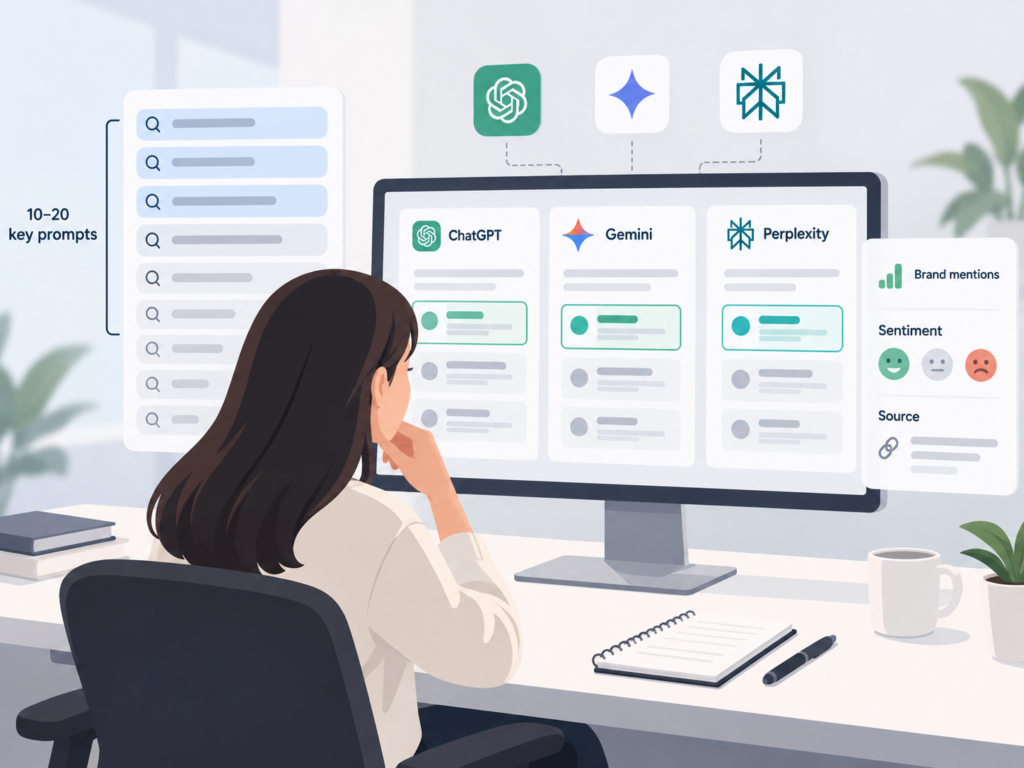
- Visibility: are you mentioned at all when someone asks an AI system about your category, regardless of whether they click anything
- Sentiment: how does the AI describe your brand when it does mention you, and does that match your actual positioning
- Position: where do you land relative to competitors when multiple brands appear in the same answer
- Source: which domains and pages the AI is actually pulling from, since that’s where influence over future answers gets built
None of these show up in a standard analytics report, because none of them require a click to happen.
Where Traditional Analytics Tools Fall Short Here
This isn’t a knock on Google Analytics or Search Console. They were built to measure what happens after someone reaches your site, and they still do that well. The gap is upstream, in the moment an AI system decides whether to mention you, describe you accurately, and point to your content as the source. That moment happens entirely off your own domain, which is exactly why session-based tools can’t see it.
How Topify Turns Zero-Click Visibility Into Measurable Data
This is the layer Topify was built to close. Its Comprehensive GEO Analytics tracks brand performance across ChatGPT, Gemini, Perplexity, and other major AI platforms through the same dimensions the zero-click shift just made essential: visibility, sentiment, position, and source.
In practice, that means a marketing team can spot a drop in ChatGPT mentions for their category and trace it back to a specific domain that recently started dominating the citations, all inside the same dashboard instead of piecing it together across screenshots and manual prompts. Source Analysis reverse-engineers which URLs an AI platform is actually citing, so a brand that’s being mentioned but not credited can see exactly where the credit is going instead. Sentiment tracking catches the kind of drift the B2B survey flagged, where an AI system’s description of a brand quietly stops matching how that brand positions itself.
For teams trying to justify a GEO investment internally, Topify’s CVR metric estimates how likely an AI-generated answer is to actually move a user toward engaging with your brand, giving zero-click visibility a number that connects to outcomes rather than stopping at “we were mentioned.” That distinction matters more than it sounds. AI-referred traffic is growing fast enough to demand it: Adobe found that AI traffic to US retail sites climbed 1,324% between October 2024 and May 2026, and 2,215% in travel over the same period. A channel growing that quickly needs its own reporting line, not a footnote in an organic traffic report.
Putting Zero-Click Search Measurement Into Practice
Start narrow. Pick the 10 to 20 prompts most likely to surface your category, the same way you’d pick priority keywords, and check where your brand shows up across two or three AI platforms. Track sentiment and source alongside mentions from day one, not as a later add-on, since a mention with the wrong sentiment or no source credit isn’t the win it looks like on the surface.
Report it separately from organic traffic at first. Folding a new, currently-smaller number into an existing traffic report just makes the existing number look worse. Framed on its own, with visibility and sentiment trends over a few weeks, it tells a clearer story about where the brand actually stands.
Conclusion
A ranking that no longer converts to a visit isn’t proof your content failed. It’s proof the scoreboard changed underneath you. Zero-click search didn’t remove your visibility, it just moved most of it somewhere your existing tools can’t reach. The teams treating this as a measurement gap, and building a way to see mentions, sentiment, position, and source, are the ones who’ll have a real answer the next time someone asks why traffic is flat while rankings look fine.
FAQ
Q: What exactly counts as a zero-click search?
A: A search that ends without the user clicking any result, organic or paid, because the query gets answered directly on the results page through a featured snippet, knowledge panel, or AI Overview.
Q: Does a high zero-click search rate mean SEO is no longer worth doing?
A: No. It means clicks stopped being the only signal that matters. Being cited or mentioned inside an AI answer can still influence a buyer’s decision even without a visit, which is why visibility and sentiment tracking matter alongside traditional traffic metrics.
Q: How is zero-click search rate different from AI Overview click-through rate?
A: Zero-click search rate covers all searches, including ones resolved by featured snippets or knowledge panels with no AI involved. AI Overview CTR looks specifically at what happens when Google’s generative summary appears, which tends to push zero-click rates even higher for that subset of queries.
Q: What’s the first thing a team should measure to understand its zero-click search exposure?
A: Start with visibility, whether your brand is mentioned at all across a set of category-relevant AI prompts, before layering in sentiment and source analysis. Mentions with no way to check accuracy or citation credit give an incomplete picture on their own.

