


Your AI visibility report landed in your inbox this morning. It’s got a dashboard full of percentages, a line chart trending slightly up, and a mention count that moved from 340 to 362 last month. None of that tells you why the mentions moved, which platform is actually costing you customers, or what to change before next month’s report looks the same.
That gap between having data and having a decision is where most AI visibility reporting quietly fails.
Your AI Visibility Report Probably Looks Like This
Open a typical AI visibility report and you’ll find the same shape every time. A visibility score. A mention count. Maybe a sentiment badge that says “mostly positive.” It answers the question “are we showing up,” which matters, but it’s not the only question that matters.
The scale of the underlying problem is bigger than most teams realize. One analysis of 1,700 businesses across 32 industries found that 88% were invisible when checked against ChatGPT, and a separate audit of nearly 7,000 buyer-question checks put the overall AI citation rate at just 15.3%, with half of brands invisible across all four major platforms tested.
A report that only shows a score can’t explain either number. It can tell you that you’re in the invisible half. It can’t tell you why, or what to fix first.
The AI Visibility Metrics a Complete Report Can’t Skip
A complete set of AI visibility metrics covers more ground than a single score. At minimum, a report needs to separate five things: whether you’re mentioned, how you’re positioned relative to competitors, what tone the AI uses toward you, which sources it’s pulling from, and how often the topic gets asked about at all. One competitor visibility framework frames this the same way, auditing five dimensions across mention frequency, citation sources, sentiment, share of voice, and prompt coverage.
Each dimension answers a different question. Mention frequency tells you if you exist in the conversation. Position tells you if you’re the first answer or the fifth. Sentiment tells you if the AI is helping or hurting you. Source analysis tells you where the AI is getting its facts. Miss any one, and you’re steering with half the dashboard dark.
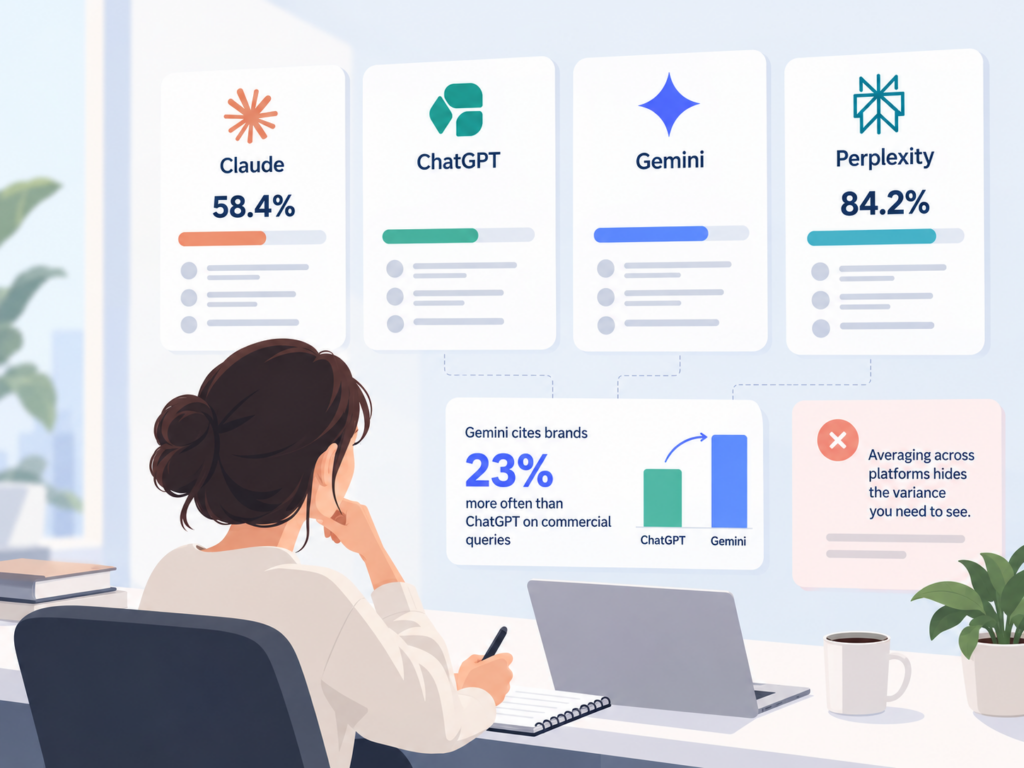
Platforms don’t behave the same way, either. Testing across 8,400 prompts found brand mention rates ranging from 58.4% on Claude to 84.2% on Perplexity, and a separate benchmark of 60 brands found Gemini citing brands 23% more often than ChatGPT on commercial queries. A report that averages across platforms instead of breaking them out hides exactly the variance you need to see.
Being Mentioned Isn’t the Same as Being Recommended
This is the distinction most dashboards blur. A brand can show up in an AI answer and still lose the sale, if the answer buries it fourth on a list or frames it as the budget option when it’s positioned as premium.
The Blind Spots Most Vendors Leave Out
Two gaps show up again and again once you start comparing reports against what they’re supposed to measure.
The first is source attribution. Knowing you’re mentioned is useless if you don’t know which page, listing, or article the AI pulled that mention from. Research analyzing 6.8 million AI citations found that 86% of citations traced back to brand-managed sources, split between first-party websites at 44% and business listings at 42%. If your report doesn’t show you which of your own pages is doing the work, you can’t double down on it or fix the ones that aren’t.
The second is the connection between AI visibility and traditional search performance, because the two don’t move together the way most teams assume. One study of 150 SaaS companies found that 44% of brands ranking in Google’s top 10 got zero ChatGPT citations for the same keywords, and organic traffic turned out to be a weak predictor of AI citations at all. A report that only tracks AI mentions in isolation, without flagging that gap, leaves teams assuming their SEO investment is already covering this.
That’s the trap. Strong Google rankings feel like proof you’re covered. The data says otherwise.
There’s a structural reason vendors skip these layers. As one analysis of GEO reporting put it, most dashboards function as “an observation layer dressed up as a strategy tool”, tracking citation counts and sentiment scores without connecting either one to a specific piece of content or a next action. Building the connective layer takes more engineering than building the count.
A Two-Minute Check for Whether Your Report Holds Up
Before your next reporting cycle, run your current report through a short checklist. Does it break results out by platform instead of averaging them? Does it name the actual source URL behind each citation, not just a citation count? Does it show sentiment as a trend, not a single snapshot? Does it compare your position against named competitors on the same prompts, not just your own numbers in isolation?
If you answered no to more than one, the report is measuring visibility without explaining it. One team building an alternative approach summed up the failure mode bluntly: your citation rate moves, and the report gives you no way to find out why.
How Topify Structures a Complete AI Visibility Report
Filling those gaps means building the reporting layer around metrics that connect to each other, not a single headline score. Topify structures its reporting around seven metrics in one view: visibility, sentiment, position, volume, mentions, intent, and CVR, so a drop in one number can be traced to a shift in another instead of showing up as an unexplained blip.
In practice, that means a marketing team tracking a sentiment dip can pull up Position Tracking and Source Analysis in the same dashboard to see whether a specific competitor gained ground, or whether a single low-authority source started getting cited more often. Topify’s citation analysis works backward from the AI’s answer to the exact domains it drew from, which is the source-attribution layer most reports leave out entirely. Its competitor benchmarking runs the same prompts against named rivals automatically, so position isn’t reported in isolation.
None of that replaces judgment. It just gives the people making the call something to base it on, instead of a percentage with no explanation attached. Teams evaluating their current setup can get started with Topify to see what a report built this way actually looks like against their own brand.
Conclusion
A visibility score tells you where you stand. It doesn’t tell you why you’re there or what to do next, and that’s the piece most reports still skip. Before your next AI visibility report lands, check it against the five dimensions that matter: mentions, position, sentiment, sources, and platform-level breakdowns. If two or three are missing, you’re not getting a report. You’re getting a headline number with a chart attached.
FAQ
Q: What should an AI visibility report actually include?
A: At minimum, it should break out mention frequency, position relative to named competitors, sentiment trends over time, and the specific sources or domains the AI cited, separated by platform rather than averaged together.
Q: Is there a standard AI visibility report template?
A: Not yet an industry-wide standard, but most complete reports converge on the same core structure: a visibility and mention overview, sentiment and positioning detail, source and citation analysis, and competitor benchmarking, often customized by stakeholder audience.
Q: How is an AI visibility report different from a traditional SEO report?
A: SEO reports track rankings, organic traffic, and backlinks. An AI visibility report tracks how often and how favorably a brand gets mentioned inside AI-generated answers, which research shows correlates weakly with traditional rankings.
Q: How often should a brand generate an AI visibility report?
A: Monthly is typical for tracking trend direction, though brands in fast-moving categories often check weekly, since AI platforms can shift which sources they cite in a matter of days.

