

Your team read about the Amazon vs Perplexity ruling as a legal update, filed it under “not my problem,” and moved on. That’s the wrong reaction. The Ninth Circuit didn’t just settle a fight between two companies. It confirmed that an AI shopping agent can operate on almost any retail site a user chooses, which means the real question isn’t whether these agents are allowed to shop anymore. It’s whether they mention your brand when they do.
What the Ninth Circuit Actually Ruled on AI Shopping Agents
The case started in November, when Amazon sued Perplexity over its Comet browser, alleging the tool covertly accessed customer accounts and violated the Computer Fraud and Abuse Act. A federal judge agreed in March 2026 and blocked Comet’s agentic shopping features on Amazon.
That injunction didn’t last. On August 4, 2026, the Ninth Circuit Court of Appeals overturned it, ruling that Amazon was unlikely to win its core legal claim.
The court’s reasoning is now known as the browser analogy. Comet takes a screenshot of what the user’s own browser sees, sends it to Perplexity’s servers, and sends navigation instructions back. Perplexity never talks to Amazon’s servers directly, so the judges compared it to Safari or Chrome: nobody accuses Apple of hacking Amazon just because someone uses Safari to shop there.
That’s the first federal appellate ruling on whether an AI shopping agent can legally act on a user’s behalf online.
Why This Ruling Widens the Lane for Every AI Shopping Agent
This case was about Perplexity, but the logic isn’t Perplexity-specific. It applies to any agent that acts on a user’s instructions rather than accessing a retailer’s systems on its own.
That’s a real narrowing of what a retailer’s terms of service can do. If a court won’t treat the agent’s operator as the one doing the accessing, blocking agents through lawsuits gets a lot harder.
The timing matters, too. Adoption isn’t waiting on court decisions. Seventy percent of brands, retailers, and agencies are already testing or deploying an agentic storefront, and only 7% have no plans at all. On the consumer side, ChatGPT hit 900 million weekly active users in February 2026, and AI-referred traffic to US retail sites was still up 393% year over year in the first quarter.
Ruling or no ruling, shoppers were already handing purchase decisions to agents. This decision just removed one of the few legal levers retailers had to slow that down.
The Real Question: Does Your Brand Get Recommended by AI Shopping Agents
Here’s the shift most marketing teams haven’t made yet. Before this ruling, the risk conversation was about access: could an agent even reach a product page. After it, the risk conversation is about relevance: does the agent mention your product at all.
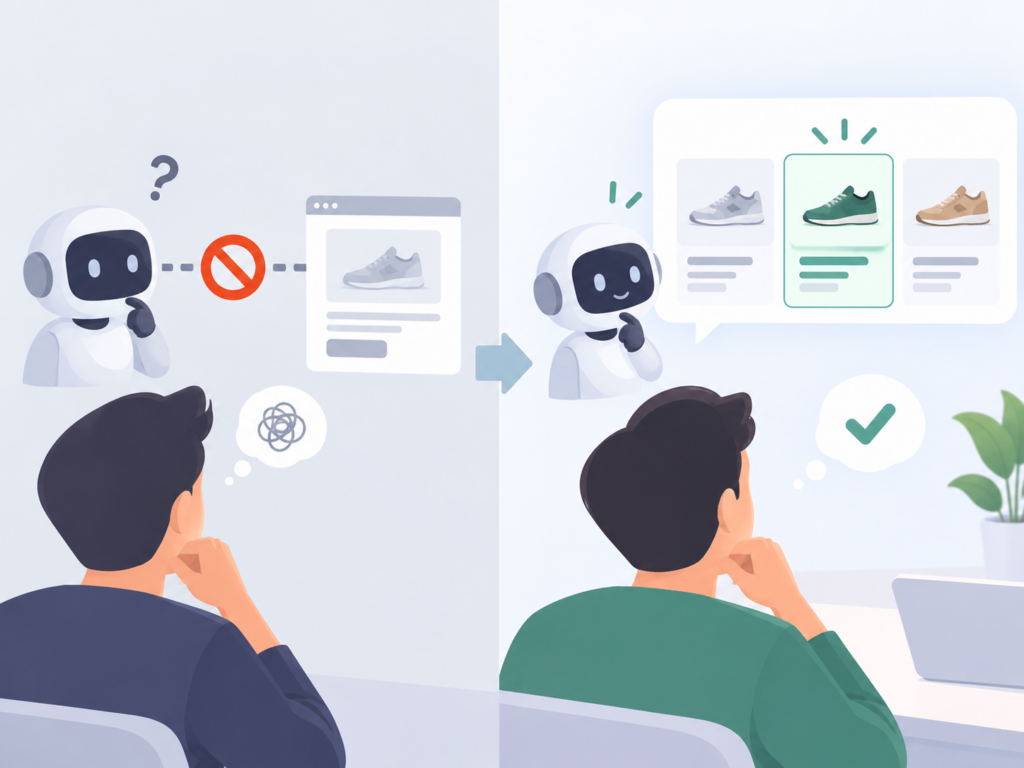
An AI shopping agent doesn’t rank products the way a search engine does. It reads product data, reviews, comparison content, and third-party sources, then decides what to say based on what it can find and trust. There’s no bid, no sponsored slot, no guaranteed placement.
That’s a fundamentally different game than the one most brand and SEO teams have spent a decade optimizing for.
The IBM Institute for Business Value found that 45% of consumers already use AI for part of their buying journey, and usage keeps climbing across every age group. Your domain authority, your keyword rankings, your ad spend on the retailer’s own platform: none of that tells you whether Perplexity or ChatGPT is quietly recommending a competitor instead of you.
How to Measure Whether an AI Shopping Agent Recommends You
Most teams’ first instinct is to type their own product name into ChatGPT and see what comes back. That’s a start, but it only tells you what happens when someone already knows to search for you.
The more useful test runs the prompts a real shopper would type without your brand name in them. Category questions. Comparison questions. “Best X for Y” questions. Then check a few specific things:
- Are you mentioned at all, and how often across repeated runs
- Where you land in the list when you are mentioned
- What tone the agent uses to describe you
- Which sources the agent is pulling its information from
Doing this by hand across ChatGPT, Perplexity, and Gemini, on a rotating set of prompts, tends to fall apart after the first week. That’s the part Topify is built to automate.
For marketing teams tracking this across multiple platforms, Topify pulls visibility, sentiment, and position data into a single view. In practice, that means you can spot a drop in Perplexity mentions and trace it back to the exact source that stopped citing your brand, without running the prompts manually every morning.
What to Do If Your Brand Is Invisible to AI Shopping Agents
If the test above comes back empty, don’t panic and don’t guess. The fix starts with finding out why the agent skipped you, not with publishing more content at random.
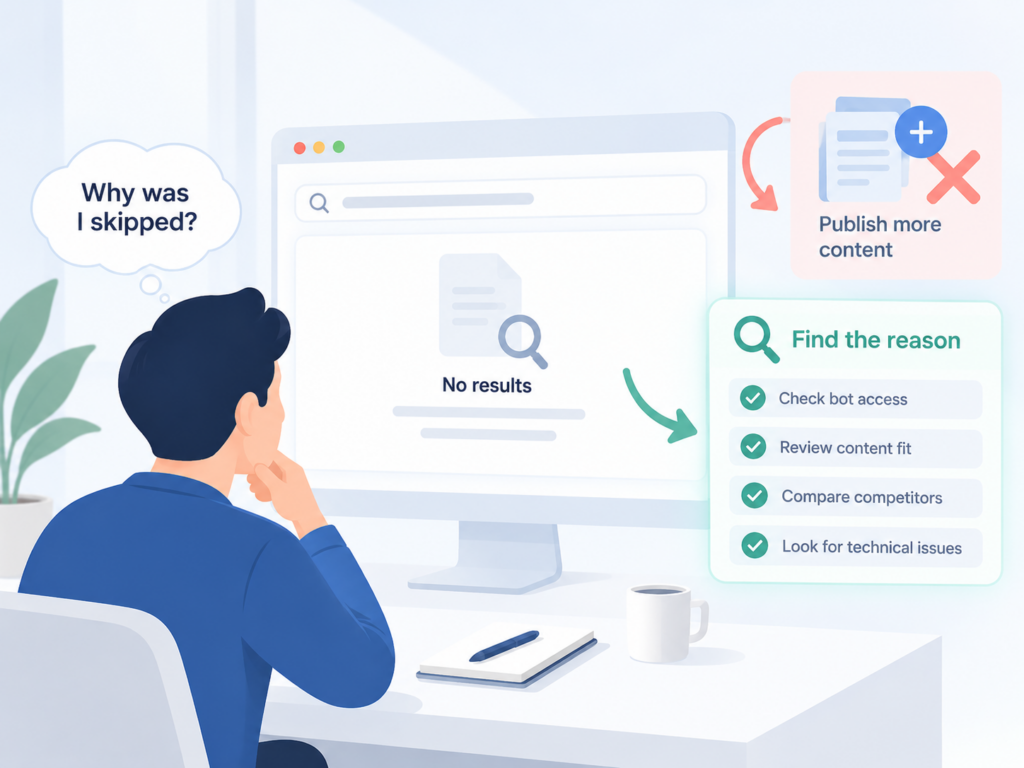
Look at which domains the agent is actually citing when it answers category questions in your space. Often it’s a handful of comparison sites, review aggregators, or forum threads the agent trusts more than your own product pages.
This is less about writing more and more about closing a specific gap. Topify’s source analysis reverse-engineers which URLs an AI platform is citing for a given prompt, so you know exactly where to place content or where to fix a data gap instead of publishing blind. Once you can see the gap, getting started with visibility tracking takes a few minutes, not a quarter-long project.
Conclusion
The Amazon vs Perplexity ruling settled a legal question, but it opened a business one. An AI shopping agent can now operate across the web with fewer legal roadblocks, and that means more of your category’s purchase decisions will run through an agent’s recommendation instead of a search results page. The brands that check their visibility now, before it becomes a quarterly fire drill, are the ones that’ll show up when it counts.
FAQ
Q: Is it legal for an AI shopping agent to browse and buy on a retail site without permission?
A: The Ninth Circuit’s ruling in Amazon v. Perplexity found that when a user directs an AI shopping agent to shop on their behalf, it’s the user who is legally accessing the site, not the company that built the agent. This weakens a retailer’s ability to block agents through hacking-law claims, though the underlying case continues in lower court.
Q: How do I know if ChatGPT or Perplexity recommends my product?
A: Run realistic category and comparison prompts, without your brand name included, across each platform multiple times. Track whether you’re mentioned, where you rank in the answer, and how the agent describes you. A tool built for this, like Topify, automates the process across platforms instead of requiring manual checks.
Q: What’s the difference between AI shopping agent visibility and traditional SEO rankings?
A: Traditional SEO rewards keyword relevance and backlink authority within a search results page. AI shopping agent visibility depends on whether the agent’s underlying model finds and trusts information about your product when generating a conversational answer, which often draws from different sources than your top Google rankings.
Q: Which AI platforms should I monitor for AI shopping agent visibility?
A: At minimum, ChatGPT and Perplexity, since both now have active agentic shopping features and were directly involved in this ruling. Gemini and other emerging shopping assistants are worth adding as adoption grows across each platform.

