

You ran the campaign. The ads performed. The landing page converted. But when a potential customer asked ChatGPT which tool to use for your exact use case, AI cited a three-year-old Reddit thread, a YouTube comment section, and a G2 review you didn’t even know existed. Your brand wasn’t mentioned once.
That’s not a content problem. That’s a word of mouth problem that most brands still don’t see coming.
Word of mouth marketing has always been the highest-trust channel in any marketer’s playbook. What’s changed is where it happens, what it feeds into, and how much it now controls whether AI systems recommend you at all.
Word of Mouth Marketing Has a New Battlefield
Word of mouth used to live in private conversations. A colleague mentioned a product over lunch. A friend texted a recommendation. These exchanges were real, but they were invisible to any tracking system.
That era is over.
Today, word of mouth plays out on Reddit threads, YouTube comment sections, GitHub issue boards, Discord servers, and LinkedIn posts. These aren’t fleeting social moments. They’re permanent, indexed, machine-readable signals that AI systems actively mine when deciding which brands to cite. According to research on AI citation behavior, a brand’s presence on Reddit alone can increase its AI citation rate by 3x compared to brands absent from community platforms.
The battlefield has shifted. Organic brand mentions that once reached dozens of people now reach millions, indirectly, every time an AI assistant surfaces them as part of a synthesized recommendation.
Why Organic Brand Mentions Now Shape AI Recommendations
Most modern AI assistants, including ChatGPT and Perplexity, use a Retrieval-Augmented Generation (RAG) architecture. When a user asks a question, the system doesn’t just rely on pre-trained knowledge. It retrieves relevant content from the web in real time, evaluates credibility, and synthesizes an answer.
Here’s what that means for earned media strategy: AI doesn’t rank content the way Google does.
Traditional SEO rewards domain authority and keyword density. AI RAG systems reward fact density, semantic relevance, and what researchers call “independent entity consensus,” meaning your brand gets cited when multiple unaffiliated sources say the same thing about you in different contexts. Brand-owned marketing copy tends to score low on this measure. Third-party community discussions, user-generated reviews, and peer-to-peer comparisons score high.
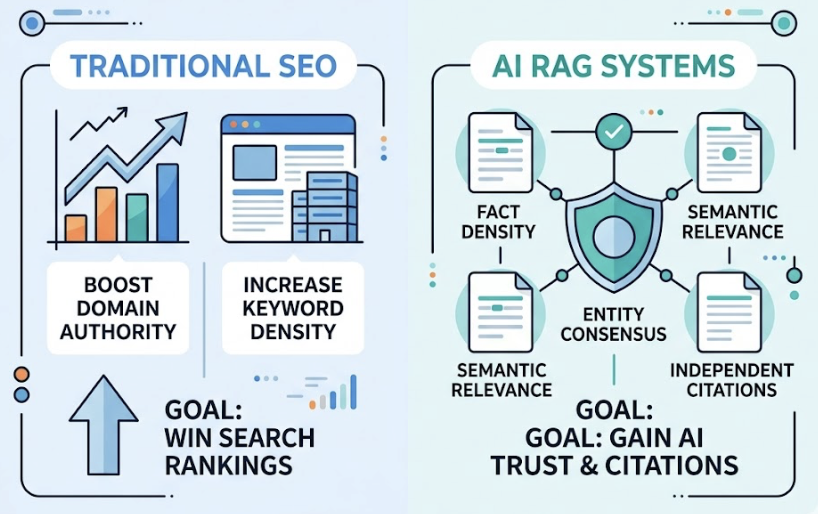
Approximately 85% of AI citations come from earned media sources, not from brand websites or paid placements. If you’re not generating organic brand mentions in credible communities, you’re functionally invisible to the systems that increasingly drive purchasing decisions.
Social Proof Marketing Is the Raw Material AI Trusts Most
There’s a reason 92% of consumers trust earned media over traditional advertising and 83% trust recommendations from real peers over any brand message. AI systems have essentially formalized this human tendency into an algorithm.
When AI evaluates which brands to recommend, it looks for three patterns in the content it retrieves. Cross-platform consistency: is your brand mentioned as a go-to solution across multiple independent communities? Problem-solution match: do users in Q&A environments name your brand as the direct answer to a specific pain point? Non-commercial tone: is the language natural, specific, and experiential rather than polished and promotional?
That last one is worth sitting with.
AI models are trained to identify and discount overtly promotional language. A Reddit comment that says “I switched to this tool six months ago and our team’s onboarding time dropped by 40%” carries far more weight than a blog post titled “Why Our Platform Is the Industry Leader.” Authentic brand promotion, the kind that comes from real users describing real experiences, is what AI is actually optimized to surface.
One counterintuitive finding from citation research: AI references positive and negative brand mentions at nearly equal rates. It’s not looking for praise. It’s looking for honest assessment.
How to Build Brand Advocacy Through Community Platforms
Not all engaged users are brand advocates. A fan follows, likes, and occasionally buys. An advocate creates content that seeds your brand into new conversations without being asked.
That distinction matters enormously for community-led growth. Advocates are the source of the organic discussions that AI indexes. Without them, your word of mouth footprint stays thin.
The most effective brand advocates in AI-visible communities tend to behave in specific ways. They answer technical questions in places like Stack Overflow and Discord using your product as the reference solution. They write detailed comparison breakdowns in “Best [tool] for [use case]” Reddit threads. They publish LinkedIn posts that share genuine outcomes, not brand talking points.
Building this ecosystem isn’t passive. It requires identifying users who already exhibit these behaviors, then giving them context, access, and sometimes early data to amplify what they’re already inclined to do. Think less about loyalty programs and more about knowledge-sharing infrastructure.
The community platform breakdown matters too. Reddit carries the highest citation weight among AI systems, particularly for tools and software recommendations. LinkedIn functions as the authority signal for B2B categories, influencing how ChatGPT frames industry perspectives. Discord and Slack communities, though partially closed, are increasingly accessible to AI agents through public archiving and emerging data partnerships.
Earned Media Strategy Doesn’t Scale by Accident
Here’s the thing: earned media that reliably feeds AI citation pipelines doesn’t just happen organically. It’s designed.
Three content types consistently generate the highest AI citation rates. Original research with named data points, because AI treats primary data as high-value source material and actively seeks it for factual grounding. User-authored first-person case studies published on their own channels, which AI extracts at roughly 40% higher rates than equivalent content published on brand-owned pages. And detailed Q&A threads with specific resolution steps, because they align directly with how AI retrieves answers to problem-based queries.
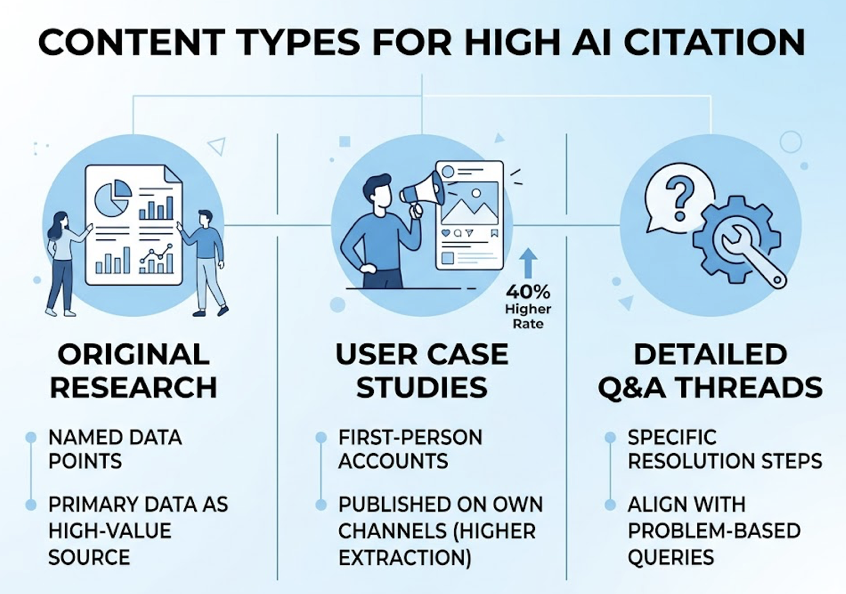
That’s the content architecture. The distribution layer is equally important.
Shareable moments need to be built into the product or service experience itself. If using your tool produces a result that makes users look competent or insightful in their professional community, they’ll share it without being prompted. That’s peer-to-peer marketing at its most scalable: value so tangible that broadcasting it becomes self-serving for the user.
When organic brand mentions start accumulating at scale, you face a new problem: you can’t tell which ones are actually driving AI visibility and which ones are just noise. That’s where Topify comes in. The platform’s Source Analysis function traces which specific third-party posts, forum threads, and reviews are actively being cited by ChatGPT, Perplexity, and other AI engines. You can see exactly which community investments are translating into AI-layer recommendations, and which aren’t, without guessing.
Topify’s Sentiment Analysis layer adds another dimension: it monitors the specific language AI is using to describe your brand, so you know whether the word of mouth reaching AI systems is framing you as “efficient and cost-effective” or “complex and expensive.” That’s direct insight into whether your earned media narrative matches your intended brand positioning.
How Word of Mouth Marketing Supports GEO Optimization
If Generative Engine Optimization (GEO) is the engine, word of mouth is the fuel.
Traditional SEO is built around links and keywords, optimized to earn clicks from a search results page. GEO is built around entity consensus and citation share, optimized to earn inclusion in synthesized AI answers. The two strategies aren’t opposed, but they’re powered by different inputs.
Word of mouth produces exactly what GEO requires. When users discuss your brand in community contexts, they naturally generate long-tail phrases that associate your product with specific use cases, pain points, and outcomes. AI indexes these associations. When a future user asks a scenario-specific question, AI retrieves the community consensus built from those organic conversations and surfaces your brand as the relevant answer.
The feedback loop compounds over time. AI recommendations drive more users to discover your brand through high-intent channels. Those users, if the product delivers, become the next generation of advocates producing the next wave of organic mentions. Research from Similarweb shows that users arriving via AI assistant recommendations convert at roughly 7%, significantly higher than traffic from broad search or social platforms, because they’ve already been pre-qualified by the AI’s synthesis process.
This is the core business case for treating word of mouth as a GEO investment rather than a soft brand metric.
How to Track and Measure Word of Mouth Marketing Performance
Net Promoter Score was built for a world where word of mouth happened in private. It measured willingness to recommend, but it couldn’t capture whether those recommendations were actually being made, where they were landing, or whether AI systems were picking them up.
The measurement framework has to evolve.
A complete word of mouth tracking system now needs to monitor seven dimensions: Visibility (how often your brand appears in AI answers for target prompts), Sentiment (the language AI uses when it describes you), Position (whether you’re listed first or buried fifth), Volume (total organic mentions AI considers credible), Mentions (specific instances where AI cites your content as a source), Intent (whether the contexts where you’re mentioned align with high-purchase-intent queries), and CVR (the conversion rate of users who arrive via AI-cited recommendations).
That’s the reporting framework Topify operationalizes across its analytics dashboard.
In practice, this changes how marketing teams communicate performance internally. Instead of “our Reddit engagement is up,” you can present something concrete: “After our developer community activation last month, our visibility score in ChatGPT for ‘cross-platform collaboration tools’ increased from 12% to 28%. Source Analysis shows 60% of those citations traced back to three deep-dive community threads from the previous week. AI-referred traffic contributed 15% of new trial signups, converting at 2x the rate of paid acquisition.”
That’s the kind of data that earns budget. And it’s the kind of visibility that compounds.
Get started with Topify to see which of your existing brand mentions are already feeding AI recommendations, and which gaps in your earned media strategy are costing you citation share.
Conclusion
Word of mouth has never been more powerful or more measurable. What’s changed is that its final destination is no longer a friend’s inbox or a Slack message. It’s an AI system synthesizing the answer to a high-intent purchase query for millions of users simultaneously.
The brands that treat community engagement, authentic user stories, and earned media as trackable growth infrastructure, not soft brand-building, are building an asset that pays out across every AI platform where their future customers are searching. Start by understanding where your brand already shows up in AI answers. Then build the systems to amplify what’s working and fix what isn’t.
FAQ
Q: How does word of mouth marketing differ from paid advertising in terms of AI visibility?
A: Paid advertising generates controlled impressions with low trust scores, roughly 41% consumer trust on average. It doesn’t contribute to the AI’s long-term citation database in any meaningful way. Word of mouth marketing, by contrast, produces earned media that AI RAG systems treat as third-party factual evidence. The tradeoff is time: WOM typically takes 60 to 90 days to move through AI indexing cycles, but the citation benefits compound and sustain in a way that paid placements can’t replicate.
Q: How can I tell if my brand is being discussed in communities that AI platforms might cite?
A: The most direct method is using Topify’s Source Analysis feature, which reverse-engineers AI recommendation results to show you the original source documents. You can also manually prompt ChatGPT or Perplexity with “What are the best [category] tools?” and examine the citations in the response. The subreddits, review platforms, and community threads that appear are the ones currently shaping AI’s understanding of your category.
Q: What types of organic content are most likely to be cited by AI search engines?
A: AI engines consistently favor content with high fact density and clear structure. Original research reports with specific data points, detailed product comparisons in structured formats, Q&A threads with resolution steps, and expert-authored analyses with named credentials all perform well. The common thread is information gain: content that tells AI something it couldn’t infer from general knowledge is far more likely to be surfaced as a citation.
Q: How long does it take for word of mouth campaigns to impact AI search recommendations?
A: The typical indexing and weighting cycle runs 60 to 90 days. That said, platforms like Reddit carry real-time retrieval weight in systems like Perplexity, which means high-quality organic discussions on those platforms can influence AI citations in as little as four to six weeks. The speed depends on the platform, the quality of the discussion, and whether the content matches the specific prompts your target customers are using.

