

Your team spent two years building a decision funnel: SEO content, comparison pages, retargeting ads engineered to catch someone mid-search. Then a customer stopped typing altogether. They opened ChatGPT, described what they needed, and let GPT-6 Astra find, compare, and recommend an option without ever touching a search box or landing on your site. The funnel didn’t break. It got skipped.
That’s not a hypothetical anymore. Astra doesn’t just answer questions. It browses, executes multi-step tasks, and increasingly makes the call before a person ever sees a list of options.
GPT-6 Astra Doesn’t Just Answer. It Goes and Does.
OpenAI released GPT-6 Astra to a limited set of organizations on September 3, 2026, with general availability the next day across ChatGPT Plus, Pro, Business, and Enterprise, plus the API and AWS.
The headline difference isn’t a smarter chatbot. It’s a model built for agentic computer use: browsing sites, comparing options, and completing multi-step workflows on its own. Astra scores 91.5% on BrowseComp, the benchmark for browsing, reading, and compiling information across the web, and 98.6% on ARC-AGI-3, a jump OpenAI’s own president tied to the start of what he called the AGI era.
That’s the shift. Older models answered a question and left the deciding to you. Astra can take the question, do the research across multiple sites, and hand you a finished recommendation.
The Data Behind the Shift: Consumers Are Already Skipping the Search Box
Astra didn’t create this pattern. It’s accelerating one that was already underway. 37% of consumers now start their searches with AI tools rather than Google, up from a rounding error two years ago.
The shift is sharper in B2B. 51% of B2B software buyers now start their research in an AI chatbot more often than Google, and 71% use one somewhere in the process. ChatGPT itself crossed 1 billion monthly active users in May 2026, making it the fastest app in history to reach that mark.
People also seem to like what they’re getting. 60% of users say AI delivers clearer answers than traditional search, and only 6% say it’s worse.
That said, trust hasn’t fully caught up to adoption. 85% of AI users still double check the answer somewhere else. People are handing off the legwork, not the final judgment, at least not yet.
What Changes When the Assistant Does the Browsing, Not the User
Job hunting is a good example of what Astra actually replaces. Instead of opening ten job boards and copying listings into a spreadsheet, Astra browses the boards, extracts structured data, and organizes the results directly.
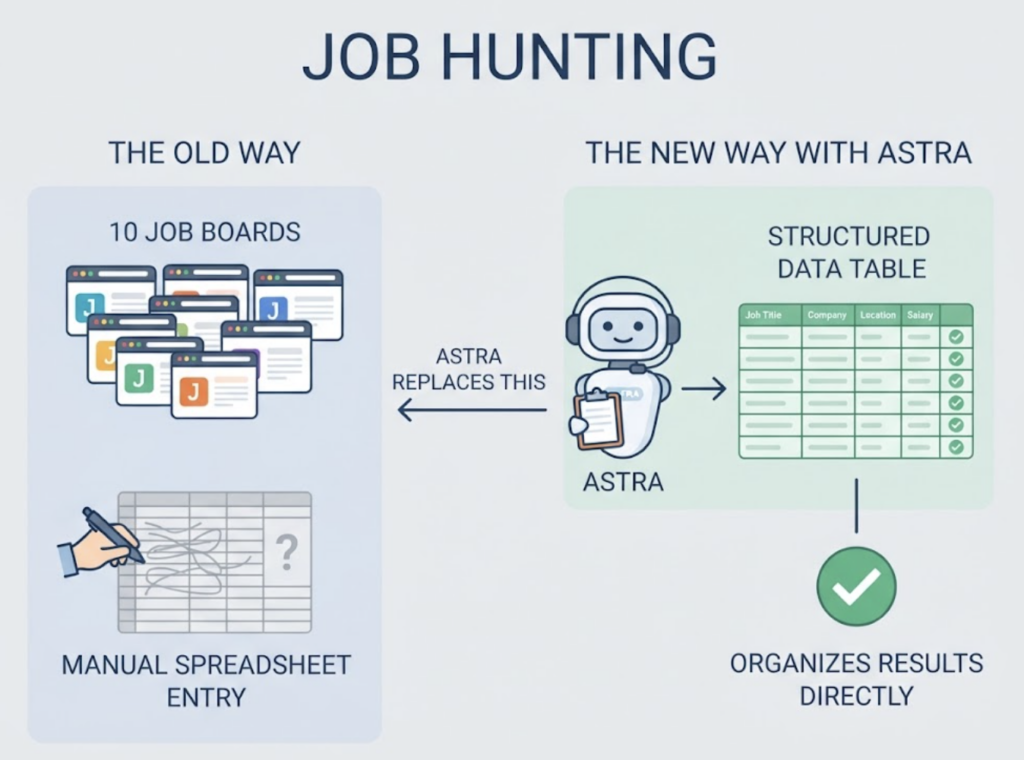
Apply the same pattern to buying a product, choosing software, or picking a service provider, and the comparison shopping that used to generate a dozen page views for a dozen competing brands now happens inside a single agent session. Nobody clicked through. Nobody scrolled a results page. The decision still got made.
ChatGPT is already behaving less like a destination and more like a router. 21.6% of all ChatGPT outbound traffic goes back to Google, and the buyer journey increasingly runs ChatGPT to Google to the brand’s own site, if it gets there at all. When it does convert, it tends to convert well: AI-referred traffic converts 42% better than non-AI traffic.
The traffic that shows up is valuable. The traffic that never shows up because Astra already made the call is the part most dashboards can’t see.
The Old Visibility Playbook Doesn’t Cover This Layer
Zero-click search was already a problem before Astra. Between 58% and 60% of Google searches end without a click, and that climbs toward 83% when an AI Overview sits at the top of the page. Astra pushes the same logic further: not just fewer clicks, but fewer moments where a human ever compares options directly.
Traditional SEO metrics were built to measure whether a page ranks, not whether an agent chooses to mention, recommend, or route around a brand mid-task. Ranking first on a results page and being invisible inside an agentic workflow can both be true at the same time.
The generational split hints at where this goes next. Among 13 to 24 year olds, Google holds 74% share versus ChatGPT’s 17%, compared to 89% versus 5% among people 65 and older. The habit is forming youngest first, which usually means it isn’t done growing.
You can rank first on Google and still be invisible to Astra.
How Topify Tracks Where GPT-6 Astra Sends the Decision
This is the layer Topify was built to cover. Its Comprehensive GEO Analytics tracks brand performance across major AI platforms, including newly launched models like GPT-6 Astra, through seven metrics: visibility, sentiment, position, volume, mentions, intent, and CVR.
For a marketing team trying to understand agentic search specifically, two capabilities matter most. High-Value Prompt Discovery surfaces the prompts and task types where AI platforms are already making recommendations in your category, so you can see which agentic queries are actually shaping purchase decisions before a person ever compares options themselves. Dynamic Competitor Benchmarking shows who gets recommended instead of you, in something closer to real time, so a drop in mentions doesn’t sit undetected for a quarter.
In practice, this means a brand can spot that Astra started routing a category of buyers toward a competitor, trace it to a specific source Astra is citing, and act on it before the next reporting cycle rather than after. If you want to see where your brand currently stands in that layer, you can get started with Topify directly.
Conclusion
The search box isn’t gone, but it’s no longer the only place a decision gets made. GPT-6 Astra is pulling more of that decision into a single agent session, one where browsing, comparing, and choosing all happen before a person sees a results page. Brands that only track rankings and click-through rate are measuring a shrinking part of the picture. The practical next step is simple: find out what Astra and the other major AI platforms are already saying about you, before a customer asks and acts on the answer without you knowing it happened.
FAQ
Q: What makes GPT-6 Astra different from earlier AI models for search behavior?
A: Astra is built for agentic computer use, meaning it can browse, compare, and complete multi-step tasks on its own rather than just returning an answer. That shifts more of the research and comparison stage of a purchase away from the user and into the AI session itself.
Q: Are consumers actually skipping traditional search because of this?
A: Adoption was already climbing before Astra, with 37% of consumers starting searches with AI tools instead of Google and over half of B2B software buyers starting research in a chatbot. Astra’s agentic abilities are extending that shift from answering questions to executing the comparison itself.
Q: Does this mean traditional SEO no longer matters?
A: No. Google still handles the majority of global search volume, and most AI users still double check answers elsewhere. What’s changing is that ranking well no longer guarantees an AI agent will mention or recommend your brand during a task, so the two need to be tracked separately.
Q: How can a brand tell if GPT-6 Astra is recommending it or a competitor?
A: That requires monitoring AI-specific metrics like visibility, sentiment, and position across platforms, which is what tools like Topify’s GEO analytics are built to track, rather than relying on traditional search rankings alone.

