

Most brands still think about “fresh content” the way Google taught them to: publish something, keep it up, wait for a ranking bump. Then GPT-6 shows up with a training cutoff months before its release date, a web search tool bolted on, and a completely different idea of what “current” means. That gap between what a model remembers and what it looks up is exactly where AI knowledge freshness lives, and it just moved.
What AI Knowledge Freshness Actually Means
Every large language model has two separate clocks running at once. The first is the training cutoff: the point where the model stopped learning from new data. The second is whatever it can pull in through live tools at the moment you ask it something.
GPT-6 Astra illustrates this well. OpenAI’s flagship model carries a knowledge cutoff of April 30, 2026, but reached general availability months later, in September 2026. That lag between cutoff and release is not unusual. A training-to-release gap of six to twelve months is typical across major model families, which means even a freshly launched model is already behind the present day before anyone opens a chat with it.
This is the part most marketing teams skip past. A model’s internal memory is frozen the day training data collection stops. Everything after that date exists only if the model reaches out and grabs it, and whether it bothers to reach out depends on the query, the tool configuration, and increasingly, on how confident the model is that its own memory is stale.
What Changed With GPT-6 Specifically
GPT-6 Astra ships with a 1,050,000-token context window and native access to web search, file search, and other retrieval tools. That is a meaningful jump from earlier GPT-5.x models, and it shifts more of the “freshness” burden from training data onto live retrieval.
Here’s the tradeoff. A bigger context window and better tool use mean Astra can pull in more real-time information per query. But the model still has to decide when to bother. For anything time-sensitive, brand-specific, or recently changed, it needs a reason to trust an external source over its own frozen memory. Content that signals recency clearly gives it that reason. Content that doesn’t gets treated as background knowledge, accurate only up to April 2026.
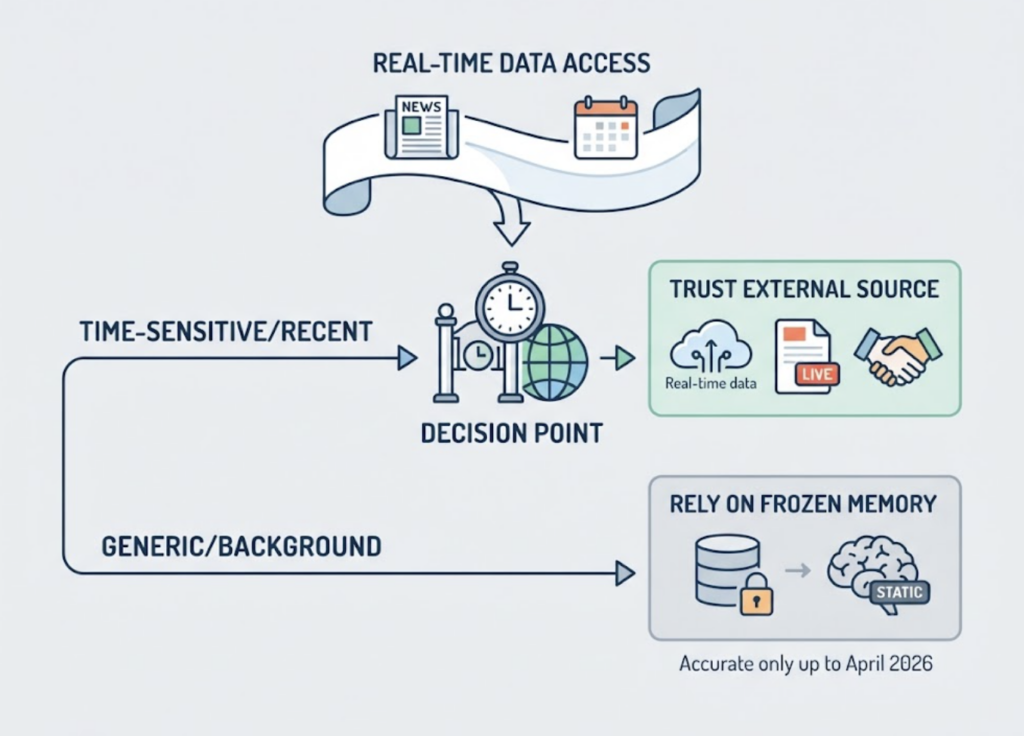
That’s the actual shift GPT-6 introduces. It’s not that the model became worse at knowing things. It’s that the line between “what GPT-6 knows” and “what GPT-6 has to go find” got sharper, and brands now sit on the wrong side of that line by default unless they actively signal otherwise.
Why AI Search Now Rewards Recent Content More Than Ever
The data backs this up across every major AI platform, not just GPT-6. A 2026 Seer Interactive study found that 75% of the pages cited by large language models had been updated within the past year. Only 3% of citations went to content untouched for five years or more.
The more interesting finding is how pages earn that freshness. Seer’s research shows that when a page’s original publish date is used instead of its last update date, the citation rate for “recent” content drops from 72% to 42%. In plain terms, models are rewarding maintained pages, not new ones. More than a quarter of the pages the study classified as fresh were first published over two years ago and simply kept current.
That pattern holds up across independent research. Ahrefs’ analysis of roughly 17 million citations found that AI-cited content averages about 2.9 years old, versus 3.9 years for content ranking in Google’s organic top ten, a 25.7% freshness gap. Separately, AirOps’ 2026 research found that 83% of commercial citations come from pages updated in the past year, and pages left untouched for more than three months become three times more likely to drop out of AI answers entirely.
Recency doesn’t weigh the same everywhere though. GrowByData’s engine-level breakdown puts the citation lift for content under 30 days old at roughly 3.2x for ChatGPT, 2.6x for Perplexity, 2.1x for Gemini, and only 1.3x for Claude, which weights authority more heavily than recency.
| AI Engine | Citation lift for content under 30 days old | Recency sensitivity |
|---|---|---|
| ChatGPT | ~3.2x | High, especially news, tech, finance |
| Perplexity | ~2.6x | Very high, recency is the core promise |
| Gemini | ~2.1x | High on Google-linked queries |
| Google AI Overviews | ~1.8x | Moderate, topic-dependent |
| Claude | ~1.3x | Lower, weights authority more |
Since GPT-6 Astra now powers ChatGPT, that top row matters most for anyone trying to stay visible there. ChatGPT’s recency lean was already the strongest among major engines, and a model with a wider training-to-release gap has even more reason to defer to fresh, well-timestamped sources.
The Blind Spot Most Brands Have Right Now
Most GEO strategies were built around a one-time content push, not a maintenance schedule.
That’s the gap GPT-6 just made more expensive. A page published eighteen months ago and never revisited isn’t just aging quietly. It’s actively losing citation share every quarter, at a rate the newest research puts around three times higher risk of dropping out of AI answers once it crosses the three-month mark without an update.
Teams that treat GEO like a launch instead of an ongoing operation are optimizing for a version of AI search that no longer exists.
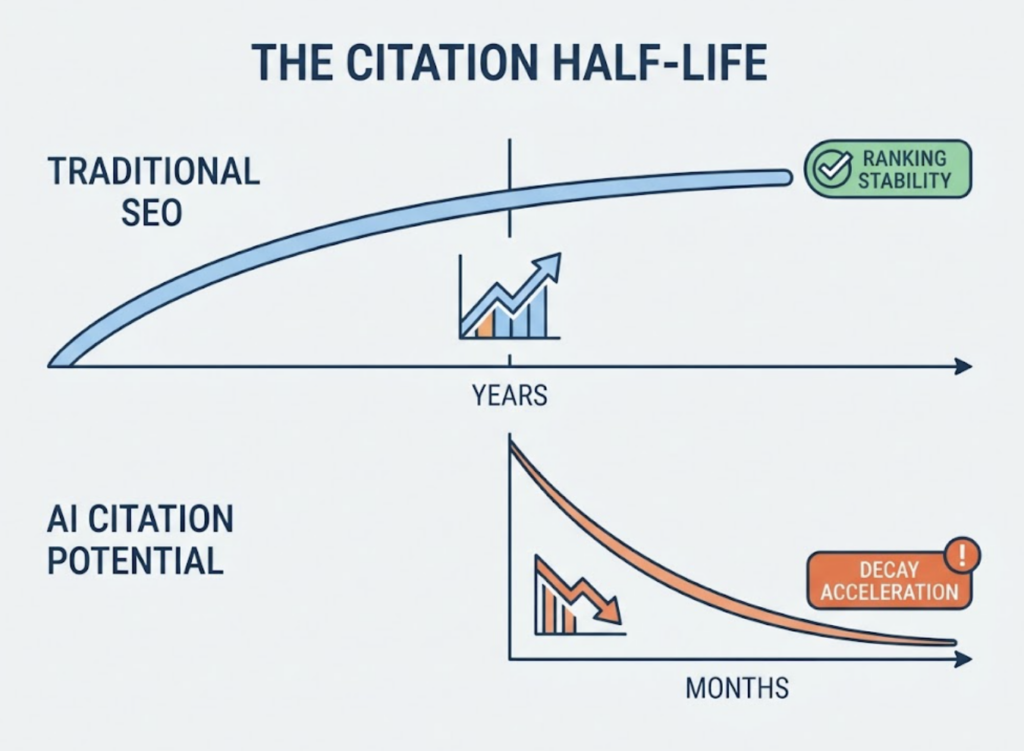
It’s an easy trap to fall into. Traditional SEO rewarded patience. A well-built page could rank for years with minor tweaks, and content teams learned to treat publishing as the finish line. AI citation behavior doesn’t follow that same curve. The half-life on a page’s citation potential is measured in months, not years, and a model release like GPT-6’s can accelerate that decay simply by shifting how much weight the engine puts on recency versus raw authority.
How to Know If Your Brand Still Looks Fresh to AI
Guessing whether your content still reads as current to GPT-6 isn’t a great strategy, since the freshness signals models respond to (last-modified dates, sitemap timestamps, visible on-page dates, and actual content changes) aren’t things you can eyeball across dozens of pages.
This is where Topify fits in. Its Source Analysis feature tracks which domains and specific URLs AI platforms are actually citing right now, alongside how recently those sources were updated. Instead of assuming your evergreen guide from last year still counts as fresh, you can see whether GPT-6 and other engines are still pulling from it, or whether they’ve quietly moved on to a competitor’s more recently touched page.
Paired with AI Volume Analytics, which tracks how search behavior around a topic shifts after a model release like Astra’s, teams get a clearer read on whether a drop in AI mentions is a content problem or just a broader shift in what people are asking about post-launch. Visibility Tracking adds the other half of the picture, showing whether your brand’s mention frequency across ChatGPT, Gemini, and Perplexity moved at all once GPT-6 rolled out, so freshness fixes can be pointed at the pages actually losing ground instead of applied blindly across the whole site.
What to Do Before the Next Model Update
A few concrete moves matter more than a full content overhaul:
- Audit your highest-traffic pages for last-updated dates, not just publish dates, and refresh anything past the six-month mark.
- Make sure dateModified schema, visible on-page dates, and sitemap lastmod values actually match. Mismatched signals undercut the freshness case even when the content itself was updated.
- Prioritize refreshing pages that already earn citations over publishing net-new content. Maintained authority typically outperforms volume.
- Set a recurring review cycle, quarterly at minimum, rather than treating freshness as a one-time fix.
- Track citation source data over time so you catch decay before traffic drops, not after.
None of this requires guessing what the next model update will look like. It requires treating freshness as infrastructure instead of a launch checklist, so the next clock reset doesn’t catch your content flat-footed again.
Conclusion
GPT-6 didn’t invent the freshness problem, but its training-to-release gap and heavier reliance on live retrieval made the cost of stale content more visible than it’s ever been. Brands that keep publishing once and walking away are competing against pages that get revisited every quarter. Get started with Topify’s Source Analysis to see exactly where your content stands with the models people are actually using today.
FAQ
Q: What is GPT-6’s knowledge cutoff date?
A: GPT-6 Astra’s published knowledge cutoff is April 30, 2026, even though the model reached general availability months later, in September 2026.
Q: Does GPT-6 search the web in real time?
A: Yes. GPT-6 Astra includes an integrated web search tool alongside file search and other retrieval tools, letting it pull in information published after its training cutoff when a query calls for it.
Q: How often should brands update content to stay visible in AI search?
A: Recent research points to a quarterly refresh cycle as a reasonable minimum, since pages left untouched for more than three months become notably more likely to lose AI citations entirely.
Q: Does content freshness matter equally across every AI platform?
A: No. ChatGPT and Perplexity show the strongest recency bias, while Claude weights source authority more heavily than how recently a page was updated.

