

You’ve got a DA of 70, solid keyword positions, and a content calendar that runs like clockwork. Then you type your category prompt into Perplexity and get back a list of five recommendations. Your brand isn’t one of them. You check again next week with a slightly different prompt. Still nothing. The worst part? You don’t know if this has been happening for months, because nothing in your SEO stack was built to catch it.
Perplexity ranking doesn’t show up in any traditional dashboard. And the gap between “manually spot-checking AI answers” and “systematically tracking your brand’s position” is where most marketing teams are stuck right now.
Why Perplexity Ranking Works Nothing Like Google’s Top 10
Google gives you a static list. Ten blue links, ranked by a crawlable algorithm, measurable with dozens of established tools. Perplexity doesn’t work that way.
Perplexity operates on a Retrieval-Augmented Generation (RAG) architecture. It queries the live web, retrieves relevant documents in real time, and uses a large language model to synthesize those documents into a direct, cited answer. There’s no fixed index. There’s no static position #1. The “ranking” is the model’s real-time decision about which sources to prioritize, cite, and weave into the response.
That’s a fundamentally different game.
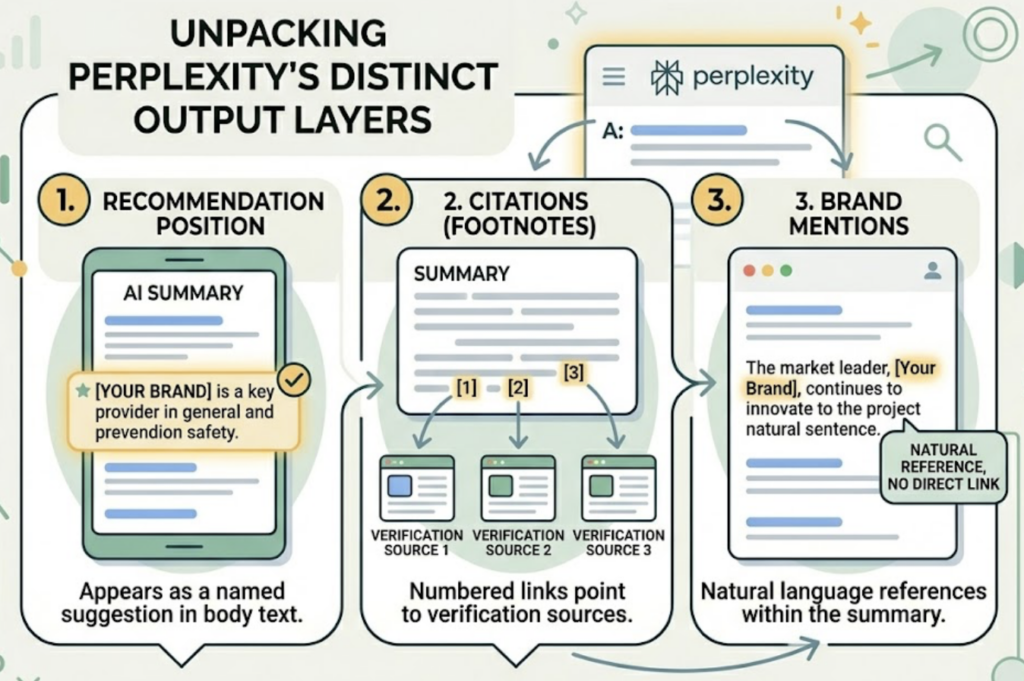
In practice, Perplexity’s output has three distinct layers. First, there’s the recommendation position: whether your brand appears in the body text as a named suggestion. Second, there are citations, the numbered footnote links ($[1], [2], [3]$) that point readers to verification sources. Third, there are brand mentions, natural language references to your company within the summary, often without any direct link attached.
Here’s the thing: tools like Ahrefs and Semrush were designed to crawl indexable SERPs. They can’t simulate the dynamic reasoning behavior of a RAG system or capture the source-selection logic that determines which domains get cited. That’s why your current stack has a blind spot the size of an entire search platform.
What Actually Influences Your Perplexity Ranking
Perplexity’s Sonar models don’t evaluate content the way Google’s crawlers do. The ranking signals are different, and some of them shift faster than most teams expect.
Content structure matters more than you’d think. RAG models favor what researchers call “extractable” content: pages built with clear H1-H3 headers, bulleted lists, and concise summary blocks (think TL;DR sections at the top). If your page buries the answer in paragraph seven of a 3,000-word essay, the model often skips it entirely.
Recency is arguably the single biggest lever. Perplexity’s models heavily weight recently updated content. Field data from GEO practitioners suggests that resources older than roughly three months often lose priority in citation selection. Content decay isn’t just a Google problem anymore. It’s accelerated in AI search.
Traditional domain authority still plays a role. Strong E-E-A-T signals and established Google rankings act as a prerequisite. Models tend to favor domains already recognized as authoritative for specific queries. But authority alone isn’t enough if the content is stale or poorly structured.
Data-driven content gives you an edge. Original research, specific statistics, and expert quotes significantly increase the probability of being cited. Perplexity’s model is looking for claims it can attribute. Give it something worth attributing.
How to Track Your Brand’s Perplexity Ranking Step by Step
Moving from manual spot-checks to systematic tracking requires a structured approach. Here’s a four-step framework that works.
Step 1: Define your prompt universe. Identify the 30 to 50 most critical prompts for your brand. These should mirror the questions your target audience actually types into Perplexity, not your internal keyword list. Think “best project management tool for remote teams” rather than “project management software.”
Step 2: Run a baseline audit. Execute each prompt in a clean browser environment (no personalization, no cookies) and document where your brand stands. Are you cited? Mentioned? Recommended first, third, or not at all? This baseline is your starting point.
Step 3: Set up continuous tracking. This is where manual effort hits a wall. Running 50 prompts weekly across Perplexity, ChatGPT, and Gemini isn’t sustainable by hand. Platforms like Topify automate this by monitoring brand visibility, citation sources, and position rank across multiple AI engines from a single dashboard. Topify’s Position Tracking shows exactly where your brand sits relative to competitors for each tracked prompt, while its Source Analysis reveals which domains Perplexity is citing most frequently.
Step 4: Close the feedback loop. Integrate tracking data with your content pipeline. Use gap analysis to identify the prompts where your brand is consistently absent, then produce structured, data-dense content specifically designed to fill those voids. Topify’s High-Value Prompt Discovery continuously surfaces new prompt opportunities as AI recommendation patterns evolve.
That’s not a one-time project. It’s an ongoing system.
Perplexity Citations vs. Brand Mentions: What Each Metric Actually Tells You
These two signals often get lumped together, but they measure different things and require different optimization strategies.
Perplexity citations are the explicit footnote links in the response. When your domain appears as $[3]$ in a Perplexity answer, it means the model treated your page as a primary authority for a specific fact or claim. The strategic value is high: citations drive direct traffic, validate your expertise, and signal to the model that your content is trustworthy enough to verify claims against.
Perplexity brand mentions are different. These happen when the model references your brand by name in the narrative (“The top players in this space include X, Y, and Z”) without necessarily linking to your site. The value here is market salience. Mentions build brand recall, signal that you’re part of the “consideration set,” and increase the likelihood that users will search for you directly afterward.
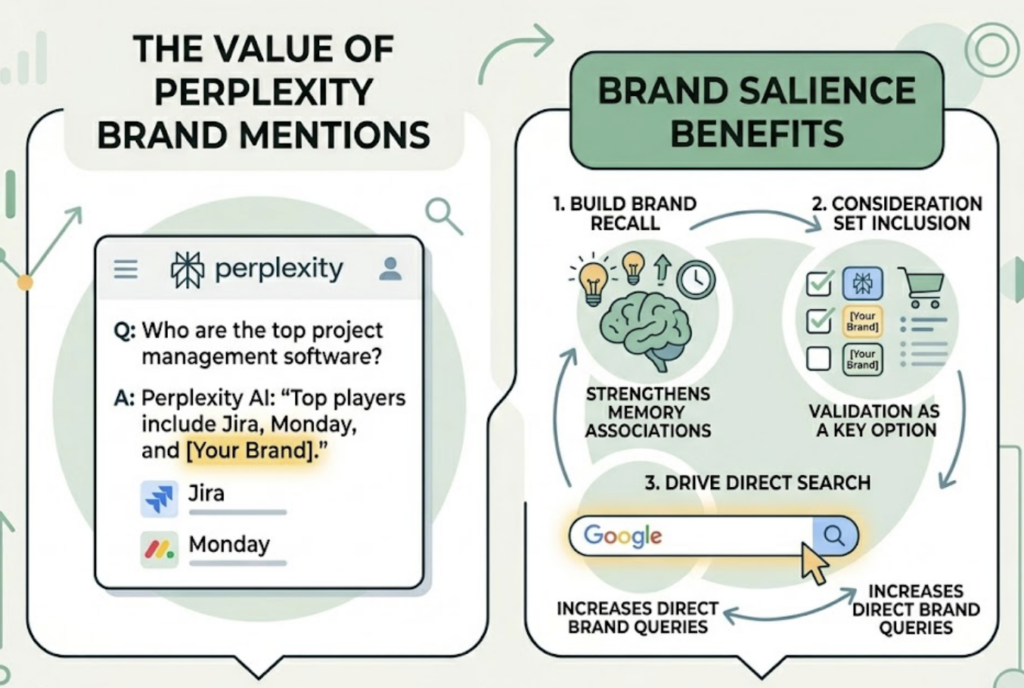
A brand with high citations but low mentions typically has strong content authority but weak brand recognition in AI contexts. A brand with high mentions but low citations has the opposite problem: the model knows who you are but doesn’t trust your content enough to cite it as a source.
Tracking both metrics separately is what makes the difference. Topify’s analytics break down visibility into these distinct layers, so you can diagnose whether your Perplexity SEO problem is a content problem, a brand awareness problem, or both.
The Perplexity SEO Playbook: 5 Moves That Shift Your Ranking
Knowing how Perplexity ranking works is step one. Here are five specific actions that tend to move the needle.
1. Turn static pages into living documents. Perplexity’s recency bias means your content has a shelf life. Establish a rotating schedule to refresh core pillar pages every 8 to 12 weeks. Update statistics, add new examples, and revise outdated sections. The goal is to keep your best content within that freshness window.
How to verify: check the “last updated” date on your top 10 pages. If any are older than 90 days, they’re likely losing Perplexity citation priority.
2. Optimize for extractability. Every high-value page should open with what GEO practitioners call a “direct summary block”: a concise, factual paragraph or bulleted list that answers the core query in the first 150 words. This is what the RAG model lifts into the response box.
How to verify: read your page’s opening. If you can’t extract a standalone, quotable answer in under 30 seconds, the model probably can’t either.
3. Implement structured data. Use explicit schema markup (FAQ schema, HowTo schema, Organization schema) to help AI models understand entities and their relationships. This is table stakes for Perplexity SEO, not a differentiator, but skipping it puts you at a disadvantage.
4. Build third-party presence. Models use authoritative third-party sources as “cross-reference” validation. Being mentioned in industry reports, comparison sites, and expert roundups increases the probability that Perplexity will include your brand in its synthesized answers. This is the Perplexity brand mentions strategy that most teams underinvest in.
5. Drive early engagement signals. Perplexity tracks content performance signals to validate that users find cited content useful. Leverage social media, email campaigns, and community channels to drive high initial traffic and dwell time to newly published content. The first 48 hours matter.
What’s the Best Tool to Check Perplexity Rankings
This is the most common question brands ask once they realize traditional SEO tools can’t help.
There are three approaches, and they’re not equal.
Manual spot-checks are where most teams start. Open Perplexity, type your prompts, screenshot the results. It works for a handful of queries, but it doesn’t scale, doesn’t track changes over time, and is subject to personalization bias.
General SEO platforms like Semrush or Ahrefs have started adding AI search features, but their core architecture is built around crawlable SERPs. Perplexity citation tracking and brand mention monitoring typically aren’t part of their standard workflow.
Dedicated AI visibility platforms are purpose-built for this problem. Among them, Topify stands out for several reasons. It tracks visibility across Perplexity, ChatGPT, Gemini, DeepSeek, and other major AI platforms from a single dashboard. It provides citation-level data, showing exactly which URLs are cited for specific prompts. And it bridges the gap between detection and action with a content optimization workflow powered by its AI agent, so you’re not just seeing problems but fixing them.
| Tracking Method | Perplexity Coverage | Citation Data | Multi-Engine | Automated |
|---|---|---|---|---|
| Manual Spot-Checks | Partial | No | No | No |
| Traditional SEO Tools | Limited | No | Partial | Yes |
| Topify | Full | Yes | Yes (7+ engines) | Yes |
Topify’s pricing starts at $99/month for the Basic plan (100 prompts, 9,000 AI answer analyses) and $199/month for Pro (250 prompts, 22,500 analyses). For brands serious about Perplexity ranking, the Basic plan typically covers the initial monitoring needs.
Conclusion
Perplexity ranking isn’t a future concern. It’s a current blind spot. Every week your brand goes untracked in AI search is a week where competitors may be capturing the visibility, citations, and brand mentions that should be yours.
The shift from manual spot-checks to systematic monitoring doesn’t require a massive budget or a new team. It requires the right framework (prompts, baseline, tracking, feedback loop) and a tool that can actually see what’s happening inside AI-generated answers. Start with your top 30 prompts, run a baseline audit, and build from there.
FAQ
Q: How often do Perplexity rankings change?
A: Frequently. Because Perplexity uses RAG to query the live web in real time, rankings can shift with every query execution. In practice, most brands see meaningful position changes on a weekly basis, with content freshness being the primary driver of short-term fluctuations.
Q: Can I track Perplexity rankings for free?
A: You can manually search your target prompts and document the results, but this doesn’t scale beyond a few queries. For systematic, automated tracking with historical data, you’ll need a dedicated platform. Topify offers a free GEO Score check as a starting point.
Q: Does Perplexity SEO require different content than Google SEO?
A: Mostly yes. While strong domain authority helps on both platforms, Perplexity rewards extractable content structure (summary blocks, clear headers, data-rich claims) and penalizes content decay more aggressively than Google does. The optimal approach is to optimize for both, starting with structure and freshness.
Q: How long does it take to improve your Perplexity ranking?
A: It depends on your starting position. Brands that already have strong domain authority and well-structured content can see citation improvements within 4 to 6 weeks of targeted optimization. Brands starting from low visibility typically need 2 to 3 months of consistent content updates and third-party presence building.

