

Your team’s SEO dashboard looks solid. Rankings are stable, organic traffic is trending up, and your quarterly report has all the right charts. Then your CMO asks a question nobody on the team can answer: “When someone asks ChatGPT which product to buy in our category, do we even show up?”
You check manually. You type a few prompts. Your brand doesn’t appear. Or it does, but it’s described as a “budget option” when your positioning is premium. The problem isn’t that your SEO failed. It’s that AI search runs on a completely different set of signals, and traditional tools weren’t built to see them.
That’s where AI answer monitoring software comes in.
What AI Answer Monitoring Software Actually Tracks
AI answer monitoring software is a category of analytics tools built to audit how a brand, product, or service appears inside AI-generated responses. Instead of tracking blue links on a results page, these tools simulate real-world user prompts across platforms like ChatGPT, Perplexity, and Gemini, then analyze what the AI actually says.
The difference from traditional SEO monitoring isn’t incremental. It’s structural.
| Dimension | Traditional SEO Tool | AI Answer Monitoring Software |
|---|---|---|
| Visibility unit | Organic ranking position (1-100) | Mention rate and position in synthesized answer |
| Output type | URL/link | Natural language summary with source citations |
| Evaluation focus | Keyword volume, CTR | Sentiment, authority, brand erasure risk |
| Underlying data | Crawled search results | RAG (Retrieval-Augmented Generation) inputs |
Here’s the thing: AI models don’t “rank” brands the way Google does. They synthesize. They pull from training data, retrieval pipelines, and citation sources to construct a narrative. Your brand is either part of that narrative or it isn’t.
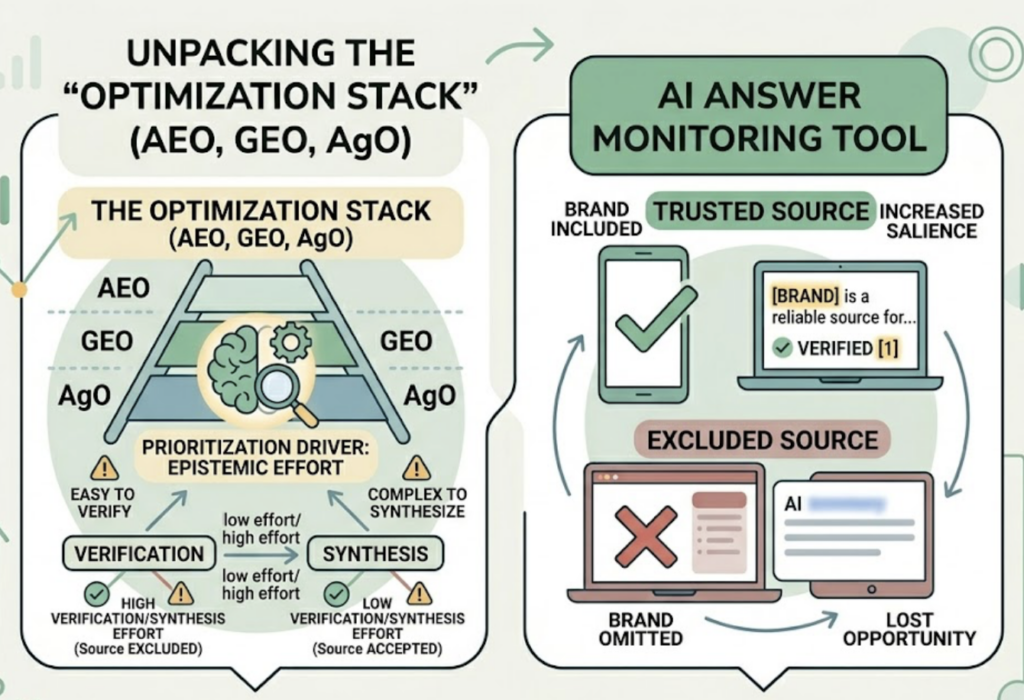
Recent academic work on what researchers call the “Optimization Stack” (spanning AEO, GEO, and AgO) suggests that AI agents prioritize information based on “epistemic effort,” meaning how easily they can verify and synthesize a source. AI answer monitoring software tracks whether your brand functions as a trusted source or gets excluded entirely.
5 Metrics Your AI Answer Monitoring Software Should Measure
Not all monitoring tools measure the same things. Before you compare platforms, you need to know what the core metrics actually mean, especially if your team is also evaluating top Perplexity rank trackers alongside broader AI visibility platforms.
Visibility/Mention Rate. How often your brand appears across a representative set of high-intent prompts. This is the baseline. If you’re not being mentioned, nothing else matters.
Sentiment Score. Being mentioned isn’t always good. If Gemini describes your product as “outdated” or associates it with a recalled feature, that mention is doing more harm than silence. Sentiment scoring tells you how the AI talks about your brand, not just whether it does.
Position Rank. In platforms like Perplexity that produce cited lists, your placement in the “reference cluster” matters. Showing up fifth in a list of five isn’t the same as being the first recommendation.
Citation Sources. Which third-party domains (or your own) is the AI pulling from when it mentions your brand? This metric reveals whether your content assets are being used as source material or ignored entirely.
AI Search Volume. This is the opportunity gap: queries where your brand should appear based on relevance and authority, but currently doesn’t. Think of it as the AI equivalent of “unranked keywords” in traditional SEO, except you can’t see these gaps without purpose-built monitoring.
For teams evaluating how to measure AI answer monitoring software performance, these five metrics form the minimum viable dashboard. Anything less, and you’re flying partially blind.
Where Most Teams Go Wrong with AI Answer Monitoring
The tools are new, and so are the mistakes. Four patterns show up repeatedly when teams start monitoring AI answers without a clear framework.
The “One-Model” Fallacy. Checking your brand on ChatGPT doesn’t tell you what Perplexity or Gemini are saying. Different LLMs pull from different training data and RAG pipelines. A brand that ranks well in one model’s responses can be completely absent from another. Cross-platform coverage isn’t a nice-to-have. It’s a prerequisite.
Ignoring Sentiment and Hallucinations. Some teams celebrate when they see their brand mentioned, without reading what was actually said. A mention that associates your product with negative reviews, outdated specs, or a competitor’s use case can do more damage than being omitted. Monitor what the AI says, not just that it says it.
Static, Manual Spot-Checks. Typing a prompt into ChatGPT once a month and screenshotting the result isn’t monitoring. GenAI models update their outputs dynamically. What the AI said about your brand last Tuesday might differ from what it says today. Intermittent auditing produces stale strategy data.
Treating AI Visibility Like SEO. Applying link-building metrics and keyword density rules to AI responses doesn’t work. AI models prioritize “semantic groundedness” and “authoritative entity mapping” over backlink profiles. The signals that make you visible to AI are different from the ones that rank you on Google.
How to Choose AI Answer Monitoring Software: A Practical Checklist
The market for AI answer monitoring software is still forming, which means feature sets vary widely between platforms. Use this checklist to separate tools that offer real visibility intelligence from those that only provide surface-level mention counts.
| Capability | What to look for | Why it matters |
|---|---|---|
| Cross-platform coverage | ChatGPT, Perplexity, Gemini, Claude, and regional models | Your audience doesn’t use just one AI platform |
| Monitoring frequency | Automated daily or real-time auditing of core prompts | AI outputs shift constantly; weekly checks miss the changes |
| Competitor benchmarking | Side-by-side brand vs. competitor visibility data | You can’t improve what you can’t compare |
| Metric depth | Visibility, sentiment, position, citation sources, volume | Mention rate alone doesn’t tell the full story |
| Reporting and export | Dashboard + CSV/API for BI integration | AI visibility data needs to reach stakeholders beyond the SEO team |
| Pricing transparency | Clear per-prompt or per-project pricing | Avoid tools that lock core metrics behind enterprise-only tiers |
If a tool only covers one AI platform, or only tells you whether you were mentioned without scoring sentiment and position, it’s not solving the full problem.
Top AI Answer Monitoring Software to Consider in 2026
Topify
Topify is built specifically for AI search optimization, combining monitoring, analytics, and execution into a single platform. It covers ChatGPT, Perplexity, Gemini, DeepSeek, and other major AI engines, tracking seven core metrics: visibility, sentiment, position, volume, mentions, intent, and CVR (Conversion Visibility Rate).
For teams looking for top Perplexity rank trackers, Topify’s Position Tracking is worth noting. It monitors where your brand lands in Perplexity’s cited reference lists relative to competitors, so you can see whether you’re the first recommendation or buried at the bottom.
What sets it apart is the closed-loop approach. Most platforms stop at dashboards. Topify’s Source Analysis shows exactly which domains and URLs the AI is citing, so you can trace a visibility drop back to a specific content asset that fell out of the model’s citation pipeline. Its Competitor Monitoring auto-detects rival brands and benchmarks your visibility, sentiment, and position against them in real time.
The platform also surfaces high-volume AI prompts relevant to your brand, revealing opportunity gaps where you should be cited but aren’t. For teams ready to act on the data, Topify’s one-click agent execution lets you define GEO goals in plain English and deploy optimization strategies without manual workflows.
Pricing starts at $99/month for the Basic plan (100 prompts, 9,000 AI answer analyses, 4 projects) and scales to $199/month for Pro (250 prompts, 22,500 analyses). Enterprise plans start at $499/month with custom configurations. Details are on the Topify pricing page.
Other Tools in the Category
Google Search Console + AI Overviews. Google has started surfacing limited AI Overview data within Search Console. It’s free and useful as a supplemental signal, but it only covers Google’s own AI layer, not ChatGPT, Perplexity, or any other LLM.
Custom GPT-Based Auditing Scripts. Some technical teams build internal tools using the OpenAI or Anthropic APIs to simulate prompts and log responses. This works for narrow, one-off audits but requires engineering resources to maintain and doesn’t provide competitive benchmarking, sentiment scoring, or cross-platform coverage out of the box.
Manual Monitoring Workflows. Spreadsheet-based tracking where a team member types prompts and records results. It’s free, but the data is always stale, the coverage is limited to whatever one person has time to check, and it doesn’t scale.
| Feature | Topify | Google Search Console | Custom API Scripts | Manual Tracking |
|---|---|---|---|---|
| Cross-platform AI coverage | ChatGPT, Perplexity, Gemini, DeepSeek, others | Google AI Overviews only | Depends on API access | Whatever you manually check |
| Sentiment analysis | Yes (0-100 score) | No | Requires custom build | Subjective |
| Position tracking | Yes | Limited | Requires custom build | Manual |
| Competitor benchmarking | Auto-detected | No | Requires custom build | Manual |
| Citation source analysis | Yes | No | Partial | No |
| Effort to maintain | Low (SaaS) | Low | High (engineering) | High (time) |
How to Improve Your AI Answer Monitoring Over Time
Installing the software is step one. Getting value from it requires a strategy that evolves beyond the initial setup.
Expand your prompt coverage systematically. Start with 20-30 core “decision-making queries” your target audience actually types into AI assistants. “Best [category] for [use case]” and “Compare [your brand] vs [competitor]” are typical starting points. Over 30 days, review which prompts generate the most volatile results and prioritize those for daily monitoring.
Feed citation data back into content strategy. The Source Analysis report tells you which of your content assets the AI trusts enough to cite. Double down on those assets: update them, add structured data, expand their depth. At the same time, identify content that’s being ignored or leading to incorrect brand associations. Pruning or rewriting those pages can shift what the AI says about you.
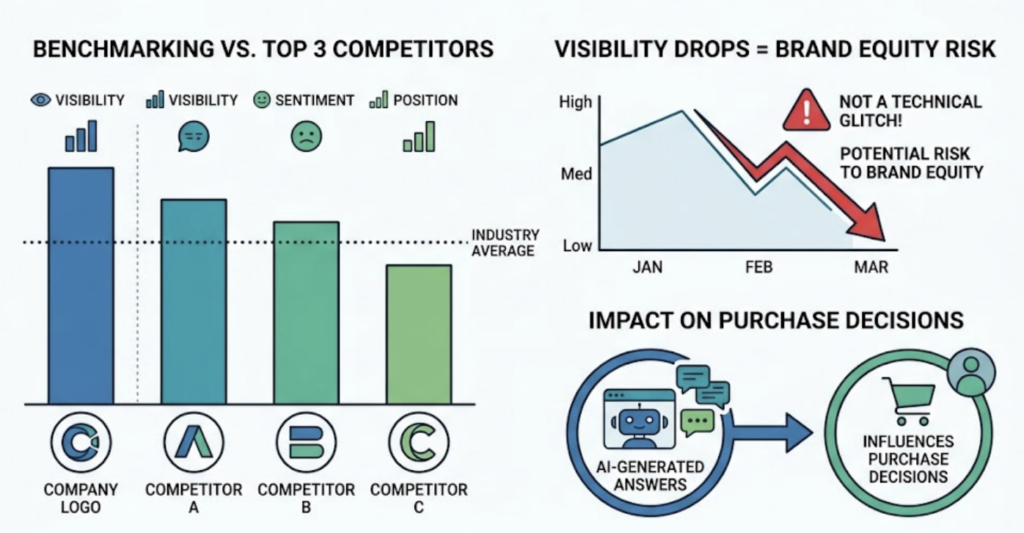
Establish monthly AI visibility reviews. Treat this the same way you’d treat an SEO performance review, but with different metrics. Benchmark your brand’s visibility, sentiment, and position against your top three competitors. When visibility drops, treat it as a brand equity risk, not a technical glitch. AI-generated answers influence purchase decisions, and a single quarter of declining visibility can compound into lost market share.
The teams that get the most from AI answer monitoring software are the ones that close the loop: monitor, analyze, act, and re-monitor. The data is only useful if it changes what your team does next. Get started with Topify to see where your brand stands across AI platforms today.
Conclusion
The question your CMO asked, “Are we showing up in AI search?”, isn’t going away. It’s becoming a standard KPI for marketing teams that take AI-driven discovery seriously. AI answer monitoring software gives you the infrastructure to answer that question with data instead of guesswork.
Start with the metrics that matter: visibility, sentiment, position, citation sources, and volume. Avoid the common traps of single-platform monitoring and manual spot-checks. Pick a tool that covers the platforms your audience actually uses and gives you enough depth to act on the data, not just stare at a dashboard.
The brands that build this capability now will have a 12-month head start on the ones still relying on traditional SEO metrics to measure a fundamentally different channel.
FAQ
Q: What is AI answer monitoring software?
A: AI answer monitoring software tracks how your brand appears in AI-generated responses across platforms like ChatGPT, Perplexity, and Gemini. It measures whether your brand is mentioned, what the AI says about it, where it ranks relative to competitors, and which sources the AI cites. It’s a distinct category from traditional SEO tools, which were designed for search engine results pages, not synthesized AI answers.
Q: How does AI answer monitoring software work?
A: These tools simulate real-world user prompts at scale, send them to multiple AI platforms, and analyze the resulting responses. They extract metrics like mention rate, sentiment score, position rank, and citation sources. The best tools run these audits automatically on a daily basis, so you’re tracking changes over time rather than relying on one-off manual checks.
Q: How much does AI answer monitoring software cost?
A: Pricing varies by platform coverage and prompt volume. Topify’s plans start at $99/month for 100 monitored prompts and scale to $199/month for 250 prompts. Enterprise plans with custom configurations start at $499/month. Some teams start with free manual auditing, but the time cost and data staleness typically justify a dedicated platform within the first quarter.
Q: Can AI answer monitoring software track Perplexity rankings?
A: Yes, if the tool supports Perplexity as a monitored platform. Topify, for example, tracks Position Rank specifically in Perplexity’s cited reference lists, showing you where your brand appears relative to competitors. This is a key capability for teams evaluating top Perplexity rank trackers, since Perplexity’s citation-heavy format makes position data particularly actionable.

