

Your domain authority is climbing. Your target keywords sit on page one. Traffic from Google looks healthy. Then you open Perplexity, ask the exact question your best customers ask, and watch it recommend three competitors by name without naming you once.
Your SEO dashboard registered nothing, because it was never built to see what an answer engine decides to say. Tracking your Perplexity brand mentions is the only way to know how often this happens, for which questions, and what’s pulling the answer toward someone else.
Why Perplexity Brand Mentions Matter More Than Rankings
A Google ranking is binary. You’re position four or you’re not. A Perplexity mention is probabilistic. The model decides, answer by answer, whether your brand earns a sentence in its response or gets left out entirely.
That difference is now expensive to ignore. By 2026, around 50% of software buying journeys start inside an AI chatbot, a jump of roughly 71% in four months, according to data compiled by Column Five. Demand Gen Report puts the share of B2B software buyers who say AI chatbots changed their research process at 87%.
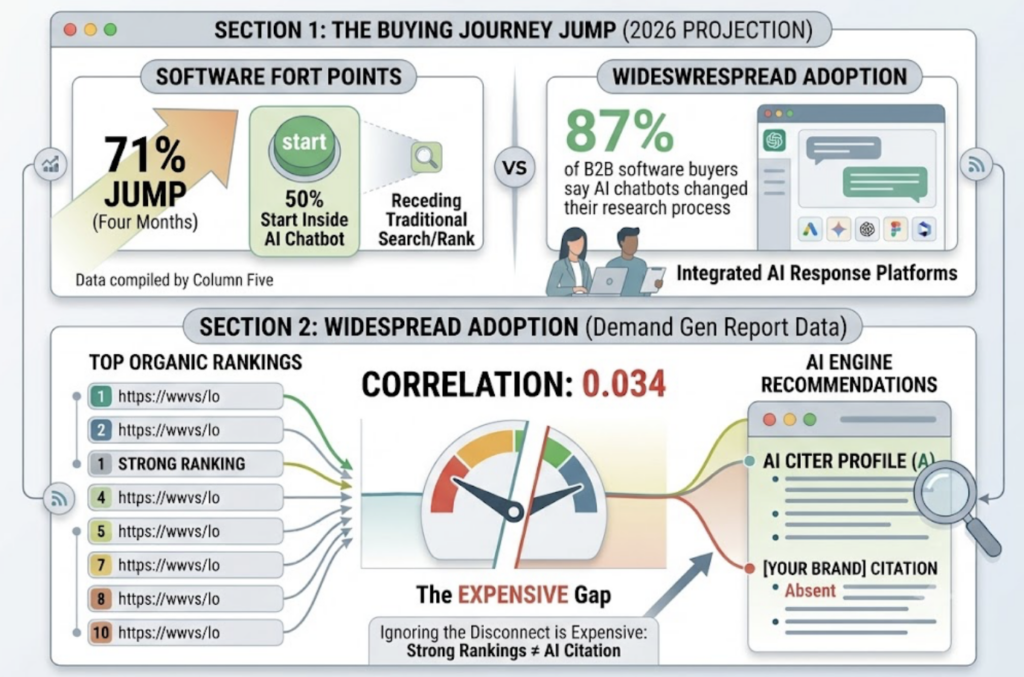
Here’s the part most SEO teams miss. Ranking and getting mentioned are nearly unrelated. One industry analysis found the correlation between Google organic position and AI citation probability runs as low as 0.034, which is effectively noise.
You can hold the top organic spot and still be absent from the answer your buyer actually reads.
Perplexity SEO Is Not the Same as Google SEO
Classic SEO instincts (chase keywords, build backlinks, climb the SERP) don’t carry over cleanly. Perplexity doesn’t rank a list of links. It retrieves sources in real time, synthesizes an answer, then footnotes the pages it leaned on.
So Perplexity SEO is less about domain backlinks and more about two things: whether your content is extractable, and whether the wider web agrees on what your brand is. A page can rank first in Google and still get skipped if it loads only through JavaScript or buries its answer ten paragraphs down.
The evidence for this gap is hard to wave away. An Ahrefs study found 28% of ChatGPT’s most-cited pages have zero organic visibility on Google. Separately, roughly 12% of URLs cited by Perplexity rank in Google’s top 10 for the same query, per a 2026 analysis from WP SEO AI.
Different engine. Different rules. Different scoreboard.
The Three Signals to Track: Mentions, Ranking, and Citations
Perplexity visibility isn’t one number. It’s three, and each tells you something the others can’t.
Tracking Perplexity Brand Mentions
A mention is the simplest signal: does the answer name your brand in its natural-language text? This is your awareness layer. It tells you whether the model considers you a relevant option for a given question at all.
The trick is coverage. Tracking mentions for branded queries (people already searching your name) flatters you. The real test is category and comparison queries, where a buyer who’s never heard of you is deciding who to shortlist.
Tracking Perplexity Ranking
Mentions tell you if you showed up. Perplexity ranking tells you where. Being named in the first sentence of an answer carries far more recall and click intent than a passing reference in the last paragraph.
Order also signals how the model weighs you against rivals named alongside you. If a competitor consistently leads the answer and you trail, that’s a positioning gap, not a volume gap.
Tracking Perplexity Citations
Citations are the footnoted links Perplexity attaches to its answers, and they drive the actual referral traffic. They matter more here than on most engines: Perplexity supplies an average of 6.61 citations per answer, compared with ChatGPT’s 2.62, based on 2026 research from Evergreen Media.
Watching Perplexity citations also exposes content gaps a traditional SEO tool would never flag. If the answer keeps citing a competitor’s comparison page or a third-party review instead of your site, you’ve found exactly what to build next.
How to Set Up Perplexity Tracking Step by Step
You don’t need a data science team to start. You need a repeatable process, because manual spot-checks go stale fast.
Step 1: Build your prompt set. Define a golden set of 50 to 100 high-intent queries spanning category questions, comparisons, and problem-based prompts. This is the universe you’ll measure against.
Step 2: Standardize the environment. Run queries in clean browser profiles or through an API so personalization and session history don’t skew results. Guidance from Rankability stresses this point: without a controlled setup, you’re measuring your own search history, not the model’s default answer.
Step 3: Track on a cadence. Citation models shift constantly, and one-off audits produce false signals. A weekly or bi-weekly run lets you catch citation drift before it becomes a trend.
Step 4: Act on the gaps. For every query where you’re absent, record which sources the answer cited instead. That list is your content roadmap.
Run this for a month and the limits of doing it by hand become obvious. A hundred prompts, across multiple engines, every week, is not a spreadsheet job.
What a Good Perplexity Tracking Tool Actually Does
So what separates a tool worth paying for from a dashboard full of numbers? Three things, matching the three signals above: it should measure mention frequency, position within the answer, and the exact sources being cited, then track all of it over time across more than one engine.
Topify is built around that exact structure. Its Visibility Tracking surfaces how often your brand is named across your prompt set, while Position Tracking shows where you land relative to competitors in each answer. For the citation layer, Source Analysis reverse-engineers the specific domains and URLs Perplexity pulls from, so you can see whether your pages or a rival’s are feeding the response.
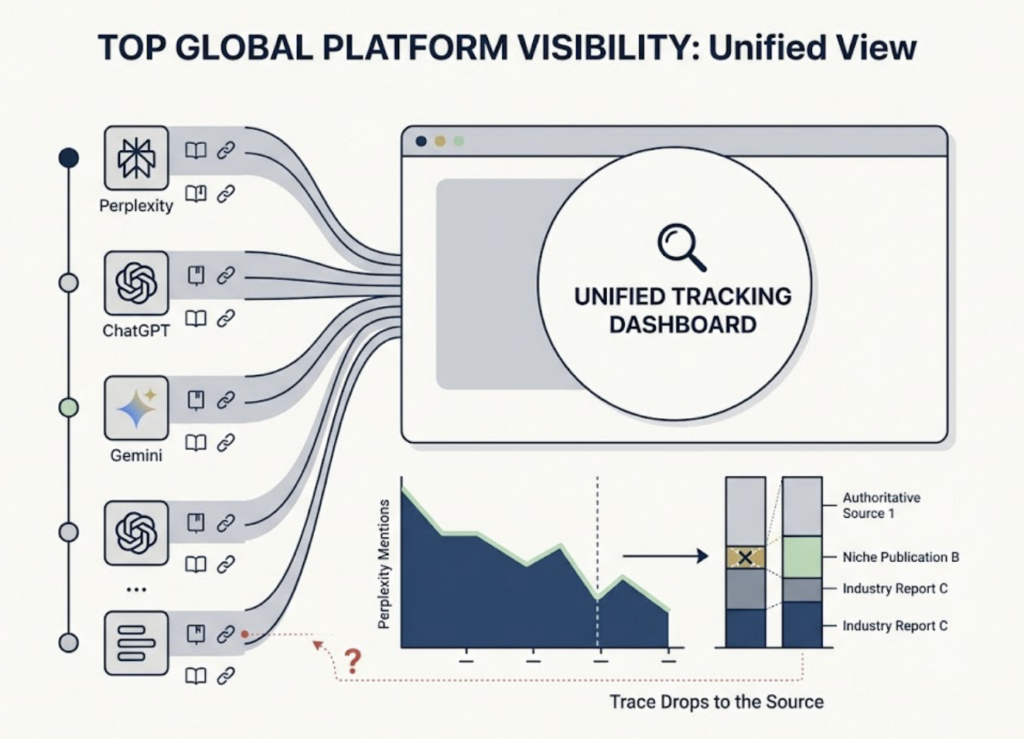
Coverage is the other piece that matters. Buyers rarely use one engine, and citation overlap between platforms can be as low as 11 to 12%, so a Perplexity-only view misses most of the picture. Topify tracks the same prompts across Perplexity, ChatGPT, Gemini, and other major models in a single view, which means a drop in Perplexity mentions can be traced back to the source that stopped citing you without switching tools.
Plans start at $99 a month and include Perplexity, ChatGPT, and Google AI Overviews tracking with room for 100 prompts, which lines up almost exactly with the golden set most teams need. You can get started and load your first prompt set in an afternoon.
Common Mistakes When Tracking Perplexity Brand Mentions
Three patterns trip up teams new to this.
The first is checking once. A single audit captures one roll of the dice from a non-deterministic model. Without a cadence, you can’t tell a real change from normal variance.
The second is tracking only branded prompts. Of course Perplexity names you when someone types your company name. The questions that grow pipeline are the category ones, where you’re competing to be mentioned at all.
The third is watching mentions while ignoring citations. Mentions tell you the model knows you exist. Citations tell you which content earned that trust, and they’re the lever you can actually pull. Skip them and you’re tracking a symptom, not the cause.
Conclusion
Your Google rankings can stay perfectly healthy while Perplexity quietly recommends someone else. That gap won’t show up in any traditional SEO report, which is the whole reason tracking matters.
Start small. Define a tight prompt set, measure mentions, ranking, and citations together, and run it on a schedule rather than as a one-off. Once you can see which sources Perplexity trusts, fixing your visibility stops being guesswork and becomes a content decision you can actually make.
FAQ
Q: What’s a good tool to track Perplexity brand mentions?
A: Look for one that measures three things together: how often you’re mentioned, where you rank inside the answer, and which sources Perplexity cites, ideally across several engines. Topify covers all three and tracks Perplexity alongside ChatGPT and Gemini, so you’re not stitching together separate tools.
Q: How is Perplexity SEO different from regular SEO?
A: Perplexity SEO optimizes for being retrieved and cited inside a synthesized answer, not for ranking a link. It rewards extractable, answer-first content and consistent brand entity signals across the web, which is why a top Google ranking doesn’t guarantee a Perplexity mention.
Q: How often should I check my Perplexity ranking and citations?
A: Weekly or bi-weekly. Perplexity weights freshness and its citation behavior shifts with model updates, so a one-time audit gives a false read. A regular cadence lets you spot citation drift early.
Q: Can my brand be mentioned without being cited?
A: Yes, and it’s common. Perplexity can describe your brand in its answer text without linking to your site as a source. Mentions build awareness, citations drive referral traffic, and a full strategy tracks both.

