

A player opens ChatGPT and types, “I want a cozy co-op game my partner and I can finish in a weekend, something like It Takes Two.” The model returns five titles. Your game fits that description better than three of them. It isn’t on the list.
That gap isn’t a quality problem. Your game might review well, sell steadily, and have a loyal Discord. The problem is technical: AI systems can’t see, parse, or trust your brand the way they see the titles they recommend. That’s a Generative Engine Optimization issue, and it’s measurable.
You can check exactly where you stand with the free GEO Score Checker from Topify, which scores your AI visibility from 0 to 100 across four dimensions.
✅ Free ⚡ Results in 60 seconds 🔒 No signup required
GEO Score Checker
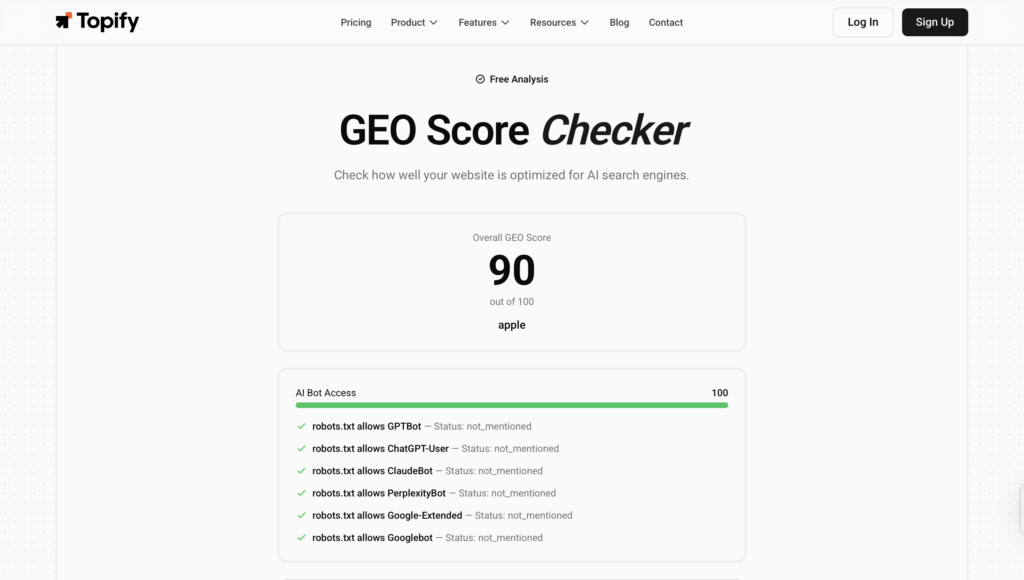
The Four Numbers That Tell You Why AI Skips Your Studio
Game discovery through AI is intent-driven, not keyword-driven. Players don’t search your title. They describe a feeling, a session length, or a game they already love, and the model decides what to surface. Whether your game shows up depends on four technical signals.
| Score Dimension | What It Measures | Gaming Impact |
|---|---|---|
| Bot Access | Whether AI crawlers like GPTBot, ClaudeBot, and PerplexityBot can reach your pages | A blocked store page, wiki, or devlog means your game’s details never enter what AI can recommend |
| Structured Data | Whether AI can parse the meaning of your content | Genre, platform, player count, and tags buried in images or trailers stay invisible to models |
| Content Signals | Whether AI treats your content as authoritative | Thin official pages lose to forums and aggregators when the model decides who to trust |
| Visibility Score | How often your game appears across AI platforms | Low frequency means players asking for “games like yours” get competitors instead |
Each number maps to a real failure mode studios run into. Here are the three most common.
Your Store Page and Wiki Are Closed to AI Crawlers
Many studios route everything through platforms and CDNs that, by default, restrict automated access. If GPTBot or PerplexityBot can’t crawl your pages, your game’s description, mechanics, and reviews never reach the models. A Bot Access score under 30 usually points here.
Your Genre and Vibe Live in Trailers, Not Text
A roguelike deckbuilder with tight 20-minute runs is exactly what a player might ask for. But if that pitch only exists in a YouTube trailer and a key art banner, AI can’t read it. Structured data is how you tell a model what kind of experience you actually deliver.
You’re Loud on Reddit, Quiet Everywhere Official
Plenty of indie games have active communities and weak official content signals. AI may know your game exists from forum chatter but won’t recommend it confidently without authoritative, well-structured pages to anchor the citation. That’s a Content Signals gap.
Running the check takes under a minute:
- Open the GEO Score Checker and enter your game’s domain or brand name
- Get four-dimension scores plus an overall number in about 60 seconds
- Compare the four scores to find your weakest signal
- Start fixing the lowest one first, since it’s dragging the rest down
What Players Actually Type Into AI Before They Buy
Gaming prompts look nothing like product searches. They’re about mood, similarity, and context. Here’s the kind of language players use, and what each prompt reveals about whether your game has a chance of appearing.
| AI Prompt Example | Platform | Search Intent | What It Reveals |
|---|---|---|---|
| “Games like Hades but on mobile” | ChatGPT | Find a similar experience on a specific platform | Whether AI maps your game to a known reference title |
| “Best co-op games for two people 2026” | Perplexity | Current shortlist for a social context | Whether your freshness and review signals are strong enough to surface |
| “Cozy farming sim I can play 30 minutes a night” | Gemini | Match by session length and tone | Whether your structured tags describe pacing and mood |
| “What roguelike should I try after Balatro” | ChatGPT | Sequential recommendation off a hit | Whether AI associates you with the right genre cluster |
| “Indie horror game with good story under $20” | Perplexity | Filter by genre, quality, and price | Whether your metadata and community reviews are parseable |
The behavioral shift is real and well documented. Around 62% of gamers aged 18 to 34 now use AI tools at least monthly, with game discovery among the top use cases. Meanwhile Steam is on pace to release over 16,000 titles in 2026, and AI tends to default to a narrow list of legacy hits when asked broad questions.
Here’s the consequence. Every prompt where your game should appear but doesn’t is a player who never sees you, never wishlists, never downloads.
Where Gaming Brands Lose GEO Points That ASO Never Measured
App store optimization and wishlist campaigns don’t touch the signals AI reads. Three blind spots show up again and again for studios.
The first is the semantic gap between keywords and intent. Your ASO might rank you for “puzzle platformer,” but a player asks for “a relaxing game with a sad story.” If your content doesn’t carry that semantic meaning in text AI can parse, you lose the match. Content Signals and Structured Data scores expose this directly.
The second is that you can’t buy your way in. There’s no ad slot in ChatGPT for games. You can’t sponsor a Perplexity recommendation. AI visibility is earned entirely through web presence, which is a different optimization problem than paying for a Steam feature or a streamer deal. The brands building that presence now, while competitors stay focused on storefront algorithms, are the ones AI will know how to recommend later.
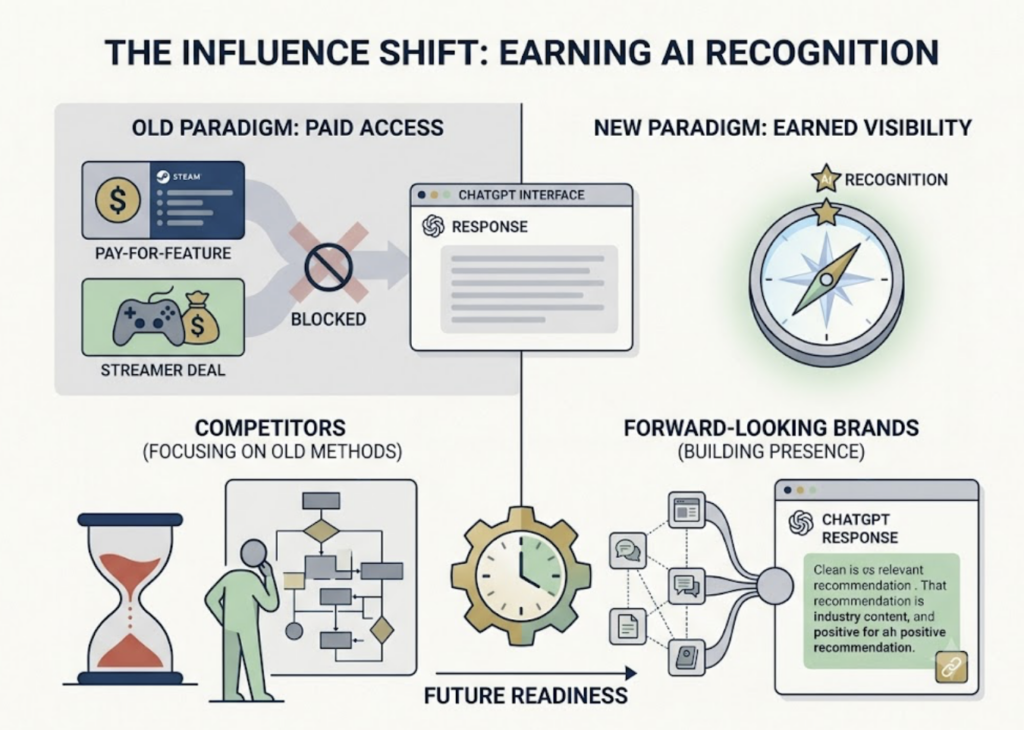
You don’t pay for AI visibility. You earn it, or you stay invisible.
The third blind spot is platform divergence, and it hits gaming harder than most categories. Across recent large-scale studies, only about 11% of domains were cited by both ChatGPT and Perplexity. Perplexity leans heavily on community sources like Reddit, where gaming discussion is dense. ChatGPT leans toward authoritative and encyclopedic sources. A single visibility number averages these into something close to meaningless.
| Gaming Scenario | GEO Score Signal | Likely Cause | Where to Look |
|---|---|---|---|
| Strong on Perplexity, absent on ChatGPT | Visibility Score split across platforms | Community-rich, authority-light footprint | Build structured official content |
| Game never matched to similar titles | Content Signals under 40 | Genre and tone not described in parseable text | Add semantic detail to official pages |
| Recent patch or DLC not reflected in answers | Visibility Score lagging | Stale content, no freshness signals | Refresh pages on a regular cycle |
That gap between platforms is exactly why one score, checked once, can mislead you.
From a One-Time Score to Tracking Every Patch and Launch
The GEO Score Checker gives you a snapshot. For a game, that snapshot ages fast. Launches, patches, seasonal events, and review surges all shift how AI sees you, and each platform reacts on its own schedule.
A single score tells you where you stand today. Continuous monitoring tells you which direction you’re moving, per platform, over time.
| Capability | Free GEO Score Checker | Topify Platform |
|---|---|---|
| Check frequency | One-time snapshot | Continuous monitoring |
| Dimensions tracked | 4 GEO scores | Full GEO analytics, sentiment, citations |
| Historical trends | None | Full trend history with alerts |
| Competitor benchmarking | Not included | Real-time competitor tracking |
| Platform breakdown | Aggregated | Per-platform (ChatGPT, Perplexity, Gemini, AI Overviews) |
| Optimization actions | Directional guidance | Specific, prioritized steps |
Comprehensive GEO Analytics tracks all four GEO signals across every major platform and shows you how they trend through each release cycle. You can start a free trial with no credit card, and see full plan details on the pricing page.
Conclusion
For a game studio in 2026, AI visibility isn’t a marketing nice-to-have. It’s the discovery channel you can’t pay into and can’t ignore. The players asking AI what to play next are the same ones who used to scroll Steam, and right now most of them aren’t hearing your game’s name.
Start with the free GEO Score Checker to see your four scores in under a minute. If Bot Access comes back low, the AI Robots Checker helps you trace the exact crawler rules blocking you. To dig into how trustworthy AI considers your official content, the Brand Authority Checker goes deeper, and the AI Visibility Report gives you a cross-platform snapshot of where your brand surfaces.
Frequently Asked Questions
Why does AI recommend older games instead of my new release?
AI tends to surface titles with the most established, parseable web presence, which often means legacy hits. A new game usually has thin structured content and few authoritative pages early on. Running the GEO Score Checker shows whether weak Content Signals or Structured Data scores are holding your launch back.
Can I pay to get my game recommended by ChatGPT or Perplexity?
No. There are no ad slots for game recommendations inside these models. Visibility is earned through web presence, structured content, and authority signals AI can read. That’s why it’s a technical optimization problem, not a media buy.
My game is popular on Reddit but never shows up in ChatGPT. Why?
Different platforms pull from different sources. Perplexity weighs community discussion heavily, while ChatGPT favors authoritative and encyclopedic content. A strong community footprint with weak official pages can leave you visible on one platform and absent on another, which is why per-platform tracking matters.
How is GEO different from ASO for games?
ASO optimizes how your game ranks inside an app store’s own search. GEO optimizes whether AI models understand and recommend your game when players ask in natural language across ChatGPT, Perplexity, and others. The two measure different things, and strong ASO does not guarantee AI visibility.
Read More:

