

Your domain authority is solid. Your Google rankings are holding. But none of that tells you whether ChatGPT is recommending your brand, dismissing it, or not mentioning it at all. With 37% of consumers now starting their product searches with AI tools rather than traditional engines, the gap between where your brand ranks on Google and where it stands in AI responses is becoming a real business problem.
The issue isn’t awareness. Most marketing and SEO teams have heard about ChatGPT brand mentions by now. The issue is that nobody has a clean answer for how to actually track them.
ChatGPT Brand Mentions Are Not the Same as Google Rankings
This distinction matters more than most teams realize.
A Google ranking is a fixed position on a list. You’re #3 for a keyword, or you’re not. ChatGPT brand mentions work differently: every time a user asks a question, the model generates a fresh response. There’s no list. There’s no stable position. Whether your brand gets mentioned depends on the prompt phrasing, the user’s context, and what the model has “learned” to associate with your category.
Research into how AI platforms handle citations shows that ChatGPT, Gemini, and Perplexity each rely on different retrieval and training signals. A brand that gets strong citations on Perplexity might be nearly invisible on ChatGPT. The underlying mechanics are different enough that you can’t extrapolate from one platform to another.
The strategic implication: ChatGPT brand mentions function more like reputation signals than rankings. They reflect how the model has synthesized information about your brand across its training data and retrieval pool. Getting mentioned is about trust, not just keyword relevance.
Why Your Current Toolset Has a Blind Spot Here
Ahrefs, Semrush, and similar platforms were built for a specific task: tracking what happens on pages that can be crawled, indexed, and ranked. That model doesn’t extend to AI-generated responses.
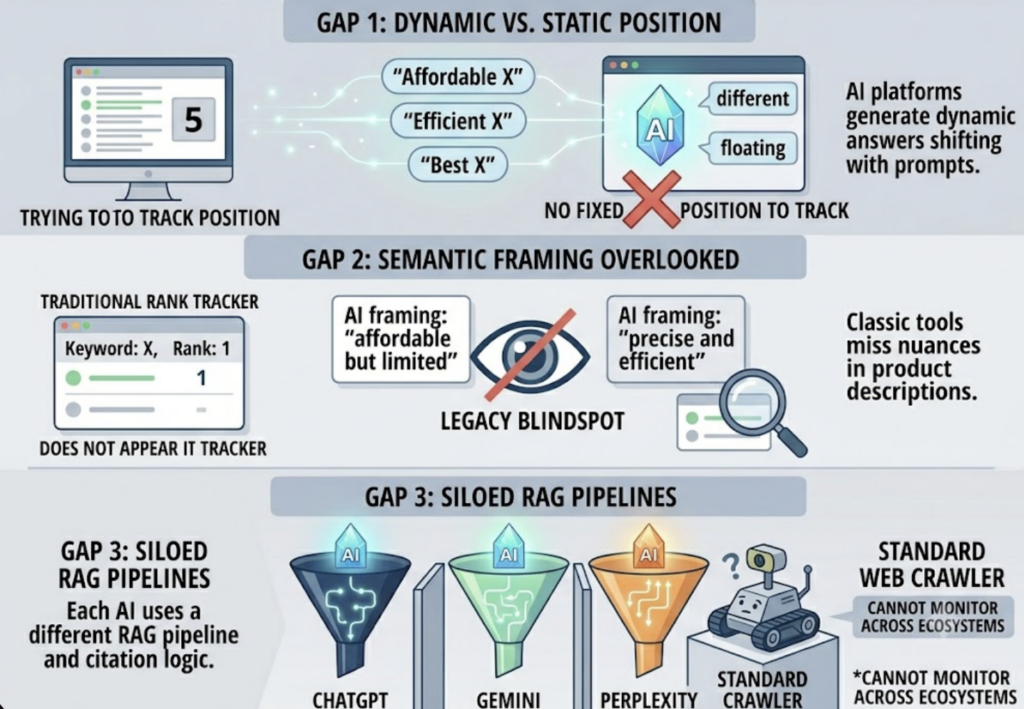
Analysis of legacy SEO tool limitations points to three specific gaps. First, traditional tools measure keyword position on a static list. AI platforms generate dynamic answers that shift based on prompt variation. There’s no single “position” to track. Second, classic tools don’t capture semantic framing. When ChatGPT describes your product as “affordable but limited” versus “precise and efficient,” that distinction doesn’t show up in any rank tracker. Third, each major AI platform uses a different RAG (Retrieval-Augmented Generation) pipeline, meaning the citation logic for ChatGPT isn’t the same as for Gemini or Perplexity. Standard crawlers can’t monitor across these ecosystems.
The result is a genuine monitoring blind spot. Your brand could be losing ground in AI-generated recommendations every week, and you’d have no way of knowing until a client or competitor points it out.
What Makes ChatGPT Brand Mentions Hard to Measure
There’s no API that returns “here’s who ChatGPT mentioned today.” Tracking requires what researchers call synthetic probing: systematically querying AI models at scale using variations of real user prompts, then analyzing the responses for brand mentions, position, sentiment, and citation sources.
A single query gives you one data point. To get statistically meaningful data, you need to run hundreds or thousands of prompt variations across different phrasings, user scenarios, and question types. Then you need to normalize that data into a metric that shows change over time.
This is why the evaluation criteria for AI visibility tools look different from what you’d apply to a traditional rank tracker:
| Evaluation Metric | Why It Matters |
|---|---|
| Multi-platform coverage | ChatGPT and Perplexity use different citation logic; single-platform data is incomplete |
| Statistical sampling depth | Hundreds of prompt variations required for a meaningful Visibility Score |
| Source analysis | Identifying which domains AI cites reveals your content gaps |
| Sentiment tracking | Captures how AI frames your brand, not just whether it appears |
| Workflow integration | Data needs to connect to content execution, not just dashboards |
Most tools check one or two of these boxes. The better ones cover all five.
Best Tools to Monitor ChatGPT Brand Mentions
The market for AI visibility monitoring has grown quickly in the past 18 months, but the tools vary considerably in what they actually measure.
Topify is the most comprehensive option for teams that need full-spectrum ChatGPT brand monitoring. It tracks brand mentions across ChatGPT, Gemini, Perplexity, DeepSeek, and several other major AI platforms simultaneously, which matters because your audience isn’t using just one. The platform’s Visibility Tracking feature runs systematic prompt queries across your target category and aggregates results into a Visibility Score: the percentage of relevant AI responses where your brand appears. That score updates over a rolling window, so you can see whether you’re gaining or losing ground.
What separates Topify from simpler mention trackers is the Source Analysis layer. It doesn’t just tell you whether ChatGPT mentioned your brand. It tells you which domains the AI cited when it did, and which domains it cited when it recommended a competitor instead. That data directly points to content gaps: articles you haven’t written, FAQs you haven’t answered, data you haven’t published. It turns a monitoring problem into an optimization roadmap.
The platform also includes Sentiment Analysis (tracking how AI frames your brand, scored 0-100), Competitor Monitoring (automatically detecting which rivals are appearing in your target prompts), and Position Tracking (where your brand appears relative to competitors within the same AI response). For teams that want to act on the data, the One-Click Execution feature lets you define a content or optimization goal and deploy it without building a manual workflow.
Topify’s Basic plan starts at $99/month and covers 100 prompts and 9,000 AI answer analyses across four projects. The Pro plan at $199/month expands to 250 prompts and 22,500 analyses.
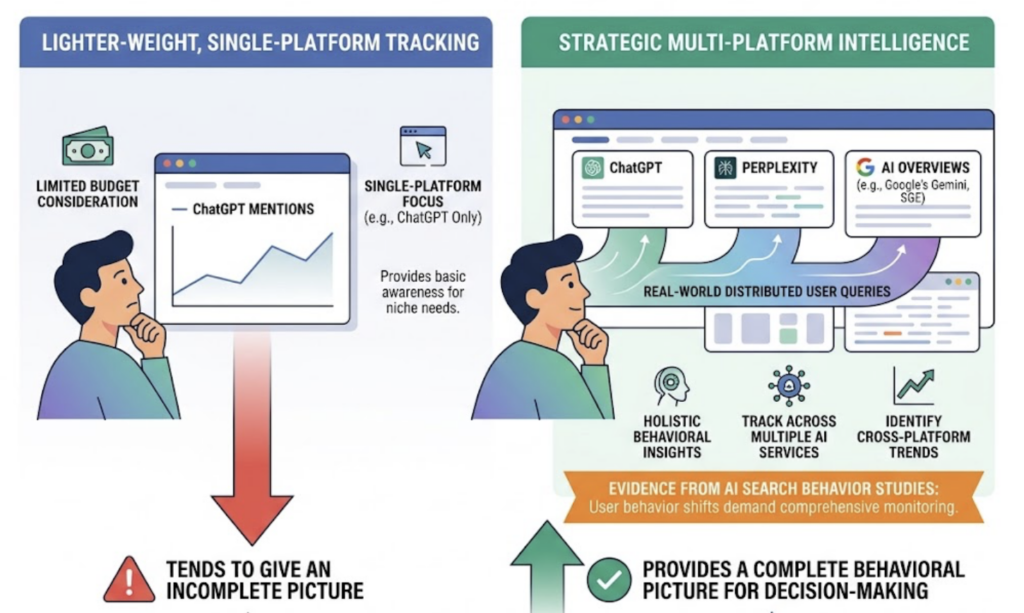
Other tools in this space include platforms that focus on single-platform tracking or offer lighter-weight mention alerts. They’re worth considering if your budget is limited and ChatGPT is the only platform you need to monitor. That said, evidence from AI search behavior studies suggests that user queries are increasingly distributed across ChatGPT, Perplexity, and AI Overviews simultaneously. Single-platform monitoring tends to give an incomplete picture.
How to Set Up ChatGPT Brand Monitoring in Practice
The setup process matters as much as the tool you choose. A few things to get right from the start.
Define your prompt set carefully. The prompts you monitor should reflect how your actual target audience asks about your category, not how you’d phrase it internally. “Best [category] tools” and “which [category] platform should I use” will surface different brands. Include both.
Add your top three competitors from the start. ChatGPT brand mentions are relative. A Visibility Score of 40% means something very different if your closest competitor is at 20% versus 80%. Competitor Monitoring in Topify tracks this automatically once you configure your competitive set.
Look at Source Analysis before you touch your content calendar. Most teams jump straight to “we need more content.” Source Analysis tells you what kind of content is actually driving AI citations in your category. You might find that AI consistently cites comparison pages, or data-heavy resources, or community posts on specific platforms. That’s where your effort should go first.
Set a 30-day baseline before optimizing. ChatGPT citation patterns shift gradually. You need at least 30 days of data to distinguish a real trend from normal variance. Use Topify’s app to set up tracking now, then review your baseline before making content decisions.
Turning Brand Mention Data into Actual Strategy
Data without a workflow is just a dashboard nobody looks at.
The most useful output from ChatGPT brand mention monitoring isn’t the Visibility Score itself. It’s the pattern behind it. Which prompts produce mentions? Which produce silence? Which produce a mention of your competitor with a framing that positions them as the default choice?
Those patterns map directly to GEO best practices: structure content for extractability (clear H2s, direct answer-first paragraphs, FAQ sections), address the specific sub-questions AI models break complex queries into, and use consistent entity naming with proper schema markup so the model can unambiguously associate your content with your brand.
Research on AI citation behavior also shows that small brands can compete effectively on this dimension. AI models prioritize “answerability,” not domain size. A focused, data-rich response to a specific question often gets cited over generic content from a much larger site. That’s a real opportunity for brands that haven’t had it in traditional SEO.
Track it. Optimize it. Repeat.
Conclusion
ChatGPT brand mentions are now a measurable, trackable signal, not a mystery you have to accept. The challenge isn’t philosophical. It’s practical: you need a tool that runs systematic prompt queries at scale, surfaces source-level citation data, and connects that data to what your content team does next.
The gap between brands that monitor this and brands that don’t is growing. The ones tracking ChatGPT visibility today are building a compounding advantage in AI search, the same way early movers in Google SEO did in the early 2010s. Starting with a 30-day baseline is enough to know where you actually stand.
FAQ
Q: How often does ChatGPT update its brand recommendations?
A: There’s no fixed update schedule. ChatGPT’s recommendations shift as the model’s retrieval pool changes and as your brand’s underlying authority signals (citations, mentions, expert coverage) evolve across the web. This is why tracking over a rolling 30-day window gives more reliable data than point-in-time checks.
Q: What’s the difference between ChatGPT brand mentions and Google rankings?
A: Google rankings are based on link equity and keyword relevance, measured against a static index. ChatGPT brand mentions reflect semantic understanding, factual verification, and trust signals synthesized from multiple sources. A high-authority domain doesn’t automatically translate to frequent AI mentions, and vice versa.
Q: Can small brands get mentioned in ChatGPT?
A: Yes. Because AI prioritizes “answerability,” a smaller brand that provides precise, data-rich answers to specific questions often gets cited ahead of larger, more generic competitors. The playing field in AI search is more level than in traditional SEO, particularly for niche or specialized categories.
Q: How do I know if my ChatGPT visibility is improving?
A: Move away from keyword rank as your primary metric. Monitor Citation Share (the proportion of relevant AI responses where your brand is cited) and Visibility Score (the percentage of category prompts where your brand appears) over a 30-day rolling window. Both are available in Topify’s tracking dashboard.

