

Search “best GEO tool” and you’ll find no shortage of results. The harder problem is that most of what comes up looks similar on the surface: dashboards, brand mention counts, and some version of AI visibility tracking. The difference is in what each platform actually measures, how deep it goes, and whether it can tell you why your brand is or isn’t appearing in AI-generated answers.
That gap matters more than most teams realize. According to the 2026 AI + Search Behavior Study by Eight Oh Two, 37% of consumers now start their research with AI tools rather than traditional search engines. If your brand isn’t part of the synthesized response, it doesn’t exist in that discovery moment.
Here’s a clear-eyed breakdown of the leading generative engine optimization tools in 2026, what they’re built to do, and how to figure out which one fits your situation.
Most GEO Tools Track Mentions. Fewer Actually Tell You Why They Change.
Before looking at specific tools, it’s worth understanding what separates a basic AI monitoring product from a real generative engine optimization platform.
Many incumbent SEO platforms have added “AI visibility” modules, but these often suffer from the same structural limitations. They track brand mention frequency without analyzing the context or sentiment behind those mentions. They don’t reverse-engineer why an AI chose a particular source, so you can’t act on the data. And they rely on SERP scraping rather than direct LLM probing, which means they miss how AI models actually generate answers.
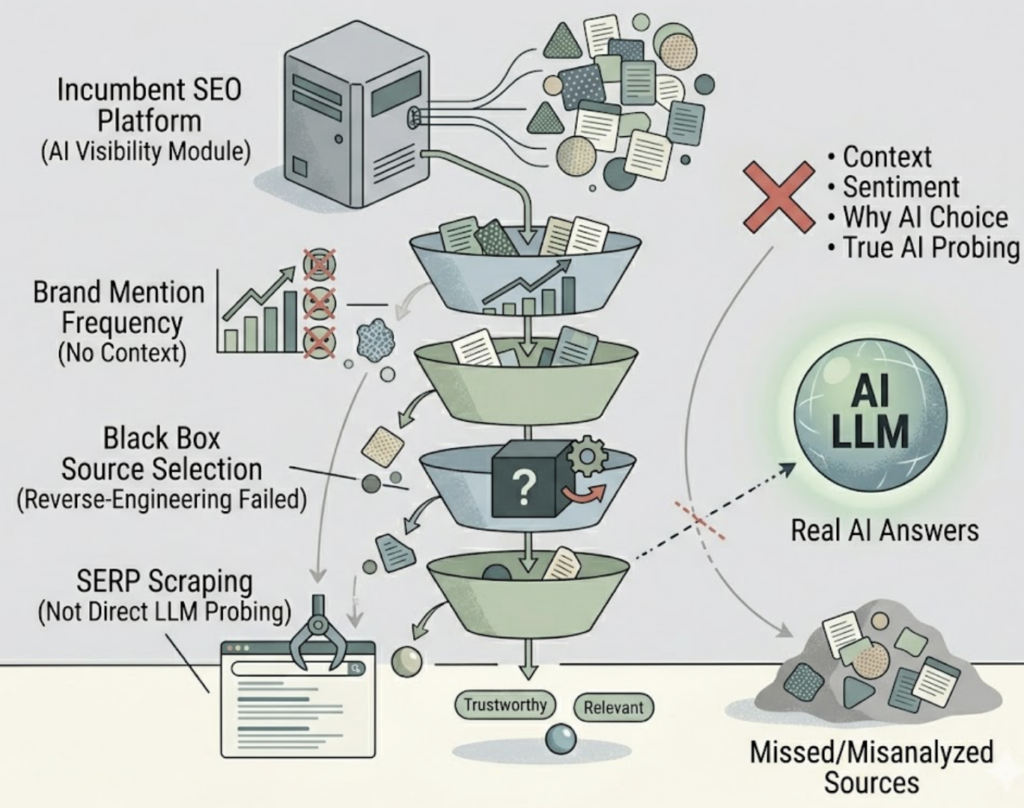
The result: you know your brand was mentioned, but not whether the AI described you accurately, ranked you above a competitor, or cited a third-party source that’s quietly building a competing narrative.
Five metrics separate surface-level monitoring from real AI search intelligence:
- Visibility Score: How often your brand appears across a defined set of high-intent prompts
- Citation Share: The percentage of AI answers that link to your domain as a primary evidence source
- Sentiment Score: How the AI characterizes your brand, its tone and framing
- Position: Where you land relative to competitors within a synthesized answer
- CVR (Conversion Visibility Rate): The downstream impact of AI-mediated discovery on branded traffic and conversions
If a tool doesn’t track all five, you’re working with an incomplete picture.
Top AI Visibility Optimization Tools at a Glance
| Tool | AI Platforms Covered | Core GEO Features | Starting Price | Best For |
|---|---|---|---|---|
| Topify | ChatGPT, Gemini, Perplexity, Claude, AI Overviews, DeepSeek, + more | Full 7-metric GEO suite, Source Analysis, One-Click Execution, Competitor Monitoring | $99/mo | Marketing teams and agencies needing full-stack GEO intelligence |
| Semrush | Google AI Overviews | AI Overviews tracking, SERP integration | $129/mo (bundled) | Existing Semrush users focused on Google’s ecosystem |
| Ahrefs | Web mentions (limited AI) | Brand mention tracking, content gap analysis | $129/mo (bundled) | Content teams tracking broad brand presence |
#1 Topify: Built for AI Search Intelligence, Not Bolted On
Topify is the only platform in this comparison engineered specifically for AI Search Intelligence rather than extended from a legacy SEO product. That distinction shows in how the platform approaches the problem.
Most tools observe. Topify actively probes.
Instead of scraping SERPs for AI summary snippets, Topify uses synthetic LLM probing to test how AI engines answer high-intent consumer queries in real time. That’s how it surfaces “invisibility gaps”: the prompts where your brand should appear but doesn’t, and the specific signals causing the absence.
Visibility Tracking spans ChatGPT, Gemini, Perplexity, Claude, AI Overviews, DeepSeek, Doubao, Qwen, and other major platforms, with seven core metrics tracked per prompt: visibility, sentiment, position, volume, mentions, intent, and CVR. That cross-platform depth matters because each AI engine operates differently. Perplexity pulls roughly 46.7% of its top citations from Reddit. Gemini prioritizes pages already ranking in traditional Google search. A brand winning on ChatGPT can be invisible on Perplexity. Tracking only one platform misses that entirely.
Source Analysis reverses-engineers the citation engine. The platform identifies exactly which domains and content structures (tables, structured definitions, FAQs with schema markup) trigger AI recommendations. A B2B SaaS client using Topify discovered that Perplexity was prioritizing G2 reviews over the company’s own documentation. After restructuring their docs with How-To schema and running a targeted review campaign, they saw a 300% increase in AI Share of Voice within three months. That kind of diagnosis isn’t possible with mention-counting tools.
One-Click Execution bridges the gap between insight and action. You state your optimization goal in plain English, review the proposed strategy, and deploy with a single click. No manual content workflows.
Topify also includes Competitor Monitoring that tracks rival brands across the same prompt set, Sentiment Analysiswith 0-100 scoring, and High-Value Prompt Discovery that scores prompts on AI query volume, visibility gap, commercial intent, and content readiness.
Pricing: Basic at $99/mo (100 prompts, 9,000 AI answer analyses, 4 projects), Pro at $199/mo (250 prompts, 22,500 analyses), Enterprise from $499/mo. Trusted by 50+ enterprises and startups.
Best for: Marketing teams managing brand visibility across multiple AI platforms, SEO agencies adding GEO services, and SaaS brands where product discovery happens inside LLM answers.
#2 Semrush: Solid for Teams Already Invested in the Ecosystem
Semrush added AI Overviews tracking as part of its broader platform, making it a reasonable choice for teams already paying for the suite. The integration with existing keyword and backlink data creates a unified workflow for traditional SEO practitioners who are starting to add AI search visibility to their scope.
The constraint is platform depth. Semrush’s AI visibility features center primarily on Google AI Overviews, with limited tracking of ChatGPT and Perplexity beyond surface mention counts. For teams whose primary concern is SERP stability and the impact of AI Overviews on organic click-through rates, that’s often sufficient. For teams that need cross-platform GEO intelligence, it’s a starting point, not a destination.
#3 Ahrefs: Useful for Content Teams Monitoring Brand Presence
Ahrefs brings its backlink-centric DNA to AI citation tracking through its brand monitoring module. The platform surfaces brand mentions across the web, including some AI-generated content, and integrates that data with content gap analysis.
It’s more useful as a brand awareness tool than a GEO optimization platform. The depth of AI search analytics is limited compared to purpose-built platforms, and the absence of real-time LLM probing means you’re seeing historical snapshots rather than live visibility data. For content teams that want a rough sense of brand presence alongside their existing Ahrefs workflow, it’s a practical addition. For teams where AI search optimization is a primary initiative, it’s not the right primary tool.
When Lighter Tools Are Enough (And When They’re Not)
Not every team needs an enterprise GEO platform on day one.
If your primary concern is understanding how your site reads to AI crawlers before investing in ongoing monitoring, Topify’s free GEO Score Checker evaluates any URL across four dimensions: AI bot access, structured data, content signals, and overall visibility. The tool gives you a prioritized fix list, and Topify’s scan data across 12,000+ domainsshows that most teams move from a 30 to a 70 GEO score within two weeks by unblocking AI crawlers, adding FAQ schema, and rewriting key page intros.
That’s the right starting point for smaller teams or those just entering the GEO space.
The calculus changes when your revenue depends on AI-mediated discovery. According to Deloitte Digital’s research on the future of search, consumers who arrive via an AI recommendation convert at a measurably higher rate than those arriving from traditional organic search. Early data from Topify’s platform puts that conversion premium at roughly 5x the rate of traditional organic search visitors, because the AI has pre-qualified the user before they ever click through.
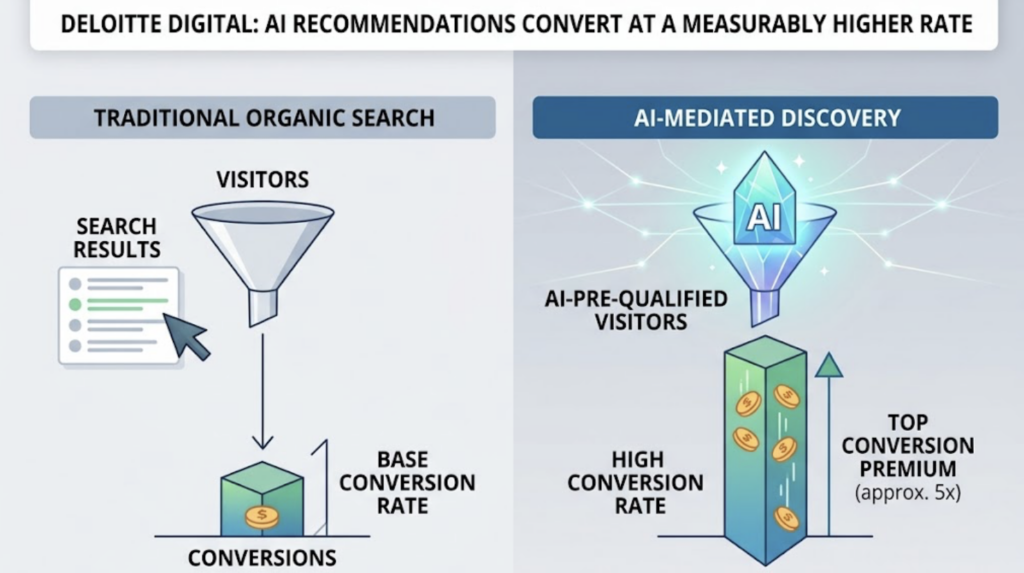
At that conversion rate, the cost of being invisible in AI answers isn’t a traffic metric. It’s a revenue number.
Deploy a full AI visibility platform when you’re operating in competitive categories where AI shortlists determine your consideration set, when you need cross-platform tracking across more than Google AI Overviews, and when content optimization at scale requires more than manual effort.
How to Start with Generative Engine Optimization
Step 1: Establish your baseline. Run your top 15-20 category-level prompts across ChatGPT, Perplexity, Gemini, and Google AI Overviews. Record visibility score, position, and sentiment per platform. This is your Share of Model. Topify’s AI Search Volume Checker is a practical free entry point: paste any prompt and get its 12-month volume curve across major AI platforms, with the first 10 prompts free and no sign-up required.
Step 2: Analyze the citation pool. Identify which domains and content structures AI engines cite when answering prompts in your category. According to AirOps research on AI visibility metrics, the content structures that trigger AI citations consistently include data-dense tables, structured definitions, FAQ schema, and verifiable third-party claims. Topify’s Source Analysis maps this at the domain level, showing you exactly where to earn inclusion.
Step 3: Implement continuous monitoring. AI models retrain frequently, and Jellyfish’s 2026 research on brand discovery found that visibility is volatile, with only about 30% of brands maintaining consistent AI visibility across multiple regenerations of the same query. Set up prompt-level alerts so you catch sentiment drift or citation drops before they affect revenue.
GEO results move faster than traditional SEO. Topify’s data shows that targeted changes, like adding expert quotes, verifiable statistics, or modular answer structures, often produce measurable AI visibility changes within 30 days.
Conclusion
The generative engine optimization tool landscape isn’t short on options. What’s short is platforms that go beyond mention tracking into the full loop: why AI recommends certain brands, which sources it trusts, and what changes actually move the metrics.
For most marketing teams and agencies operating in competitive categories, Topify covers that loop end-to-end, from synthetic LLM probing to one-click execution across 7+ AI platforms. Semrush and Ahrefs remain solid choices for teams already in those ecosystems who need AI visibility as a secondary signal alongside traditional SEO.
If you’re not sure where to start, run a free GEO score on your site at topify.ai/tools/geo-score-checker and see where your brand stands today.
FAQ
What is generative engine optimization?
Generative engine optimization (GEO) is the practice of making your brand visible, citable, and recommended by AI systems like ChatGPT, Gemini, and Perplexity. Unlike traditional SEO, which optimizes for keyword rankings in a list of blue links, GEO is a citation game: AI engines synthesize single answers from sources they deem credible and structured, and your presence in that answer is the new definition of search visibility.
How is AI SEO different from traditional SEO?
Traditional SEO optimizes for domain authority, keyword rankings, and click-through rates from a results page. AI search optimization focuses on whether AI systems trust your content enough to include it in a synthesized answer. The competition shifts from “who ranks higher” to “who gets cited, recommended, and described accurately inside the AI response.”
Which AI platforms should I track for GEO?
At minimum: ChatGPT (highest query volume), Perplexity (highest citation density, preferred by research-oriented users), Google AI Overviews (carries over traditional search traffic), and Claude (strong in B2B and professional services contexts). The right platform mix depends on your audience and category.
What’s the best AI visibility optimization tool for small teams?
Start with Topify’s free GEO Score Checker and AI Search Volume Checker to establish a baseline with no sign-up required. For ongoing multi-platform tracking, Topify’s Basic plan at $99/mo covers 100 prompts and 9,000 AI answer analyses, which is sufficient for most focused campaigns.
How do I know if my brand appears in ChatGPT or Perplexity answers?
You can check manually by running your category-level prompts directly in each AI tool. For systematic tracking across many prompts and platforms, you need a tool that probes LLMs programmatically. Topify’s AI Search Volume Checker lets you test specific prompts across platforms, while Topify’s full platform runs continuous prompt-level monitoring with alerts.

