

There’s a spreadsheet on your team’s shared drive with about a dozen prompts in it. Someone runs them through ChatGPT every Monday, screenshots the answers, and fills in a column marked “mentioned: yes/no.” Last week your brand showed up in four out of twelve. This week it’s two. Nobody can say whether something actually changed or whether the model just answered differently that morning. That gap is where most prompt search reporting collapses, usually right after someone in the meeting asks a follow-up question.
Ten Prompts in a Spreadsheet Isn’t Tracking. It’s Sampling Noise.
Manual spot-checking fails for a reason that has nothing to do with effort. AI answers are probabilistic, so the same question produces a different brand list nearly every time you ask it.
SparkToro and Gumshoe.ai tested this directly. Running 2,961 prompts across ChatGPT, Claude, and Google’s AI surfaces, they found less than a 1-in-100 chance that the same prompt would return the same list of brands across repeated runs. Search Engine Journal
Read that number again before you plan your next report.
If a single run has roughly a 1% chance of reproducing itself, then a screenshot proves nothing about your position. It proves the model said something once. A company can’t credibly claim it “ranks number one in ChatGPT” based on an isolated response, which is what most internal AI visibility decks are quietly built on. Web Logix Group
The fix isn’t more careful screenshotting. It’s changing the unit of measurement from a binary yes/no to a frequency: out of N runs of this prompt, on what percentage did the brand appear, and in what position.
Prompt Search Isn’t Keyword Search Wearing a New Name
A prompt search is a full natural-language question submitted to an AI system that returns a synthesized answer instead of a ranked list. That difference in output format changes what you can measure.
Here’s the part most teams get backwards. Real prompts aren’t the elaborate templates you see in AI marketing threads. Semrush clickstream data puts the average prompt length in ChatGPT’s search mode at 4.2 to 8.7 words, roughly the same as a Google query. Survey work from Stella Rising found that only 12% of respondents wrote anything resembling a “real” prompt, while about 60% phrased their query as a question.
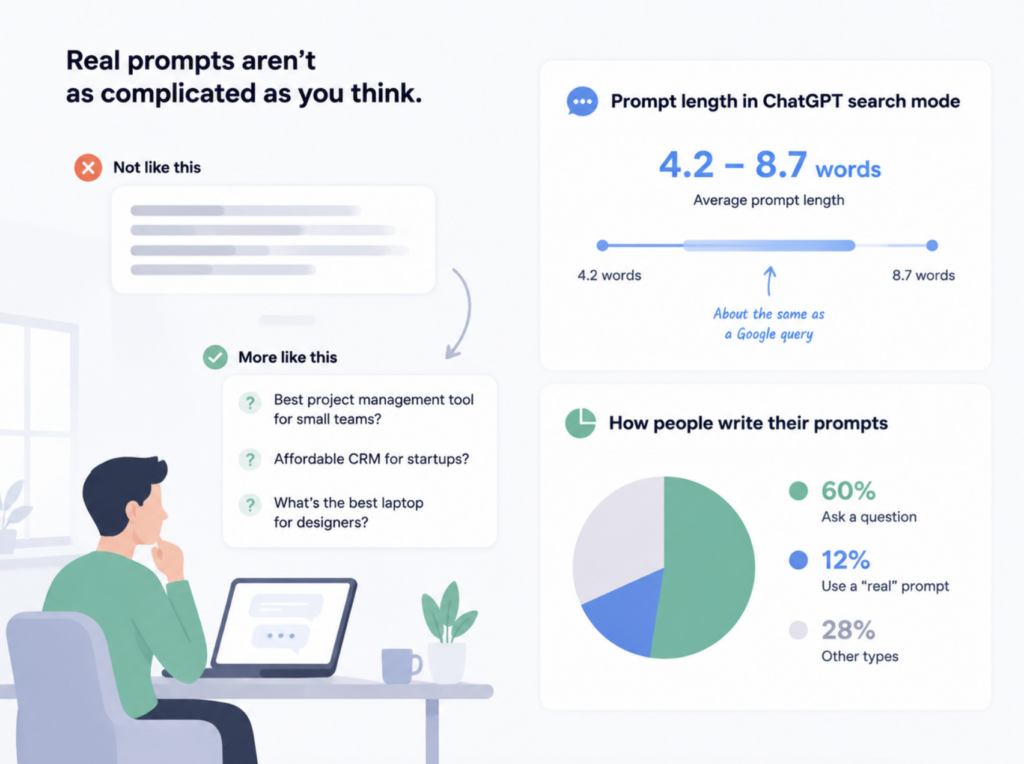
So the prompts your buyers actually type look closer to keywords than you’d expect. The divergence happens after they hit enter.
AI engines don’t retrieve against the string you typed. They expand it. Google’s query fan-out technique breaks one prompt into related searches across subtopics before synthesizing an answer. Research on AI Mode shows 59% of prompts trigger between five and eleven simultaneous sub-queries, with complex B2B queries averaging nine to eleven, while ChatGPT runs 2.3 to 2.8 sub-queries per prompt. Pepper
Bottom line: one prompt search is not one query. It’s a bundle of them, and your brand has to survive the whole bundle to show up in the answer.
Step 1: Build a Prompt Set That Matches How Buyers Actually Ask
Start with coverage, not volume. A tracked prompt set should map to the decisions your buyers make, not to the questions that flatter your product.
Four categories cover most of the ground:
| Prompt type | Example shape | What it tells you |
|---|---|---|
| Category discovery | “best [category] tools for [use case]” | Whether you’re in the consideration set at all |
| Comparison | “[competitor] vs alternatives” | Where you sit when a rival is the anchor |
| Problem-led | “how do I fix [problem]” | Whether your content gets pulled into solution answers |
| Brand-direct | “is [your brand] any good” | How AI describes you when you’re named |
Skip the brand-direct prompts as your starting point. They’re the easiest to win and the least informative, since a user who already knows your name isn’t the acquisition problem.
The best source material is your own sales calls and support tickets. Pull the actual phrasing people use when they don’t know your category vocabulary yet. That phrasing is what feeds the fan-out.
For scale, a set of 100 prompts tends to be enough to cover a single product line across four engines. Multi-product or multi-market brands generally need 250 or more before the coverage stops feeling arbitrary.
Step 2: Define What Counts as Brand Visibility Before You Measure It
Most teams measure mentions and stop. That’s the single biggest reason prompt search dashboards look impressive and change nothing.
Visibility has three layers, and they answer different questions:
- Mention rate. Out of N runs, how often does your brand appear at all?
- Position. When you appear, are you first in the list or fourth? Users read AI answers top-down.
- Citation. Which of your URLs did the engine actually pull from, if any?
A brand can have a healthy mention rate and zero citations, which means AI knows your name but isn’t reading your content. That’s a very different problem from being absent, and it needs a different fix.
Platform baselines matter here too. One 2026 analysis of 34,234 AI responses found ChatGPT cited brands 0.59% of the time while Perplexity sat at 13.05%. Comparing your ChatGPT mention rate against your Perplexity mention rate without adjusting for that gap will make ChatGPT look like a failure when it’s behaving normally. Leapd
Sentiment belongs in the definition as well. Appearing in an answer that calls you “a budget option” isn’t the same win as appearing as “the enterprise standard,” even though both count as a mention.
Step 3: Run Prompt Searches on a Schedule, Across Every Engine That Matters
Frequency solves the variance problem. Nothing else does.
Since a single run is close to meaningless, you need repeated sampling to turn noise into a rate. Weekly cadence works for most brands. Anything slower and you’ll miss the shifts that follow model updates or a competitor’s content push.
Coverage solves the second problem. Engines don’t share source pools, and the overlap is far smaller than most teams assume. Analysis across hundreds of millions of citations found that only 11% of domains are cited by both ChatGPT and Perplexity, and Google AI Overviews and AI Mode cite the same URLs just 13.7% of the time. Leapd
That means single-engine tracking isn’t a partial view. It’s a view of a different ecosystem than the one your buyer might be using.
If you collapse everything into one blended “AI visibility score,” you lose the ability to act on it. As one analysis of citation reporting put it, collapsing all AI visibility into one number removes your ability to see where you’re winning, where you’re absent, and where competitors are taking share.
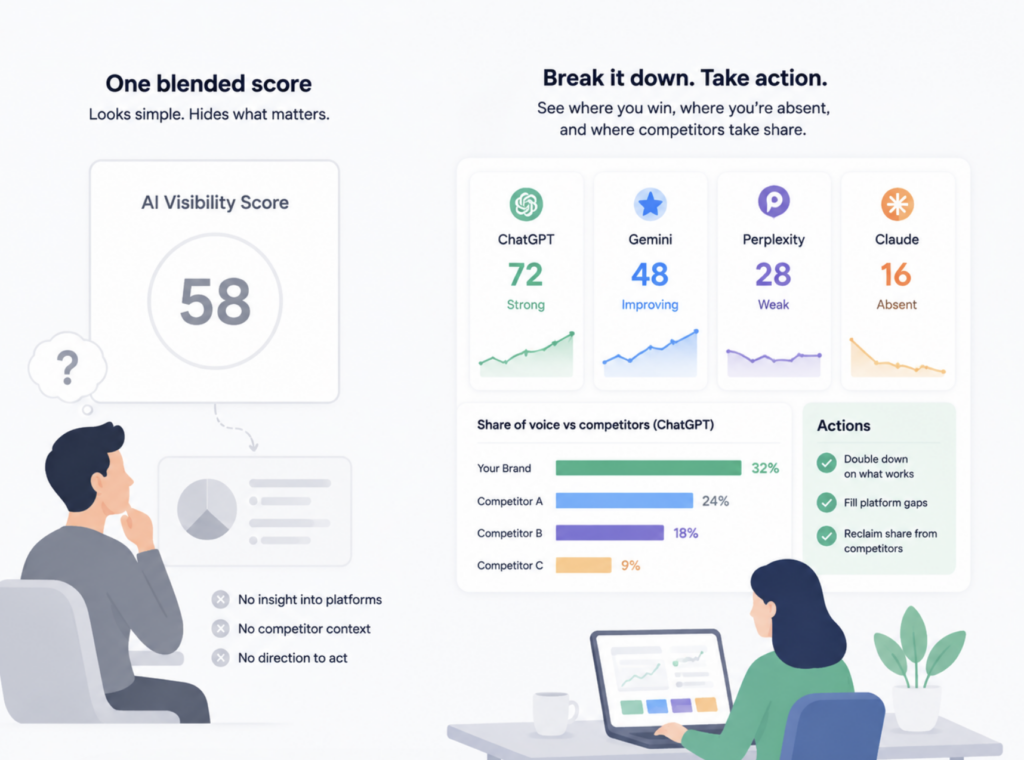
Track per engine, per prompt, per week. Then blend for the executive summary, never for the diagnosis.
Step 4: Trace Each Mention Back to the Source That Produced It
A visibility number without attribution is a mood ring. It tells you how things feel this week and nothing about what to do next.
The actionable layer is the source. When your mention rate drops on a comparison prompt, the useful question is which domain the engine cited instead, and whether that domain mentions you at all.
This matters more now that AI citations have decoupled from rankings. In mid-2025, 76% of AI Overview citations came from top-10 organic results. By early 2026, that had fallen to 38% in Ahrefs data. Your rank report is no longer a proxy for your citation footprint. Leapd
Practically, source tracing gives you a content backlog. If three of your competitors show up through the same industry roundup and you don’t, that roundup is a placement target. If Reddit threads are feeding an entire prompt cluster, that’s a community presence problem, not a blog problem.
Track it. Trace it. Fix the source.
Four Mistakes That Make Prompt Search Data Useless
Tracking only brand-name prompts. You’ll see great numbers and learn nothing, because the people asking those prompts already found you.
Running one engine. With roughly 11% domain overlap between major platforms, one-engine tracking leaves most of your citation landscape unmeasured. Cross-platform work has documented citation volume differences of up to 615 times for the same brand between platforms.
Sampling once and calling it data. One run per prompt per month produces a chart that moves for reasons you can’t explain. Repeat runs are what convert a yes/no into a defensible rate.
Stopping at the mention. A mention count tells you the score. It doesn’t tell you which play to run. Without source attribution, every optimization decision is a guess.
What Prompt-Level Tracking Looks Like When It’s Not Manual
Everything above is doable by hand. The math is what kills it. One hundred prompts, four engines, five repeat runs, weekly, is 2,000 answers a week to capture, parse, and classify. That’s a full-time job before anyone looks at a single insight.
This is where a purpose-built platform earns its cost. Topify handles the sampling layer, running prompt sets across ChatGPT, Gemini, Perplexity, AI Overviews, and regional engines including DeepSeek, Doubao, and Qwen, then reporting results as rates rather than snapshots.
The part worth paying attention to is what happens after the data lands. Topify’s analytics cover seven metrics in one view: visibility, sentiment, position, volume, mentions, intent, and CVR. So when your mention rate on a comparison prompt drops, you can check whether position slipped, whether sentiment shifted, and which cited domains changed, without exporting anything. Its prompt discovery keeps surfacing new high-volume questions in your category as buyer language moves, which is the piece a static spreadsheet can never do. Competitor benchmarking runs on the same prompt set, so you’re comparing like for like instead of guessing at rival performance.
Pricing starts at $99/month for 100 prompts across three engines, and $199/month for 250 prompts, with details on the Topify pricing page. You can get started with a single project before committing a whole team to the workflow.
Conclusion
The spreadsheet isn’t wrong. It’s just built on a unit of measurement that doesn’t hold up: a single answer treated as a fact, when the underlying system produces a different answer nearly every time it’s asked.
Fixing this takes two decisions and one habit. Decide which prompts represent real buying questions, decide whether you’re measuring mentions, position, or citations, then commit to running the set on a schedule across more than one engine. Do that for 30 days and you’ll have something you can defend in a meeting.
Start with 20 prompts you can name a business reason for. Expand once the pattern is visible.
FAQ
Q: How many prompts should I track to get reliable data?
A: Around 100 prompts covers a single product line across the four main prompt types. What matters more than the count is repeat sampling. Ten prompts run five times weekly produces better data than 50 prompts run once a month, because AI answers vary run to run.
Q: What’s the difference between prompt search tracking and keyword research?
A: Keyword research measures search volume for phrases that return ranked links. Prompt search tracking measures how often your brand appears inside a synthesized answer, and in what position. The two overlap in phrasing, since real prompts average under nine words in search mode, but diverge in what happens after retrieval.
Q: How often should I run prompt searches?
A: Weekly is the practical default. AI engines update models and refresh their retrieval indexes frequently enough that monthly data misses the changes you’d want to react to. Give any new tracking set at least 30 days before drawing conclusions.
Q: Why does the same prompt return different brands each time?
A: Generative systems are probabilistic, and personalization adds session context, location, and history on top. Research on repeated brand recommendation prompts found the same list reappears less than 1% of the time. This is why prompt-level visibility should be reported as a percentage across runs, not as a single result.

