

Your keyword file has thousands of terms in it. It took years to build, and it still predicts what people type into Google with decent accuracy. Then you pull a month of AI referral data and almost none of the phrasings match anything in that file. Depending on the dataset, somewhere between 65% and 85% of ChatGPT prompts have no matching keyword in standard keyword databases. That’s not a coverage gap you close by adding long-tail variants. Prompt search runs on a different unit of demand, and mapping it takes a different method.
Prompt Search Isn’t Keyword Search With More Words
Start with the size difference, because it sets up everything else. ChatGPT prompts average about 60 words against Google’s typical 3.4-word query. Even inside AI search specifically, prompts are getting longer: Semrush’s clickstream analysis found search-enabled prompt length nearly doubled from 4.7 to 8.7 words between early 2025 and early 2026.
Google’s own data points the same direction. The average AI Mode query now runs triple the length of a traditional search query.
Length is the symptom. Context is the actual change.
A keyword names a topic. A prompt describes a situation. “project management software” tells you a category. “We’re a 12-person agency moving off spreadsheets, need something with client-facing views, budget under $20 per seat” tells you the category, the constraint, the buying stage, and the disqualifiers.
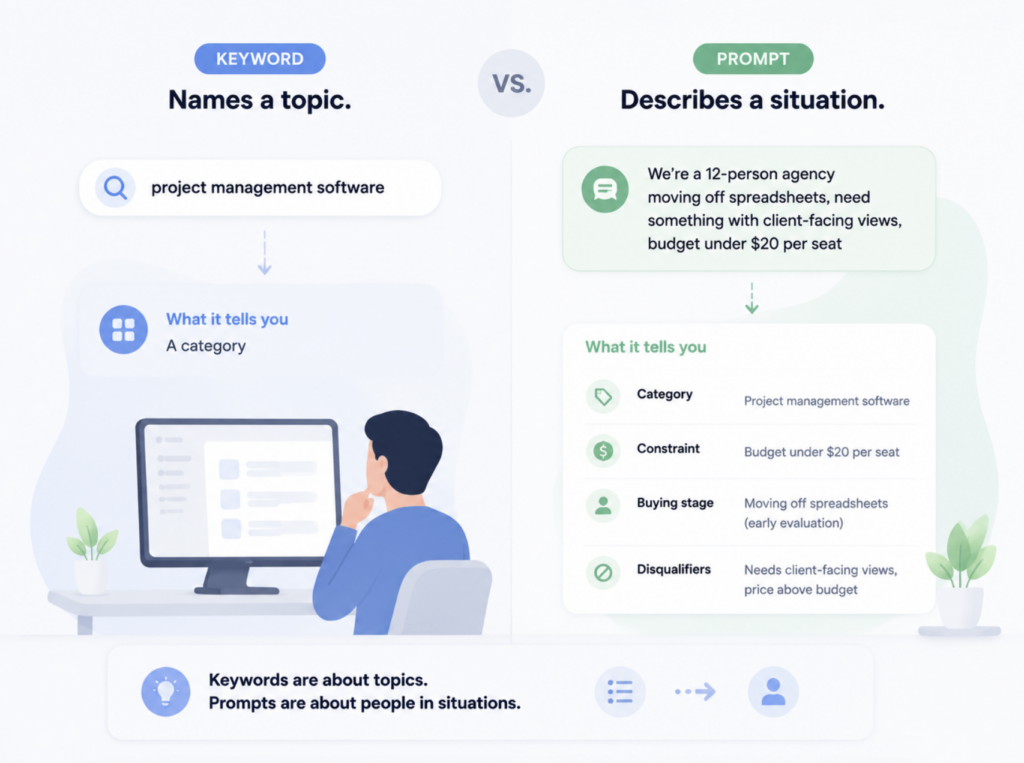
That matters for mapping because intent stops being something you infer from a three-word string. In prompt search, the user hands it to you directly. The work shifts from guessing intent to organizing it.
One Prompt Search, Many Hidden Queries: What Fan-Out Does to Intent
Here’s the part most keyword-to-prompt migrations miss. AI systems rarely search the prompt you wrote. They decompose it. One query goes in, many related queries come out, and the results get synthesized into a single answer. Google runs this explicitly in AI Mode and AI Overviews, and most other engines use some version of it.
Longer prompts feed that machinery better. NP Digital’s analysis of 10,000 AI-generated overviews found AI results appeared on 36.1% of queries that were 6 to 10 words long, against 12.4% for one and two-word queries. Separate data suggests queries of 8 words or more are 7 times more likely to generate an AI Overview.
One estimate puts the multiplier at 10 to 16 times more retrieval events per AI query than its traditional search equivalent. The exact number depends on the model and the prompt, so treat it as a range rather than a constant. The direction is what counts.
You’re not competing for a prompt. You’re competing for its fragments.
This is the single biggest reason a prompt list copied from a keyword list underperforms. The keyword file assumes one query maps to one results page. Prompt search assumes one prompt maps to a cluster of sub-questions, each pulling from different source types. A definition sub-query wants a clean explanation. A comparison sub-query wants a table. Your content either matches one of those shapes or it doesn’t get pulled.
The Three Intent Layers Inside Every Prompt
The most useful classification of prompt intent doesn’t come from the SEO world. It comes from OpenAI’s study with NBER covering more than a million messages, which sorted usage into three buckets: 49% Asking, 40% Doing, and 11% Expressing. Among work-related messages, the balance flips, with about 56% classified as Doing.
That split has direct commercial consequences, and most prompt maps ignore two of the three layers entirely.
| Intent layer | What the user wants | What it means for your brand |
|---|---|---|
| Asking | Information, judgment, a recommendation | The layer where brands get named and cited. Highest visibility value per prompt. |
| Doing | An output produced: a draft, a plan, a comparison table | Your product may get used as raw material without ever being named. Watch for silent usage. |
| Expressing | Reflection, opinion, venting | Rarely worth tracking, but useful sentiment signal in category conversations. |
Asking is where prompt search visibility lives. When someone asks which tool fits their situation, the model produces a shortlist, and that shortlist is the whole game.
Doing is the layer teams overlook. When a user says “build me a vendor comparison table for warehouse automation,” the model still retrieves and synthesizes. Your brand either lands in that table or it doesn’t. Same visibility mechanics, different prompt phrasing, and most tracking lists contain zero prompts written this way.
How to Build a Prompt Search Intent Map in Five Steps
Step 1: Pull seeds from places keyword tools can’t see
Keyword databases won’t have these phrasings. Your own systems will. Internal site search logs, sales call transcripts, support tickets, and Search Console queries filtered for who, how, which, and why all contain the natural language your buyers already use. Objection language from sales calls tends to produce the highest-intent prompts you’ll find anywhere.
Step 2: Classify by intent, not by topic
Topic clustering is a habit carried over from keyword research for GEO and AEO work, and it’s the wrong first cut here. Sort by what the user wants back: a recommendation, a process, a comparison, a verdict on a specific brand, or a finished output. Topic becomes your second-level tag.
Step 3: Expand each prompt the way a model would
Take each seed and write out the sub-questions a system would need to answer it. No tool reveals the actual synthetic queries, so approximation is the job. Read the follow-up suggestions in AI Mode, the sources cited under a Perplexity answer, and the People Also Ask boxes. Those are the shards already firing.
Step 4: Tag branded against unbranded before you count anything
A workable starting ratio is roughly 75% unbranded and 25% branded. You almost certainly show up when your own name is in the prompt, so branded results tell you about accuracy and positioning, not discoverability. Mixing them into one average inflates every number you report.
Step 5: Score for influenceability, then cut hard
A prompt earns a slot only if it’s competitively relevant, commercially meaningful, and something your content can plausibly move. A practical starting point is 20 to 40 prompts across 2 to 3 models, tracked for at least 30 days before you draw conclusions. Short and filtered beats long and unfocused.
Phrasing Moves the Answer More Than Your Content Does
This is the finding that breaks most intent maps built on keyword logic. An analysis of 37,804 AI responses across five engines found that how you phrase a prompt shifts brand density more than what you ask. Ranking and comparison formats surfaced roughly 20% more brand mentions than open-ended questions. Concise, keyword-style prompts pushed visibility up to 25% higher than persona-engineered ones, because heavy role framing widens the query into educational territory where fewer brands appear.
Two consequences for your map.
First, phrasing variants belong in separate rows. “Best CRM for small business” and “I run a 10-person business and need help picking a CRM, what should I consider” express the same intent and will produce different brand sets. Collapsing them into one entry hides the gap.
Second, freeze your wording once measurement starts. Editing prompts mid-quarter resets your baseline, and you’ll misread the change as a visibility swing.
Turning a Prompt Search Intent Map Into Something You Can Measure
A static map decays fast. Prompts have no search volume, no rankings, and no stable position data, so the only signal available is repeated observation across engines over time. That’s a monitoring problem, not a spreadsheet problem.
This is where a platform earns its place. Topify approaches prompt search from the discovery side first, continuously surfacing high-volume prompts relevant to your category rather than asking you to guess the full list upfront. In practice, that means the map keeps growing as AI recommendation patterns shift, instead of freezing on the day you built it.
The measurement side runs on seven metrics across major AI platforms: visibility, sentiment, position, volume, mentions, intent, and CVR. The intent metric is what makes an intent map operational rather than descriptive, because you can see whether you’re winning Asking prompts and losing Doing prompts, or the reverse. CVR estimates how likely a given answer is to push a user toward interacting with your brand, which is the closest thing prompt search has to a conversion signal.
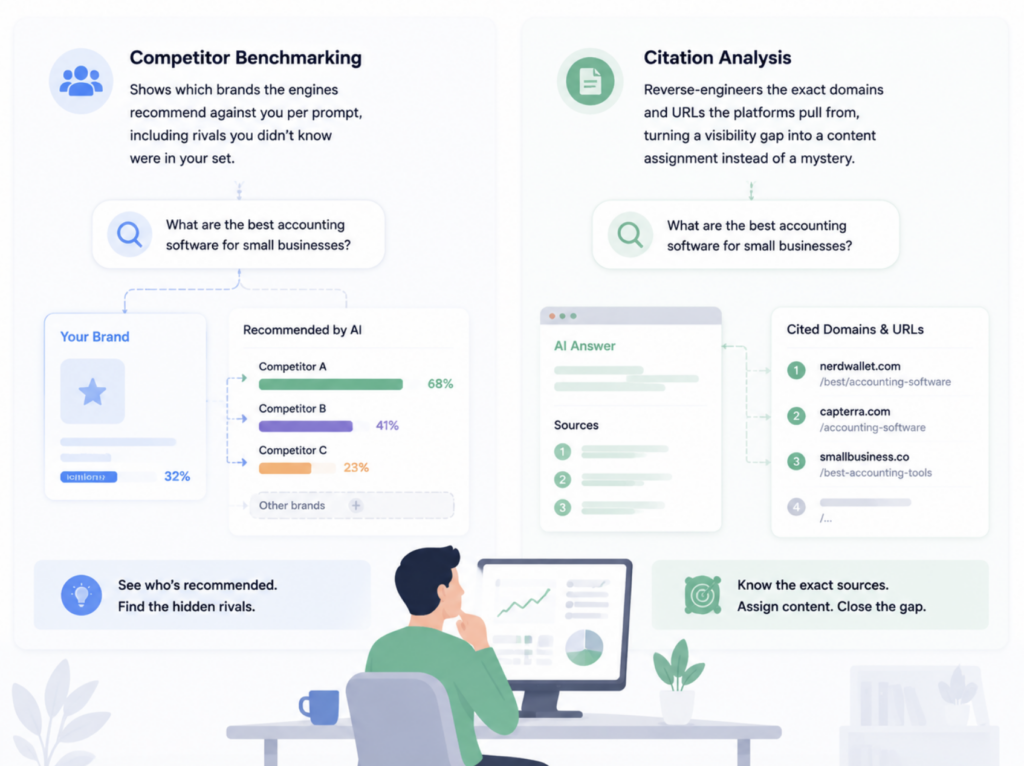
Two more pieces matter for map maintenance. Competitor benchmarking shows which brands the engines recommend against you per prompt, including rivals you didn’t know were in your set. Citation analysis reverse-engineers the exact domains and URLs the platforms pull from, which turns a visibility gap into a content assignment instead of a mystery.
Coverage spans ChatGPT, Gemini, Perplexity, DeepSeek, Doubao, Qwen, and others, which matters if your audience isn’t concentrated in one market. Plans start at $99 per month for 100 tracked prompts and $199 for 250, so a first map sized at 20 to 40 prompts fits comfortably inside an entry tier. You can get started with a baseline run before committing to a full taxonomy.
Where Prompt Intent Maps Break Down
Three failure patterns show up repeatedly.
Branded inflation. Load the list with your own name and share of voice looks excellent while discoverability quietly erodes. This is the most common way a prompt program produces reassuring numbers and zero insight.
Treating fan-out shards as keywords. Synthetic sub-queries shift by model, session, and user context. Building a separate page for each one produces thin content targeting phrases that may never repeat. Map the patterns, write for the cluster.
Ignoring intent mix. Seer Interactive’s analysis of 49,353 queries found AI Overviews appearing on 36% of informational queries against 8% of commercial and 5% of transactional ones, while comparison-format queries triggered them 95.4% of the time. A map weighted toward transactional prompts will show almost no AI surface area, and the conclusion “AI search doesn’t matter for us” will be an artifact of your sampling, not a finding.
One more, quieter than the rest: running each prompt once. Model outputs vary between runs. Without repeat runs and averaging, you’ll chase noise for a quarter.
Conclusion
The keyword file isn’t wrong, it’s just answering a question users stopped asking in that form. Prompt search gives you richer intent data than keywords ever did, since the user states their constraints outright, but it arrives without volume, rankings, or any of the scaffolding that made keyword strategy legible.
Start narrow. Pull 20 to 40 seed prompts from sales calls and site search, sort them by Asking against Doing rather than by topic, hold your branded share near 25%, and run them across two or three engines for a full month before you interpret anything. The map that survives contact with real data is the one small enough to maintain.
FAQ
Q: What’s the difference between prompt search and keyword search?
A: A keyword names a topic in a few words. A prompt describes a situation, including constraints, context, and criteria, then gets decomposed by the AI system into multiple sub-queries before any answer is generated. Keyword search competes for a results page. Prompt search competes for fragments of a synthesized answer.
Q: How many prompts should I track to start?
A: Most practitioners suggest 20 to 40 prompts across two or three models, tracked for at least 30 days. Larger lists are harder to keep clean, and prompt tracking costs scale with volume, so a filtered list generally outperforms an exhaustive one.
Q: Should I track branded or unbranded prompts?
A: Both, but separately, at roughly 25% branded and 75% unbranded. Branded prompts reveal whether AI describes your pricing, features, and positioning accurately. Unbranded prompts reveal whether you’re discoverable at all when someone hasn’t heard of you.
Q: Can I use keyword research tools for prompt search intent mapping?
A: Partially. Keyword tools give you topic coverage and question-form seeds, which is a reasonable starting layer. They won’t capture conversational phrasing, multi-constraint prompts, or the sub-queries fan-out generates, so pair them with internal sources like sales transcripts and site search logs.

