


Most teams start prompt search work the same way. Someone exports the keyword list, pastes the top 20 terms into ChatGPT one at a time, screenshots the answers where the brand shows up, and calls it a baseline. Two weeks later the same 20 prompts return different answers, different competitors, different sources, and nothing in the report explains what moved.
The data isn’t broken. The method is. A keyword list was never a prompt list, and one run was never a measurement.
Your Keyword List Isn’t a Prompt Search List
The first gap is linguistic. The average prompt runs about five times longer than a classic search keyword, which means the odds of two people typing the exact same thing are close to zero.
Real user data shows how fast that gap is widening. In an August 2025 panel, roughly half of free-text prompts were still short and keyword-shaped. By January 2026 that share had dropped closer to 30%, with the rest growing longer and more contextual.
What replaced them is more specific than any keyword tool records. Nearly a quarter of prompts include the word “best,” 28% carry a price or budget constraint, 16% are location-based, and 32% include a personal attribute like profession, team size, or health condition. Separate panel research found task delegation prompts jumped from 10% to 37% between July 2025 and June 2026, while keyword-style prompts fell from 18% to 3%.
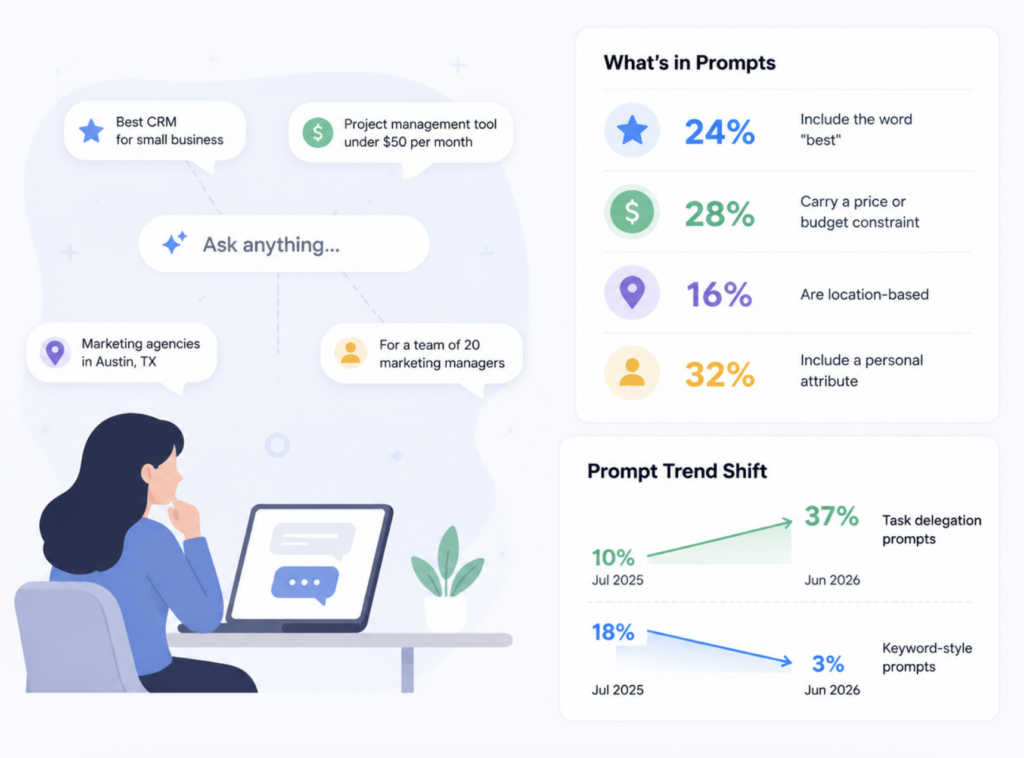
The prompts deciding your category are the ones your keyword tool never recorded.
One Prompt Search Turns Into a Dozen Hidden Queries
Here’s the thing about prompt search that trips up most SEO teams: the prompt you track is almost never the query the model actually runs.
AI search engines decompose a single question into parallel sub-queries before retrieving anything. Published measurements put the range at roughly 9 to 11 sub-queries per prompt, with software and B2B buying questions fanning out hardest. One analysis of 60,000+ fan-out queries found software prompts averaged 11.7 sub-queries on Google, compared with 3.79 for local intent.
Those sub-queries are invisible and mostly unsearchable. A study of 72,000+ AI-generated queries found that 95% of fan-out phrases show zero monthly search volume, yet they gatekeep which sources make the final answer.
Which explains the ranking disconnect. Analysis of 173,902 URLs found 68% of pages cited in AI Overviews were not in the top 10 organic results. In SaaS specifically, 81% of brand appearances in ChatGPT answers came from brands outside Google’s top 10 for that keyword.
You’re not competing for the prompt. You’re competing for a dozen queries nobody showed you.
Being Mentioned and Being Cited Are Two Different Scoreboards
Prompt search optimization gets muddy when teams treat “our brand appeared” and “our page was cited” as the same outcome. They behave differently on every platform.
A 2026 study of 34,234 AI responses found ChatGPT cited brands 0.59% of the time while Perplexity sat at 13.05%, a 46x spread. The same analysis found only 11% of domains are cited by both engines. ChatGPT will happily name your brand in prose and link somewhere else entirely.
Citation volume differs too. ChatGPT averages around 15 sources per response while Gemini cites 3, and on Gemini the overlap between brands mentioned and domains cited can fall to 30%.
| Signal | What it tells you | What it doesn’t |
|---|---|---|
| Brand mention | Whether the model considers you part of the category | Whether any page of yours influenced the answer |
| Source citation | Which URL earned retrieval and attribution | Whether the brand was recommended favorably |
| Answer position | Whether you’re framed as first choice or footnote | Whether the framing is stable across runs |
| Sentiment | How the model characterizes you | Which source shaped that characterization |
Track one signal and you’ll optimize for the wrong thing. Track a mention rate that climbs while your citation rate flatlines, and someone else’s content is doing the work of describing you.
How to Build a Prompt Search Set Your Buyers Would Recognize
Prompt selection is where most programs quietly fail. A short, well-filtered set outperforms a long, unfocused one, so the goal is coverage of decisions, not coverage of keywords.
Start from the buying journey, not the keyword export. Semrush’s study of 50,000 brands structured each category as five representative prompts: definition, comparison, alternatives, use case, and buying question. That shape is a workable default for any category you own.
Seed from paid keywords. Competitor bids on three-word-plus commercial terms are already validated by someone’s budget. “CRM for construction companies” converts into “What’s the best CRM for construction companies?” without guessing.
Borrow the phrasing from community threads. Reddit sits among the most-cited domains across engines, and its question style is closer to how people actually prompt than any template.
Add the constraint layer. Budget, location, industry, and role appear in a large share of real prompts, and constraints change results in ways that vary by platform. On ChatGPT and Perplexity they tend to narrow the brand set. On Gemini and AI Overviews they can widen it by triggering more fan-out.
Keep the wording plain. Controlled testing published in June 2026 found concise keyword-style prompts produce up to 25% more brand mentions than persona-heavy prompts, which tend to push answers toward education instead of recommendation.
On volume: start with 20 to 40 prompts across 2 or 3 models and hold for at least 30 days. That’s enough to detect absence. To detect movement of a few percentage points, you need far more surface area, which is why mature programs monitor 200 to 500 prompts grouped into intent clusters rather than read individually.
Measure Prompt Search Visibility as a Distribution, Not a Screenshot
Every prompt is n = 1. Run it once and you’ve captured one sample from a probabilistic system, which is why last week’s screenshot keeps contradicting this week’s.
The volatility is measurable. Citation patterns for the same prompts shift 40% to 60% month to month as models update and competitors publish. A 2026 paper argued that AI search visibility should be characterized as a distribution rather than a single-point outcome, because answers vary across runs, wording, and time.
In practice that means three things. Repeat each prompt several times per platform per cycle instead of once. Fix your sampling conditions, including location and account state, so run-to-run differences reflect the model and not your setup. Report ranges and trend lines, not a number your CMO will treat as precise.
Semrush’s category data shows why patience matters: across 1,094 tracked categories, only 15% had a clear brand winner. In the other 85%, no single brand showed up consistently across a topic’s related prompts. Category leadership in AI answers is still unclaimed in most markets.
Where AI Answers Actually Pull Their Sources
Once you can see which prompts you’re losing, the next question is what to change. The citation data is unusually blunt about this.
An analysis of 25 million cited links across ChatGPT, Claude, and Gemini found 84% of AI citations trace back to earned media, with paid and advertorial content accounting for about 0.3%. Consolidated ranking of 680 million citations found Reddit is the top source across every major engine at roughly 40% frequency, Wikipedia accounts for 26% to 48% of ChatGPT’s top-10 citation share, and the top 15 domains capture 68% of all citation share.
Three moves follow from that, in order.
First, check whether machines can read you at all. A 2026 analysis of over a million citations reported that roughly 73% of sites carry technical barriers blocking AI crawler access, which makes every content decision downstream irrelevant.
Second, work the sources your prompts already surface. If a comparison roundup or a subreddit thread is being cited for your category prompt, presence in that thread moves your visibility faster than a new landing page will.
Third, make your own pages quotable. The GEO study from Princeton, Georgia Tech, and IIT Delhi found that adding statistics lifted visibility by 41%, while keyword stuffing lowered it. Models extract passages, so write passages worth extracting.
Turning Prompt Search Data Into Weekly Decisions
The operational problem is scale. Repeating 200 prompts across four engines with several runs each, then attributing every change to a source, isn’t manual work anyone sustains past month two.
That’s the gap platforms like Topify are built for. It tracks brand performance across ChatGPT, Gemini, Perplexity, and other major engines using seven metrics: visibility, sentiment, position, volume, mentions, intent, and CVR. Prompt discovery surfaces high-volume prompts in your category as they emerge, so your tracked set expands with the market instead of freezing at whatever you brainstormed in the kickoff meeting.
The part that matters most for citation work is source-level analysis. Topify maps the exact domains and URLs engines cite for your prompts, which turns “we dropped in ChatGPT” into “the roundup that used to cite us now cites a competitor.” Competitor benchmarking runs on the same prompt set, so position changes are comparative rather than absolute.
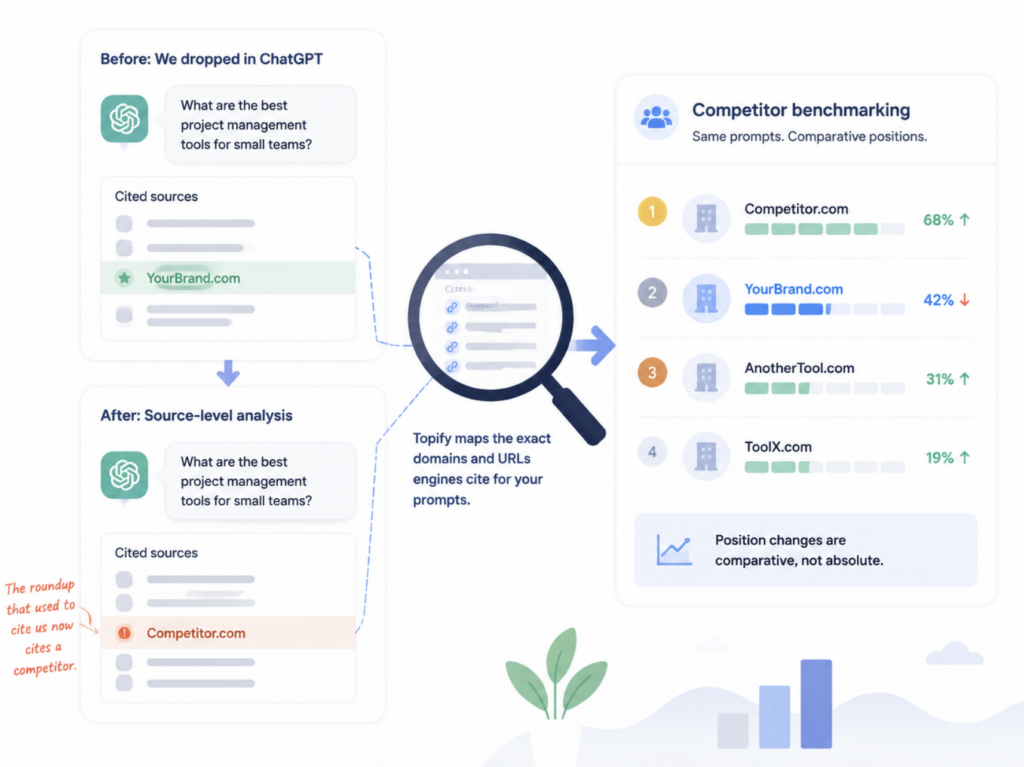
Pricing starts at $99/month for 100 tracked prompts and 9,000 answer analyses, with the Pro tier at $199/month for 250 prompts. If you want a baseline before committing to a program, running a first prompt set takes less setup than most keyword audits.
Conclusion
Prompt search optimization isn’t SEO with a new vocabulary. Prompts are longer and more contextual than keywords, each one fans out into sub-queries you can’t see, and the answer changes between runs, which makes single-shot screenshots worse than useless.
Build a prompt set around buying decisions instead of search volume. Track mentions and citations as separate signals. Measure across repeated runs and report ranges. Then spend your effort where 84% of citations actually come from: third-party sources that already show up in your category’s answers.
With 85% of categories still lacking a consistent AI answer winner, the position is open. It goes to whoever measures the prompts first.
FAQ
Q: What is prompt search optimization?
A: It’s the practice of tracking the natural-language prompts buyers use in AI assistants, measuring whether your brand is mentioned and cited in the resulting answers, and optimizing the sources that feed those answers. The unit of measurement is a prompt and its variants, not a keyword and its ranking position.
Q: How many prompts should I track to get a reliable read?
A: 20 to 40 prompts across two or three engines is enough to confirm whether your brand appears at all. Proving that visibility moved from 18% to 23% takes a much larger, stratified set, typically 150 or more prompts repeated on a fixed schedule.
Q: If I rank #1 on Google, will AI engines cite me?
A: Often not. Analysis of 173,902 URLs found 68% of pages cited in AI Overviews weren’t in the organic top 10, and in SaaS, 81% of ChatGPT brand appearances came from brands outside Google’s top 10 for that keyword. Ranking and citation are separate selection mechanisms.
Q: Why do my AI answers change every time I run the same prompt?
A: Because generative engines are probabilistic and their retrieval layer refreshes constantly. Citation patterns shift 40% to 60% month to month for identical prompts, so a defensible measurement needs repeated runs and confidence ranges rather than a single answer.

