

Etsy’s stock jumped 16% the week ChatGPT turned on Instant Checkout. That’s not a stat about AI hype. It’s a stat about where purchase decisions are actually happening now, and it’s the reason brands that can’t answer “are we visible inside ChatGPT” are flying blind on a channel that’s already converting.
Agentic commerce means an AI agent handles the full purchase, from product discovery to payment, without the shopper ever landing on your site. ChatGPT, Gemini, and Perplexity aren’t just answering shopping questions anymore. They’re completing the sale. If your product isn’t part of that conversation, no ad budget fixes it after the fact.
This guide walks through what’s actually changed, the layers of visibility you need to track, and a step-by-step approach to building that tracking system instead of guessing.
Your Site Isn’t the Point of Sale Anymore
For most of ecommerce history, the store was the checkout. That’s no longer true. OpenAI’s Agentic Commerce Protocol and Google’s Universal Commerce Protocol now let AI agents search a product catalog, build a cart, and finish payment inside the chat interface itself.
ChatGPT already has roughly 900 million weekly users, and AI-driven retail traffic grew 393% year over year in Q1 alone, according to Elogic’s 2026 commerce data. eMarketer projects AI platforms will drive $20.9 billion in retail spending in 2026, nearly four times 2025’s total.
Your site is no longer the primary conversion surface. It’s the fulfillment layer.
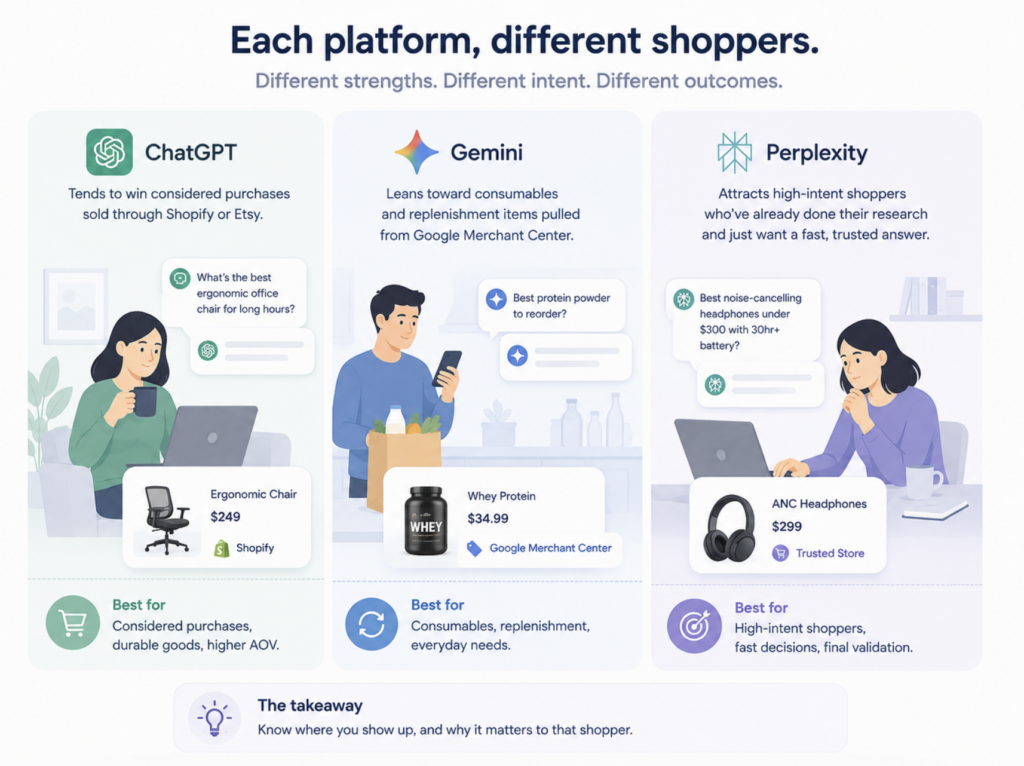
That shift matters because each platform behaves differently. ChatGPT tends to win considered purchases sold through Shopify or Etsy. Gemini leans toward consumables and replenishment items pulled from Google Merchant Center. Perplexity attracts high-intent shoppers who’ve already done their research and just want a fast, trusted answer.
Tracking one platform and assuming it represents the whole picture is how brands miss the agentic commerce keyword entirely in their own reporting.
Why Asking ChatGPT Yourself Doesn’t Count as Tracking
Most marketing teams start the same way. Someone opens ChatGPT, types a query their customer might ask, and screenshots whatever comes back. It feels like tracking. It isn’t.
AI answers aren’t static. The same prompt asked twice in one week can surface different brands, different rankings, and different tones. A single good answer tells you nothing about your trend line.
Manual checks also can’t scale across platforms. Conversion behavior alone proves the point: Claude converts shoppers at 16.8%, ChatGPT sits between 14.2% and 15.9%, Perplexity converts at 10.5%, and Gemini trails at 3.0%, per Elogic’s platform comparison. Each platform is a different audience with different intent, and a single spot check can’t tell you where you stand across all of them at once.
That’s the gap most brands still can’t see.
The Three Layers of Agentic Commerce Visibility
Tracking your brand’s visibility in agentic commerce isn’t one metric. It’s three layers stacked on top of each other, and most tools only cover the first.
Presence. Can the agent even find your product? This depends on whether your catalog is properly fed through Shopify’s Agentic Storefronts, Google Merchant Center, or direct ACP integration, and whether your product pages carry complete Schema.org markup.
Recommendation. When a shopper asks a relevant question, does the agent mention you at all, or does it default to a competitor? This is where most brands first realize they’re invisible, not because their product is bad, but because the agent never surfaces it.
Position and sentiment. Being mentioned third on a list of five isn’t the same as being the top pick, and a neutral mention isn’t the same as an enthusiastic one. Both affect whether a shopper actually clicks through.
Products with complete Schema.org markup are 6.4 times more likely to be selected by AI agents for recommendations, according to LLMRecommend.com’s Q1 2026 data cited by Lexsis. That single technical fix moves you across all three layers at once.
How to Actually Set Up Tracking
Here’s the sequence that works, whether you’re doing this manually at first or moving straight to an automated system.
Step 1: Build your prompt set from real shopper language. Skip generic keywords. Pull the actual phrasing your customers use, questions like “best running shoe for a wide toe box under $120,” not just your product category name.
Step 2: Track those prompts across ChatGPT, Gemini, and Perplexity on a recurring basis. A one-time check tells you nothing. You need visibility over weeks, because agentic commerce answers shift as agents recrawl feeds and update reasoning.
Step 3: Run the same prompts against your top two or three competitors. Visibility only means something in context. If a competitor shows up in nine out of ten answers where you show up in two, that’s the gap you need to close first.
Step 4: Connect visibility to conversion likelihood, not just mention count. Getting named isn’t the goal. Getting named in a way that leads to a click or a completed purchase is.
This is where a dedicated system starts to matter more than spreadsheets. Topify tracks brand mentions, position, and sentiment across ChatGPT, Gemini, Perplexity, and other major AI platforms automatically, and its CVR metric estimates how likely a given AI answer is to actually drive a customer to engage with your brand rather than just count how often you’re named. Dynamic Competitor Benchmarking runs the same comparison from Step 3 continuously, so a shift in a competitor’s position shows up as it happens instead of during a quarterly review.
That combination matters specifically in agentic commerce, because a mention with no purchase intent behind it isn’t worth much when the whole point of the channel is that the agent can complete the sale on the spot.
The Blind Spot Most Brands Miss: Amazon Doesn’t Play the Same Game
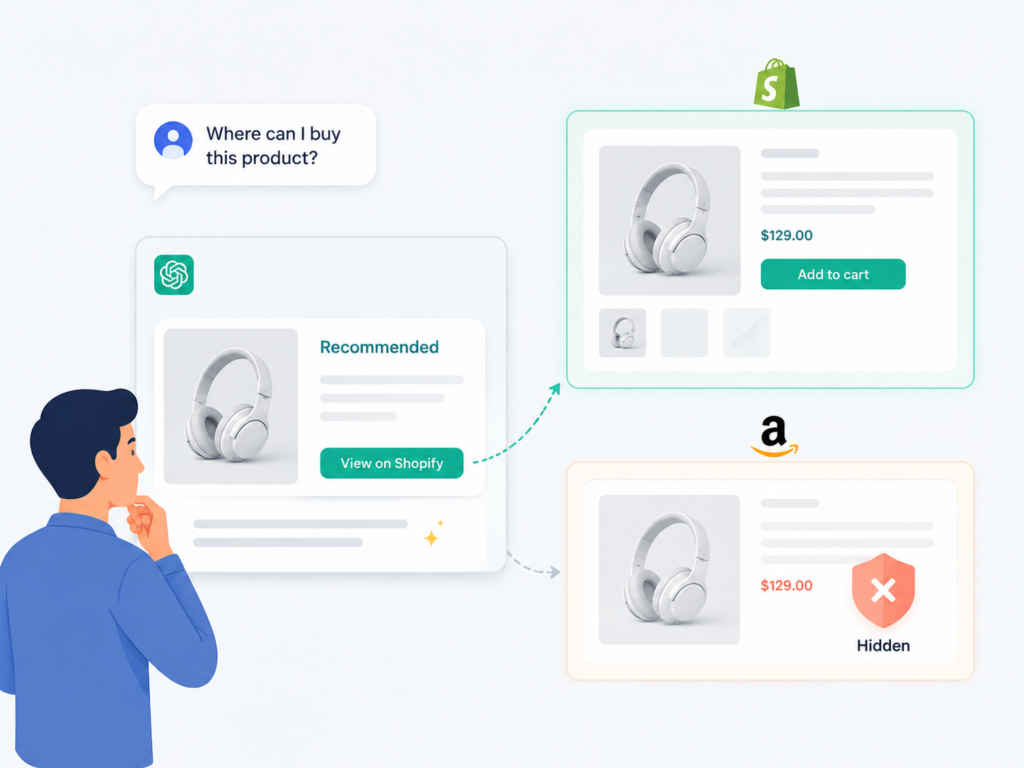
If part of your catalog lives on Amazon, your tracking strategy needs a separate lane for it. Amazon has blocked the ChatGPT-User and OAI-SearchBot crawlers in its robots.txt file, which means Amazon listings can’t appear in ChatGPT’s shopping results in real time, per Elogic’s analysis.
That’s a defensive move to protect Amazon’s own advertising business, but it creates an opening. A brand selling the same product on both Amazon and an independent Shopify store will see that Shopify listing surface in ChatGPT while the identical Amazon listing stays invisible.
Amazon’s own agent, Rufus, works entirely differently. It recommends only from Amazon’s catalog and reviews, so optimizing for the open web agents does nothing for your Rufus visibility, and vice versa, according to Eevy’s 2026 comparison of AI shopping agents. If Amazon is a meaningful share of your revenue, track it as its own category, not a subset of your ChatGPT or Gemini numbers.
Common Mistakes That Skew Your Visibility Data
A few patterns show up again and again in brands new to this kind of tracking.
Treating one good result as proof of visibility is the most common. One good answer from ChatGPT last week doesn’t mean you’re visible today.
Others focus entirely on mention frequency and ignore sentiment and position, which means a brand can look “visible” on paper while consistently landing in a lukewarm, low-ranked mention that rarely converts. Review depth and third-party corroboration, things like editorial roundups and Reddit threads, are heavily weighted inputs across ChatGPT, Gemini, and Perplexity because they’re the closest thing to ground truth an agent can check your claims against, per Eevy’s research. A brand with thin review coverage will underperform in agent recommendations even with a technically clean product feed.
The table below breaks down what each major platform actually weighs, so you know where to focus first.
| Platform | Primary Signal | Best Fit For |
|---|---|---|
| ChatGPT | Product feed via ACP, review depth | Considered purchases, Shopify and Etsy sellers |
| Gemini | Google Merchant Center feed, Schema.org markup | Consumables, replenishment items |
| Perplexity | Third-party trust, independent corroboration | High-intent, research-heavy shoppers |
| Amazon Rufus | Amazon catalog and review data only | Amazon-first sellers |
Conclusion
Agentic commerce didn’t arrive as a future trend. It’s already routing purchases through ChatGPT, Gemini, and Perplexity today, and the brands winning that channel are the ones treating visibility as something to measure, not assume. Start with your prompt set, track presence, recommendation, and position across platforms consistently, and connect what you find to actual conversion likelihood instead of raw mention counts. That’s the difference between knowing you’re in the conversation and just hoping you are.
FAQ
What is agentic commerce?
Agentic commerce is the shift where AI agents like ChatGPT, Gemini, and Perplexity handle the entire purchase process, from discovering a product to completing payment, without the shopper visiting a brand’s website directly.
How is tracking AI shopping visibility different from tracking traditional SEO rankings?
Traditional SEO tracking measures a fixed position on a results page. AI shopping visibility is dynamic. The same prompt can return different brands, different rankings, and different sentiment depending on when it’s asked, which makes recurring, cross-platform tracking necessary instead of a one-time check.
Which AI platform should ecommerce brands prioritize first?
It depends on your catalog. ChatGPT tends to favor considered purchases on Shopify and Etsy, Gemini favors consumables tied to Google Merchant Center, and Perplexity attracts shoppers who’ve already done deep research. Most brands need coverage across all three rather than picking one.
Can I track AI shopping visibility manually?
You can start manually by running a consistent set of shopper prompts across platforms on a schedule, but manual checks struggle to catch trend shifts, competitor movement, and sentiment changes at scale, which is why most teams eventually move to automated tracking.

