

Your Direct traffic jumped 30% last quarter and nobody on your team ran a new campaign. Sales are up, the CFO wants an explanation, and your GA4 dashboard has nothing useful to say. That gap isn’t a tracking bug you can patch with a UTM parameter. It’s what happens when agentic commerce starts routing purchases through a conversation your analytics stack was never built to see.
When the Agent Buys, Your Dashboard Goes Blank
Agentic commerce means an AI agent handles discovery, comparison, and increasingly the checkout itself, inside ChatGPT, Perplexity, or a Shopify Agentic Storefront, without the shopper ever landing on a page your pixels can fire on. OpenAI’s Instant Checkout and the newer Agentic Commerce Protocol let a customer buy without leaving the chat window, and Shopify reports AI-attributed orders on its platform grew 11x between January 2025 and January 2026.
That’s not a niche edge case anymore. Salesforce projected agent-driven purchases would account for 22% of global orders during Cyber Week 2025 alone. Every one of those transactions starts with a recommendation your team never saw happen.
The 70% That Vanishes Into Direct Traffic
Here’s the mechanical reason your reports look wrong. When someone taps a link inside the ChatGPT app, the referrer header often gets stripped before it ever reaches your site. iOS uses WKWebView, Android uses Chrome Custom Tabs, and both drop that header on the way out.
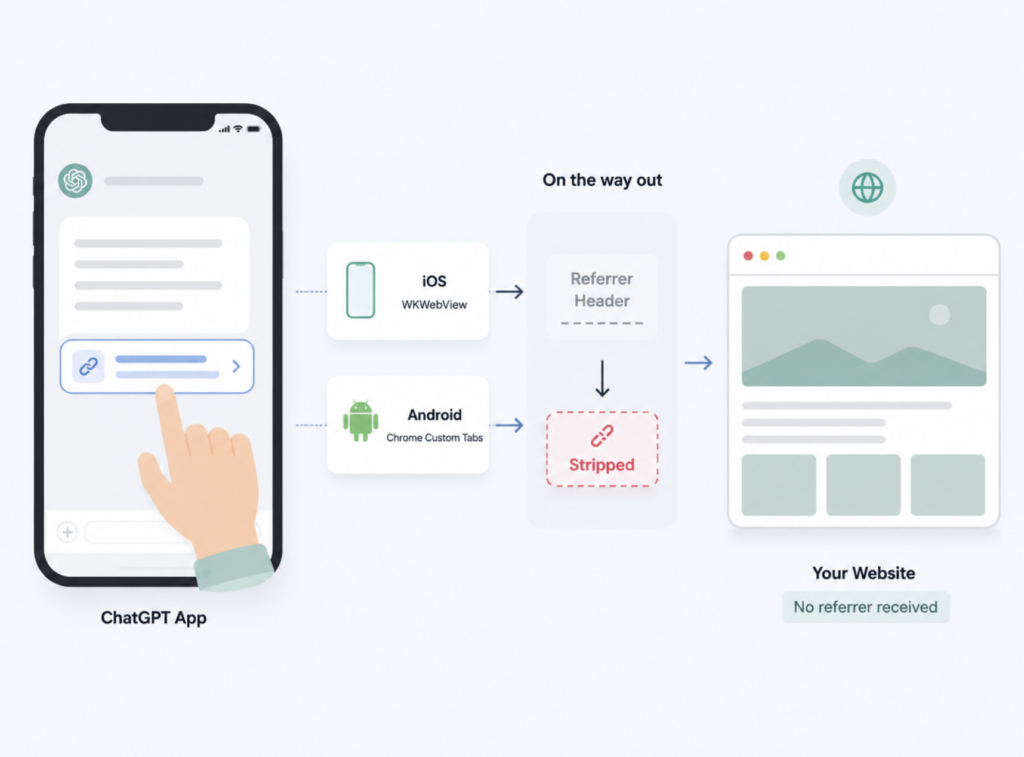
The result is roughly 70.6% of AI-driven traffic arriving with no referrer at all, which means GA4 dumps it straight into Direct. One marketing researcher found 86% of her site’s new users were classified as Direct during a stretch when measurable referral traffic actually dropped 90%, even as new users grew 126% year over year.
This isn’t a ChatGPT problem specifically. TikTok, Slack, Discord, and WhatsApp have stripped referrers for years. AI assistants just made the blind spot big enough that finance teams started asking questions.
Why the Invisible Traffic Might Be Your Best Traffic
Here’s the part that should actually worry you. The traffic your reports can’t see tends to convert better than the traffic they can.
Dark AI traffic converts at 10.21% versus 2.46% for non-AI traffic, a 4.1x gap. Across the board, AI-referred sessions convert at roughly 4.4x the rate of traditional organic search. If your budget decisions run off GA4’s channel report, you’re likely underfunding the exact channel that’s outperforming everything else, simply because it shows up as “Direct” instead of “AI.”
What You Can Still Track
Some of this is fixable. Google rolled out a default AI Assistant channel in GA4 in May 2026, which catches ChatGPT and Gemini automatically, but it still misses Perplexity and Claude. A custom regex channel group covering the major AI domains recovers most of what’s left, though it needs quarterly maintenance since referrer patterns keep shifting.
Platform-native tools help too. Shopify’s Agentic Storefronts show you whether an order came from ChatGPT, Copilot, or Perplexity directly in the admin. That’s real progress. But even with all of it stitched together, 89% of brands still can’t properly attribute their AI referral traffic, because knowing an order came from an AI platform is a different problem from knowing why the AI chose you over a competitor in the first place.
The Part That Stays Permanently Dark
This is the actual black hole, and no amount of GA4 configuration closes it. Even a perfectly instrumented store can tell you a sale came from ChatGPT. It can’t tell you which prompt surfaced your brand, what the agent compared you against, or why it picked your product over three others with similar specs.
That question doesn’t live in web analytics at all. It lives in the same layer that determines whether an AI agent can parse your product data in the first place: 42% of customers abandon purchases due to insufficient product information, and agents are far less forgiving of gaps than human shoppers, since they don’t guess in your favor when structured data is missing.
This is where visibility tracking has to pick up where traffic attribution stops. Instead of chasing individual sessions, tools built for this measure the probability that an AI response leads to brand engagement at all. Topify’s Conversion Visibility Rate metric works this way, estimating how likely a given AI answer is to drive a customer toward your brand, even in cases where no clean referral trail exists to prove it after the fact. Paired with source analysis that shows exactly which domains and pages an AI platform is pulling from, it turns an unmeasurable event into a directional signal your team can actually act on.
Building an Attribution Strategy for a Black Box
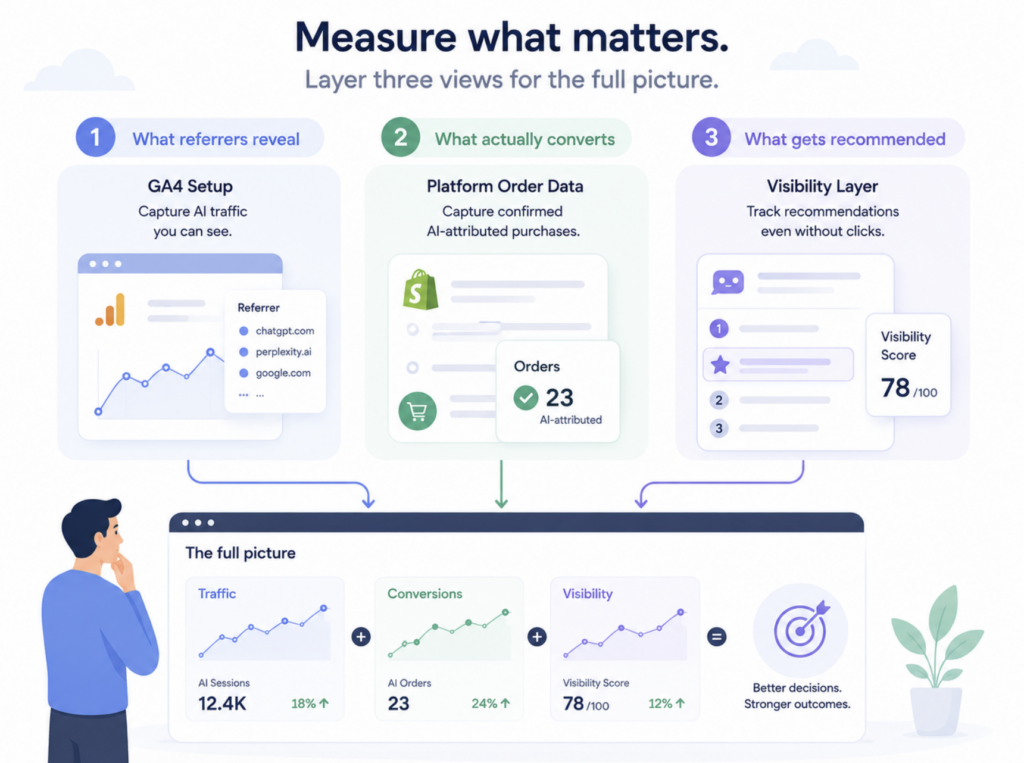
The practical move isn’t chasing one unified number. It’s layering three views: a cleaned-up GA4 setup that catches what referrers reveal, platform-native order data from Shopify or your commerce backend that catches confirmed AI-attributed purchases, and a visibility layer that tracks whether you’re getting recommended in the first place, regardless of whether that recommendation ever produces a trackable click.
Structured product data underpins all three. Without accurate Schema.org markup, agents can’t reliably evaluate your catalog, and no attribution fix downstream matters if the agent never considered you to begin with. Most estimates put full-confidence attribution frameworks 18 to 24 months out. Brands building the visibility and data infrastructure now will have evidence to show when that measurement matures. The ones waiting for a clean dashboard will still be guessing.
Conclusion
The attribution black hole in agentic commerce isn’t going away, and pretending your existing GA4 setup covers it just delays the budget conversation you’ll eventually have to have. Fix what’s fixable in traffic reporting, but don’t stop there. Pair it with a visibility layer that tracks whether AI systems are recommending you at all, because that’s the one question traffic data was never going to answer.
FAQ
Q: What is agentic commerce?
A: Agentic commerce refers to purchases where an AI agent, such as ChatGPT or a Shopify-connected assistant, handles product discovery, comparison, and sometimes checkout on a customer’s behalf, often without the customer visiting the brand’s website directly.
Q: Why does ChatGPT traffic show up as Direct traffic in GA4?
A: Mobile apps typically strip the referrer header before a link opens, so GA4 has no source to attribute the visit to and defaults it to Direct. This affects a majority of AI-referred sessions, not just a small fraction.
Q: Can brands fully track AI agent purchases?
A: Partially. Platform-native tools like Shopify’s Agentic Storefronts can confirm an order originated from an AI platform, but they can’t explain why the agent recommended that brand over a competitor, which remains outside standard analytics.
Q: What’s the difference between ACP and UCP?
A: ACP, the Agentic Commerce Protocol, powers checkout inside ChatGPT and similar assistants. UCP, the Universal Commerce Protocol from Google and Shopify, covers the broader commerce journey including discovery, cart, and post-purchase steps. Most retailers end up needing both.

