

Your team finally figured out how to track whether ChatGPT mentions your brand. You’ve got a dashboard, a prompt list, maybe even a monthly report showing citation rates across AI platforms. Then OpenAI released GPT 5.6 and ChatGPT Work on July 9, 2026, and the visibility problem you just learned to measure got bigger overnight.
ChatGPT Work isn’t another chatbot. It’s an autonomous agent that connects to your customer’s tools, pulls data from their CRM and Slack, and builds finished competitive analyses, vendor reports, and board decks while they sleep. When that agent decides which brands to include in a deliverable, your brand is either in the document or it isn’t. And right now, most teams have zero visibility into that layer.
GPT 5.6 Isn’t a Model Upgrade. It’s a New Surface for Brand Exposure.
GPT 5.6 is a three-model family released by OpenAI: Sol (the flagship), Terra (balanced everyday work), and Luna (fast, cost-efficient). Sol is the engine behind ChatGPT Work and what OpenAI calls its strongest model for coding, enterprise work, and cybersecurity. Sam Altman told CNBC that Sol is 54% more token efficient on AI coding tasks compared to previous models.
That’s the technical side. The strategic side is what matters for brand visibility.
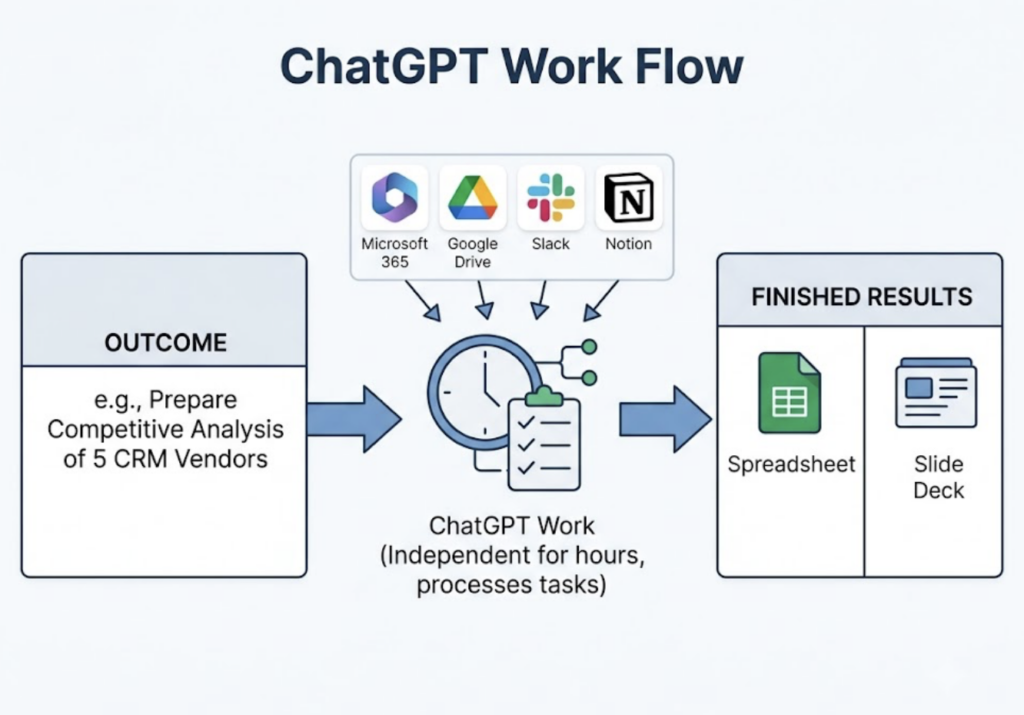
ChatGPT Work takes an outcome instead of a prompt. You tell it “prepare a competitive analysis of five CRM vendors” and it pulls context from connected apps, breaks the task into subtasks, and works independently for hours before delivering a finished spreadsheet or slide deck. It connects to Microsoft 365, Google Drive, Slack, and Notion. The Codex app is merging into a single ChatGPT desktop app that puts Chat, Work, and Codex side by side.
This isn’t search. It’s execution. And the brands that show up in those deliverables are the ones that shape purchase decisions downstream.
ChatGPT Search Put Brands in Answers. GPT 5.6 Puts Them in Deliverables.
The first wave of AI visibility was about mentions. Could ChatGPT name your brand when someone asked “what’s the best project management tool?” That question still matters. But GPT 5.6 introduces a second, higher-stakes question: does the AI agent include your brand when it’s building a report, a vendor shortlist, or a board presentation for an enterprise buyer?
Here’s why the gap is wider than most teams realize. 53% of brands are already invisible in AI answers, according to data from over 6,900 live AI platform checks. Only 14% of brands have a defined AI search visibility strategy. And a 2026 industry analysis found that 44% of SaaS brands with strong Google rankings had zero ChatGPT visibility.
Those numbers describe the search layer alone. The work layer compounds the problem.
When ChatGPT Work builds a competitive analysis, it doesn’t just mention brands in a chat bubble. It embeds them in structured outputs: tables comparing pricing, feature matrices ranking capabilities, executive summaries recommending shortlists. These documents get forwarded to stakeholders, attached to email threads, and referenced in procurement decisions. A brand that’s invisible at this stage isn’t just missing a mention. It’s missing a deal.
Three GPT 5.6 Visibility Layers Most Brands Don’t Track Yet
Before GPT 5.6, AI visibility was one-dimensional: does the model mention you in a search-style answer? Now there are three layers, and they operate on different signals.
Layer 1: Search Visibility. This is the familiar one. A user asks ChatGPT a question, and the model either cites your brand or it doesn’t. It’s the layer most GEO tools track today. Across 8,400 prompts tested by one study, the top-cited brand in any sector captured an average of 31.4% of all citations. The top three combined took 64.7%.
Layer 2: Work Visibility. This is new with ChatGPT Work. The agent is tasked with producing a deliverable, like “compare these five marketing automation platforms and recommend the top two for our team.” The agent pulls from connected apps, searches the web, cross-references sources, and builds a structured output. Your brand either makes the shortlist or it doesn’t. The difference from search: the output is a document someone will act on, not just read.
Layer 3: Agent Visibility. This is the emerging frontier. OpenAI’s workspace agents run on schedules, respond in Slack, and execute repeating workflows. KPMG data shows AI agent deployment quadrupled from 11% to 42% of organizations between Q1 and Q3 2025, and employee adoption hit 56% by Q2 2026. When an agent repeatedly selects the same brand across recurring tasks, it creates an embedded preference loop that competitors can’t see and can’t interrupt.
Only tracking Layer 1 means you’re measuring the smallest part of where AI makes brand decisions.
What Determines Which Brand GPT 5.6 Picks for a Work Task
The signals that drive ChatGPT Work’s brand selection overlap with search visibility signals, but they’re weighted differently. A quick answer needs a credible mention. A multi-hour work task needs sustained, cross-verified authority.
Ahrefs studied 75,000 brands and found branded web mentions correlate with AI visibility at 0.664 on the Spearman scale. Backlinks? 0.218. That’s a 3x gap. YouTube mentions showed an even stronger signal at 0.737. The implication: AI systems prioritize how often credible third parties discuss your brand, not how many links point to your site.
For ChatGPT Work specifically, three factors tend to compound.
First, contextual association strength. The model maps your brand to specific use cases, pain points, and buyer types. A brand consistently discussed in the context of “enterprise project management” will surface when an agent builds a report on that topic. A brand discussed only in generic product-feature terms won’t build those anchors.
Second, source diversity. ChatGPT Work cross-references multiple sources when building a deliverable. If your brand appears on your own site but nowhere else, the agent has limited corroboration. Semrush’s study of 50,000 brands in ChatGPT found only 15% of AI search categories have a clear brand winner. In the other 85%, no single brand shows up consistently. The agent fills that gap with whatever sources are most structurally sound.
Third, recency and freshness. One visibility study found that once won, an AI citation persists at the same brand for an average of 41 days before drifting. ChatGPT Work’s web-connected retrieval means it pulls live information. Stale content is a structural disadvantage when the agent is checking sources in real time.
The bottom line: if your content earns mentions across credible third-party sources, uses structured data, and stays current, you’re building the kind of authority ChatGPT Work relies on when it selects brands for deliverables.
How to Track Brand Visibility Across GPT 5.6’s Expanding Surface
Most teams are stuck measuring one layer of AI visibility while GPT 5.6 creates three. Closing that gap requires cross-platform, cross-scenario monitoring.
Topify approaches this by tracking brand performance across ChatGPT, Perplexity, Gemini, and other major AI platforms through seven key metrics: visibility, sentiment, position, volume, mentions, intent, and CVR. In practice, this means a marketing team can spot a pattern like “our brand gets mentioned in informational prompts but drops out of comparison prompts,” which is exactly the kind of gap that predicts poor performance in ChatGPT Work’s deliverable-building tasks.
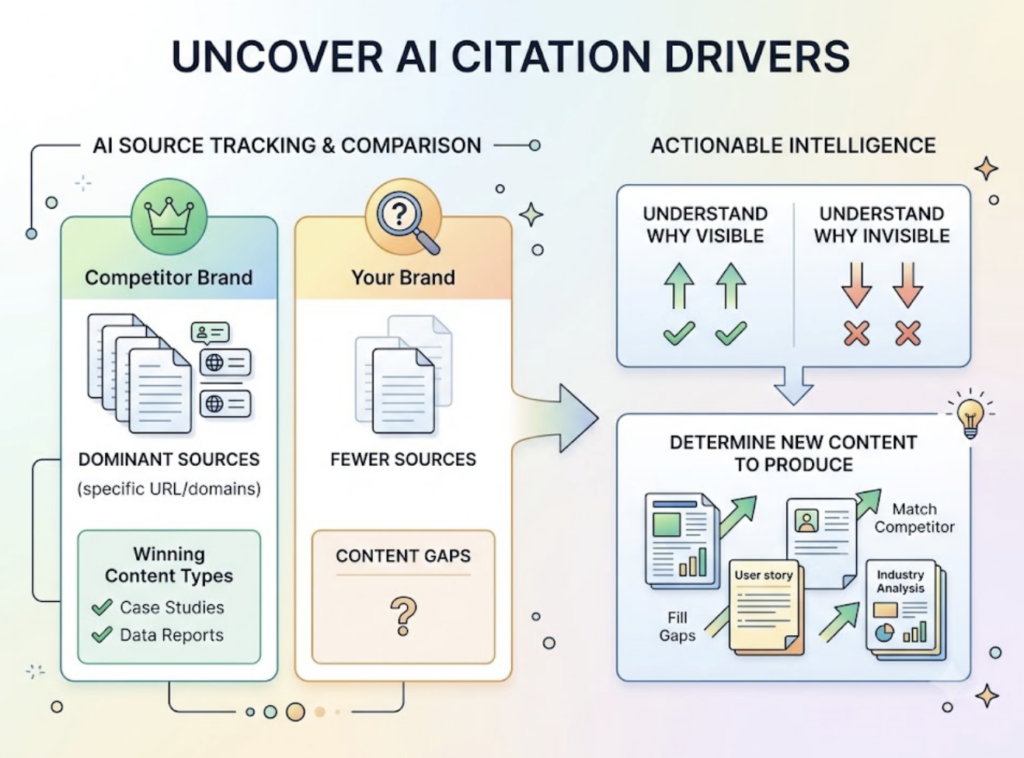
The Source Analysis capability is particularly relevant in a post-GPT-5.6 world. It tracks the exact domains and URLs that AI platforms cite when recommending brands. If a competitor dominates the source layer for your category, you can see which content types are earning those citations and where your brand’s content gaps are. That’s actionable intelligence: not just “are we visible?” but “why are we visible or invisible, and what content do we need to produce?”
For teams tracking competitive dynamics, Topify’s Competitor Monitoring shows real-time shifts in how AI platforms rank and recommend brands relative to each other. When a new model version like GPT 5.6 rolls out, recommendation patterns often shift. Having a baseline before the model change and monitoring after it lets you measure impact rather than guess at it.
The broader point isn’t about any single tool. It’s about the measurement shift GPT 5.6 demands. Brands that only monitor search-layer visibility are missing the work layer and the agent layer. And as 72% of enterprises plan to deploy AI agents from trusted providers in 2026, the surface area where brand decisions happen inside AI systems is only going to grow.
Tracking all three layers now, before competitors do, is the strategic move. Get started with Topify to see where your brand stands across the full AI visibility surface.
Conclusion
GPT 5.6 didn’t just give ChatGPT a faster engine. It gave AI systems a new role: producing the documents, reports, and recommendations that drive enterprise decisions. The brands that show up in those deliverables will shape purchasing conversations. The ones that don’t won’t know what they missed.
The playbook is straightforward. Audit your brand’s visibility across all three layers: search, work, and agent. Invest in the signals that actually drive AI citation, like earned mentions across credible third-party sources, structured content, and fresh, contextually relevant pages. And build the monitoring infrastructure to track shifts as new models launch and agent adoption accelerates.
The AI visibility battlefield just got bigger. The question is whether your tracking covers it.
FAQ
Q: What is GPT 5.6 and how is it different from GPT 5.5?
A: GPT 5.6 is OpenAI’s latest model family, released July 9, 2026, in three variants: Sol (flagship), Terra (balanced), and Luna (cost-efficient). The biggest difference from GPT 5.5 isn’t just benchmark scores. It’s the product layer: GPT 5.6 Sol powers ChatGPT Work, an autonomous agent that builds finished deliverables like spreadsheets, slide decks, and reports by connecting to enterprise tools and working independently for hours.
Q: How does ChatGPT Work affect brand visibility?
A: ChatGPT Work shifts brand visibility from “being mentioned in a chat answer” to “being included in a business document.” When the agent builds a competitive analysis or vendor comparison, it selects which brands to feature based on source authority, contextual relevance, and data freshness. Brands that are invisible at this layer miss consideration at the decision-making stage, not just the awareness stage.
Q: What is AI agent visibility and why should brands care?
A: AI agent visibility refers to how often autonomous AI agents, like OpenAI’s workspace agents or ChatGPT Work, select and reference your brand in recurring workflows. With AI agent deployment growing from 11% to 42% of organizations in a single year, and employee adoption reaching 56%, this layer represents a fast-growing surface where brand preferences get embedded into automated processes.
Q: How can I track my brand’s visibility in ChatGPT Work and other AI agents?
A: Start by monitoring your brand across multiple AI platforms using a tool that tracks visibility, sentiment, position, and source citations. Look for gaps between your performance on search-style prompts versus comparison or recommendation prompts. Those gaps predict how your brand will perform in the work and agent layers that GPT 5.6 introduced.

