

Your marketing team just got asked a hard question in a planning meeting: are you ready for AI agents to shop on your customers’ behalf? Nobody had a clean answer.
That’s not surprising. ChatGPT alone now handles roughly 50 million shopping queries a day, and AI-driven traffic to U.S. retail sites grew 393% year over year in the first quarter of 2026. Agentic commerce isn’t a future scenario anymore. It’s a channel your brand is already being evaluated in, whether you’ve set anything up for it or not.
The problem is most readiness conversations stay abstract. “Get AI-ready” isn’t a checklist. It’s a slogan. This piece breaks agentic commerce readiness into five concrete signals you can check against your own brand today, no guesswork required.
What Agentic Commerce Actually Changes for Brands
Agentic commerce means an AI agent researches, compares, and increasingly completes a purchase on a shopper’s behalf, rather than just suggesting where to look. The shopper states an intent. The agent handles discovery, comparison, and checkout, sometimes without the shopper ever visiting your site.
That shift matters because the rules of persuasion change. A polished product page written for a human browser doesn’t help much if the agent making the decision never renders that page the way a person would. It reads your data, not your design.
The scale backs this up. McKinsey estimates agentic commerce could account for $3 trillion to $5 trillion in global retail spend by 2030, and Gartner projects AI agents will intermediate $15 trillion in B2B purchases by 2028. Consumer behavior is moving just as fast. 73% of consumers already use AI somewhere in their shopping journey, from getting product ideas to comparing prices.
Here’s the gap. Demand is real, but most merchants aren’t set up to capture it. That gap is exactly what the five signals below are designed to surface.
Signal 1: Your Product Data Is Structured for Machines, Not Just Humans
Check this first: can an AI agent read your price, availability, and product attributes without guessing?
Most brands still optimize product pages for people scanning with their eyes. Agents don’t scan. They parse structured data, and when it’s missing or incomplete, they either skip your product or misrepresent it. Pages with complete product schema, including pricing, availability, and ratings, see meaningfully higher visibility in AI-driven commerce queries.
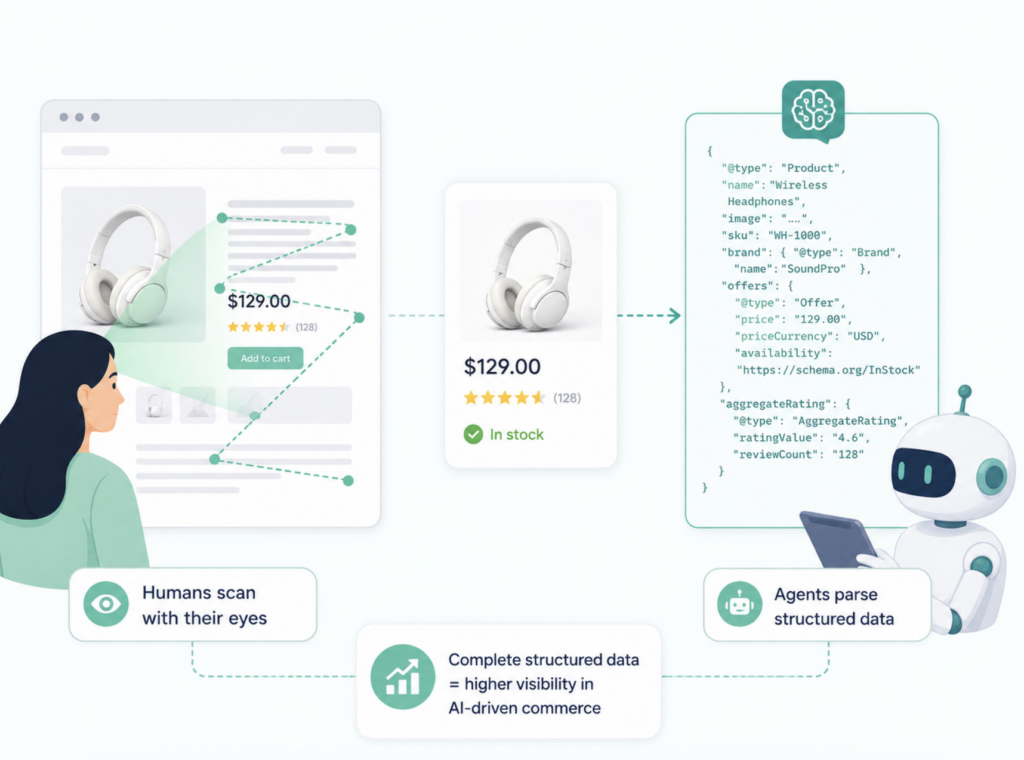
The evidence is consistent across independent tests. One study running comprehensive schema markup against a matched control group over 60 days found a 68% increase in AI citations for the pages with schema in place. Separately, pages combining Product schema with AggregateRating markup were found to be three times more likely to appear in AI recommendations than pages without it.
The common mistake here isn’t ignorance. It’s assuming your existing SEO schema is “good enough” for agentic use cases. It rarely is. Agents need GTIN or MPN fields for product matching, synced availability status, and complete price and currency fields on every offer, not just a subset of your catalog.
Signal 2: You Know Where AI Agents Currently Mention or Skip Your Brand
Structured data gets you discoverable. Visibility tracking tells you whether it’s working.
Here’s the uncomfortable truth: most brands have zero visibility into how often they show up when someone asks ChatGPT, Perplexity, or Gemini to recommend a product in their category. They’re flying blind on the exact channel that’s growing fastest.
That’s a problem you can’t fix if you can’t see it. Topify tracks how often your brand gets mentioned in AI shopping and comparison prompts across major platforms, so you can see whether you’re showing up in the exact queries that lead to a purchase decision, not just generic brand searches.
Without that visibility, you’re guessing at a scale problem. 54% of brands that rank well on Google are never cited by AI at all, which means your traditional SEO rank tells you almost nothing about your agentic commerce readiness. These are separate scoreboards.
Signal 3: Your Pricing and Availability Data Stays in Sync in Real Time
An agent that recommends a product with the wrong price or a sold-out size doesn’t just frustrate a shopper. It burns the trust the agent needs to keep recommending your brand at all.
This is where a lot of otherwise well-prepared brands quietly fail. Their catalog feed updates nightly, or their inventory sync runs on a delay built for human browsing patterns, not machine-speed decision loops. Agents that hit stale data tend to route around it, choosing a competitor whose data they can trust in the moment.
Real-time sync isn’t a nice-to-have anymore. Merchants are already seeing the payoff for getting this right: orders attributed to AI-powered search carried 14% higher average order values compared to organic search, and traffic from catalog-powered AI search converted twice as well as traffic from general AI search. The brands winning that upside are the ones whose data an agent can trust without double-checking.
Signal 4: You Can Track Whether AI Recommendations Turn Into Actual Purchases
Getting mentioned by an AI agent and getting bought by one are two different outcomes, and the gap between them is bigger than most teams assume.
Consumer surveys show the disconnect clearly. 73% of consumers use AI somewhere in their shopping journey, but only 13% have completed a purchase after being referred by an AI assistant. Another study found a similar pattern: 58% research with AI, but only 17% complete a purchase through it. Visibility without conversion tracking leaves you celebrating a metric that doesn’t pay the bills.
This is where most brands stop measuring, and it’s the exact gap Topify’s Conversion Visibility Rate is built to close. Rather than counting mentions alone, it estimates how likely an AI recommendation is to actually turn into an interaction with your brand, so you can tell the difference between an agent that name-drops you and one that’s actively steering shoppers your way.
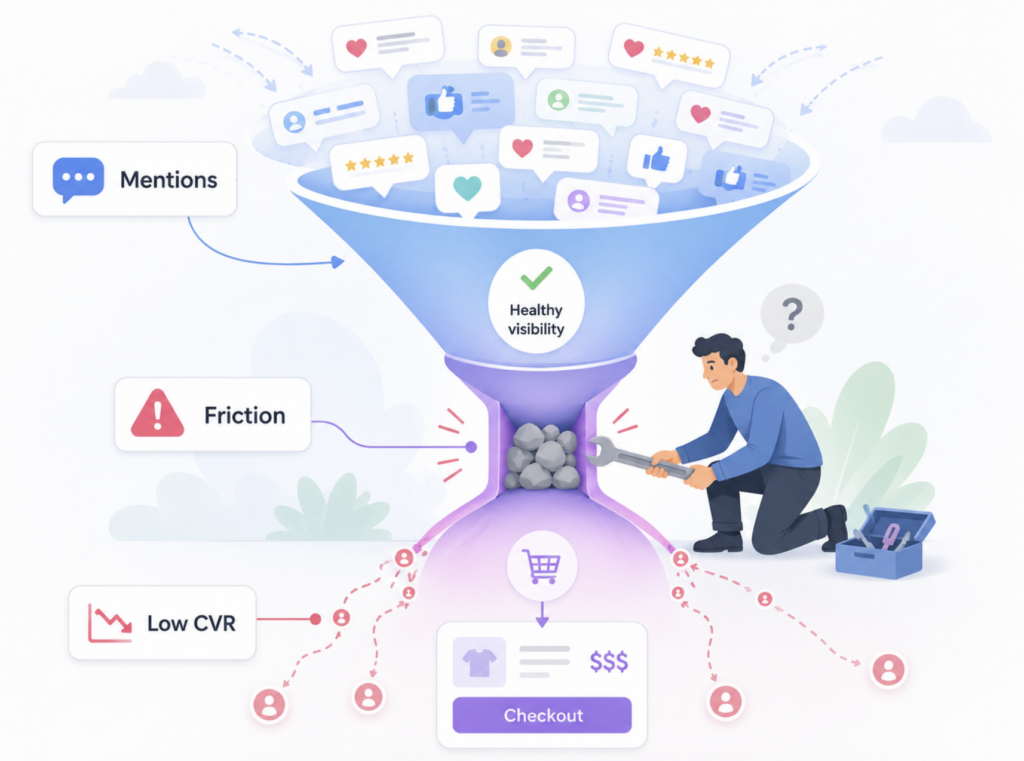
In practice, that distinction changes what you optimize for. A brand with strong mention volume but weak CVR usually has a friction problem further down the funnel, not a visibility problem. Fixing the wrong end of that funnel wastes budget on a signal that was never the bottleneck.
Signal 5: You’ve Mapped Which Competitors AI Agents Choose Instead of You
The last signal is the one most teams skip entirely: do you know who wins when an agent picks a competitor over you for the same shopping intent?
Agents don’t rank brands the way search engines rank pages. They evaluate options against the shopper’s stated goal, and the brand with clearer data, better reviews signal, or faster fulfillment details often wins, even if it’s less known. Structured, real-time delivery data is one of the deciding factors agents weigh when choosing between merchants, so a competitor with tighter logistics data can beat you on a query where your product is objectively a better fit.
Without competitor benchmarking, you’re optimizing in the dark. Topify’s competitor benchmarking shows exactly which brands AI engines recommend instead of you for shared prompts, so you can see the pattern instead of guessing at it. Often the fix isn’t a better product description. It’s closing a specific data gap a competitor already closed.
How to Start Closing the Gaps You Just Found
If you checked most of these boxes, you’re ahead of most of the market. If you didn’t, the fix isn’t to tackle all five at once.
Start with Signal 1. Structured data is the highest-leverage, lowest-cost fix, and every other signal depends on agents being able to read your catalog correctly in the first place. From there, move to visibility and conversion tracking, since you can’t prioritize what you can’t measure. Competitor benchmarking comes last, once you know your own baseline well enough to know what “winning” looks like.
Get started with Topify if you want a single view across visibility, conversion tracking, and competitor benchmarking instead of stitching the picture together from five different tools.
Conclusion
Agentic commerce readiness isn’t a single feature you can buy off a shelf. It’s five separate capabilities, structured data, visibility tracking, real-time sync, conversion measurement, and competitor awareness, that together determine whether AI agents can find, trust, and choose your brand. The brands treating this as infrastructure work now will be the ones agents default to later. Start with the signal where your gap is widest, not the one that’s easiest to talk about in a meeting.
FAQ
Q: What is agentic commerce, in simple terms?
A: It’s when an AI agent handles the shopping process on a person’s behalf, from comparing products to completing checkout, based on the goals the person set rather than manual browsing.
Q: How is agentic commerce readiness different from regular
Q: How do I know if AI shopping agents are already mentioning my brand?
A: You need a visibility tracking tool that monitors AI platforms for the specific shopping and comparison prompts relevant to your category, since generic brand search tools won’t capture this.
Q: What’s the fastest first step to improve AI agent shopping readiness?
A: Audit your product schema first. It’s the foundation every other signal depends on, and gaps here are usually the cheapest to fix relative to the visibility they unlock.

