

Your competitor shows up in ChatGPT’s answer for your highest-intent category prompt. You don’t. So you open their page next to yours and look for the difference. Their content is thinner. Their domain authority is lower. Their page loads slower.
Nothing on that page explains the gap, because the answer wasn’t assembled from that page. It was assembled from a set of third-party sources that mention them and skip you, and that never surfaces in a two-tab comparison. It only surfaces in citation-level data, which is exactly what a GEO rank tracker exists to capture.
Your Competitor Isn’t Winning on Content. They’re Winning on Sources.
The default assumption is that AI engines reward better pages. The citation data says otherwise.
Muck Rack’s 2026 analysis of 25 million cited links across ChatGPT, Claude, and Gemini found that 84% of AI citations trace back to earned media rather than owned content, paid placements, or SEO pages. CiteMetrix, tracking 680 million citations, put the performance gap between earned and owned placements at 325%. AirOps research landed in the same place from a different angle: brands are 6.5x more likely to be discovered through third-party sources than through their own domains.
The source pool is also narrower than most teams expect. A synthesis of six citation studies covering more than 680 million citations found that the top 15 domains absorb roughly 68% of everything ChatGPT, Claude, Gemini, Perplexity, and Google AI Overviews produce, with Reddit alone cited at around 40% frequency across engines.
So when a competitor gets recommended and you don’t, the useful question isn’t “what’s better about their page.” It’s “which sources did the model read, and why does your brand not appear inside them.”
That’s a different investigation, and it needs different data.
What a GEO Rank Tracker Records the Moment a Competitor Gets Cited
Most tools marketed as AI rank trackers record a position and stop. Position tells you the outcome. It doesn’t tell you the mechanism.
A tracker built for attribution captures five layers on every run: the prompt that triggered the answer, which brands were mentioned, the order they appeared in, the specific URLs cited, and the domains those URLs belong to. The last two layers are where reverse-engineering actually happens. Everything above them is a scoreboard.
The gap between layers is measurable. ChatGPT cites an average of 15 sources per response while Gemini cites 3, and on Gemini the overlap between brands mentioned in the text and domains cited underneath can fall to 30%. ChatGPT is also selective about what makes the cut, citing only about 15% of the pages it retrieves for a given query.
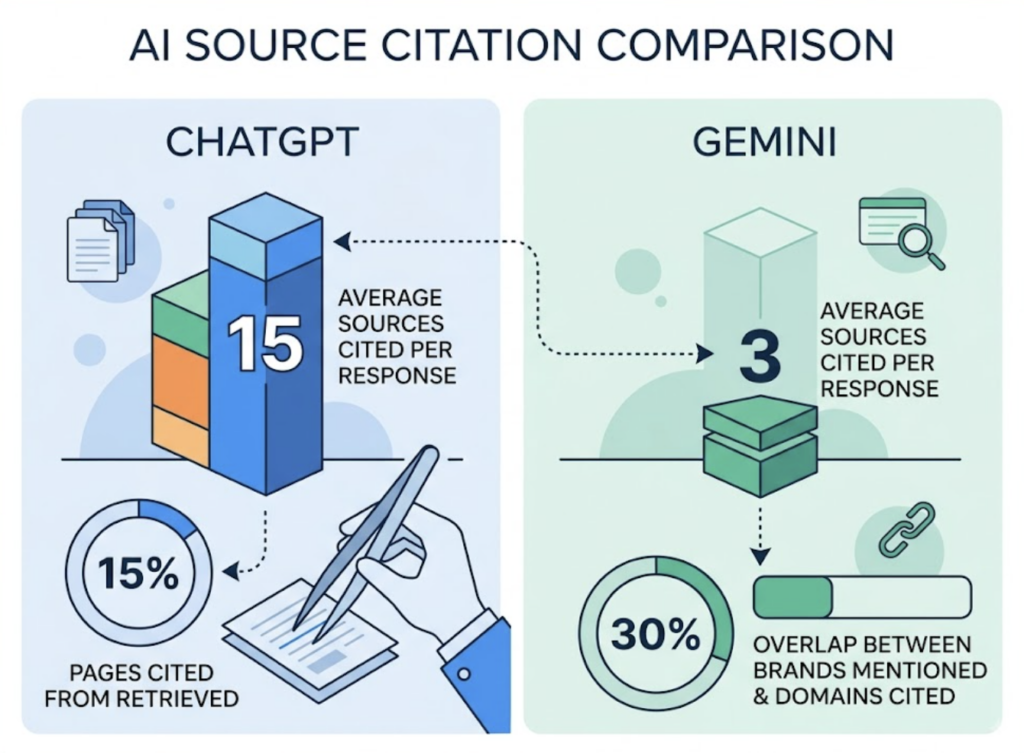
Read those two numbers together and the implication is uncomfortable. A competitor can be named in an answer built almost entirely from sources they don’t own, and your absence can be decided at a retrieval step you never see.
The Four Citation Gaps Behind Every “Why Them and Not Us”
Once you have prompt-level citation logs for both brands, the gaps sort into four types. Each one produces a distinct signature in the data, and each one needs a different response.
| Gap type | What the tracker shows | What it actually means | First action |
|---|---|---|---|
| Owned-content gap | Competitor’s own pages cited, yours absent | They have a comparison, pricing, or use-case page that answers the prompt directly | Build the specific page the prompt asks for, not a broader guide |
| Third-party citation gap | Cited domains are review sites, forums, or editorial, none mentioning you | The sources the model trusts have no record of your brand | Target placement in the exact domains already cited for that prompt cluster |
| Narrative gap | Your brand appears, but framed as niche, cheap, or secondary | The model has signal about you, and the signal is off-position | Correct the description at its source, then re-measure sentiment and position |
| Technical gap | Your pages are indexed but never retrieved | Structure, access, or clarity is blocking the retrieval step | Audit crawler access and answer formatting for the failing prompts only |
A caution on the technical bucket, because it collects a lot of wasted effort. Zyppy’s citation factor analysis scored LLMs.txt at 2.0 out of 10 for influence on AI citations, with no credible evidence it moves the number. Fixing files nobody reads is a comfortable way to avoid the harder source-placement work.
Mentioned but Never Cited Is a Different Problem Than Never Mentioned
This distinction decides your entire remediation plan, and most dashboards blur it.
Being mentioned means the model names your brand. Being cited means the model treats your domain as the source behind the claim. A brand can be recommended by name while the model cites a review site or a competitor’s pageinstead. That gap is diagnostic: absent from the answer entirely points to an awareness problem, while present but never sourced points to a trust problem.
Academic work supports the split. A 2026 study analyzing 602 controlled prompts across ChatGPT, Google AI Overviews, and Perplexity treated citation and absorption as two discrete stages, not one metric.
Benchmarks give you a rough read on severity. Category leaders rarely clear 60% AI share of voice because engines diversify sources by design, so treat anything under 15% as a structural citation gap rather than a bad month.
Five Steps to Reverse-Engineer a Competitor’s Citation Advantage
Here’s the workflow that turns citation logs into a queue of fixes.
1. Define the prompt cluster, not the keyword. Pick 30 to 50 prompts a real buyer would type at the comparison stage. Commercial phrasing matters for retrieval: prompts carrying words like reviews, comparison, or a year trigger live web search in ChatGPT 53.5% of the time versus 18.7% for informational queries.
2. Lock a competitor set of three to five. Include the brands buyers compare you against, plus any name that keeps appearing in answers even though it never showed up in your SEO reports. Those are the ones winning on sources.
3. Log every cited URL, then classify it. Own domain, review platform, community thread, editorial, directory. The distribution is the finding. If 70% of a competitor’s citations come from community and editorial sources, no amount of on-site optimization closes that.
4. Map your absence inside their winning sources. Not “do we have a page on this,” but “does the cited page mention us at all.” This is the step teams skip, and it’s the one that produces an actionable target list.
5. Rank fixes by leverage, not effort. Off-site signals carry the most weight. Ahrefs’ data put branded web mentions at a 0.664 correlation with AI Overview visibility, with YouTube mentions at 0.737, the strongest single factor measured. SE Ranking’s 129,000-domain study found citation rates nearly doubling once a site crossed roughly 32,000 referring domains.
Bottom line: earn mentions on the pages the engine already cites, before you write anything new.
Where the Data Lies to You: Volatility, Platform Split, and Sample Size
One run proves nothing. AI answers regenerate a different brand set on repeat queries, so a single screenshot of a competitor beating you is noise until it repeats.
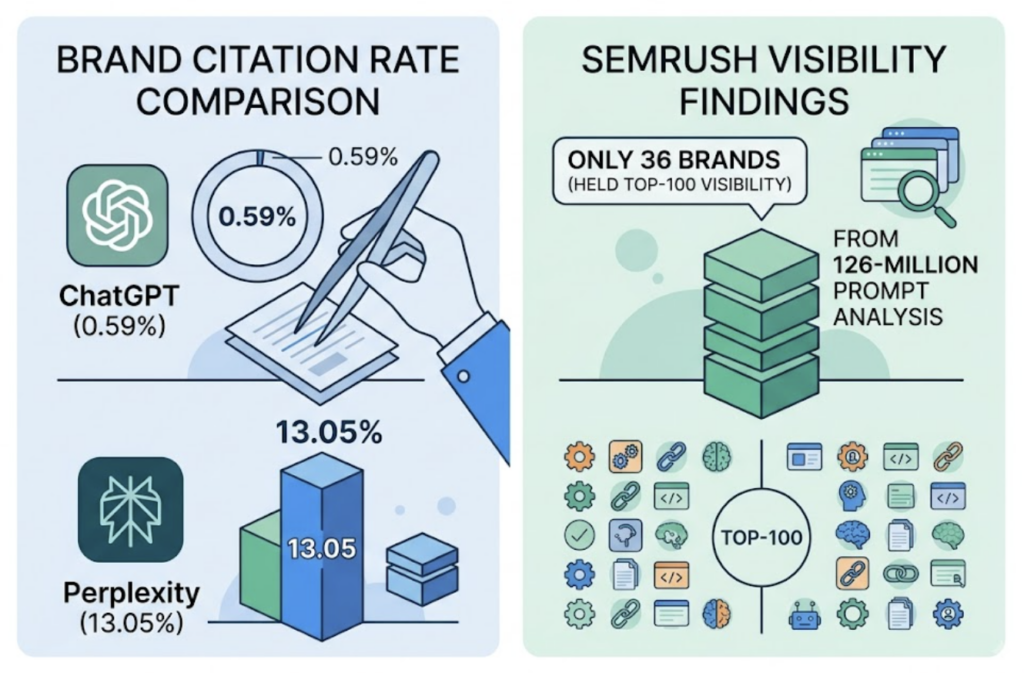
Platform differences are larger than most teams budget for. A 2026 study of 34,234 AI responses found a 46-times spread in brand citation rates, with ChatGPT citing brands 0.59% of the time and Perplexity at 13.05%. Semrush’s 126-million-prompt analysis found only 36 brands held top-100 visibility across all four major AI platforms.
A finding on one engine is not a finding on the others. Wikipedia strategy is a clean example: it carries meaningful citation weight inside ChatGPT and close to none inside Claude or Perplexity.
The practical guardrail is boring. Same prompt set, same competitor set, weekly cadence, raw answers preserved so a change can be audited later. Trend lines survive volatility. Screenshots don’t.
Turning Citation Intelligence Into an Action Plan
Most platforms stop at reporting the gap. The work that matters starts one layer down, at the domain and URL level, and it needs to run continuously because citation patterns shift in weeks.
Topify is built around that layer. Its Reverse-Engineer AI Citations function analyzes the exact domains and URLs AI platforms cite for your prompt set, then shows whether you or your competitors dominate those references at scale. Paired with Dynamic Competitor Benchmarking, you can see which rival is gaining position on a specific prompt cluster and trace the movement back to the sources driving it.
The seven-metric view matters here more than the feature count. Visibility, sentiment, position, volume, mentions, intent, and CVR sit in one place, which is what lets you separate the mention problem from the citation problem without exporting three dashboards into a spreadsheet.
Coverage spans ChatGPT, Gemini, Perplexity, DeepSeek, Doubao, Qwen, and other major engines, which matters given how little findings transfer between platforms. High-Value Prompt Discovery keeps surfacing new prompts as recommendation patterns shift, so the tracked set doesn’t go stale while you’re working the current backlog.
Plans start at $99 per month for 100 prompts and 9,000 AI answer analyses, with a 30-day trial. You can get started on a single prompt cluster before expanding the tracked set.
Conclusion
The side-by-side page comparison fails because it’s the wrong unit of analysis. Your competitor’s advantage is usually sitting in a Reddit thread, a review roundup, or an editorial piece that a model trusts and that doesn’t mention you.
Start narrow. Take the ten prompts closest to purchase in your category, log every cited URL for you and three competitors over four weeks, and classify the sources. The pattern will point at one of the four gaps, and the fix follows from the classification rather than from guesswork.
Track it. Classify it. Then go earn the mention.
FAQ
Why does AI cite my competitor instead of me when my content is better?
Because page quality is not the primary input. With 84% of AI citations tracing to earned media, the deciding factor is usually whether the third-party sources an engine trusts mention your brand at all. A competitor with weaker content and stronger source presence will win that prompt.
What’s the difference between mention share and citation share?
Mention share counts how often your brand name appears in AI answers. Citation share counts how often your domain is credited as the source. Being mentioned without being cited signals a trust gap in your content, while being absent from both signals an awareness gap. The two require different fixes.
How many competitors should a GEO rank tracker cover?
Three to five direct competitors is the practical starting point for core category prompts. Add any brand that appears frequently in AI answers even if it never ranked against you in traditional search, since those are often the brands winning on third-party citations.
How often should I run competitor citation gap analysis?
Weekly for measurement, monthly for action. Answers vary between runs, so single-run comparisons are unreliable. Consistent cadence on a fixed prompt set is what makes a genuine competitive shift distinguishable from normal output variance.

