

You ran your weekly SEO report. Rankings look solid. Then someone on your team manually searches one of your top keywords on Google and spots an AI Overview at the top, listing three competitors but not your brand. Organic CTR for that query has dropped 61% since AI Overviews rolled out. Your position 1 ranking is still there. It just doesn’t matter the way it used to.
That’s the gap an AI overview tracker is designed to close.
Step 1: Understand What an AI Overview Tracker Actually Measures
Traditional rank trackers tell you where you appear in the blue links. An AI overview tracker answers a different set of questions: Does your brand appear in the AI-generated summary? Which URLs does Google cite? How does the AI describe your brand relative to competitors?
These are distinct metrics from anything in your current SEO stack.
Google AI Overviews now appear on 48% of all search queries, up 58% year-over-year. In B2B tech verticals, that trigger rate climbs to 82%. Healthcare hits 88%. For most brands, the majority of high-intent informational queries now have an AI Overview sitting above the organic results, absorbing attention before a user ever reaches the blue links.
The core metrics you need to track are: Visibility Rate (how often your brand appears across a defined set of prompts), Citation Integrity (which specific URLs Google’s AI selects as authoritative), Sentiment Framing (whether the AI positions your brand as a leader, a budget option, or an afterthought), and Competitive Co-occurrence (which competitors appear alongside you in AI responses).
None of these show up in Google Search Console.
Step 2: Build Your Prompt Tracking List Before You Do Anything Else
Most teams make the same mistake: they try to monitor hundreds of keywords with the same logic they use for traditional rank tracking. AI Overviews don’t work that way. They’re context-dependent, query-sensitive, and frequently updated.
What you need instead is a curated prompt set: 50–100 high-intent queries grouped into three categories. Brand prompts cover how customers search for you specifically. Category prompts map to the problems your product solves (“best software for X,” “how to choose Y”). Competitive prompts capture comparison queries where buyers are evaluating alternatives.
Long-tail, informational, and question-based queries trigger AI Overviews 46% of the time, significantly higher than transactional queries. That means your prompt list should skew toward the “how to,” “what is,” and “best option for” framing your buyers actually use.
Start with 50 prompts. Prioritize queries where you know buyers are making decisions, not just researching. That’s where citation presence has direct revenue impact.
Step 3: Run Your First Visibility Check (And Learn Why Manual Won’t Scale)
Once you have a prompt list, the first instinct is to start manually searching. Open Chrome, type your queries, screenshot the AI Overviews that appear. It works for a one-time audit. It fails as a monitoring system.
Organic CTR for queries with AI Overviews dropped from 1.76% to 0.61%, a 61% decline tracked across 25.1 million impressions. But that aggregate hides the split that matters: brands cited in AI Overviews earn 35% more organic clicks. Brands not cited lose those clicks to competitors who are.
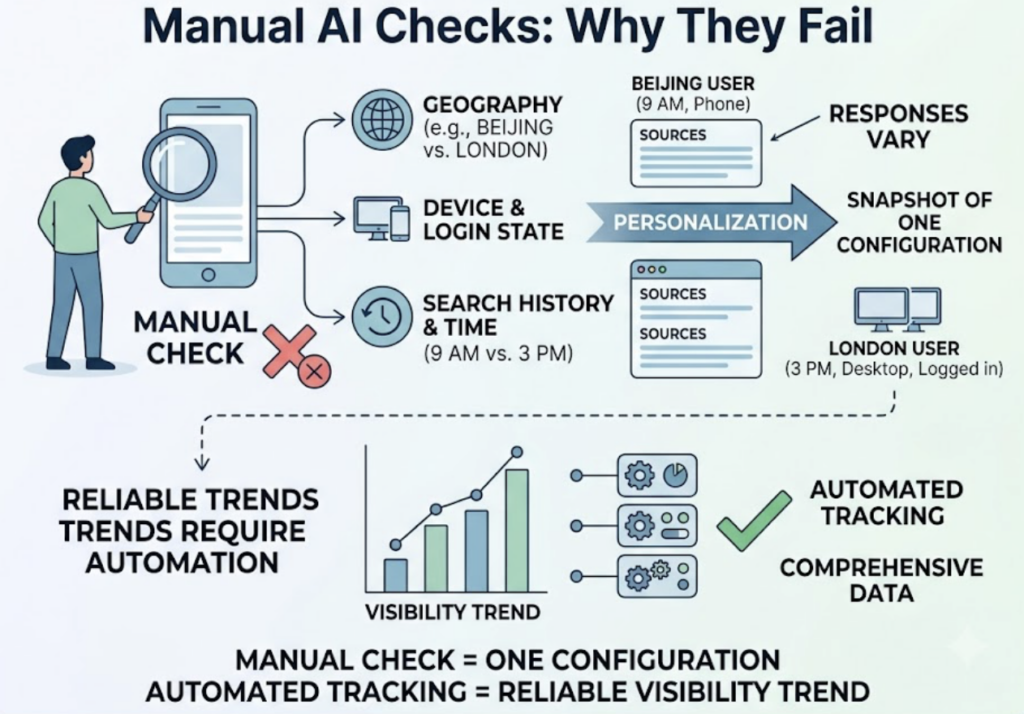
The problem with manual checking is that AI Overview responses are personalized. They vary by geography, device, login state, and recent search history. A result you see in Beijing looks different from what your buyer in London sees. A single query at 9 AM may show different sources than the same query at 3 PM. Manual checks give you a snapshot of one configuration, not a reliable visibility trend.
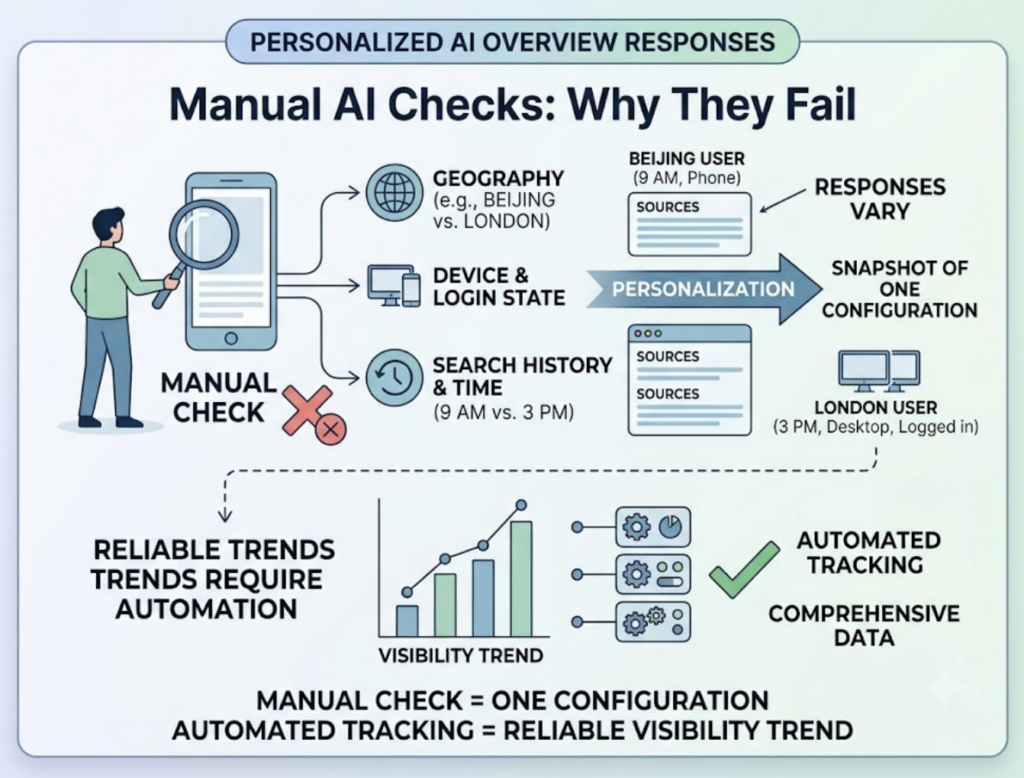
For your initial audit, manual search is fine to orient yourself. To track changes over time, you need automation.
Step 4: Use an AI Overview Tracker to Automate Monitoring at Scale
This is where the actual tracking infrastructure goes. An automated AI overview tracker runs your entire prompt set on a defined schedule, logs what the AI Overview says for each query, records which URLs are cited, and scores the sentiment of how your brand is described.
Topify is built specifically for this use case. Across its Comprehensive GEO Analytics dashboard, it tracks brand performance within AI Overviews and across other major AI platforms simultaneously, measuring seven metrics per prompt: visibility, sentiment, position, volume, mentions, intent, and CVR (Conversion Visibility Rate).
In practice, this means you can see which of your 50 tracked prompts are generating AI Overview citations, which URLs Google is pulling from your domain, and whether the AI’s framing of your brand has shifted after a content update.
The Basic Plan at $99/month supports 100 tracked prompts and 9,000 AI answer analyses per month. That’s enough data volume to establish statistically meaningful visibility trends across a full prompt set, not just a handful of spot checks.
Two features matter most for AI Overview tracking specifically. Source Analysis maps which exact URLs Google’s AI cites as authoritative, so you can see whether your homepage, a blog post, or a third-party mention is driving citations. Sentiment Analysis scores each AI response on a 0-100 scale, flagging whether the AI’s description of your brand is consistent with your positioning or quietly undermining it.
That last point is easy to overlook. Plenty of brands are cited in AI Overviews but described in ways they’d never approve. Tracking that you appear isn’t enough. Tracking how you appear is the part most teams miss.
Step 5: Benchmark Against Competitors Already in AI Overviews
Your visibility data in isolation doesn’t tell you much. A 40% visibility rate sounds solid until you discover your main competitor is at 70%.
Competitive benchmarking in AI Overviews surfaces things that traditional SERPs don’t show: which brands the AI treats as the default recommendation in your category, which competitors are being co-cited with your brand (which implies the AI groups you together), and which rivals are earning citations you’re missing entirely.
The analysis workflow is straightforward. For any prompt where a competitor is cited and you’re not, pull the URL Google is referencing. Is it a long-form FAQ? A comparison page? A structured data-rich listicle? The cited content reveals what Google’s AI considers authoritative for that query type.
Topify’s Competitor Monitoring feature automates this comparison. It tracks your position relative to competitors across your full prompt set, flags when a new competitor starts appearing in your tracked queries, and shows the exact citation gap you need to close.
This kind of analysis used to require hours of manual SERP scraping. Running it at scale across 100 prompts, weekly, is what separates brands that react to AI visibility changes from those that catch them early.
Step 6: Turn AI Overview Data into Specific Content Actions
Data without a decision isn’t useful. The output of your AI overview tracking should feed directly into your content calendar.
Three optimization actions consistently move the needle. First, Citation URL reinforcement: when a specific URL is already earning AI Overview citations, double down on it. Expand its depth, update its schema markup, and ensure it’s internally linked prominently. The AI is already treating it as authoritative. Help it become more so.
Second, Gap filling: for prompts where competitors are cited and you’re not, create content that directly answers that query using an answer-first format. Position 1 organic CTR has fallen from 39.8% in 2022 to 27.6% in 2026. Traditional ranking alone isn’t enough. The content winning AI Overview citations tends to be structured around the exact question, not optimized for a keyword.
Third, Entity correction: if your Source Analysis shows the AI is pulling your brand description from a third-party review site rather than your own domain, that’s a signal your brand entity needs strengthening. Consistent schema, a well-structured “About” page, and accurate information across all directories are the inputs LLMs use to construct their understanding of who you are.
Topify’s one-click execution connects the analysis to the action. You can state your optimization goal in plain English, review the proposed strategy, and deploy it without manual workflows. For teams managing multiple clients or brands, this is the difference between AI Overview tracking being a quarterly report and a live feedback loop.
Conclusion
Gartner projects that 25% of organic search traffic will shift to AI chatbots and voice assistants by the end of 2026. That shift is already showing up in Search Console data for teams that know where to look. The brands adapting fastest aren’t the ones with the highest domain authority. They’re the ones who built an ai overview tracker workflow before the traffic loss became undeniable.
Six steps: define what you’re measuring, build a targeted prompt list, run an initial audit, automate monitoring, benchmark competitors, and turn the data into content actions. The process is repeatable. The compounding effect on citation presence is real.
Start with 50 prompts. Measure where you stand today. Everything after that is optimization.
FAQ
Q: What is an AI overview tracker?
A: An AI overview tracker is a tool that automatically monitors whether and how your brand appears within Google’s AI-generated summaries (AI Overviews) across a defined set of search queries. It tracks visibility rate, cited URLs, sentiment framing, and competitor co-occurrence over time, giving you data that traditional rank trackers don’t capture.
Q: How often should I check my brand’s AI Overview appearance?
A: Weekly monitoring is the minimum for active optimization. AI Overview results can shift within days of a content update or algorithm change, so a monthly cadence misses meaningful fluctuations. Automated tools like Topify run these checks continuously, surfacing changes without manual effort.
Q: Can I track competitors in Google AI Overviews?
A: Yes. Competitive benchmarking is one of the highest-value applications of AI overview tracking. By running the same prompt set against competitor visibility data, you can identify which queries they’re winning citations for, which URLs Google treats as authoritative in your category, and where your content has a clear gap to close.
Q: Does appearing in AI Overviews affect my website traffic?
A: The data is clear on this. Brands cited in AI Overviews earn 35% more organic clicks than uncited brands. Meanwhile, organic CTR for non-cited results on AI Overview queries dropped 61% compared to pre-AIO baselines. Citation status is now one of the strongest predictors of whether a query drives traffic to your site.

