

Your rank tracker just told you something reassuring: positions 1 and 2, green across the board. Meanwhile, your organic traffic is down 30% quarter-over-quarter.
This isn’t a bug in your analytics. It’s the defining blind spot of 2026 SEO — the gap between where you rank and whether you actually exist in the answer a user receives. Google AI Overviews (AIO) now appear in roughly 48% of all tracked search queries in the US, with B2B technology and education verticals reaching as high as 82–83% of queries by late 2025. And ranking #1 only gives you a 17–54% chance of being cited inside that AIO box.
Traditional rank trackers were not built for this world. AI Overview trackers were. Here’s exactly what separates them — and what you’re flying blind to without one.
What Traditional Rank Trackers Actually Measure
Traditional SEO tools were built for a static, link-based SERP. For the better part of two decades, that model worked. The metrics they track reflect that architecture:
Blue link position. Where your URL sits among the ten organic results. Position 1 meant the most clicks. Position 11 meant page two, effectively invisible.
SERP feature detection. Some tools flag when a featured snippet, People Also Ask box, or knowledge panel appears for a given keyword. This gives partial context around what else is happening on a results page.
These metrics still matter. But they describe only one layer of the modern search experience — and increasingly, not the most important one.
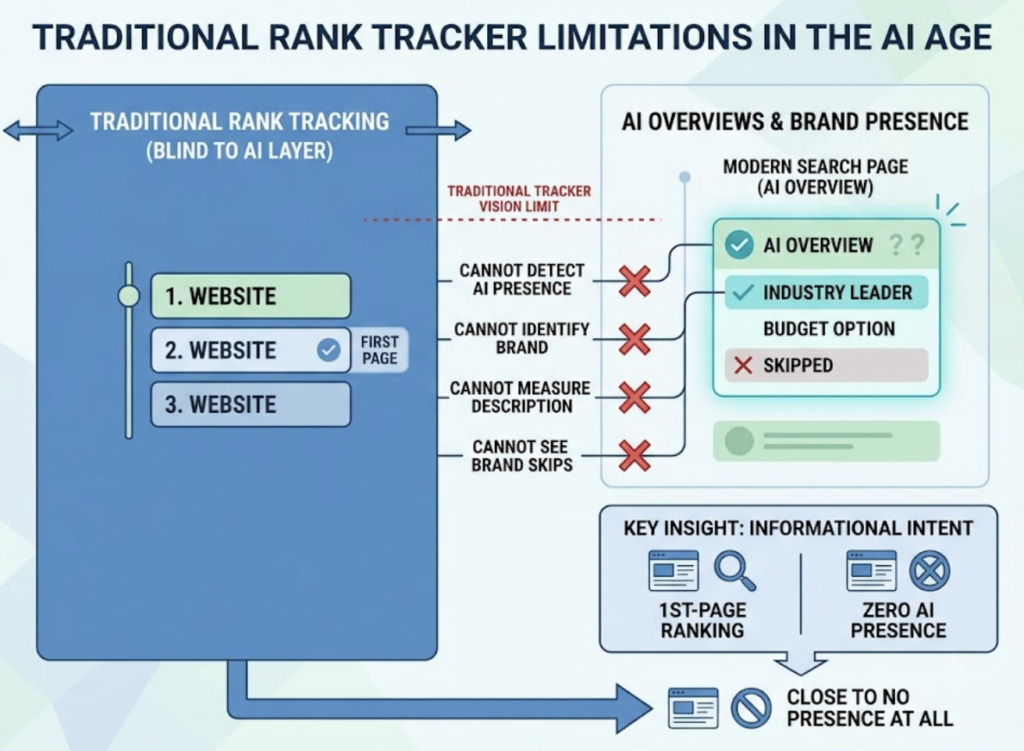
The fatal limitation is structural: traditional rank trackers are entirely blind to the AI layer. They cannot detect whether an AI Overview is present. They cannot identify whether your brand appears inside that summary. They cannot measure whether the AI describes you as an industry leader, a budget option, or skips you entirely. A first-page ranking with zero AI presence is, for informational intent, close to no presence at all.
What Is an AI Overview Tracker — And Why It’s Different
An AI Overview tracker is a purpose-built monitoring system for generative search. Rather than measuring position, it measures presence — whether and how your brand appears inside AI-synthesized responses across Google AIO, ChatGPT, Perplexity, and other generative engines.
The core tracking dimensions shift accordingly:
Presence detection. Does the AI mention your brand, product, or service within its summarized response? This is binary visibility that rank position cannot capture.
Citation frequency. When the AI provides source links, is your URL included? Being cited positions your content as authoritative in the AI’s knowledge model — a signal with compounding value over time.
Prompt-level visibility. How does the AI respond to specific high-intent user queries versus broad keyword searches? A brand can be invisible on head terms but consistently cited on long-tail prompts — or the reverse. Without prompt-level tracking, you cannot know.
Sentiment and framing. This is the dimension most SEOs completely miss. The AI may mention your brand, but describe it as “a lower-cost alternative to [Competitor]” or “best suited for smaller teams.” That framing shapes user perception before they ever reach your site. Monitoring it is the first step to correcting it.
Where traditional tools measure where you are on a page, AI trackers measure whether you exist in the AI’s internal model of your category.
The Visibility Gap: What You’re Blind To Without an AI Tracker
The gap between traditional ranking data and AI-layer reality is not theoretical. It shows up in three concrete ways that damage revenue and brand equity every day.
The rank paradox. You hold a solid top-three organic position. Traffic is down 40%. An AI tracker reveals that for your most important keywords, a large AIO summary appears above the fold citing only competitors. Users get their answer before they scroll. Your ranking is technically accurate; your visibility is functionally zero.
This pattern is increasingly common. Organic CTR on queries with AI Overviews dropped 61% — from 1.76% to 0.61% — per Seer Interactive data covering over 5 million tracked queries. Users are nearly 47% less likely to click a traditional organic result when an AIO is present.
The silent brand erosion. You may be cited in AI summaries, but the framing is working against you. Sentiment tracking surfaces these cases — when the AI has pattern-matched your brand to messaging you didn’t choose. Without visibility into that framing, your content strategy cannot address it.
The competitive citation gap. Competitors are being consistently cited as primary sources for your category’s core queries. Without citation monitoring, you cannot reverse-engineer what’s driving those inclusions — whether it’s content structure, domain authority signals, or specific semantic patterns the AI engines favor. You’re losing Share of Voice without knowing it.
Key Differences Side-by-Side
| Dimension | Traditional Rank Tracker | AI Overview Tracker |
|---|---|---|
| Data source | Classic SERP (blue link positions) | AI engine responses (LLM synthesis) |
| Primary metric | Keyword rank position | Presence rate / Share of Voice |
| Visibility scope | Page 1 organic results | AI summaries, chat responses |
| Context model | Link-based URL authority | Entity-based semantic relevance |
| Sentiment data | None | Brand framing, competitor comparison |
| Output | Rank trends, SERP feature flags | Citation efficacy, mention sentiment, CVR |
The divergence isn’t just technical. It’s strategic. Traditional trackers optimize for a SERP that no longer drives the majority of informational-intent traffic in most B2B and content-heavy verticals.
When You Need Both — And When AI Tracking Takes Priority
Traditional SEO is not obsolete. The right framework depends on where your audience lives within the search landscape.
Lean on traditional SEO when your business is primarily transactional or local. AI Overviews appear in fewer than 7% of local and transactional query types, and your conversion path still runs through blue links. Long-tail, low-volume navigational queries are also largely unaffected.
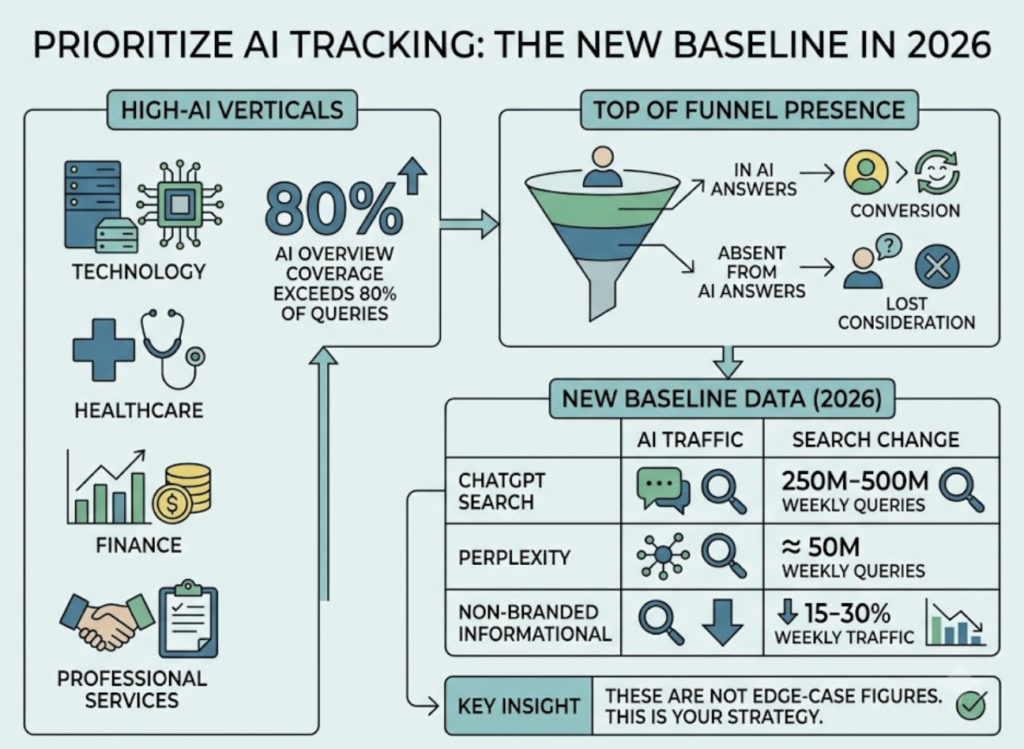
Prioritize AI tracking when your content is informational, educational, or B2B-focused. In these verticals — technology, healthcare, finance, professional services — AI Overview coverage exceeds 80% of queries. Being absent from AI answers means being absent from the top of the user’s consideration funnel. ChatGPT Search now processes 250–500 million weekly queries; Perplexity handles around 50 million. Non-branded informational query traffic is down 15–30% across content sites in 2026. These are not edge-case figures. They are the new baseline.
For most brands operating in informational or considered-purchase categories, AI tracking is no longer supplementary. It is the primary visibility metric.
How Topify Fills the Gap
Topify is built for the search landscape that actually exists in 2026. While traditional tools stop at the blue-link layer, Topify’s Comprehensive GEO Analytics closes the visibility gap with three core capabilities:
AI-specific prompt tracking. Audit your brand’s presence across hundreds of high-intent user queries that trigger AI summaries — across Google AIO, ChatGPT, and Perplexity simultaneously. Move from “are we ranking?” to “are we the answer?”
Citation monitoring. Automatically detect which URLs are cited in AI responses and track citation frequency over time. Understand what content formats and signals are driving competitor inclusions — and replicate that structure for your own authority building.
Cross-platform Share of Voice. Monitor your brand’s presence not just on Google, but across every major AI search engine. Get a complete, comparable picture of your AI-driven search dominance and spot the gaps before they compound.
You can explore GEO tools and resources to start understanding your baseline — including a set of free GEO toolsavailable for teams getting started with AI visibility tracking.
Traditional rank data tells you where you stand in a list. Topify tells you whether you exist in the answer.
Start your AI visibility audit with Topify today.
Conclusion
Ranking #1 was once the endgame of search strategy. In 2026, it is increasingly a partial metric — necessary but no longer sufficient. As AI Overviews become the default entry point for informational search, the real competition is not for position on a page. It is for presence in an answer.
AI Overview trackers don’t replace traditional rank tracking. They expose the layer of the search experience that traditional tools have never been able to see. For brands in informational, B2B, or high-consideration verticals, that layer is now where the majority of discovery decisions are made.
The data gap is already costing you traffic and brand equity. Closing it starts with knowing it exists.
Frequently Asked Questions
Can I use an AI Overview tracker alongside my existing rank tracker, or do I have to choose?
You should use both. They measure fundamentally different layers of the search experience and the data doesn’t overlap. Your traditional rank tracker tells you where your URLs sit in classic SERP results. An AI Overview tracker tells you whether and how your brand appears inside AI-generated summaries. Removing either creates a blind spot. The priority you place on each should shift based on your vertical — B2B and informational content teams should weight AI tracking more heavily, while local and transactional businesses can lean more on traditional metrics for now.
Why is my organic traffic declining if my rankings haven’t changed?
This is the “rank paradox” described in the article — and it’s increasingly common in 2026. When an AI Overview appears above organic results for a keyword, users often receive a complete answer without scrolling. Organic CTR on AIO-triggered queries dropped 61% per Seer Interactive data. Your rank position is accurate; your actual visibility to the user has diminished because an AI summary has intercepted the query. Only an AI tracker can surface this gap.
What’s the difference between an AI Overview tracker and a GEO (Generative Engine Optimization) tool?
They are closely related but differ in function. An AI Overview tracker is primarily a monitoring tool — it tells you where you currently stand: whether you’re cited, how often, and with what framing. A GEO tool or platform combines that monitoring with optimization guidance, helping you take action to improve your AI visibility. Topify’s Comprehensive GEO Analytics encompasses both: measurement and the strategic intelligence needed to act on it.

