

A procurement manager at a mid-sized manufacturer opens ChatGPT and types: “What are the best 3PLs for temperature-controlled freight in the Southeast?” The AI responds with three names. Yours isn’t one of them.
That’s not a pricing problem. It’s not a service problem. It’s a GEO problem.
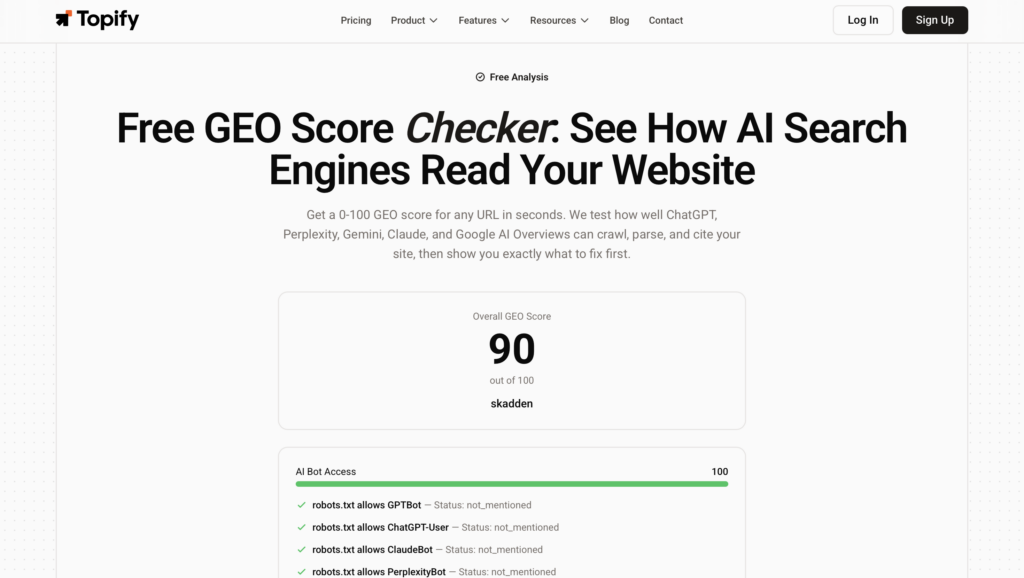
The content on your website — coverage maps, SLA benchmarks, integration specs, cold chain certifications — exists. The issue is that it’s structured in formats AI systems treat as noise. And if AI can’t read it, it can’t cite you. Run your domain through the GEO Score Checker right now to see exactly where the gap is.
✅ Free ⚡ Results in 60 seconds 🔒 No signup required
GEO Score Checker
When a Shipper Asks AI for a 3PL, Your Brand Isn’t in the Answer
Logistics is a B2B category where the shortlisting stage is everything. By the time a procurement team issues an RFP, the vendor list is largely set. AI is now shaping that list before a single human conversation happens.
Here’s what that looks like in practice.
Scenario 1: Global Coverage, Invisible to AI
A freight forwarder with 40 offices across 18 countries runs a technically rich website. Service pages detail port-to-port transit times, customs brokerage capabilities, and hazmat handling protocols. None of it reaches AI systems because the site’s robots.txt inadvertently blocks GPTBot and ClaudeBot. The forwarder scores below 25 on Bot Access. Every time a shipper asks an AI platform to recommend a global freight forwarder, that brand doesn’t exist.
Scenario 2: Strong Technical Docs, Wrong Format
A TMS vendor publishes detailed integration documentation: ERP connectors, carrier API specs, EDI compatibility guides. It’s exactly the content supply chain decision-makers want when evaluating platforms. The problem: it lives in gated PDFs and behind login walls. AI crawlers see a login prompt and stop. The vendor’s Content Signals score sits at 34. Its competitors with publicly accessible HTML documentation get cited instead.
Scenario 3: Perplexity Yes, ChatGPT No
A regional 3PL has invested in content marketing. Blog posts, case studies, a carrier network overview — all indexed and visible. Perplexity cites them regularly. ChatGPT doesn’t. The reason: ChatGPT weights structured data markup and domain authority signals differently from Perplexity’s citation model. The 3PL’s Structured Data score is 29. On the platform where most enterprise procurement teams start their research, this brand is absent.
These aren’t edge cases. They’re the default state for most logistics companies that haven’t specifically optimized for AI visibility.
The Four GEO Scores That Reveal Your Logistics Brand’s AI Blind Spots
The GEO Score Checker evaluates your domain across four dimensions. Each one maps directly to how AI systems decide whether to surface your logistics brand when a shipper, procurement lead, or supply chain consultant asks for recommendations.
| Score Dimension | What It Measures | Logistics Impact |
|---|---|---|
| Bot Access | Whether AI crawlers (GPTBot, ClaudeBot, PerplexityBot) can access your site | Freight portals, carrier networks, and TMS platforms often gate content behind logins or block bots via robots.txt — making service pages invisible to AI |
| Structured Data | Quality of Schema markup and JSON-LD | Logistics sites rarely implement Organization, Service, or FAQPage schema, so AI can’t interpret what services you offer, where you operate, or what certifications you hold |
| Content Signals | Depth, semantic authority, and E-E-A-T signals in your content | Case studies, white papers, and capability decks buried in PDFs don’t register as AI-readable content authority |
| Visibility Score | How often your brand appears in ChatGPT, Perplexity, Gemini, and AI Overviews | Most logistics brands appear in one or two AI platforms, not all four — creating blind spots exactly where their buyers research |
Score interpretation for logistics brands:
- 0–40: AI systems have no reliable way to identify or recommend you. Procurement teams using AI tools won’t see your name.
- 41–60: You appear in some AI contexts, but competitors with stronger signals consistently outrank you in recommendation outputs.
- 61–80: Solid baseline visibility. Gaps in one or two dimensions are limiting your reach in specific AI platforms.
- 81–100: AI systems can read, understand, and recommend you with high confidence across platforms.
How to run your check:
- Go to the GEO Score Checker
- Enter your domain or brand name
- Get your four-dimension score in under 60 seconds
- Identify your lowest-scoring dimension — that’s where AI is losing you
What Supply Chain Buyers Actually Ask AI Before Issuing an RFP
The shortlisting stage happens earlier than most logistics marketers realize. Procurement teams and supply chain managers are using AI to generate vendor lists, compare capabilities, and validate service claims — often weeks before they reach out to a sales team.
These are the actual prompts circulating in logistics procurement workflows right now:
| AI Prompt Example | Platform | Search Intent | What It Reveals |
|---|---|---|---|
| “Best 3PLs for e-commerce fulfillment with same-day delivery capability” | ChatGPT | Vendor shortlisting | Brands without structured service schema won’t appear |
| “Compare freight forwarders for air cargo from Asia to Europe” | Perplexity | Capability comparison | Brands absent from earned media citations are invisible |
| “Which TMS platforms integrate with SAP and support multimodal routing?” | Gemini | Technical evaluation | Integration documentation needs to be in AI-readable HTML format |
| “Find cold chain logistics providers certified for pharmaceutical transport” | ChatGPT | Compliance verification | Certification data buried in PDFs doesn’t surface in AI answers |
| “What are the top last-mile delivery solutions for high-density urban markets?” | Perplexity | Solution discovery | Low Content Signals scores mean competitors with more crawlable content win |
| “Recommend a customs brokerage firm with experience in EU trade compliance” | AI Overviews | Specialist sourcing | Brands blocked by Bot Access issues are completely excluded |
For freight carriers, logistics providers, and supply chain technology vendors, the shift to AI-mediated procurement creates a binary environment: suppliers are either algorithmically visible or effectively invisible to growing market segments.
That gap between visible and invisible isn’t decided by your service quality. It’s decided by four technical signals.
Why Logistics Content Scores Low on AI Signals (And It’s Not the Content Itself)
Most logistics companies have more content than they realize. The problem isn’t quantity. It’s format, structure, and access.
PDF-heavy documentation is the biggest culprit. Capability decks, carrier scorecards, lane rate sheets, compliance certifications — the materials that procurement teams actually want are almost universally stored as PDFs. AI crawlers can extract some text from PDFs, but they can’t reliably interpret structured relationships, hierarchies, or context. A freight forwarder’s 40-page capability document might as well not exist from an AI visibility standpoint.
Gated content blocks AI at the threshold. Logistics platforms routinely gate their best content: integration docs, API references, case studies, SLA calculators. These require a login, a form submission, or a demo request. From a buyer experience perspective, that’s reasonable. From an AI visibility perspective, it means your most authoritative content is invisible to every AI crawler that would surface it to a procurement team.
robots.txt configurations inherited from pre-AI SEO strategies are still blocking AI bots. Many logistics companies set up their robots.txt years ago to manage Google’s crawl budget. Those configurations often block entire subdirectories — including the service pages and technical documentation that AI systems need to understand what you do and where you do it.
| Logistics Scenario | GEO Signal | Likely Cause | Action Direction |
|---|---|---|---|
| 3PL not appearing in “cold chain provider” queries | Bot Access: <30 | robots.txt blocking GPTBot/ClaudeBot on key service pages | Audit robots.txt and explicitly allow AI crawler access to service directories |
| TMS vendor absent from integration comparison answers | Content Signals: <35 | Integration docs behind login wall or in PDF format | Publish key integration capability content in accessible HTML format |
| Freight forwarder visible on Perplexity, absent from ChatGPT | Structured Data: <30 | Missing Service and Organization schema markup | Implement JSON-LD schema on service pages with coverage areas and certifications |
| Supply chain software brand not cited in vendor roundups | Visibility Score: <40 | Insufficient earned media presence and third-party citations | Build citation footprint through industry publications and partner sites |
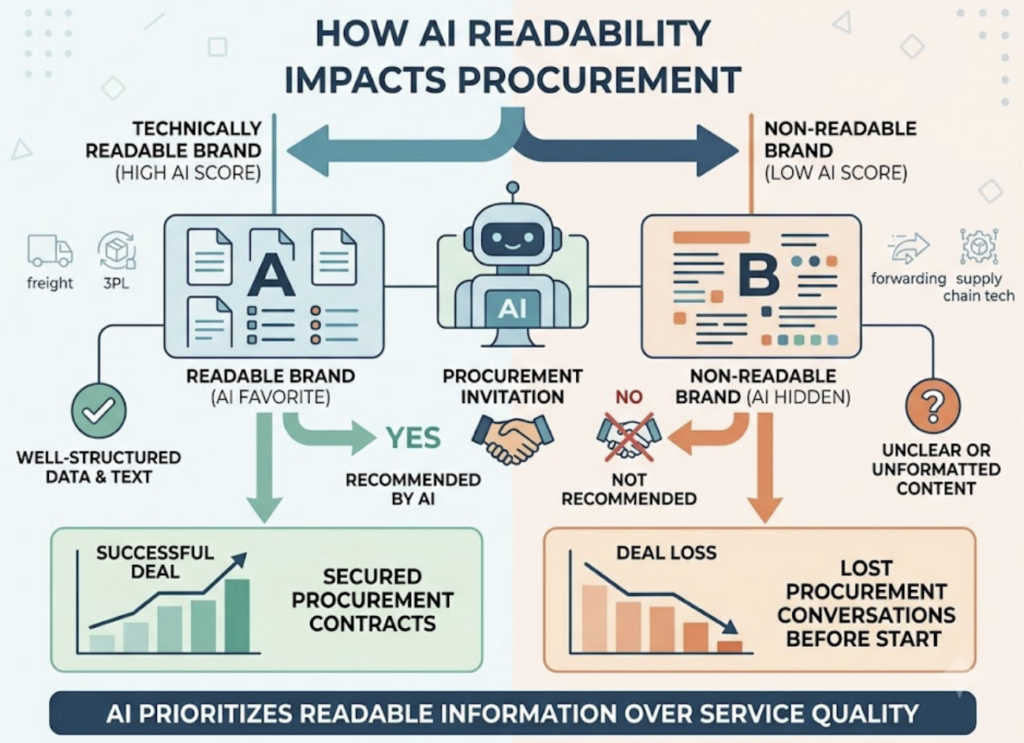
The pattern holds across freight, 3PL, forwarding, and supply chain tech. Brands that score below 50 on these dimensions are losing procurement conversations before they start. AI recommends the brand that’s technically readable — not necessarily the one with better service.
From a One-Time Score to Continuous Freight Brand Monitoring
The GEO Score Checker gives you a clear starting point: four scores, instantly, no account required. That snapshot tells you where you stand today.
The challenge is that AI visibility isn’t static. New competitors publish content. Platform citation algorithms update. Your own content expands as you enter new lanes or markets. A score from this month may not reflect your position in three months.
That’s where Comprehensive GEO Analytics picks up. Instead of a single diagnostic, it tracks all four GEO dimensions continuously — showing you how your visibility moves across ChatGPT, Perplexity, Gemini, and Google AI Overviews over time, with alerts when signals shift and competitive benchmarks to show where gaps are opening.
| Capability | Free GEO Score Checker | Topify Platform |
|---|---|---|
| Check frequency | One-time snapshot | Continuous monitoring |
| Dimensions tracked | 4 GEO scores | Full GEO analytics + sentiment + citation tracking |
| Historical trends | None | Full trend history with alerts |
| Competitor benchmarking | Not included | Real-time competitor visibility tracking |
| Platform breakdown | Aggregated score | Per-platform (ChatGPT, Perplexity, Gemini, AI Overviews) |
| Optimization actions | Directional guidance | Specific, prioritized execution steps |
The checker gives you a snapshot. Topify‘s platform tracks the trajectory.
For logistics brands managing multiple service lines, geographies, or carrier networks, continuous tracking means knowing which content changes actually moved your AI visibility — and which ones didn’t. Plans start at $99/month. You can review pricing or start a free 7-day trial — no credit card required.
Conclusion
AI has become the first stop in logistics procurement research. The brands that show up consistently aren’t necessarily the largest or the most established. They’re the ones that removed the technical barriers between their content and the AI systems their buyers are using.
Check your four GEO scores today with the GEO Score Checker. It takes 60 seconds, costs nothing, and tells you exactly which dimension is costing you procurement conversations.
If you want to go deeper, the AI Robots Checker shows you precisely which AI crawlers your robots.txt is currently blocking. The Brand Authority Checker surfaces the earned media gaps limiting your Visibility Score. And the Knowledge Freshness Checker tells you how current AI models’ understanding of your brand actually is.
Frequently Asked Questions
What does a low Bot Access score mean for a logistics company?
It means AI crawlers — GPTBot, ClaudeBot, PerplexityBot — can’t access the pages on your website that describe your services, coverage areas, and capabilities. This typically happens because of robots.txt configurations set up for traditional SEO that inadvertently block AI bots. The result: even if your content is strong, AI platforms can’t read it, so they can’t recommend you. The AI Robots Checker can identify exactly which bots you’re blocking.
My logistics company has detailed content on its website. Why is my Content Signals score still low?
Content format matters as much as content quality. Case studies in PDF format, capability decks behind login walls, and integration specs in gated portals don’t register as AI-readable content authority — even if the information is excellent. AI systems need your content in accessible HTML, with clear semantic structure and demonstrable expertise signals, to treat it as authoritative. Publishing a representative sample of your technical content in open, structured HTML format typically produces measurable score improvement.
How is GEO Score different from traditional SEO ranking for a 3PL or freight tech brand?
Traditional SEO measures where you rank in a list of links. GEO Score measures whether AI systems can identify, understand, and recommend your brand when someone asks a direct question. A freight forwarder can rank on page one of Google and still score below 40 on AI visibility — because the two systems use fundamentally different signals. Google reads keywords and backlinks. AI platforms read structured data, semantic authority, and crawlable content. The gap between them is where most logistics brands are currently losing ground.
Does fixing GEO scores actually affect which freight vendors procurement teams consider?
Yes, in a specific and measurable way. AI systems are now used in the pre-RFP shortlisting stage. When a procurement manager asks ChatGPT or Perplexity to generate a vendor list, the brands that appear are those with sufficient Bot Access, Structured Data, Content Signals, and Visibility Score. Brands below threshold simply don’t appear — regardless of their actual service quality. Improving GEO scores doesn’t guarantee a recommendation, but scoring below 40 on any dimension typically means exclusion from AI-generated shortlists in that gap area.
Read More:

