

Search for a tool to track AI visibility and you’ll find a dozen platforms, each promising to show how your brand performs inside ChatGPT, Gemini, and Perplexity. Look closer and the promises stop lining up. One counts how often you get mentioned. Another tracks a single engine and calls it coverage. A third hands you a dashboard full of numbers with no explanation of what moved or why. The hard part isn’t deciding to measure AI search visibility. It’s figuring out which tool measures the things that actually change what your team does next.
Most Tools to Track AI Visibility Measure Only One Thing
Here’s the trap most teams fall into. They pick a tool that counts how often the brand shows up in AI answers, watch that one number, and assume they’re covered. Mention frequency is a starting point, not the whole picture.
A brand can land in a large share of Perplexity answers and stay completely absent from Google’s AI Overviews, even with strong domain authority. AI responses are probabilistic rather than fixed, so what shows up on one engine tells you little about another. Track a single platform and you’re reporting on a fraction of where buyers actually ask.
Mention count also skips the parts that decide whether a mention helps you. Where you land in the answer. How the model describes you. Whether you’re cited as the source, or just named in passing while a competitor gets the link.
That’s the gap most dashboards still can’t see.
To track AI visibility in a way that drives action, a tool needs to cover five signals: mention frequency (do you appear), citation share (are you the cited source), position (where you land), sentiment (how you’re described), and competitive gap (why a rival gets picked instead). Reporting on the first while ignoring the rest is how teams end up with numbers that look fine and a pipeline that doesn’t move. The harder part is turning those signals into business outcomes, not just collecting them.
One more thing worth knowing. AI engines don’t rank by backlinks the way Google does. They pull from retrieval systems that reward clear, extractable, trustworthy content, which means visibility depends less on authority scores and more on whether your pages are structured to be quoted.
Tools to Track AI Search Visibility Performance, at a Glance
Most tools claim the same thing. They differ in how many engines they watch, what they actually measure, and whether they tell you why a competitor wins. Here’s how six of them line up.
| Tool | Core Focus | Multi-Engine Tracking | Best Fit |
|---|---|---|---|
| Topify | Comprehensive GEO analytics (7 metrics) | Broad | Brands needing deep benchmarking and a clear path from insight to fix |
| Profound | Strategic content planning | Partial | Finding thematic content gaps at the category level |
| ArcAI | Attribution and ROI | Yes | Tying AI presence to traffic, leads, and conversions |
| Peec.AI | Lightweight diagnostics | Limited | Smaller teams wanting quick prompt-gap insights |
| Rankscale | Content authority signals | Yes | Diagnosing why a brand fails to get cited |
| MentionDesk | Automated recurring monitoring | Yes | Scalable, hands-off tracking across major LLMs |
1. Topify: Track AI Visibility Across Every Major Engine
Topify sits at the comprehensive end of the market. Instead of a single mention count, it tracks brand performance across seven metrics in one view: visibility, sentiment, position, volume, mentions, intent, and CVR (conversion visibility rate). That spread is what separates “we got mentioned” from “we know what the mention is worth.”
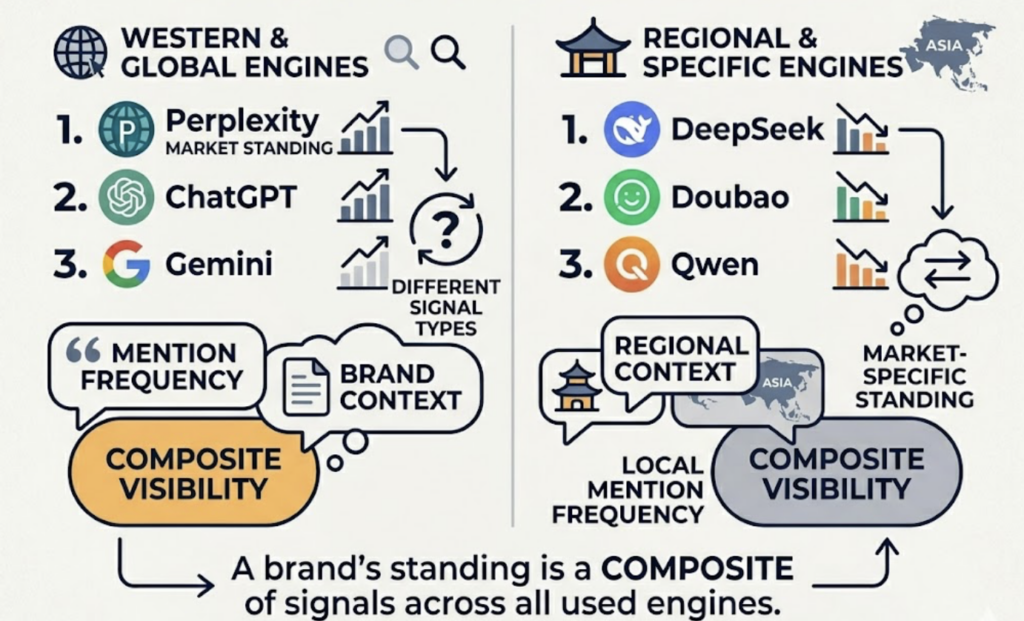
Coverage runs across the engines buyers actually use, including ChatGPT, Gemini, Perplexity, DeepSeek, Doubao, and Qwen. For teams selling into more than one market, that matters, because a brand’s standing on Perplexity often looks nothing like its standing on a regional engine.
The part that turns tracking into action is competitor benchmarking. Topify shows which brands an AI engine recommends for a given prompt, where you land relative to them, and which new rivals are starting to surface. You’re not just watching your own line on a chart. You’re seeing the full set of answers a buyer gets.
It also reverse-engineers citations. Topify analyzes the exact domains and URLs that AI platforms pull from, so when a competitor keeps getting cited and you don’t, you can trace it to the specific source and decide whether to earn a place there. That maps directly to the source-path audit most teams skip.
In practice, this means you can spot a drop in ChatGPT mentions, trace it back to a review site that stopped citing you, and route the fix to your content team, all inside the same dashboard. The one-click execution layer lets you state a goal in plain English, review the proposed strategy, and deploy without building a manual workflow.
Pricing starts at $99 a month on the Basic plan, which includes a 30-day trial, tracking across ChatGPT, Perplexity, and AI Overviews, and 100 prompts. Teams that want to confirm the data changes what they do before committing can get started on the trial first.
Best fit: marketing teams and agencies that need cross-platform tracking plus a clear route from insight to fix, not just another dashboard.
2 to 6: Other Tools to Track AI Search Visibility
2. Profound
Profound leans toward strategic planning. It’s useful for spotting thematic content gaps and high-level category opportunities, which suits teams thinking about where to invest content effort before they get into prompt-level tracking.
3. ArcAI
ArcAI focuses on attribution and ROI. If your priority is correlating AI presence with downstream traffic, leads, and conversions, it’s built around that question, though it leans more on measurement than on optimization.
4. Peec.AI
Peec.AI is the lighter, friendlier option. Smaller teams that want quick, readable insight on specific prompt gaps tend to get value fast, though coverage and depth are narrower than enterprise platforms.
5. Rankscale
Rankscale is built around the “why.” It digs into content authority and clarity signals to explain why a brand fails to get cited, which helps teams that already track presence but can’t figure out the cause.
6. MentionDesk
MentionDesk is about automated, recurring presence checks. For teams that want scalable monitoring running in the background across major LLMs, it covers the repetition without much manual setup.
How to Pick a Tool to Track AI Visibility for Your Stack
There’s no single right tool to track AI search visibility performance. The right one depends on what you’ll do with the data.
If you sell into one market and one engine dominates your category, a lighter diagnostic tool can be enough to start. The moment your buyers split across ChatGPT, Perplexity, and AI Overviews, single-engine tracking starts lying to you.
If you already know you’re underperforming and need the reason, prioritize tools that trace citations and explain the gap, not ones that only restate the score.
And if you’re an agency reporting to clients, the deciding factor is comparative data. A 30% mention rate means nothing until you can put a competitor’s rate next to it. Run the evaluation criteria that separate diagnostic trackers from full platforms before you commit.
Pick for the decision you need to make, not the prettiest dashboard.
Conclusion
The teams that struggle with AI search visibility usually aren’t measuring nothing. They’re measuring one thing, on one engine, and calling it coverage. The fix isn’t more dashboards. It’s choosing a tool that tracks the full set of signals across the platforms your buyers actually use, then routing what it finds to the people who can act on it.
Start by checking where your brand stands today. Once you can see the gap clearly, the tool you need becomes a lot more obvious.
FAQ
Q: How do you track AI visibility across multiple platforms at once?
A: You need a tool that runs the same set of buyer prompts across each engine on a schedule, then normalizes the results into one view. Manual spot checks on a single platform won’t catch the divergence between, say, Perplexity and Google’s AI Overviews, where the same brand can show up strong in one and vanish in the other.
Q: Which AI search visibility metrics actually matter?
A: Mention frequency tells you whether you appear, but it’s only the first signal. Citation share, position in the answer, sentiment, and the competitive gap (why a rival gets picked instead) are what turn a number into something your content team can act on.
Q: How often should you track AI search visibility performance?
A: AI engines shift their citation patterns regularly, so a one-time audit goes stale fast. Continuous or weekly tracking is more useful than a quarterly snapshot, especially when you’re testing whether a content change moved your standing.
Q: Are free tools enough to track brand mentions in ChatGPT and Perplexity?
A: A free check is a fine way to see where you stand right now and decide whether the gap is worth acting on. For ongoing tracking across several engines, with competitor benchmarking and source-level attribution, you’ll want a paid platform built for that depth.

