

Your GA4 dashboard shows organic sessions, bounce rate, and conversion paths. None of it tells you whether ChatGPT just recommended a competitor when a buyer asked for the best tool in your category. That blind spot is widening. More research now starts inside AI answers, where discovery happens before a single click ever reaches your site. Traditional analytics were built to measure rankings and traffic. They were never built to measure whether an AI mentions you, how it describes you, or which source it decides to trust. That’s the gap AI visibility analytics exists to close.
What AI Visibility Analytics Actually Tracks
AI visibility analytics is the systematic measurement of how a brand gets discovered, represented, and cited inside AI-generated answers. It’s not web traffic analytics. It’s not a rank tracker. It measures something those tools can’t see: your brand’s presence inside a synthesized response.
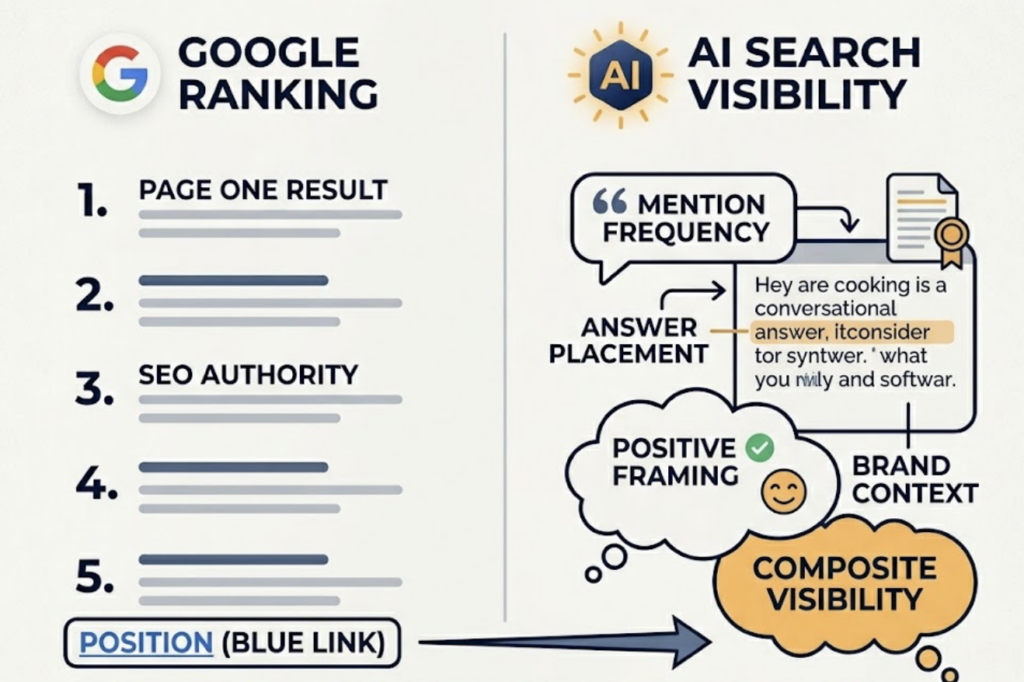
Here’s the shift that breaks the old model. Search engines used to rank pages in a list, so visibility meant a position you could point to. AI engines don’t rank in a list. They synthesize information into a single conversational answer, which means your visibility is no longer a blue-link position. It’s whether you show up in the summary at all, and how you’re framed when you do.
That makes the discipline platform-agnostic by definition. Tracking one engine isn’t enough, because the same prompt can return a different brand in Perplexity than it does in ChatGPT.
Most teams measure three dimensions:
- Presence is mention frequency: the share of relevant, high-intent prompts where your brand gets included.
- Representation is sentiment and positioning: whether the AI describes you as a category leader, a budget option, or an afterthought.
- Citation authority is the source layer: which specific domain and page the AI credits as its source of truth.
Web analytics can confirm a visit happened. It can’t tell you any of these three.
How AI Visibility Analytics Works Under the Hood
The first instinct most people have is to open ChatGPT and search their own brand once. That tells you almost nothing.
LLM responses are non-deterministic. The same prompt can produce different answers depending on context, phrasing, and model updates, so a single manual check is statistically meaningless. Real measurement works through sampling at scale, not one-off lookups.
A working system runs four steps. First, prompt orchestration builds a library of buyer-intent prompts, the kind real customers type, like “what are the best solutions for X.” Second, cross-platform querying feeds those prompts into multiple AI engines at once, so ChatGPT, Gemini, Perplexity, and Google AI Overviews get measured side by side. Third, parsing uses named entity recognition and sentiment analysis on the raw response text to detect if, where, and how your brand appears. Fourth, aggregation rolls that up into share of voice and citation share tracked over time.
The output isn’t a rank. It’s a trend line.
The Metrics That Tell You If AI Sees Your Brand
Once you stop chasing a “rank,” a different set of KPIs takes over. These metrics capture brand influence in the pre-click window, before anyone reaches your site.
| Metric | What it answers |
|---|---|
| Citation Share | How often does the engine cite your domain versus competitors for category queries? |
| Mention Frequency | In what share of category conversations does your brand get included? |
| Sentiment Accuracy | Does the AI’s description match your intended positioning? |
| Citation Position | Are you a primary source, or buried in an “additional sources” footer? |
| Competitive Gap | Which high-intent prompts are competitors winning while you’re absent? |
The Competitive Gap row tends to drive the most action. It turns a vague worry (“are we losing ground in AI?”) into a concrete list of prompts where a named rival shows up and you don’t. That’s a content brief, not a feeling.
Best AI Overviews Tracker Tools: What to Look For
Google AI Overviews sits in a category of its own. It shows up directly on the search results page, which means it intercepts intent that used to flow to organic listings. For most brands, it’s the single highest-traffic AI surface, so a dedicated AI Overviews tracker is worth evaluating on its own merits.
Search “best AI Overviews tracker” and you’ll find platforms that all promise the same thing. The difference is in what they actually measure. Use these criteria to separate a real AIO tracker from a basic keyword monitor:
| Selection criteria | Why it matters |
|---|---|
| Platform coverage | Does it track AI Overviews alongside ChatGPT, Perplexity, and Gemini, or just one engine? |
| Dedicated AIO monitoring | Does it isolate Google AI Overviews as its own data stream, or fold it into generic SERP data? |
| Citation reverse-engineering | Can it show which exact domains and URLs the overview cites, including yours and competitors’? |
| Update cadence | Does it monitor continuously, or hand you a static one-time snapshot? |
The best AI Overviews tracker isn’t the one with the prettiest dashboard. It’s the one that connects an AIO mention back to the source page that earned it, so you know what to fix. A tracker that only tells you “you’re not visible” without showing the citation behind a competitor’s win leaves you guessing.
Common Mistakes That Skew Your AI Visibility Analytics
Plenty of teams set up tracking and still draw the wrong conclusions. A few mistakes show up again and again.
The first is the ranking fallacy: assuming a strong Google rank guarantees an AI mention. AI models prioritize authoritative, answer-ready content, and that doesn’t always line up with link-based authority. A page can rank well and still get skipped by the model.
The second is monitoring a single platform. A brand might dominate Perplexity and be invisible in ChatGPT, and tracking only one creates a false sense of safety.
The third is treating a manual snapshot as data. One search on one day, against a non-deterministic system, isn’t a measurement. It’s noise.
The fourth is the most expensive. Roughly 96% of marketers haven’t updated their KPIs to account for zero-click AI discovery, so they keep grading themselves on organic sessions while brand exposure quietly moves somewhere their reports can’t see.
A quick self-check before you trust any AI visibility report:
- Does it cover more than one AI engine?
- Does it track mentions and sentiment, not just position?
- Is it continuous, or a one-time snapshot?
- Does it tie a mention back to a citation source?
If a report fails two of those, the numbers aren’t telling you what you think they are.
How to Improve AI Visibility Analytics Across Platforms
Measurement only matters if it changes what you do next. The goal is to move from “being visible” to “being trusted,” and that takes a repeatable loop.
Start by finding content gaps. Use citation data to locate the buyer questions where competitors get cited and you don’t, then build the answer-ready content that closes each one. Next, strengthen entity authority. AI engines correlate consistent messaging across PR, social, and authoritative directories with credibility, so a coherent footprint across sources tends to lift mention frequency. Then optimize structure. Clear H2 and H3 headers, direct-answer summaries, and FAQs give LLMs content they can parse and quote cleanly.
None of that sticks without persistent monitoring. Citation patterns drift as models update, so a quarterly audit misses most of the movement.
This is where a comprehensive analytics layer does the heavy lifting. Topify approaches AI visibility analytics through a seven-metric view, covering visibility, sentiment, position, volume, mentions, intent, and conversion visibility rate across major engines. In practice, that means you can watch a drop in ChatGPT mentions, trace it to a source that stopped citing you, and see whether the same prompt still surfaces you in Google AI Overviews, all from one dashboard. Its AI Overviews tracking is built into the entry plan, so the AIO layer isn’t a paid add-on you discover later.
The point isn’t more charts. It’s a clear path from “we lost a mention” to “here’s the page that needs to change.” If you want to see where your brand stands today, you can get started with Topify and run your first cross-platform scan.
Conclusion
AI visibility isn’t a one-time project. As models update and citation patterns shift, the only reliable posture is an always-on cadence: weekly snapshots, monthly trends, and a fast loop from data to content fixes. The brands that win the early-funnel intent traditional SEO can’t see are the ones treating AI representation as ongoing governance, not a quarterly curiosity. Pick the metrics that matter, cover every engine your buyers use, and make sure each report points at something you can actually fix.
FAQ
Q: What is AI visibility analytics in simple terms?
A: It’s the practice of tracking how often, and in what context, your brand appears in answers generated by AI engines like ChatGPT, Perplexity, and Google AI Overviews. It measures presence inside an answer, not clicks to your site.
Q: How do you measure AI visibility analytics?
A: Through automated prompt testing across multiple AI platforms, calculating citation share, brand sentiment, and mention frequency over time. Because LLM responses fluctuate, measurement relies on sampling at scale rather than single manual searches.
Q: What is the best AI Overviews tracker for it?
A: The strongest AIO trackers focus on large-scale prompt orchestration, competitor benchmarking, and citation analysis, and they isolate Google AI Overviews as its own data stream instead of folding it into generic SERP data. A tracker that ties each mention back to its source page is the most useful.
Q: How much does AI visibility analytics tooling cost?
A: Pricing usually follows a SaaS model based on prompt volume and the number of AI engines tracked. Topify’s entry plan starts at $99/month and already includes ChatGPT, Perplexity, and AI Overviews tracking, with higher tiers adding more prompts, projects, and seats.

