

Your rank tracker says you own position one for your top keyword. Your domain authority is solid, your backlink profile is clean, and the monthly SEO report looks healthy. Then a buyer opens Perplexity, asks for the best option in your category, and your brand isn’t in the answer at all. The tools that built your SEO program weren’t designed to catch this. They measure where your pages sit on a results page, not whether an AI model decides to mention, cite, or recommend you inside a generated answer. That gap is exactly what an AI visibility analytics tool is built to close.
And in 2026, that gap is where most SEO teams are flying blind.
What an AI Visibility Analytics Tool Actually Does
An AI visibility analytics tool tracks how generative engines like ChatGPT, Perplexity, Gemini, and Google AI Overviews talk about your brand. Not your URLs. Your brand. It measures whether you get mentioned, how you’re framed, which of your pages get cited as sources, and where you land relative to competitors inside the same answer.
A rank tracker answers one question: where does this page rank for this query? An AI visibility tool answers a harder one: when someone asks an AI model about my category, do I show up, and what does the model say about me?
Those are not the same question, and the shift between them has reached a tipping point. Industry research through mid-2026 shows marketing teams moving away from a single “rankings” number toward a metric ecosystem built on citations, mention sentiment, and source attribution across LLM-powered interfaces.
How an AI Visibility Analytics Tool Works Under the Hood
The mechanics are different from crawling a SERP. A tool starts with a set of prompts that match real buyer questions in your category. It runs those prompts across multiple AI engines, then parses each generated answer for the things that matter: did your brand appear, in what position, with what sentiment, and which source URLs did the model cite to justify the answer.
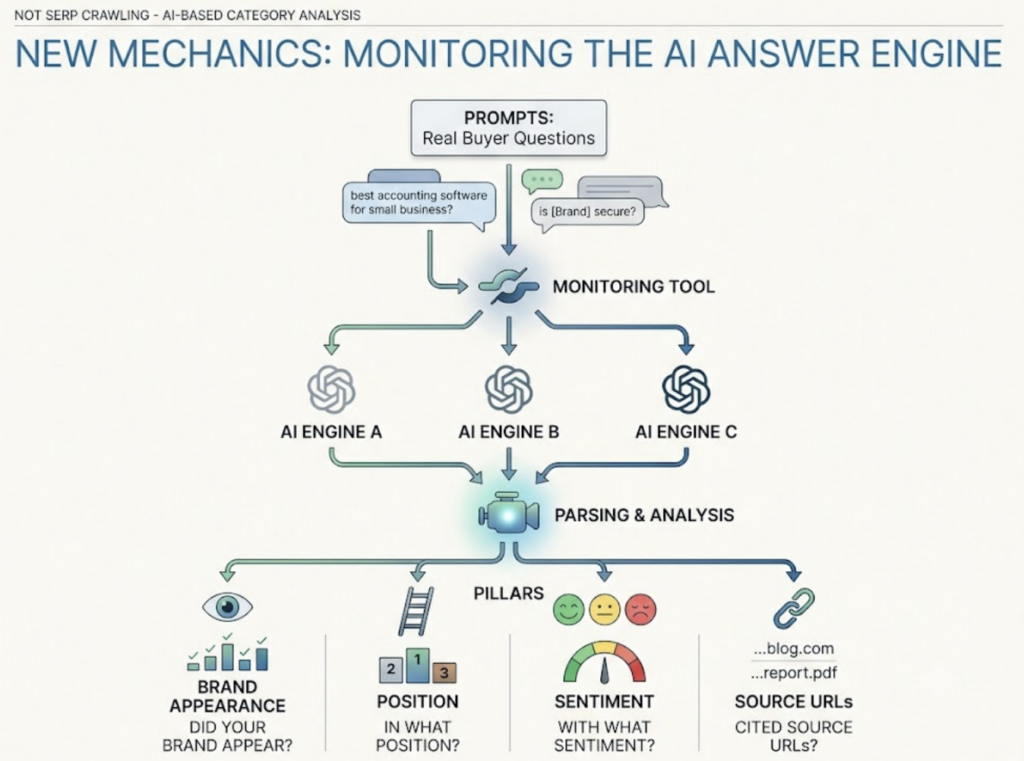
The hard part is volatility. AI outputs drift. You might be the top recommendation on Monday and absent on Tuesday, with no algorithm update you can point to. That’s why a useful tool tracks the prompt-level environment, the exact query, the generated answer, the cited sources, and the competitors present in that specific response, rather than collapsing everything into one score.
Perplexity vs Google SERP Tracking: Why One Can’t Cover the Other
This is where teams extending from SEO into GEO get tripped up. They assume their existing SERP tracking covers the new surface. It doesn’t.
Google SERP tracking measures link position. It tells you that your page is result number three for a keyword. The model behind it is relatively stable, the ranking factors are well documented, and a position is a fixed, observable thing.
Perplexity, by contrast, produces a synthesized answer. There’s no universal “position three” in a generated paragraph. Your brand is either woven into the recommendation, footnoted as a citation, or left out entirely. The reasoning that decides this is non-linear and changes as models update.
Here’s the part that surprises most SEO leads.
A brand can sit at SERP position one for a query and still be absent from the Perplexity answer to the same question, because the model pulled its sources and framing from a different set of pages. Perplexity vs Google SERP tracking isn’t a matter of running the same check on two platforms. They measure different things, and a tool built only for one will quietly miss the other.
How to Measure AI Visibility: The Metrics That Matter
The most common mistake is counting mentions and calling it a day. A raw mention count is a vanity metric. A mention without a citation, or a citation wrapped in a negative comparison, gives you nothing actionable and can even mislead you into thinking you’re winning.
The market has converged on a richer set of indicators. Across 2026 research, five pillars come up repeatedly:
| Metric | What it measures | Why it matters |
|---|---|---|
| Citation share | How often your domain is cited as a source versus competitors | The most reliable leading indicator of long-term AI search authority |
| Competitive share of voice | Your comparative presence across high-intent, decision-stage prompts | Tells you who AI recommends when buyers are close to choosing |
| Mention sentiment | Whether you’re framed as a recommended solution or a neutral alternative | A cited brand can still be called “expensive” or “hard to integrate” |
| Source attribution | Which of your pages the model prefers to cite | Shows where to invest content effort to earn more citations |
| Drift and volatility | How AI narratives about your brand change as models update | Catches sudden visibility drops before they cost you pipeline |
For teams that want this measured continuously rather than audited by hand, Topify runs its Comprehensive GEO Analytics across seven dimensions, including visibility, sentiment, position, volume, mentions, intent, and CVR. In practice, that means you can see a drop in ChatGPT mentions and trace it back to a competitor who started getting cited in your place, inside the same view, instead of stitching the story together from five tabs.
Common Mistakes Teams Make With AI Visibility Tracking
Most failures aren’t about the tool. They’re about treating AI visibility like an old metric in new clothes.
The single-platform trap is the first one. A tool that only checks ChatGPT tells you nothing about Perplexity or Google AI Overviews, where a meaningful slice of your buyers are asking the same questions. Coverage gaps create blind spots that look like wins.
The percentage-score trap is the second. A tool that hands you “62% visibility” with no underlying evidence is asking you to trust noise. Visibility isn’t a standardized industry metric. Different tools use different prompt sets, locales, and model settings, so two tools can report wildly different numbers for the same brand. Prioritize tools that show you the specific prompt and the generated answer, not just a number.
The third mistake is reading citation tracking as the whole story. Knowing you’re cited tells you that you’re a source. It doesn’t tell you whether that source is being used in a way that helps you. Context is the missing layer, and sentiment is how you measure it.
How to Improve AI Visibility: A Practical Strategy
Before buying anything, run a baseline. Take your top 20 high-intent buyer queries and ask them across ChatGPT, Perplexity, and Google AI Overviews by hand. Note where you appear, where you don’t, and who’s in the answers instead of you. That manual audit costs an afternoon and gives you a reference point that any tool you buy later has to beat.
From there, the strategy is a loop, not a one-time fix.
First, find the prompts that matter, the decision-stage questions where being absent costs you real revenue. Then reverse-engineer the citations: look at which domains and URLs the model actually pulls from for those prompts. Often the gap is structural, missing schema, thin FAQ coverage, or a comparison page that simply doesn’t exist yet. Fix the content, then re-measure to confirm the citation moved.
This is where execution-focused tools earn their place. Topify’s citation analysis surfaces the exact domains and URLs that AI platforms cite for your priority prompts, its competitor benchmarking shows who’s winning those answers in real time, and its one-click execution turns the identified content gaps into a workflow you can deploy rather than a to-do list you’ll ignore. When you’re ready to set a baseline against live data, you can get started with Topify and compare the tool’s numbers against your manual audit.
A Checklist for Choosing an AI Visibility Analytics Tool
Tool fatigue is real in 2026, so match the tool to what your team will actually do with the data. Run any option you’re considering against this checklist:
- Platform coverage: Does it track ChatGPT, Perplexity, Gemini, and Google AI Overviews, not just one engine?
- Prompt-level evidence: Can you see the exact query and generated answer, or only a score?
- Citation analysis: Does it show which sources the model cites, and whether that source is you or a competitor?
- Competitor benchmarking: Can you track share of voice across decision-stage prompts?
- Action, not just reporting: Does it tell you what to fix, or just that something dropped?
- Pricing transparency: Is the cost clear and tied to how teams actually use the product?
The right pick depends on your situation. SEO-heavy teams bolting AI tracking onto an existing stack often look at hybrid SEO tools. Lean startups that mainly need an “am I in the answer?” check tend toward lightweight prompt auditors. Enterprises managing brand reputation at scale lean on multi-model enterprise platforms. Teams that want to close the loop between measurement and content execution sit in a different group, where Topify and other GEO-native platforms compete on actionability rather than raw reporting.
On cost, Topify’s pricing starts at $99/month for the Basic plan, which covers ChatGPT, Perplexity, and AI Overviews tracking with 100 prompts and a 30-day trial. That positions it as a professional mid-tier option built for teams that want execution, not just a dashboard.
Conclusion
The teams losing AI visibility in 2026 mostly don’t know it, because their SERP tools were never built to see it. The fix isn’t another rankings report. It’s measuring the things that actually predict AI search authority, citation share first, then sentiment and share of voice, across every engine your buyers use.
Start with the manual audit of your top 20 queries this week. Establish your baseline, see who’s getting recommended in your place, then choose a tool based on whether you need alerts, enterprise oversight, or content execution. The metric has changed. Your measurement should change with it.
FAQ
What is an AI visibility analytics tool?
It’s a platform that tracks how generative AI engines like ChatGPT, Perplexity, and Google AI Overviews mention, cite, and recommend your brand. Unlike a rank tracker that measures page position, an AI visibility analytics tool measures your presence inside AI-generated answers, including citation share, sentiment, and competitive position.
How does an AI visibility analytics tool work?
It runs a set of buyer-intent prompts across multiple AI engines, then parses each generated answer for your brand’s mentions, position, cited source URLs, and the competitors present. Because AI outputs drift over time, good tools track this at the prompt level and re-measure frequently, often daily or after a model update, rather than weekly like traditional SEO.
What are the best tools for AI visibility analytics?
The right tool depends on your goal. Execution-focused teams tend toward GEO-native platforms like Topify, SEO-heavy shops look at hybrid trackers, and enterprises prioritize multi-model coverage. Whatever you compare, favor tools that show the actual prompt and answer as evidence. For spot-checking before you buy, a few free GEO tools can establish a quick baseline.
How much does an AI visibility analytics tool cost?
Pricing ranges widely. Lightweight auditors start cheap, while enterprise multi-model suites run into four figures monthly. Topify sits in the professional mid-tier, starting at $99/month for Basic with a 30-day trial, scaling up for more prompts, projects, and seats.

