

Your keyword rankings look stable. Your Google Search Console data is clean. Then traffic dips, and nobody in the weekly meeting can explain why. The problem isn’t your SEO. It’s that your dashboard only shows you one channel, and that channel is no longer the only place your audience searches.
AI search visits grew 42.8% year-over-year in Q1 2026, reaching 27 billion monthly visits across platforms like ChatGPT, Perplexity, and Google AI Mode. Your traditional ai rank checker has no visibility into any of it.
Google Still Shows You a Number. That Number Is Missing Context.
Google’s position data is accurate. It’s just incomplete.
When someone opens Perplexity and types “best [tool category] for small teams,” they’re not triggering a Google crawl. They’re getting a synthesized answer that cites two or three brands directly. If yours isn’t one of them, no keyword rank in GSC will tell you.
Zero-click rates on Google itself have reached 64.82%, while AI-native platforms run even higher. Perplexity’s zero-click rate sits at 93%. Google AI Mode reaches 88%. That means the vast majority of AI search interactions resolve without ever sending a referral to your site.
Traditional rank tracking was built for a world where ranking meant clicking. That world is shrinking.
What an AI Rank Checker Actually Measures
The distinction matters: a traditional rank checker tells you where your page appears in a list. An AI rank checker tells you whether you appear in an answer at all, and what that answer says about you.
AI search operates on a different logic. Platforms like ChatGPT and Perplexity don’t serve ranked blue links. They synthesize a response, cite a handful of sources, and present a narrative. Your “position” in that narrative is not a number from 1 to 10. It’s a set of signals that require a completely different monitoring framework.
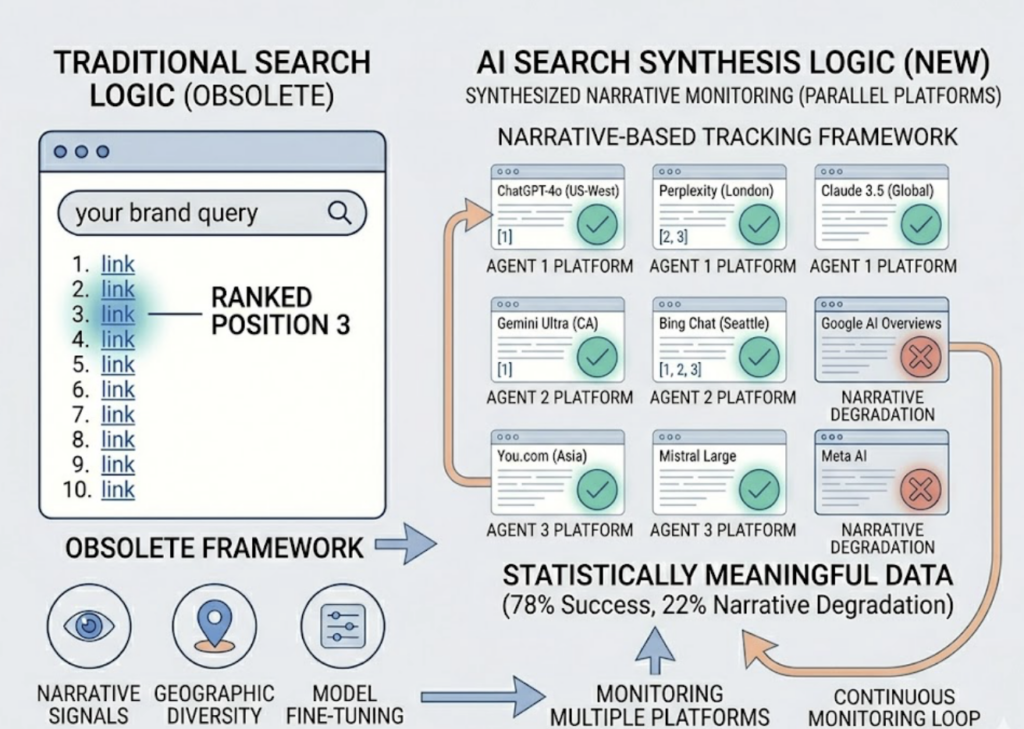
Here’s the comparison most SEO teams don’t have in front of them yet:
| Dimension | Traditional Rank Tracker | AI Rank Checker |
|---|---|---|
| What it tracks | Keyword position in Google SERP | Brand mention in AI-generated answers |
| Primary metric | Ranking position (1–100) | Mention rate, citation position, sentiment |
| Platform coverage | Google, Bing | ChatGPT, Perplexity, Gemini, AI Overviews |
| Click attribution | Direct referral traffic | Influence without clicks (brand recall) |
| Citation source | Backlink profile | Which domains AI uses to describe your brand |
| Update frequency | Daily/weekly crawl | Per-prompt, per-platform monitoring |
The right question isn’t “what page rank am I on?” It’s “when someone asks an AI about my category, do I get mentioned, where do I appear, and what does the AI say about me?”
Only 14% of Marketers Track AI Visibility. That’s the Gap.
Most teams still run exclusively on GSC and a traditional rank tracker. Only 14% of marketers currently track AI-specific visibility, according to industry data from 2026. That leaves an enormous blind spot in the standard reporting stack.
This isn’t a niche problem. Citation clusters in AI search concentrate on a narrow set of domains. BrightEdge and Ahrefs data suggest that roughly 40–55% of citations in ChatGPT Search and Perplexity flow to fewer than 1,000 domains total. If your brand isn’t establishing authority across those domains, AI platforms are systematically bypassing you, even when you rank on Google.
That’s the visibility gap. Your Google dashboard can’t detect it.
The Five Signals Your AI Rank Checker Should Be Monitoring
When SEO teams add an AI-specific layer to their reporting stack, the metrics shift. Here’s what actually needs to be tracked:
Brand Mention Rate is the percentage of high-intent prompts where your brand gets cited. It’s the AI-era equivalent of organic impressions, except it maps to buyer-stage questions, not keyword searches.
Citation Position tells you where in the AI answer your brand appears. Top-of-answer placement, a mid-paragraph mention, and a footer source list carry very different authority signals.
Sentiment Score captures the framing AI platforms use when they describe your brand. An AI that calls your product “affordable but limited” is giving buyers a specific message, whether you know about it or not.
Citation Source Dominance identifies which external domains, review sites, or publications the AI cites as evidence when it mentions your brand. These are your high-leverage content placement targets.
Answer-Engine CVR estimates the downstream impact of AI mentions on branded search volume and direct traffic, measuring the “influence without clicks” effect that traditional attribution misses entirely.
None of these five metrics live in GSC or a standard rank tracker.
How SEO Teams Are Building the Second Dashboard in Practice
The practical workflow is simpler than most teams expect. You’re not replacing your existing SEO tooling. You’re adding a parallel tracking layer.
The starting point is identifying 20–50 high-intent prompts that map to your buyers’ research journey: the questions they ask ChatGPT before they ever visit your site. These aren’t keywords. They’re full conversational queries like “what’s the best tool for X use case” or “how do Y teams handle Z problem.”
Then you run those prompts across platforms weekly and track the five signals above. Within two to four weeks, patterns emerge: which platforms cite you most, which prompts trigger competitor mentions instead, which sentiment descriptors AI associates with your category.
Topify was built for exactly this workflow. Its Comprehensive GEO Analytics monitors brand performance across ChatGPT, Gemini, Perplexity, and other major AI platforms via seven key metrics: visibility, sentiment, position, volume, mentions, intent, and CVR. In practice, that means you can run a weekly prompt sweep across platforms, spot a drop in Perplexity mentions, and trace it back to a specific citation source that stopped referencing your brand, all without switching between tools.
The Dynamic Competitor Benchmarking feature runs the same prompt set against your competitors simultaneously, so you can see when a rival gains citation position in ChatGPT while your mention rate drops. That’s the kind of signal that traditional rank tracking simply cannot surface.
Teams that get started with Topify typically begin with their existing keyword list, map those keywords to conversational prompt equivalents, and build a prompt library that mirrors the actual research behavior of their buyers.
The Prompt-Based Strategy That Replaces Keyword Volume
Here’s a shift that changes how teams allocate their optimization effort.
Traditional SEO prioritizes tracking thousands of keywords by volume. Prompt-based benchmarking prioritizes tracking 20–50 buying journey prompts by citation outcome. The signal density is higher, the connection to pipeline is cleaner, and the data updates reflect real AI behavior rather than estimated crawl schedules.
Industry forecasts suggest up to 30% of digital marketing budgets will shift toward AI-focused optimization by 2027. The teams building this infrastructure now, before it becomes standard practice, have a structural advantage. AI search citation patterns are not equally distributed. Being early to track them means being early to identify the content gaps, the authority deficits, and the sentiment issues that determine who gets mentioned when a buyer asks an AI for a recommendation.
The second dashboard isn’t optional for competitive teams. It’s the missing layer in every reporting stack that only monitors one channel.
Conclusion
The Google dashboard tells you where you rank in one channel. The AI rank checker tells you whether you exist in the channel that’s growing at 42.8% year-over-year. Both answers matter, but only one of them is new information.
If your SEO stack doesn’t have a layer tracking brand mentions, citation position, and sentiment across ChatGPT, Perplexity, and Gemini, you’re reporting on part of the picture. Topify’s seven-metric GEO analytics framework gives SEO teams exactly that layer, built to run alongside existing tooling rather than replace it. The teams adding this visibility now aren’t restarting their SEO programs. They’re extending them into the places their buyers already are.
FAQ
Q: What is an AI rank checker?
A: An AI rank checker is a tool that monitors how your brand appears in AI-generated search answers across platforms like ChatGPT, Perplexity, and Google AI Overviews. Unlike traditional rank trackers that measure your position on a Google SERP, an AI rank checker measures whether your brand is mentioned in AI responses, where it appears in those responses, and what sentiment or framing the AI uses when citing your brand.
Q: How is an AI rank checker different from a traditional rank tracker?
A: A traditional rank tracker tells you your position for a keyword in Google’s search results. An AI rank checker tracks citation-based visibility: which AI platforms mention your brand, how often, in what position within the answer, and with what framing. The underlying measurement logic is different because AI search is probabilistic and generative, not deterministic and list-based.
Q: Can I use my existing SEO tools to track AI search rankings?
A: Standard SEO tools like Semrush and Ahrefs are built for Google’s SERP model and don’t natively monitor brand mentions inside ChatGPT, Perplexity, or Gemini answers. Some have added partial AI Overview tracking, but full-spectrum AI rank checking requires a purpose-built platform. The practical approach is to run both in parallel: your existing stack for Google, and a dedicated AI visibility tool for the rest.
Q: Which AI platforms should my team be tracking?
A: At minimum, ChatGPT, Perplexity, and Google AI Overviews, since these have the largest search-intent user bases. Teams with international audiences should also monitor Gemini, DeepSeek, and regional AI platforms depending on their market. The right coverage depends on where your buyers actually research, which you can often infer from referral traffic patterns and prompt-level testing.

