

Your rank checker says everything’s fine. Page-one keywords holding steady, a couple climbing, nothing red on the dashboard. Then a prospect asks ChatGPT for the best tool in your category, gets five recommendations, and your brand isn’t one of them. That blind spot isn’t rare anymore. Between 40% and 80% of sessions on AI platforms like ChatGPT and Perplexity now end without a single click to a website, which means a growing share of your buyers form opinions inside an answer your rank checker never looks at. Which raises an awkward question for anyone shopping for the best rank checker this year: best at tracking what?
The One Question That Decides Which Rank Checker You Need
Search “best rank checker” and you’ll get a dozen lists, each crowning a different winner. The lists aren’t wrong. They’re answering a question you haven’t asked yet.
The question that matters in 2026 is simpler: are you tracking Google, or are you tracking AI? A tool built to monitor blue-link position on a results page and a tool built to monitor whether ChatGPT recommends you are not the same product. They measure different things, on different platforms, against different logic.
Once you know which side of that line you’re on, the “best” choice gets obvious. Skip the question, and you’ll buy a tool that’s excellent at something you didn’t need.
A Google Rank Checker Can’t See What ChatGPT Recommends
A traditional rank checker pings the search engine, reads where your URL lands, and logs the position. That model assumes the result you care about is a link sitting in an ordered list. AI answers break that assumption.
When someone asks Perplexity or Google’s AI Mode a question, the model synthesizes a response from multiple sources and often resolves the query without showing ten blue links at all. For queries that trigger AI Overviews, organic click-through rates have dropped by roughly 38% to 61%, according to 2026 industry data. The ranking might still exist. The click doesn’t.
Here’s the part that catches SEO teams off guard. Ranking in the top 10 doesn’t guarantee you’ll be cited in the answer sitting above it. Ahrefs found that only about 38% of URLs cited in AI Overviews actually rank in Google’s top 10 for the same query. AI models tend to pull from content that’s easy to extract, verify, and cite, and that isn’t always the content Google ranks highest. They run a kind of query fan-out, breaking one question into several sub-queries and favoring sources that read as clear and trustworthy.
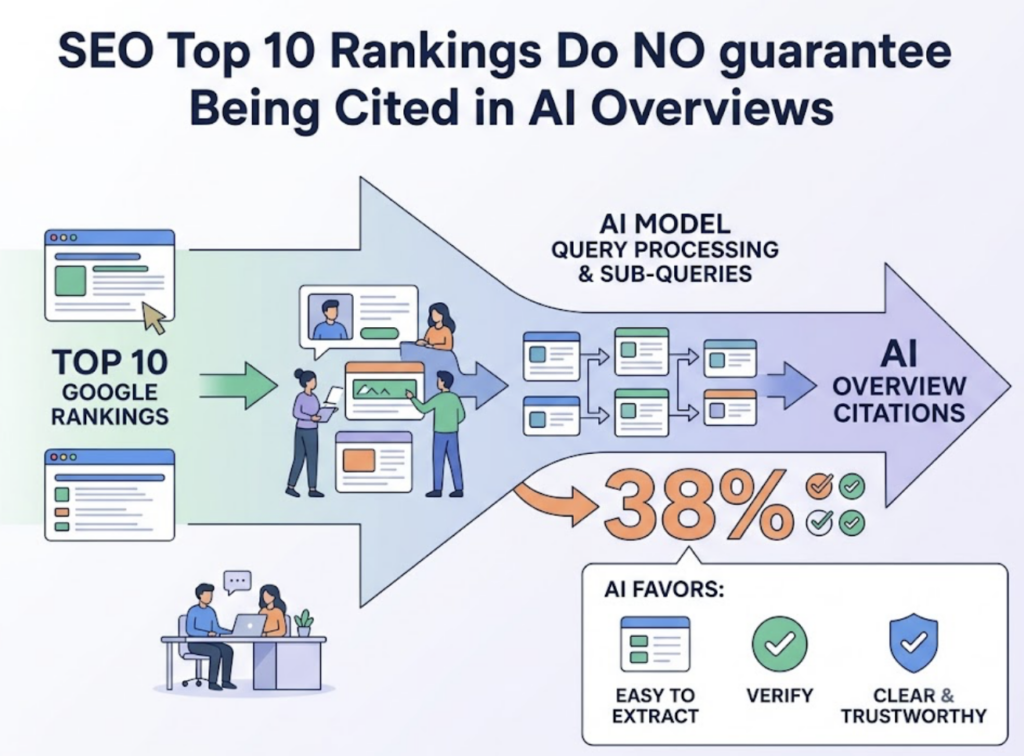
A Google rank checker can’t see any of that. It was never built to.
Google Rank Checker vs AI Rank Checker: What Each One Measures
The cleanest way to see the gap is to put the two tool types side by side. They share a name and almost nothing else.
| Dimension | Google Rank Checker | AI Rank Checker |
|---|---|---|
| Primary goal | URL position in blue links | Brand mentions and citation frequency |
| Platforms | Google, sometimes Bing | ChatGPT, Gemini, Perplexity, Claude |
| Key metric | Keyword position (1 to 100) | Visibility, sentiment, citation score |
| Output | Direct traffic and clicks | Answer authority and recommendation |
| Update pattern | Real-time, daily | Prompt-based, generative simulation |
The left column answers “where do I rank for this keyword?” The right column answers “does AI recommend me when someone asks?” Both are legitimate questions.
But if your buyers are researching inside ChatGPT, Gemini, or Perplexity, a Google rank checker leaves you guessing about the channel that’s growing fastest. ChatGPT Search alone now handles an estimated 250 to 500 million search-intent queries a week. An AI rank checker exists because that volume needs its own measurement layer, not a borrowed one.
The Best Rank Checker for AI Search Visibility
If the side you’re missing is AI, you need a tool built for it from the ground up. This is where a platform like Topify fits, since it treats AI answers, not results pages, as the thing worth measuring.
Instead of a keyword position, it tracks how often AI engines mention your brand, where you land relative to competitors inside the answer, and whether the tone around you reads positive or dismissive. The monitoring runs across ChatGPT, Gemini, Perplexity, DeepSeek, and other major engines through seven metrics: visibility, sentiment, position, volume, mentions, intent, and CVR.
In practice, that means you can watch your mention rate in ChatGPT slip, then trace it to a competitor’s article that started getting cited in your place. Topify reverse-engineers the exact domains and URLs AI platforms pull from, so you can see which content is winning the citation and why. That moves you from “we dropped” to “we dropped because of this specific page,” which is the difference between a report and a to-do list.
That last layer matters more than it sounds. AI visibility isn’t a vanity score. Visitors arriving through AI-assisted discovery tend to convert at far higher rates than standard organic traffic, with some 2026 studies putting the gap as high as 23x, because the chat interface pre-qualifies them before they ever reach your site.
You don’t have to start with a paid plan to test the idea. A set of free GEO tools can give you a baseline read on your AI visibility before you commit to anything.
Which Rank Checker Belongs in Your 2026 Stack
For most teams, the honest answer in 2026 is that you need both, weighted toward where your buyers actually are.
If your traffic still comes from long-tail commercial searches and blue-link clicks, a traditional rank tracker like Ahrefs or Semrush stays essential. Local SEO, transactional keywords, and content with high direct-click value all live on Google, and a Google rank checker measures that better than anything else.
If you’re a brand, SaaS, or enterprise where buyers research before they reach out, the AI side is the gap. A specialized AI rank checker covers the channel where, increasingly, the first impression of your category gets formed. The two tools aren’t rivals. They cover different halves of the same funnel.
The mistake isn’t picking one. It’s not realizing there were two.
Conclusion
The best rank checker in 2026 isn’t a product. It’s a decision. Work out whether your buyers find you through Google’s results or through an AI answer, and the tool you need stops being a debate.
For most brands, the Google side is already covered and the AI side is the blind spot. If that sounds like your situation, the practical next step is to measure what AI engines say about you right now, then decide how much of your stack needs to shift. You can get started with Topify and see your AI visibility before your competitors do.
FAQ
Q: What’s the difference between a Google rank checker and an AI rank checker?
A: A Google rank checker monitors where your URL sits in the blue-link results for a keyword. An AI rank checker monitors whether and how AI engines mention your brand inside their answers, measuring visibility, sentiment, and position rather than a single ranking number.
Q: Can I track my rankings in ChatGPT?
A: Not with a traditional rank checker, since ChatGPT returns a synthesized answer rather than a ranked list. You’d use an AI rank checker that simulates real prompts and records how often, and how favorably, your brand appears across AI engines.
Q: If I rank on Google, won’t I show up in AI answers too?
A: Not reliably. Ahrefs data shows only about 38% of URLs cited in AI Overviews rank in Google’s top 10, so a strong SERP position is no guarantee of a citation in the answer above it.
Q: Do I still need a traditional rank checker in 2026?
A: Usually yes. Blue-link clicks still drive real traffic for transactional and long-tail queries, so a Google rank checker stays useful. The shift is adding an AI rank checker to cover the discovery happening inside ChatGPT, Gemini, and Perplexity.

