

Your domain authority is solid. Your keyword rankings are climbing. And your team has probably added at least one AI tool to the workflow in the last year. Here’s the thing: 86% of SEO professionals have integrated AI into their day-to-day operations, yet only 22% are actively tracking whether their brand appears in the answers ChatGPT or Perplexity delivers to users. That gap is where most brands are quietly losing ground — and where the real strategic divide is opening up.
AI Search Is Now a Separate Channel
ChatGPT crossed 810 million monthly active users by late 2025, processing 2.5 billion daily prompts. Perplexity saw 191.9% annual traffic growth in the same period. These platforms aren’t taking users away from Google in a zero-sum trade. Total search usage across both legacy engines and AI platforms increased by 26% globally in 2025. Discovery is expanding, and AI is opening new entry points that your current strategy doesn’t yet cover.
The behavior on these platforms is also fundamentally different. Traditional Google searches average 3.4 words. AI search prompts average 23 words — nearly seven times longer. Users aren’t typing keywords; they’re conducting research. The average AI search session runs 13 minutes and 9 seconds, compared to 6 minutes and 12 seconds on Google. The user who finds your brand through an AI recommendation arrives already informed and pre-qualified.
How ChatGPT, Perplexity, and Gemini Answer Differently
Traditional search returns a ranked list of links. AI platforms synthesize an answer from multiple sources and deliver it directly. The user often doesn’t click at all. Between 58% and 60% of Google searches already end without a click — and when an AI Overview is present, that zero-click rate jumps to 83%.
Your brand’s goal in this environment isn’t to rank. It’s to be cited.
“SEO AI” Actually Means Two Different Things
The phrase “SEO AI” is being used to describe two entirely distinct activities that require completely different strategies. Conflating them is how teams end up optimizing hard for a metric that doesn’t reflect what they actually care about.
Using AI Tools to Do SEO Faster
The first layer is using AI to accelerate traditional SEO: faster keyword clustering, automated content drafts, real-time SERP analysis, and predictive content scoring. Tools like MarketMuse and Frase can grade content against a topic model before it’s published, reducing the repetitive cycle of publishing and re-optimizing that’s common in legacy SEO workflows.
This layer is mature. The tooling is solid, and most SEO teams are already here.
Optimizing Content to Appear in AI Answers
The second layer is less understood: structuring your content so that generative AI platforms retrieve and cite it when answering user prompts. This is what researchers at Princeton and other institutions have formalized as Generative Engine Optimization (GEO). The logic is different, the signals are different, and the measurement framework is different. And this is exactly where that 22% gap sits — teams producing content at speed with AI, but invisible in the AI answers their audiences are actually reading.
What AI Does Better Than Traditional SEO Tools
AI tools bring four specific capabilities that traditional SEO software can’t match at scale.
Intent clustering comes first. Instead of grouping keywords by exact string matches, AI platforms identify the inferred purpose behind thousands of queries simultaneously. This lets teams move from targeting individual keywords to owning entire topical clusters — a meaningful shift in content strategy depth.
Semantic content gap detection is second. Traditional gap analysis finds keywords where competitors rank and you don’t. AI-powered detection identifies “Information Gain” — the subtopics, data points, and perspectives that haven’t been fully covered in your niche. It’s the difference between knowing you’re missing a keyword and knowing you’re missing an argument.
Real-time prompt discovery is third. AI tools can surface the actual conversational queries users are submitting to ChatGPT and Perplexity, giving teams keyword intelligence that never appears in traditional search consoles. These prompts reveal how users think about a problem, not just what words they use.
Cross-platform behavior analysis is the fourth. A single AI-powered layer can monitor how intent shifts between Google, ChatGPT, and Gemini for the same topic — letting teams adapt content format and structure to each context, rather than applying one format across the board.
Why Your Content Ranks on Google but Vanishes in ChatGPT
This is the most expensive misconception in SEO right now. Holding a top organic position (#1-#3) gives you only an 8% chance of being cited in a Google AI Overview. More striking: 80% of the sources cited by AI platforms don’t rank organically for the queried keyword at all.
The selection logic is structurally different.
Traditional search retrieves content based on keyword matching and backlink signals. AI engines use vector space models — they’re matching meaning, not strings. Trust signals differ too: where Google weighs domain authority and link profiles, AI systems weight third-party validation. Research analyzing one million AI prompts found that 85.5% of citations come from editorial sites, news outlets, and established reference hubs. Brand-owned content accounts for only 14.5%.
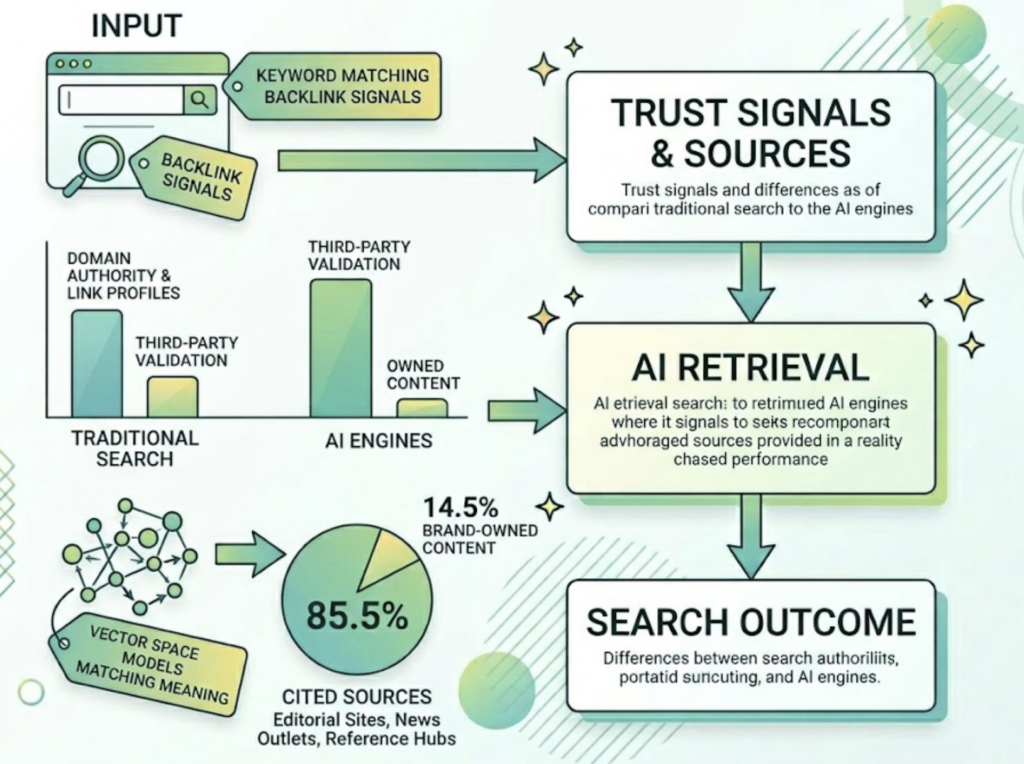
How AI Citation Logic Differs from Search Ranking
A Forbes list or a TechCrunch review is roughly 5x more likely to be cited in an AI recommendation than your product page — even if your product page ranks higher on Google. AI engines also show a systemic bias toward content published within the last 30-90 days, and toward content structured to directly answer a question in its opening sentences.
There’s also a “fan-out” dynamic that compounds this. When a user submits a complex query, the AI engine decomposes it into 4-20 sub-queries to retrieve diverse data points. A brand might rank well for the primary keyword but fail to appear in any of the secondary retrievals, resulting in total exclusion from the final synthesized answer.
Which Source Signals AI Engines Actually Trust
96% of AI citations come from high E-E-A-T sources. That means backlinks still matter — but their function has shifted. They’re no longer primarily ranking drivers. They work as trust signals that determine whether AI engines consider your domain credible enough to cite. Sites with 32,000 or more referring domains see citation counts roughly double.
Digital PR is no longer separate from SEO. If your brand isn’t discussed in the publications that LLMs trust, your brand doesn’t exist in the generative narrative.
For teams that want to see exactly which third-party domains AI engines are citing in their category, Topify‘s Source Analysis feature maps those citation patterns across ChatGPT, Gemini, and Perplexity simultaneously. It identifies which editorial sources are currently driving AI mentions for competitors — and where your content is absent from the chain.
GEO and SEO: A Two-Front Strategy, Not a Trade-Off
The question isn’t whether to do SEO or GEO. It’s whether your team has the measurement layer to manage both. Legacy search engines still process 16.4 billion daily queries and drive the vast majority of current revenue. Neither channel is optional.
What Stays the Same: E-E-A-T, Backlinks, Technical Health
Technical SEO health carries across both channels. AI bots that power platforms like Perplexity and Google AI Overviews use the same crawling infrastructure as traditional search. A site that isn’t properly indexed is invisible to both. Page speed, mobile responsiveness, and structured data all remain relevant.
E-E-A-T signals stay important too, but their function shifts: in traditional SEO, they help you rank. In AI search, they’re the entry criteria for being cited at all.
What’s New: Visibility, Sentiment, and Position in AI Answers
The new layer is about Share of Model. Unlike traditional search — where a page either ranks or it doesn’t — AI search introduces a sentiment dimension. A brand can appear frequently in AI responses and still be described as “expensive” or “unreliable.” High visibility with negative sentiment actively damages brand equity. That’s a measurement problem traditional SEO tools were never built to solve.
GEO research suggests that specific content modifications can increase visibility in AI responses by up to 40%. Structuring content into what researchers call “Answer Islands” — self-contained passages of 134-167 words that fully resolve a specific sub-intent — is one of the highest-correlation tactics identified. Each passage should answer the core question in its first 20-30 words, include supporting data, and stand alone without needing surrounding context.
How to Measure Whether Your AI SEO Is Working
Rankings, traffic, and CTR aren’t enough. They don’t tell you how often your brand surfaces in a generative answer, what position it holds relative to competitors, or whether the sentiment attached to your name is positive.
A complete GEO measurement framework covers seven dimensions. Visibility tracks how often your brand appears across a defined set of AI prompts. Position shows where you land within the AI’s recommended list. Citations measure how often the AI includes a clickable link to your domain versus a plain text mention. Sentiment maps the ratio of positive to neutral to negative characterizations. Volume tracks your share of AI mentions compared to direct competitors. Intent coverage shows which types of queries — informational versus transactional — your brand appears in. And AI CVR measures the conversion rate of traffic that arrives via AI referral.
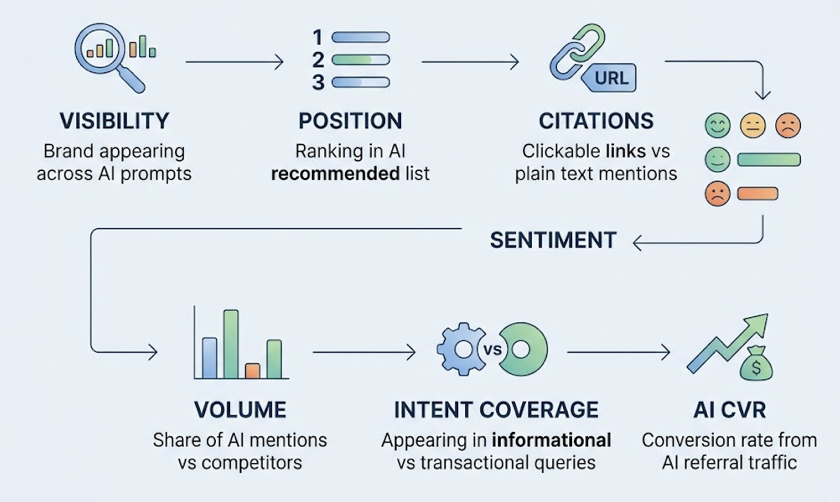
That last metric deserves attention. AI search visitors convert 4.4x to 5x better than traditional organic visitors. They arrive after a longer, more deliberate research process. The traffic volume is smaller, but the intent is materially higher — and the users referred this way exhibit 67% higher lifetime value on average.
Topify integrates all seven GEO metrics into a single dashboard, tracking brand performance across ChatGPT, Gemini, Perplexity, and other major AI platforms. The competitor benchmarking layer shows which rivals are gaining ground in AI responses and which source signals are driving those changes. You can get started here.
Conclusion
SEO hasn’t collapsed. Its scope expanded. The strategies that built organic authority over the last decade are still the foundation — technical health, E-E-A-T, indexability — but they’re no longer sufficient on their own. GEO adds a second measurement and optimization layer that tracks a channel traditional tools were never designed to see.
The practical starting point isn’t a content overhaul. It’s an audit: find out where your brand actually stands in AI answers today, then decide where to optimize. The two-front strategy isn’t complicated. It’s mostly a matter of adding the right visibility layer to a stack most teams already have.
FAQ
Q: Does AI help with Google rankings?
A: AI tools can improve rankings by enabling faster intent clustering and content refreshing, both of which correlate with ranking gains. That said, AI-generated content that lacks genuine expertise can be flagged by Google’s Helpful Content updates. AI works as a multiplier of strategy, not a substitute for human editorial judgment.
Q: What’s the best AI SEO tool in 2026?
A: The market has split into efficiency tools (Ahrefs, Semrush, Search Atlas) and visibility tools focused on AI search performance. For teams tracking generative visibility across platforms, tools that combine cross-platform prompt tracking with source analysis — like Topify — tend to provide the most actionable data for closing the GEO gap.
Q: How do I get my brand cited by ChatGPT?
A: Citations are driven primarily by earned media placements in editorial and news sources that AI engines already trust. Content should be structured for direct answerability, published within the last 30-90 days, and supported by structured data markup. Sites with strong referring domain profiles tend to see significantly higher citation rates — research suggests doubling around the 32,000 referring domain threshold.
Q: Is GEO replacing SEO?
A: No. GEO extends SEO rather than replacing it. Traditional search engines still process 16.4 billion daily queries, and the SEO foundation — technical health, E-E-A-T, indexability — is what makes content eligible for AI citation in the first place. The two strategies reinforce each other when measured and managed together.

