

Most marketing teams have adopted at least one AI tool by now. But adoption isn’t the same as integration. There’s a big difference between using AI to speed up a task and using it to fundamentally change how decisions get made across the funnel.
The teams pulling ahead aren’t just moving faster. They’ve restructured their entire workflow around AI as a judgment layer, not a content generator. This guide breaks down where AI actually fits into each stage of the marketing funnel, what’s working, and where the real leverage is hiding.
The Part of AI in Marketing No One Talks About
Everyone leads with productivity. AI writes copy faster. AI schedules posts. AI resizes images.
That’s not the story.
The more significant shift is happening at the decision layer. Researchers at Harvard Business School define traditional automation as systems that simplify workflows and reduce manual labor. But generative AI goes further: it can support, and in some cases replace, strategic judgment. That’s a different category of tool entirely.
From Automation to Judgment: What’s Actually Changed
The question companies now face isn’t “how do we automate this task?” It’s “should AI replace human judgment here, or support it?”
McKinsey research notes that executives often rely on intuition that’s been shaped by cognitive bias, reinforcing prior assumptions over time. AI counters that by surfacing real-time insights across larger datasets than any human team can process. Done well, this compresses strategy development cycles by around 50%.
But there’s a catch. A joint study from Harvard Business School and UC Berkeley tested AI assistants with entrepreneurs in Kenya. High performers saw profits rise 10–15%. Lower performers saw profits fall roughly 8%. AI amplified existing skill, rather than equalizing it.
That’s the part most vendor decks skip. AI doesn’t fill gaps in strategic thinking. It scales whatever thinking you already have.
Where AI Fits Into Your Campaign Workflow
The traditional funnel — awareness, consideration, conversion — hasn’t disappeared. But the boundaries between stages have blurred. A consumer in 2025 might discover a brand through a short-form video, research it through a generative AI assistant, and convert directly from a search result, all within minutes.
AI now operates as an invisible layer across this entire journey. Here’s how it actually functions at each stage.
Awareness: AI-Driven Research and Audience Signals
At the top of the funnel, AI is most useful for identifying intent clusters — groups of people showing early purchase signals before they’ve articulated a clear need. Natural language processing tools scan social conversations, content engagement patterns, and behavioral signals in real time.
This is meaningfully different from traditional audience targeting. You’re not just finding people who look like your existing customers. You’re finding people who are just starting to develop the problem your product solves.
Consideration: Personalization and Content at Scale
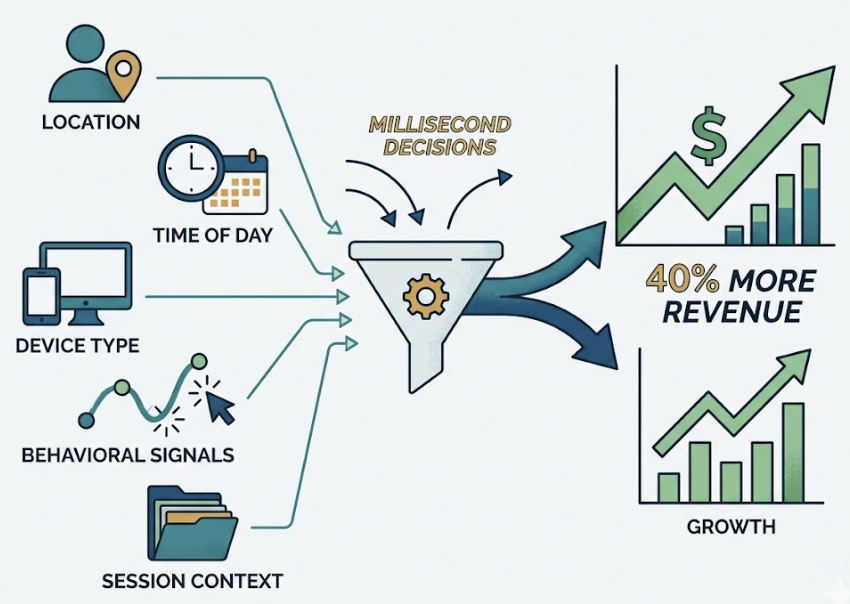
In the consideration stage, the competitive advantage shifts toward content relevance and speed. Generative AI can dynamically adjust messaging based on a visitor’s industry, location, device, and even time of day.
For B2B teams, AI-powered website assistants have largely replaced basic chatbots. They’re pulling from user context, not just a scripted decision tree. Gartner research shows that AI-driven lead scoring models can improve sales productivity by 30% and shorten sales cycles by 25% — primarily because better prioritization means faster follow-up on the right leads.
Conversion: Predictive Scoring and Timing Optimization
This is where AI delivers its most measurable ROI. Predictive models identify which visitors are most likely to convert based on behavioral patterns from similar users. They can recommend the next best offer, the right discount level, or even whether to serve a form at all.
A.S. Watson deployed an AI skincare advisor that increased transaction value by 29% and conversion rates by 396% among engaged users. Liforme cut cost per purchase by 67% using Meta’s AI-driven ad system, with 99% of purchases coming from new customers — a direct signal of AI’s ability to find net-new demand.
AI for Content Marketing: Beyond the First Draft
Content generation is the most common use case. It’s also the most misunderstood.
The first draft is the easy part. AI’s real value in content marketing is upstream: topic discovery, intent matching, content gap analysis, and increasingly, brand visibility in AI-generated answers.
Topic Discovery With AI Volume Data
Traditional keyword research tells you what people are searching. AI volume analytics tell you what people are asking AI. Those two lists are increasingly different — and the second one is where attention is actually moving.
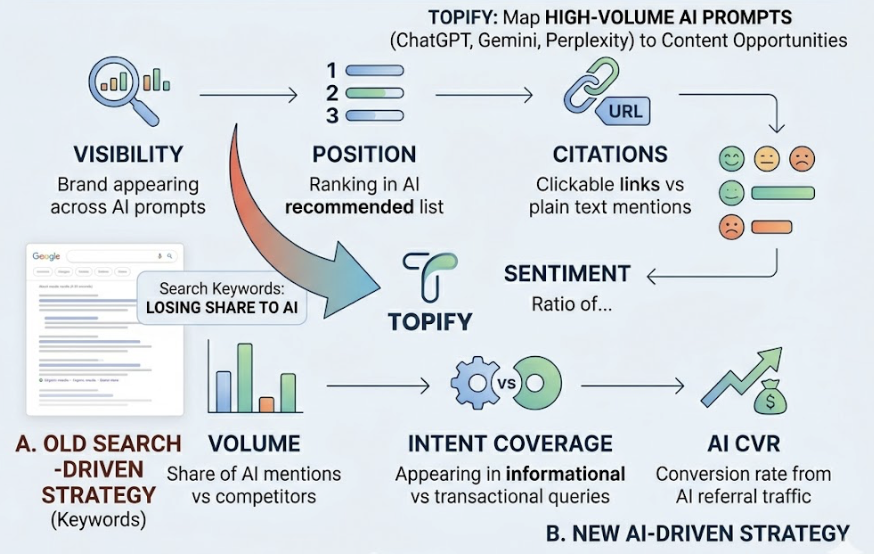
If your content strategy is still built entirely around search engine keyword data, you’re optimizing for a channel that’s losing share to AI assistants. Tools like Topify surface high-volume AI prompts — the specific questions your target audience is asking ChatGPT, Gemini, and Perplexity — and map them to content opportunities before your competitors identify them.
Why AI Search Visibility Is Now a Content KPI
Here’s a number worth paying attention to: as users shift toward AI summaries, organic click-through rates can drop by up to 61%. But conversion quality tends to rise, because the users who do click have already been pre-qualified by the AI’s answer.
This creates a new content imperative. Getting cited in AI answers is now as strategically important as ranking on page one. Research shows pages with citations and statistical data appear in AI assistant responses 30–40% more often than pages without them.
Topify’s Source Analysis tracks exactly which domains and URLs AI platforms are citing when they answer questions in your category. It shows you who’s winning AI-generated mentions, what content is driving those citations, and where your brand has gaps. That’s the content intelligence most teams are still flying blind on.
Paid Ads and AI: Where the Real Efficiency Gains Are in Digital Marketing
Meta Advantage+ and Google Performance Max represent the current ceiling of marketing automation. Both promise better results with less manual input. But they work on fundamentally different logic, and conflating them is one of the most common budget mistakes.
Meta Advantage+ creates demand. It operates on social signals — likes, watch time, comment patterns — and uses predictive behavioral models to serve content to users who aren’t yet searching but are likely to engage. It’s strongest for visually driven products and direct-to-consumer acquisition. Karaca ran Google PMax campaigns that produced a 44% ROAS improvement and 31% revenue growth through automated product prioritization.
Google Performance Max captures intent. It intercepts users who are actively searching for solutions, across Search, Shopping, YouTube, Gmail, and Maps. It’s better suited for B2B, high-consideration purchases, and local services.
The real problem with both systems is data quality. An industry study found that around 45% of marketing data is incomplete, inaccurate, or outdated — and 43% of CMOs believe less than half their marketing data is trustworthy. For AI ad systems, this is a multiplier problem. Feed bad signals, get bad optimization.
The marketers outperforming on these platforms share one practice: they track only real conversions. They use Conversion APIs to pipe CRM-verified outcomes directly back to the platforms, so the algorithm learns from actual business results rather than front-end engagement. High-quality customer lists and intent segments go in as audience signals, preventing algorithmic drift.
The Personalization Problem Most Teams Underestimate
True AI personalization isn’t adding someone’s first name to an email subject line. That’s been possible for 15 years.
Real personalization at scale means making millisecond decisions based on real-time behavioral signals, device type, location, time of day, and session context — simultaneously, for every user. McKinsey data shows that fast-growing organizations generate 40% more revenue from hyperpersonalization than slower-growing competitors. That gap is growing.
First-Party Data as the Prerequisite
None of this works without clean first-party data. A Customer Data Platform that unifies identity across touchpoints isn’t optional infrastructure anymore. It’s the precondition for any meaningful personalization. Without a unified profile, you’re personalizing fragments, not journeys.
There’s also a consent layer. Around 90% of consumers are willing to share data for better experiences, but 40% still find irrelevant ads annoying, and data security concerns haven’t gone away. When consent is withdrawn, AI systems need to switch immediately to non-identifiable context signals. That requires building the compliance layer in from the start.
Dynamic Content vs. Static Segmentation
Most teams are still at Level 1: rule-based segmentation. CRM records trigger specific messages. It works at small scale.
Level 2 uses predictive models to score users by purchase or churn propensity. This stage typically delivers 20–40% ROAS improvements. Level 3 — generative personalization — means AI is dynamically assembling landing page content in real time based on visitor intent. That requires modular content architecture, not just a better email template.
Most mid-market teams are somewhere between Level 1 and Level 2. Knowing where you are is the first step toward closing the gap.
Measuring AI Marketing Performance: Metrics That Actually Matter
Traditional KPIs — impressions, clicks, CTR — haven’t disappeared. But they’re insufficient for capturing AI’s actual contribution.
As AI summaries absorb more top-of-funnel queries, raw organic traffic often falls. That looks like a problem in the old reporting framework. In the new one, what matters is whether your brand is being cited, recommended, and positively characterized in the AI answers that are replacing those clicks.
CMOs now need a second set of metrics alongside their existing dashboard:
Share of Model (SoM): The percentage of AI-generated answers on high-intent topics where your brand appears. If 100 people ask ChatGPT about the best CRM, and your brand shows up in 48 answers, your SoM is 48%.
Recommendation Rate: The difference between being listed and being recommended. An AI that says “consider Brand X for full-funnel tracking” is more valuable than one that mentions your name in a list of ten.
Citation Share: How often AI engines pull your content as a source. This is a direct signal of domain authority in the AI layer, not just on Google.
AI Sentiment Score: A quantified measure of how AI describes your brand. Whether it characterizes you as “enterprise-grade” or “budget-friendly” directly affects which user intent buckets you get recommended for.
Topify tracks all of these in a single dashboard — across ChatGPT, Gemini, Perplexity, and other major AI platforms. Its Visibility Tracking, Sentiment Analysis, and CVR (Conversion Visibility Rate) metrics give marketing teams the reporting framework they need to tell a coherent story about AI performance to leadership. When top-line traffic dips, you need to be able to show that your Share of Model went up — and that the traffic you’re getting converts at a higher rate because AI pre-qualified it.
Where to Start If Your Team Is Still Figuring This Out
Not every team needs to build a Level 3 personalization engine in Q1. The right starting point depends on what you actually have.
Small teams and SMBs: Start with your existing tools. Most platforms — HubSpot, Meta, Google — have AI features already built in. Use them. Focus on conversion tracking hygiene: make sure you’re only feeding the algorithm real purchase signals, not vanity events. Get that right before buying anything new. ROI needs to be visible within 90 days or executive support dries up.
Mid-market teams: The priority is data unification. If you have customer data sitting in five disconnected tools, personalization at scale isn’t possible. Invest in connecting those data sources before investing in more AI tooling on top.
Enterprise teams: The challenge is governance and speed. Transformation cycles at the enterprise level typically run 18–36 months. The bottleneck isn’t usually technology — it’s organizational alignment and compliance. Building a dedicated AI function with clear ownership is the prerequisite for meaningful progress.
Across all three, there’s one move that pays off regardless of size: audit what AI is currently saying about your brand. Most teams have no idea. They’re optimizing for Google while AI systems are forming opinions about them at scale.
That’s the gap Topify was built to close. Its Competitor Monitoring tracks how AI systems position your brand relative to rivals, what language they use, and which prompts trigger recommendations — so you’re not guessing about your AI visibility, you’re measuring it.
Conclusion
AI’s real value in marketing isn’t speed. Speed is a byproduct.
The actual shift is from reactive to proactive decision-making — using real-time data to anticipate what customers need before they ask, which messages will convert before you run them, and which channels are building brand equity in the places attention is actually moving.
Three things determine who wins this transition. First, data quality: the teams feeding AI systems accurate, real-conversion signals will get disproportionate algorithmic returns. Second, visibility redefined: as search gives way to AI answers, GEO becomes a core marketing function alongside SEO. Third, the human layer: AI handles pattern recognition and scale. Humans handle ethics, brand judgment, and the weak signals that don’t show up in dashboards yet.
The brands that treat AI as a mechanical structure — something that needs clean inputs, proper integration, and ongoing calibration — will outperform the ones still looking for magic.
FAQ
What is AI in marketing?
AI in marketing refers to the use of machine learning, natural language processing, and generative AI to automate decisions, personalize experiences, and optimize performance across the marketing funnel. It ranges from basic automation like email scheduling to advanced applications like predictive lead scoring, dynamic content generation, and AI search visibility management.
How is AI used in digital marketing campaigns?
AI is used across every stage: identifying audience intent clusters at awareness, personalizing content and scoring leads at consideration, optimizing offers and pricing at conversion, and predicting churn at retention. Specific applications include AI ad platforms like Meta Advantage+ and Google Performance Max, AI-powered chatbots, predictive analytics, and generative content tools.
What are the benefits of using AI in marketing?
The documented benefits include faster campaign development (BCG research cites 25% faster go-to-market), lower customer acquisition costs (5–25% CPA reductions reported by retail SMBs), higher conversion rates, and improved customer lifetime value. Brands like Adidas have reported AOV increases of 259% within a month using AI-driven segmentation.
How do I measure AI marketing ROI?
Beyond traditional KPIs, AI marketing requires a second layer of metrics: Share of Model (how often your brand appears in AI answers), Recommendation Rate (passive mention vs. active recommendation), Citation Share (how often AI platforms pull your content as a source), and AI Sentiment Score (how AI characterizes your brand). These metrics connect AI activity to business outcomes in a way that clicks and impressions can’t capture alone.

